

This article was automatically translated from the original Turkish version.
Original Name | North Atlantic Treaty Organization | ||||||||
|---|---|---|---|---|---|---|---|---|---|
Foundation Date | 4 April 1949 | ||||||||
Entry into Force Date | 24 August 1949 | ||||||||
Place of Establishment | Washington, United States of America | ||||||||
Founding Document | North Atlantic Treaty | ||||||||
Founding Members | Belgium Canada Denmark France Iceland Italy Luxembourg Netherlands Norway Portugal United Kingdom United States of America | ||||||||
Number of Members | 32 | ||||||||
Most Recent Members to Join | Finland and Sweden | ||||||||
Headquarters | Brussels, Belgium | ||||||||
Principal Decision-Making Body | North Atlantic Council | ||||||||
Decision-Making Procedure | Consensus | ||||||||
Military Advisory Body | Military Committee | ||||||||
Strategic Commands | Allied Command Operations Allied Command Transformation | ||||||||
Basic Functions | Deterrence and defense Crisis prevention and management Cooperative security | ||||||||
Current Agendas | Support for Ukraine Increase in defense spending Strengthening the eastern flank 2026 Ankara Summit | ||||||||
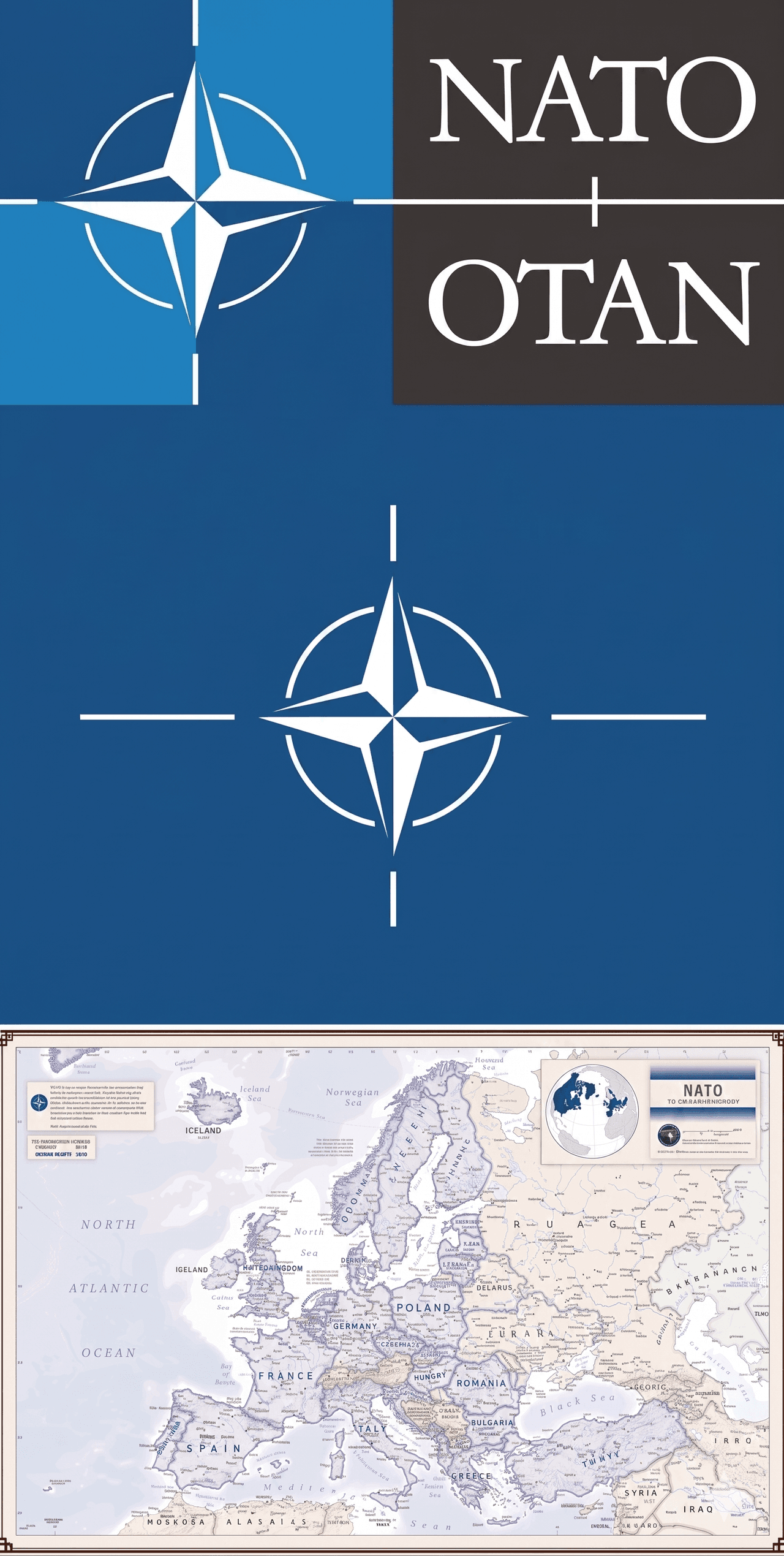
NATO (North Atlantic Treaty Organization), is an intergovernmental security and defense alliance based on the North Atlantic Treaty, signed in Washington on April 4, 1949.【1】 Established to rebuild European security after World War II and to create a lasting defense bond between North America and Europe, the organization is founded on the principles of democracy, individual liberty and the rule of law, as stated in the treaty’s preamble.【2】 Founded in 1949 by 12 states, NATO has grown to 32 members following Finland’s accession in 2023 and Sweden’s in 2024; it operates as a consensus-based alliance with its headquarters in Brussels.【3】

NATO Headquarters (NATO)
NATO’s historical evolution has progressed from its Cold War role of collective defense and deterrence to a broader set of missions adapted to the changing security environment after 1991. Following the dissolution of the Warsaw Pact, the alliance redefined its strategic orientation by incorporating crisis management, partnership policies, operations, counter-terrorism, cybersecurity, and strengthening its eastern flank onto its agenda.【4】 As of 2026, NATO’s key issues include deterrence against Russia, support for Ukraine, increasing defense expenditures, and the NATO Summit to be held in Ankara, Türkiye, on July 7–8, 2026.【5】
NATO is an acronym derived from the English name North Atlantic Treaty Organization. In Turkish, the official and established usage for the organization is North Atlantic Treaty Organization.【6】 This nomenclature refers both to the legal foundation of the organization—the North Atlantic Treaty—and to the geo-political nature of the Atlantic security bond established between North America and Western Europe at its founding. However, NATO is not a structure limited solely to maritime security in the North Atlantic basin; it is an intergovernmental alliance that organizes the political and military security of member states around the principle of collective defense.

NATO Headquarters in Brussels (NATO)
NATO’s fundamental characteristic is the assessment of member states’ security not as independent entities but within a shared security framework. The legal core of this approach is the alliance’s concept of collective defense. According to this principle, an armed attack against one member state is not viewed as an isolated issue but as a threat to the security of the entire alliance.【7】 Therefore, unlike a classical diplomatic consultation platform, NATO has evolved into an institutionalized defense organization with capabilities in military planning, deterrence, crisis management, joint exercises, development of defense capabilities, and, when necessary, conducting joint operations.
The organization’s structure is based on intergovernmental cooperation rather than a supranational model that overrides member states’ sovereignty. Member states are referred to in official texts as “allies”; these states discuss political and security matters within the alliance and make decisions by consensus.【8】 Thus, NATO is not a military force directly governed by a single state or independent superior authority, but a system of alliance based on the political will, military contributions, and shared commitments of its member states. This feature gives meaning to the term “treaty” in its name: NATO’s existence is grounded in a founding document signed among its members and the mutual obligations arising from it.
NATO’s symbols should be understood not as national symbols of a state, but as elements representing the institutional identity of an intergovernmental alliance and the political-military solidarity among its members. Therefore, the NATO emblem, flag usage, the joint display of member state flags, and the official anthem do not assert sovereignty but make visible the shared understanding of security established among allied states. NATO’s symbolic language has been shaped around the core principles of unity, consultation, collective defense, and transatlantic solidarity.
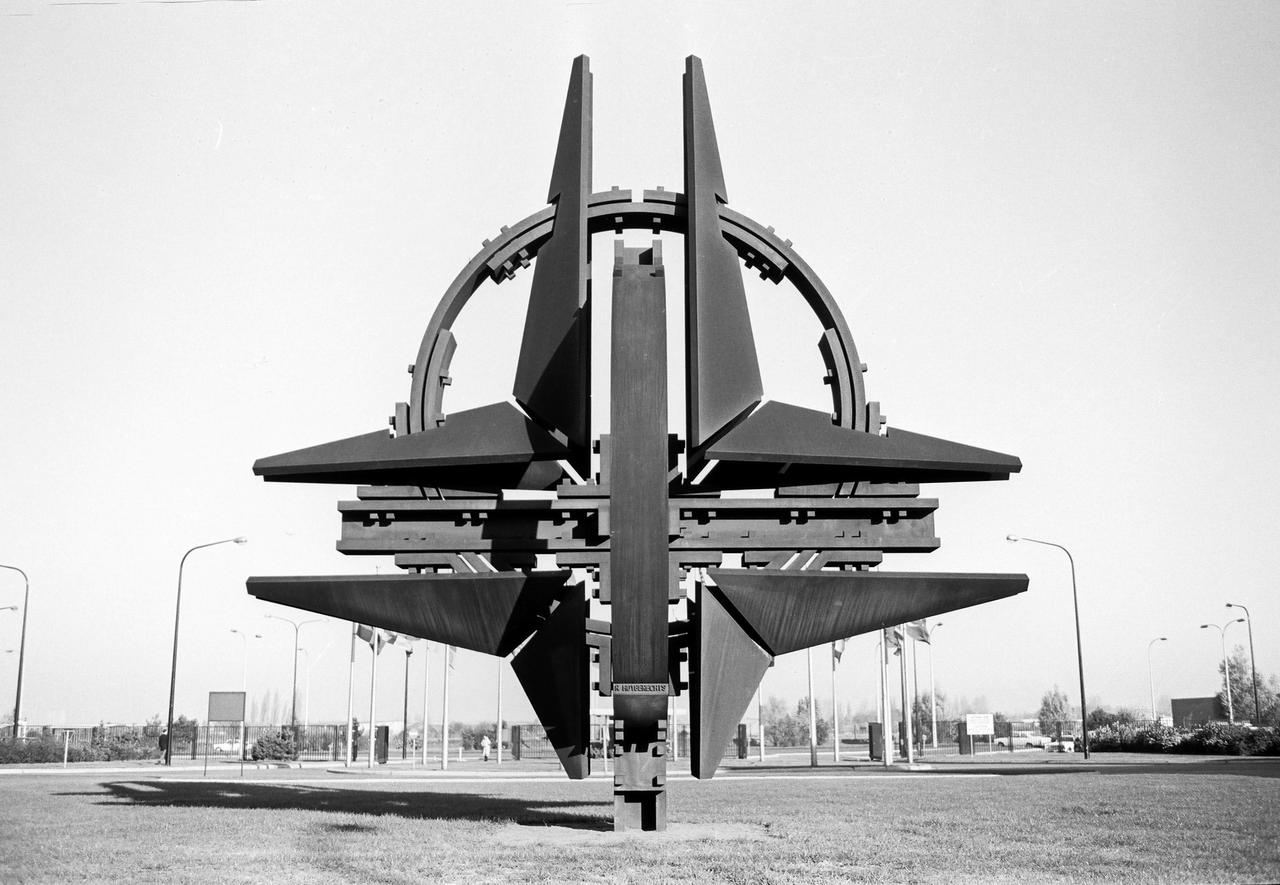
NATO Star (NATO)
The NATO emblem was adopted in October 1953 by the North Atlantic Council as the symbol of the Atlantic Alliance. The circle in the emblem represents unity and cooperation; the compass rose symbolizes the common path taken by the member states of the Atlantic Alliance toward peace.【9】 This symbolism is consistent with NATO’s self-definition not merely as a military defense arrangement but as a political alliance in which member states address security within a common orientation. The choice of the compass rose as a symbol carries the character of an institutional marker that unites members from different geographical regions under a shared security direction.
The NATO flag is also based on this emblem. The flag is one of the primary elements that visibly express the organization’s institutional identity at NATO headquarters, official meetings, military ceremonies, summits, and joint activities. However, the NATO flag is not a superior symbol that replaces the flags of member states. In accordance with the intergovernmental nature of the alliance, the NATO flag is most commonly displayed alongside the flags of member states. This joint display demonstrates that NATO is not a single political entity but a security alliance formed by sovereign states through consensus.
NATO Emblem (NATO)
The joint display of member state flags acquires ceremonial significance, especially during enlargement processes. The accession of a new state becomes visibly apparent not only through its legal ratification of the treaty but also through the commencement of its symbolic representation at NATO headquarters. For example, following the accession of the Czech Republic, Hungary, and Poland to the alliance in 1999, the national flags of these three countries were hoisted in a ceremony held at NATO headquarters.【10】 Such flag ceremonies serve a symbolic threshold function, recognizing new members not only legally and diplomatically but also within the alliance community.
NATO’s official anthem is a wordless ceremonial composition known as the NATO Anthem. Composed by Lieutenant Colonel André Reichling, Director of the Luxembourg Military Band, it was first performed during the 1989 event commemorating NATO’s 40th anniversary. The piece, used de facto as NATO’s anthem for nearly thirty years, was formally adopted by the North Atlantic Council on January 3, 2018.【11】 Its wordless nature renders it unidentifiable with any member state’s language, making it more suitable for a multinational alliance. In this respect, the NATO Anthem represents the ceremonial identity of a multinational alliance rather than a single political community, unlike national anthems.
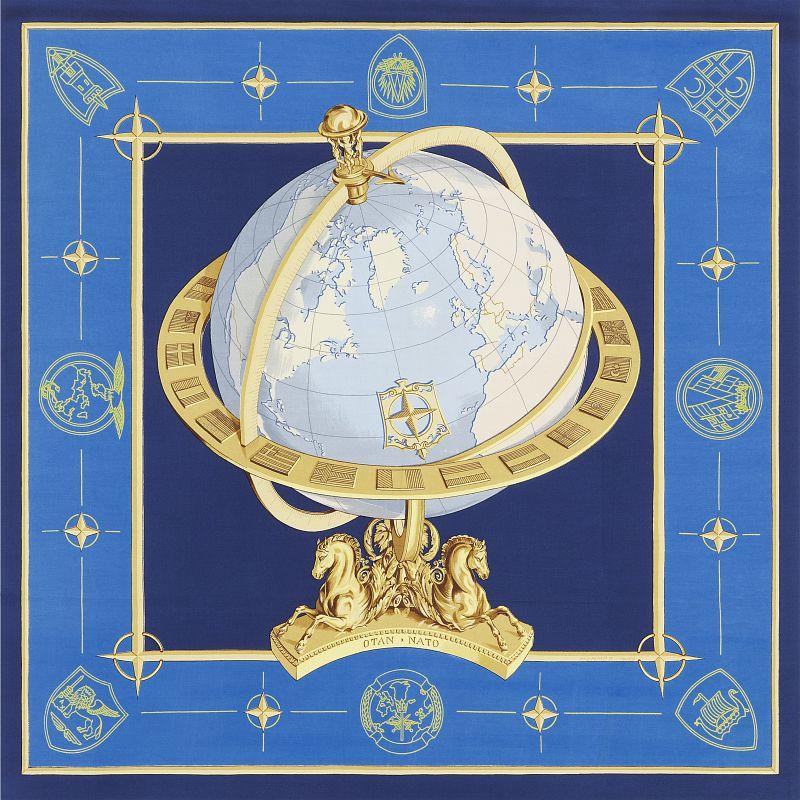
Hermes’s Special Scarf for NATO (NATO)
Before the official adoption of the NATO Anthem, various musical proposals were considered. In the late 1950s, several composers submitted anthems in anticipation of the alliance’s 10th anniversary in 1959; however, none received formal approval. In 1958, British diplomat Thomas Hildebrand Preston composed a “NATO ceremonial anthem” to accompany visitors at NATO headquarters in Paris. In 1959, a “NATO Song” was prepared by German Lieutenant Colonel Hans Lorenz, with lyrics written by Dutch Lieutenant Colonel Stephanus van Dam and American Leon van Leeuwen. In 1960, a more symbolic anthem combining the national anthems of the then 15 member states was proposed, but no further records of this composition have been found in the archives.【12】 These attempts demonstrate that NATO’s institutional symbol search was not limited to visual signs but included early efforts to create a shared ceremonial identity through music.
The 40th anniversary events in 1989 marked a decisive stage in the search for a NATO anthem. During the same event, Portuguese composer José Ludovice’s composition The Atlantic Hymn was performed by a large NATO choir; simultaneously, the Luxembourg Military Band performed a separate composition by André Reichling titled NATO Hymn. Over time, Reichling’s composition emerged as the leading proposal and began to be regularly used at NATO events. The arrangement for piccolo, flute, oboe, three clarinets, three saxophones, two cornets, two trumpets, horn, baritone horn, three trombones, tuba, and trumpet demonstrates that the piece was specifically designed for military band and ceremonial performance.【13】
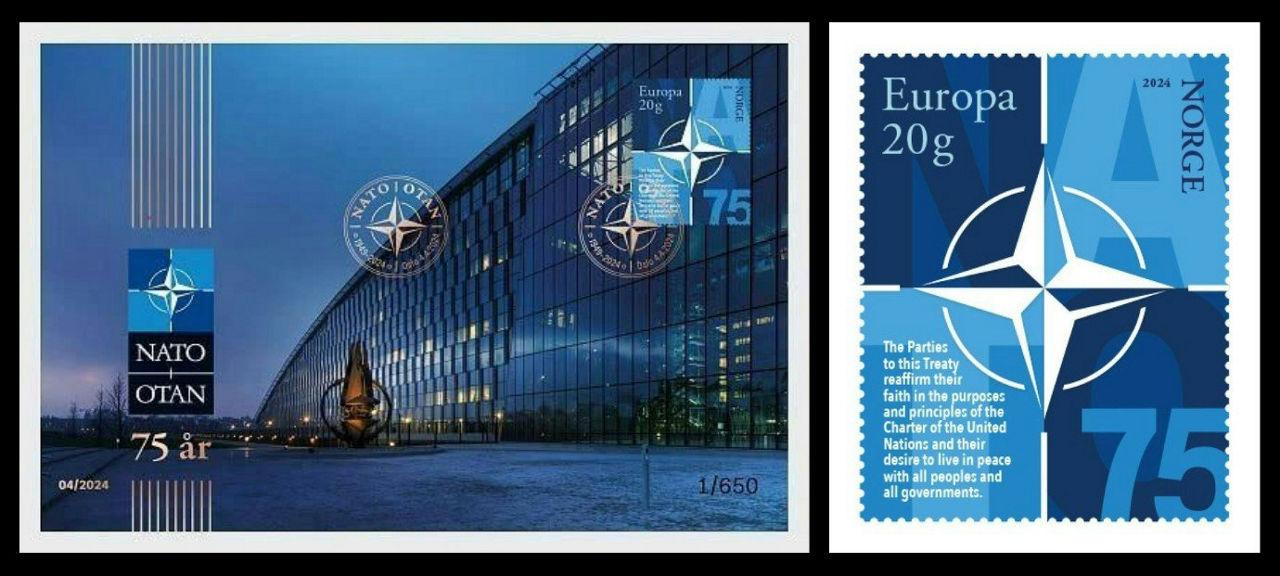
NATO Stamp for 2024 (NATO)
In conclusion, NATO’s symbols are visual and auditory elements that complete the organization’s institutional identity. While the emblem emphasizes unity, cooperation, and a shared path toward peace, flag usage and the joint display of member state flags make visible NATO’s multi-state, consensus-based structure. The official anthem, through its wordless nature, functions as a shared musical symbol in ceremonial representation, not tied to any single national language or culture. Therefore, NATO symbolism is interpreted not as representing national sovereignty, but as an expression of institutional solidarity among sovereign states established for collective security.
Although NATO legally took shape with the signing of the North Atlantic Treaty in Washington on April 4, 1949, its emergence was the result of a broader post-war security quest. After World War II, Europe faced military devastation, economic weakness, political instability, and uncertainty regarding Germany’s future. The wartime cooperation between Western allies and the Soviet Union quickly weakened; the growing Soviet influence in Eastern Europe made security a top priority for Western European states. These conditions strengthened expectations that the United States of America would commit to European security not through temporary aid programs but through a lasting political and military pledge.【14】
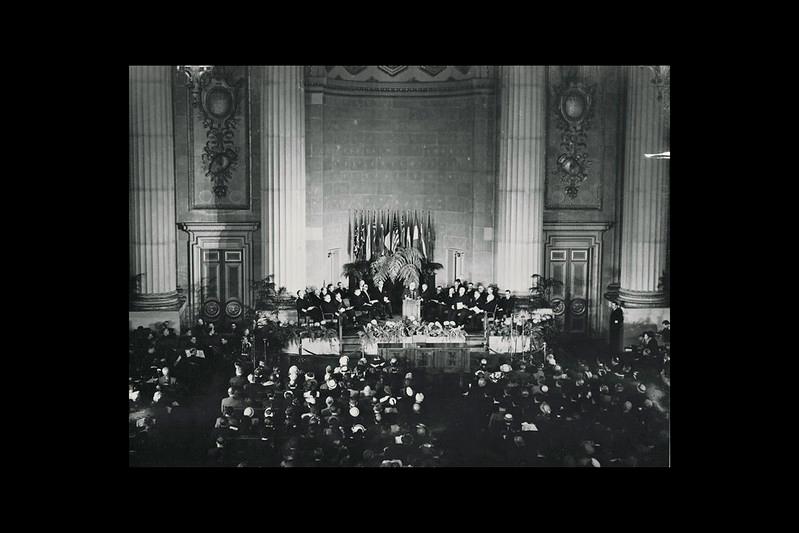
A Scene from the Signing of the North Atlantic Treaty (Flickr)
1947 marked one of the first clear steps toward an Atlantic alliance. The Truman Doctrine, announced in March 1947, revealed the United States’ shift toward a more active foreign policy, establishing a line of resistance in the East against Soviet pressure and the potential spread of communism by supporting Greece and Turkey. The Marshall Plan, unveiled in June of the same year, treated Europe’s economic recovery as an inseparable component of Western security. These programs did not directly lead to NATO’s creation; however, they made visible the link between economic vulnerability in Europe and security concerns. The Soviet Union’s opposition to the Marshall Plan further highlighted the division between Eastern and Western Europe.【15】
Western European states, in addition to economic recovery, needed a more concrete security arrangement. As a result of consultations among Britain, France, and the Benelux countries, the Brussels Treaty was signed on March 17, 1948. This treaty, signed by Belgium, France, Luxembourg, the Netherlands, and the United Kingdom, combined economic, social, and cultural cooperation with collective defense obligations. The Brussels Treaty was significant as the pre-NATO security arrangement for Western Europe; however, it was clear that Western Europe alone could not provide sufficient deterrence against the Soviet Union. Thus, the treaty’s diplomatic importance lay in demonstrating Western European states’ willingness to assume shared responsibility for their own security and in laying the groundwork for U.S. participation in a broader Atlantic arrangement.【16】
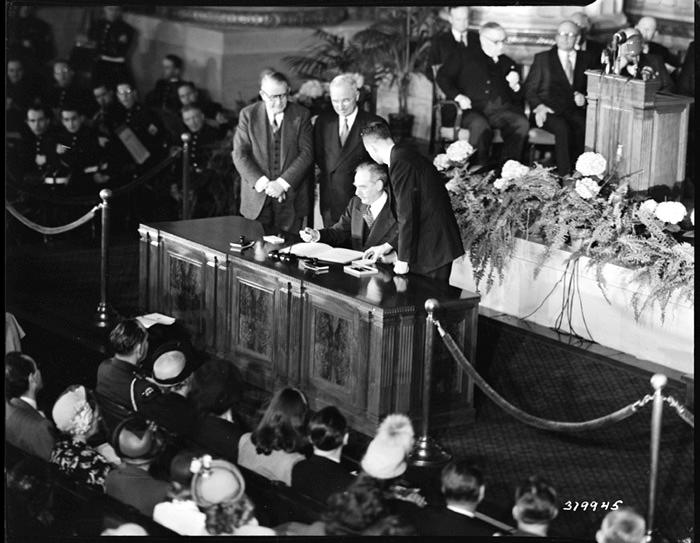
A Scene from the Signing of the Washington Treaty (National Archives)
Events in Europe throughout 1948 further heightened security concerns. In February 1948, the Communist Party’s seizure of power in Czechoslovakia reinforced the perception that the political balance in Central Europe had shifted in favor of Soviet influence. The crisis in Berlin that same year demonstrated that the German question remained central to European security. The Berlin Blockade, initiated by the Soviet Union in June 1948 when it cut off land access to Berlin, transformed into a long and tense crisis as Western allies supplied West Berlin by air. Although the blockade was lifted in May 1949, the process revealed that defense cooperation among Western states was not merely a theoretical need but a practical necessity.【17】
The United States’ participation in an Atlantic-centered collective defense arrangement could not be explained solely as a foreign policy preference; it also rested on a significant shift in American domestic politics. American foreign policy had long been characterized by an aversion to binding military alliances in Europe. Therefore, any arrangement concerning European security had to be designed with due regard for the U.S. Senate’s constitutional authority and public opinion. In this context, the Vandenberg Resolution, adopted on June 11, 1948, created the political foundation for the United States to join regional and collective defense arrangements compatible with the United Nations Charter. Following this resolution, the United States, Canada, and Brussels Treaty states began regular consultations on North Atlantic security.【18】
During Washington talks in the summer and autumn of 1948, the scope and nature of the new alliance were debated. The central issue was whether the security arrangement would remain centered on Western Europe or would form a broader Atlantic system encompassing North America and Europe. Canada’s participation strengthened the alliance’s character as a political and military bond between two continents. Countries such as Norway, Denmark, Iceland, and Portugal gained importance due to their geographical positions. North Atlantic sea lanes, air connections, base facilities, and routes for military aid to Europe demonstrated that the new alliance was not only tied to land defense but also to Atlantic transportation and supply lines.【19】
The selection of founding members was one of the most sensitive aspects of the negotiations. The five members of the Brussels Treaty, along with the United States and Canada, formed the core of the new structure. Denmark, Iceland, Italy, Norway, and Portugal were added. These choices were not based solely on regime type or geographical proximity; strategic location, Atlantic supply lines, Mediterranean security, the balance in Northern Europe, and the political cohesion of Western Europe all played a role. Italy’s inclusion as a founding member was important for integrating the Mediterranean into the security framework and maintaining the country’s political balance within the Western system. Iceland’s lack of a standing army, Portugal’s authoritarian governance, and Italy’s stronger ties to the Mediterranean rather than the North Atlantic demonstrated that the new alliance was founded not on narrow geographical criteria but on broader strategic calculations.【20】
Turkey and Greece were not among the founding members in 1949. Both countries had received U.S. support under the Truman Doctrine and had gained importance in Western security policy in the face of Soviet pressure. However, during the 1948–1949 negotiations, the initial framework of the alliance was primarily centered on North Atlantic and Western European security. Turkey and Greece’s membership would be reconsidered in light of changing military and strategic conditions after the Korean War, and both countries joined NATO in 1952. This situation demonstrates that NATO was initially established around a specific geographical security area but expanded shortly after its founding to include the Mediterranean and southeastern flank.【21】
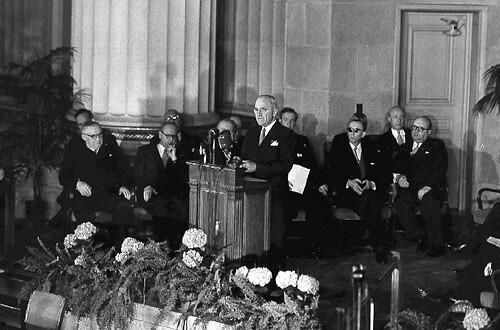
Ceremony Before the Signing of the Washington Treaty (Flickr)
The issue of compatibility with the United Nations system held special importance in drafting the treaty text. The new alliance was required not to appear as a structure that weakened the United Nations or rendered the Security Council obsolete. Therefore, the North Atlantic Treaty was linked to the individual and collective right of self-defense recognized in Article 51 of the United Nations Charter. Thus, the treaty was designed as a collective defense arrangement enabling parties to fulfill their mutual defense obligations in the event of an armed attack. This choice was decisive for the alliance’s operational viability, given the Soviet Union’s veto power in the Security Council.【22】
The Soviet Union objected to the North Atlantic Treaty even before it was signed. In a memorandum delivered by Soviet Ambassador Aleksandr Panyushkin to the U.S. Department of State on March 31, 1949, it was argued that the treaty did not have a defensive character but instead formed an aggressive bloc directed against the Soviet Union and “people’s democracies.” The memorandum further claimed that the treaty was incompatible with the United Nations Charter and that Article 5, in particular, would enable the use of armed force beyond the authority of the Security Council. Western governments rejected these claims; in a response prepared by the British Foreign Office, the treaty’s defensive nature, compatibility with the United Nations Charter, and its orientation against armed attacks rather than any specific state were emphasized.【23】
The North Atlantic Treaty was signed in Washington on April 4, 1949 following all these diplomatic and strategic preparations. The founding states were Belgium, Canada, Denmark, France, Iceland, Italy, Luxembourg, the Netherlands, Norway, Portugal, the United Kingdom, and the United States of America. The treaty entered into force on August 24, 1949. Thus, Europe’s security quest transformed into a transatlantic collective defense alliance with the participation of the United States and Canada. NATO’s founding process was completed with the convergence of post-war European economic recovery, military security, political solidarity, and deterrence objectives against the Soviet Union within a single institutional framework.【24】
The North Atlantic Treaty is the founding document that constitutes NATO’s legal foundation. The treaty was signed on April 4, 1949, in Washington by Belgium, Canada, Denmark, France, Iceland, Italy, Luxembourg, the Netherlands, Norway, Portugal, the United Kingdom, and the United States of America. Registered in the United Nations Treaty Series as No. 541, it entered into force on August 24, 1949, and was recorded on September 7, 1949.【25】 This registration demonstrates that NATO’s existence is not merely based on its own institutional documents but on a founding document that has undergone ratification by member states and is recorded under international law. Thus, NATO’s existence rests on a founding document that has passed through national ratification processes and is registered under international law, rather than a temporary military cooperation arrangement.
The treaty’s preamble does not limit NATO’s founding purpose to military defense needs alone. The signatory states affirmed their commitment to the purposes and principles of the United Nations Charter and expressed their will to live in peace with all peoples and governments. The same section emphasized the parties’ determination to protect their peoples’ freedom, common heritage, and civilization on the basis of the principles of democracy, individual liberty, and the rule of law.【26】 This framework demonstrates that the treaty addressed post-war security concerns by integrating them with political values. The emphasis on stability, prosperity, collective defense, peace, and security in the preamble revealed that NATO was designed as an alliance with both military and political characteristics.
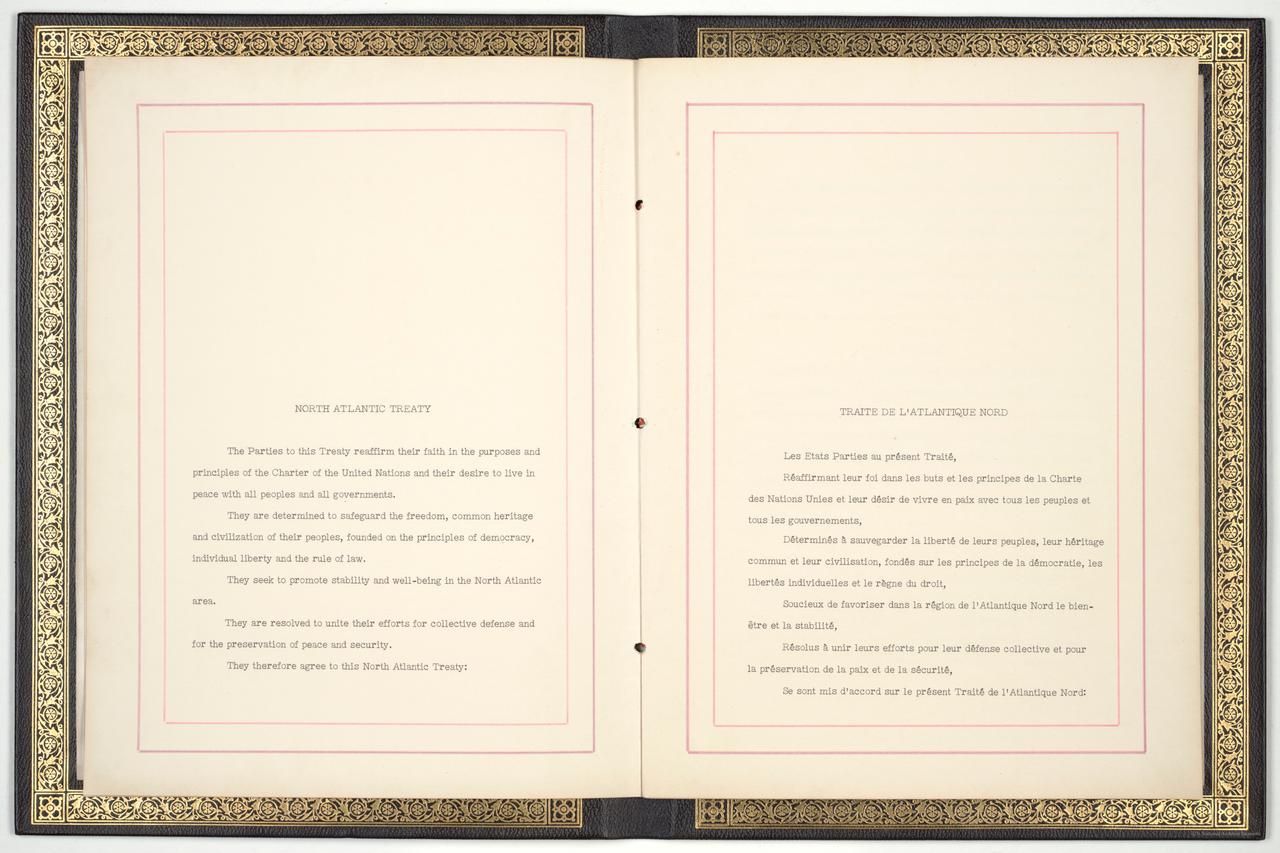
First Page of the North Atlantic Treaty (National Archives)
Article 1 of the treaty requires parties to settle international disputes by peaceful means and to refrain from the use or threat of force in their international relations in a manner inconsistent with the purposes of the United Nations.【27】 This provision demonstrates that from its inception, NATO positioned itself not as an alternative to or outside the United Nations system but as a defense alliance compatible with the United Nations Charter.
Article 2 does not reduce security issues to military preparedness alone; it requires parties to strengthen their free institutions, contribute to the development of peaceful and friendly international relations, support conditions of stability and prosperity, and work to reduce conflicts in their economic policies.【28】 Therefore, the first two articles of the treaty demonstrate that NATO’s founding linked political stability, institutional resilience, and economic cooperation with military security.
Article 3 is one of the key provisions regarding NATO’s defense preparedness. According to this article, parties shall maintain and develop their individual and collective capacity to resist armed attack through continuous and effective self-help and mutual aid.【29】 This provision reveals that NATO was not conceived merely as a mechanism that activates only after an attack occurs. Member states were expected to strengthen their defense capabilities, enhance their resilience, and continue preparations contributing to collective defense even during peacetime. In subsequent periods, defense planning, joint exercises, harmonization of military standards, capability development initiatives, and defense expenditure discussions have been linked to the logic of this article.
Article 4 established the foundation of NATO’s political consultation mechanism. According to this article, any party that considers the territorial integrity, political independence, or security of any other party to be threatened shall consult with the others.【30】 This article shows that NATO is not merely a military arrangement that activates only in the event of an actual armed attack; it is also a political platform enabling member states to bring their security concerns to the alliance’s common agenda at earlier stages of a crisis. The importance of Article 4 stems from its ability to open a member state’s perception of security to the alliance’s collective assessment. Thus, solidarity within NATO is based not only on the collective defense commitment under Article 5 but also on pre-crisis consultation and political coordination processes.
Article 5 is NATO’s most well-known provision and regulates the principle of collective defense. According to this article, an armed attack against one or more member states in Europe or North America shall be considered an attack against them all. In such a case, each party shall assist the party or parties so attacked by taking, individually and in concert with the other parties, such action as it deems necessary, including the use of armed force, in accordance with Article 51 of the United Nations Charter.【31】 However, the article does not define the form of assistance as a single, automatic military response. It specifies that parties shall take “such action as it deems necessary”; this may include the use of armed forces. This arrangement created a strong deterrence commitment while allowing each member state to preserve its own constitutional processes and political assessments.
Article 6 clarified the geographical scope of Article 5. In the 1949 text, the area covered by the article was not limited to the territories of member states in Europe and North America; it also included Allied occupation forces in Europe after World War II and specific islands, ships, and aircraft in the North Atlantic region.【32】 This provision demonstrates that NATO was initially defined around a specific North Atlantic-European security area. Some expressions in the treaty have since changed in practical meaning; notably, the reference to “French departments in Algeria” lost its practical validity following Algeria’s independence from France.【33】 Nevertheless, Article 6 remains important for understanding the treaty’s legal boundaries, as it defines under what geographical conditions the collective defense obligation applies.
Article 7 regulates the relationship between the North Atlantic Treaty and the United Nations system. According to this article, the treaty does not affect the rights and obligations of the parties under the United Nations Charter or the primary responsibility of the Security Council for the maintenance of international peace and security.【34】 This provision responds to potential legitimacy debates arising during NATO’s founding process.
Article 8 requires parties to declare that their existing international commitments are not incompatible with the North Atlantic Treaty and to refrain from entering into any future international obligations that would conflict with the treaty.【35】 Thus, the text aims to establish legal compatibility between member states’ previous treaties and their new collective defense obligations.
Article 9 laid the foundation for NATO’s institutional structure. According to this article, each party shall be represented on a council that shall consider matters relating to the implementation of the treaty. The same article provides for the council to be organized so that it can meet immediately when necessary and establish any necessary subsidiary organs.【36】 This provision established the legal basis for what later became NATO’s highest political decision-making body, the North Atlantic Council. The treaty did not outline a detailed bureaucratic organizational structure; instead, it created a flexible institutional framework based on representation, consultation, and the authority to establish auxiliary organs. This flexibility facilitated NATO’s ability to develop its political and military organs in subsequent years in response to changing security needs.
Article 10 defined NATO’s enlargement procedure. According to this article, the parties may, by unanimous agreement, invite any other European state that can further the principles of the treaty and contribute to the security of the North Atlantic area to join the treaty.【37】 This article demonstrates that NATO was not designed from the outset as a permanently closed alliance. However, membership was not regulated as a unilateral right of application. A new state’s accession is contingent upon a unanimous invitation by existing members and the candidate state’s deposit of its instrument of accession with the Government of the United States of America. Thus, NATO enlargement is a process possible only when the candidate state is a European state capable of contributing to alliance security and when there is a shared political will among current members.
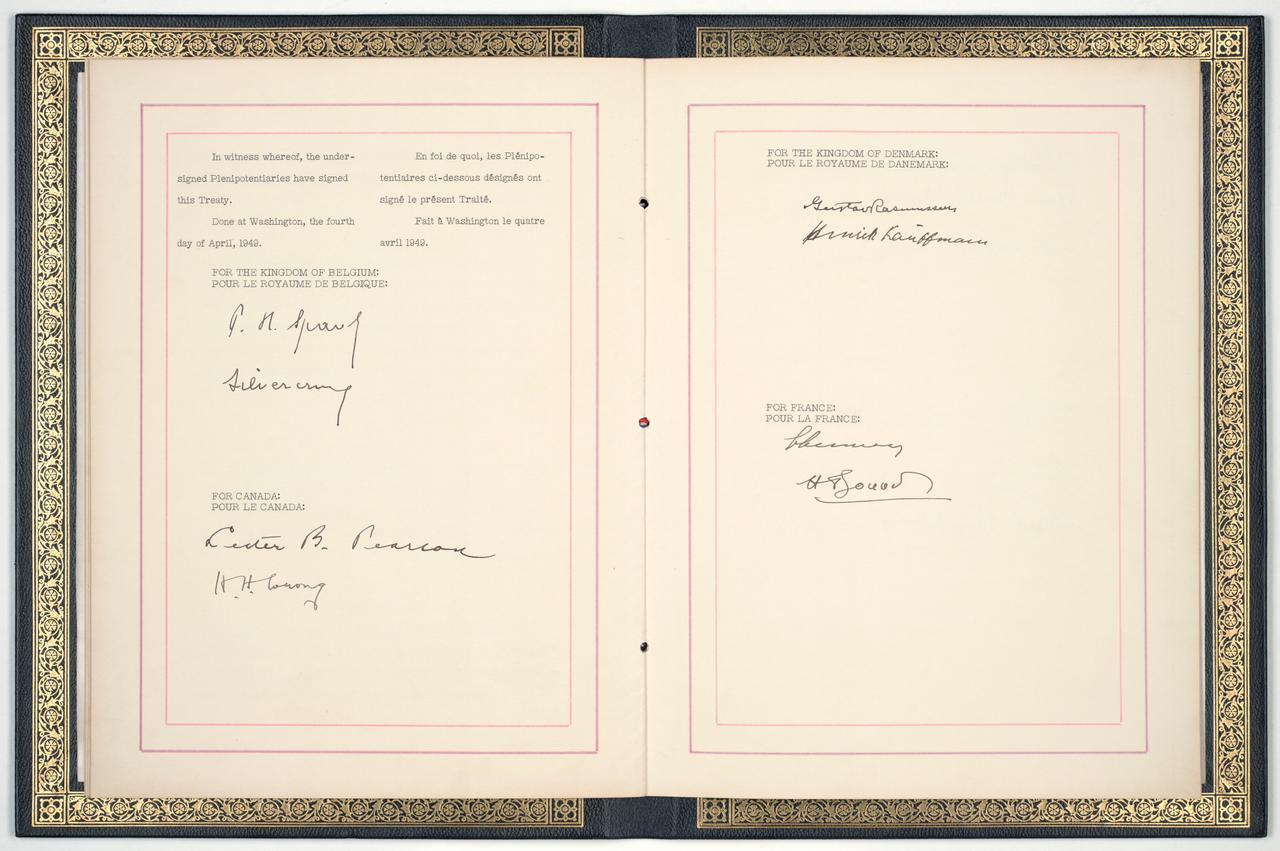
First Signature Page of the North Atlantic Treaty (National Archives)
Article 11 concerns the ratification and entry into force of the treaty. Parties are required to ratify the treaty in accordance with their own constitutional processes and deposit their instruments of ratification with the Government of the United States of America. The treaty was to enter into force upon the deposit of ratification instruments by a majority of the signatories, particularly Belgium, Canada, France, Luxembourg, the Netherlands, the United Kingdom, and the United States of America.【38】 The UNTS record specifies that the treaty entered into force for all signatory states on August 24, 1949, and indicates the exact date each founding state deposited its instrument of ratification.【39】 This information demonstrates that the treaty was completed after the ratification processes of member states and that its entry into force was the result of these processes.
Articles 12 and
Associated Press. "Turkey Detains 209 in Raids in the Capital Ahead of July’s NATO Summit." AP News, 2026. Accessed June 24, 2026. https://apnews.com/article/turkey-nato-summit-suspects-detained-864260d7cbe9ca73cd05115cd638ee93
Bilgin, Tahir Engin. "Soğuk Savaş Sonrası Değişen Kolektif Güvenlik Anlayışı Çerçevesinde NATO-Türkiye İlişkileri." Master's thesis, Kara Harp Okulu Komutanlığı, 2006. Accessed June 24, 2026. https://avesis.hacibayram.edu.tr/yonetilen-tez/d429f51d-3265-4c1d-ab13-c5a1d245306a/soguk-savas-sonrasi-degisen-kolektif-guvenlik-anlayisi-cercevesinde-nato-turkiye-iliskileri
Cesur, Emrullah, and Aykut Karadağ. "Başkent NATO Zirvesi'ne hazırlanıyor." *Anadolu Ajansı*, 2026. Accessed June 24, 2026. https://www.aa.com.tr/tr/gundem/baskent-nato-zirvesine-hazirlaniyor/3975686
Demirci, Yasin. "Ankara'da NATO Zirvesi tedbirleri." Infographic. *Anadolu Ajansı*, 2026. Accessed June 24, 2026. https://www.aa.com.tr/tr/info/infografik/52566.
Ekiz, Aynur. "İletişim Başkanı Duran: Türkiye'nin NATO'da çevreden merkeze geçtiğini görüyoruz." Anadolu Ajansı, 2026. Accessed June 24, 2026. https://aa.com.tr/tr/gundem/iletisim-baskani-duran-turkiyenin-natoda-cevreden-merkeze-gectigini-goruyoruz/3976666.
Er, Halilcan. "NATO'ya Üyelik Sürecinde Türk ve Yunan Kamuoyu (1949-1952)." Master's thesis, Ankara Üniversitesi, 2016. Accessed June 24, 2026. https://tez.yok.gov.tr/UlusalTezMerkezi/TezGoster?key=cbOXH84ZayrLjc0tI-QXKs87jNR58USyIcLb_dmosuBWFu3L2-7HbAd_XRYoeKnU
Johnston, Seth. "No Longer Obsolete: How NATO Endures in the Twenty-First Century." Modern War Institute, May 25, 2017. Accessed June 24, 2026. https://www.govinfo.gov/content/pkg/GOVPUB-D109-PURL-gpo146622/pdf/GOVPUB-D109-PURL-gpo146622.pdf
Kaplan, Lawrence S. *NATO 1948: The Birth of the Transatlantic Alliance*. Lanham, MD: Rowman & Littlefield, 2007. Accessed June 24, 2026. https://archive.org/details/nato1948birthoft0000kapl
Kaplan, Lawrence S. *The United States and NATO: The Formative Years*. Lexington, KY: University Press of Kentucky, 1984. Accessed June 24, 2026. https://archive.org/details/unitedstatesnato0000kapl
Karademir, İsmet Kürşat. "Türkiye’nin NATO Üyeliğinin Güvenlik Politikalarına ve Stratejik Seviyede Karar Mekanizmalarına Etkileri." PhD thesis, Bursa Uludağ Üniversitesi. Accessed June 24, 2026. https://acikerisim.uludag.edu.tr/entities/publication/c8dcd1ee-aba4-44e9-a421-e4fe719702ba
Karaosmanoğlu, Ali L. "NATO’s Transformation." *Uluslararası İlişkiler Dergisi* 10, no. 40 (2014): 2–38. Accessed June 24, 2026. https://dergipark.org.tr/en/pub/uidergisi/article/462648
Ministry of Foreign Affairs of the Republic of Turkey. "Şubat 2026." Accessed June 24, 2026. https://www.mfa.gov.tr/subat2026.tr.mfa
Ministry of Foreign Affairs of the Republic of Turkey. *Türkiye Cumhuriyeti Dışişleri Bakanlığı 2026 Yılı Performans Programı*. Ankara: Ministry of Foreign Affairs of the Republic of Turkey, 2026. Accessed June 24, 2026. https://www.mfa.gov.tr/data/BAKANLIK/Disisleri-Bakanligi-2026-yili-performans-programi.pdf_.
Ministry of Foreign Affairs of the Republic of Türkiye. "NATO 2030: Partnership for a New Era." Accessed June 24, 2026. https://www.mfa.gov.tr/nato-2030.tr.mfa
Ministry of Foreign Affairs of the Republic of Türkiye. "NATO Genel Information Note." Accessed June 24, 2026. https://www.mfa.gov.tr/data/nato-bilgi--notu.pdf
Ministry of Foreign Affairs of the Republic of Türkiye. "North Atlantic Treaty Organization - NATO." International Organizations Directory. Accessed June 24, 2026. https://www.mfa.gov.tr/nato.tr.mfa
NATO Archives. "Headquarters Allied Forces Northern Europe 1951-1994." Accessed June 24, 2026. https://archives.nato.int/headquarters-allied-forces-northern-europe-1951-1994
NATO Archives. "NATO Flag and Emblem." Accessed June 24, 2026. https://archives.nato.int/uploads/r/null/1/3/137354/0079_NATO_flag_and_emblem-Drapeau_et_Embleme_de_l_OTAN_BIL.pdf
NATO Office of Information and Press. *NATO Handbook*. Brussels: NATO Office of Information and Press, 2001. Accessed June 24, 2026. https://ucr.irmct.org/LegalRef/CMSDocStore/Public/English/Motions/NotIndexable/IT-04-82/MSC6328R0000289677.pdf
National Archives and Records Administration (NARA). "The North Atlantic Treaty." Accessed June 24, 2026. https://www.archives.gov/exhibits/featured-documents/north-atlantic-treaty
National Archives and Records Administration. "North Atlantic Treaty." National Archives Catalog, ID: 348806325. Accessed June 24, 2026. https://catalog.archives.gov/id/348806325?objectPage=2
National Geospatial-Intelligence Agency (NGA). "NATO Map 2024, 36x24 inches." Accessed June 24, 2026. https://www.nga.mil/resources/NGA_Maps_for_Download.html
North Atlantic Treaty Organization (NATO). "1994, Exercise Cooperation Spirit 94 Held at the Harskamp Military Training Area Veluwe, The Netherlands." Photograph [5877321192]. NATO Flickr Account. Accessed June 24, 2026. https://www.flickr.com/photos/nato/5877321192/in/photostream/
North Atlantic Treaty Organization (NATO). "1994, Exercise Cooperation Spirit 94 Held at the Harskamp Military Training Area Veluwe, The Netherlands." Photograph [5877321522]. NATO Flickr Account. Accessed June 24, 2026. https://www.flickr.com/photos/nato/5877321522/in/photostream/.
North Atlantic Treaty Organization (NATO). "2026 NATO Summit in Ankara." Accessed June 24, 2026. https://www.nato.int/en/news-and-events/events/2026/07/overview---2026-nato-summit-in-ankara-
North Atlantic Treaty Organization (NATO). "A Commemorative Exhibition / Une Exposition Commémorative." Accessed June 24, 2026. https://www.nato.int/content/dam/nato/legacy-wcm/media_pdf/pdf_archives/20121211_2012-12-11_nato_first_enlargement_booklet_1952.pdf
North Atlantic Treaty Organization (NATO). "A History of NATO Stamps." Accessed June 24, 2026. https://www.nato.int/en/about-us/nato-history/history-by-theme/symbols-of-nato/nato-stamps
North Atlantic Treaty Organization (NATO). "Defence Expenditure of NATO Countries (2014-2025)." August 28, 2025. Accessed June 24, 2026. https://www.nato.int/en/news-and-events/articles/news/2025/08/28/defence-expenditure-of-nato-countries-2014-2025
North Atlantic Treaty Organization (NATO). "Defence Expenditures and NATO’s 5% Commitment." Accessed June 24, 2026. https://www.nato.int/en/what-we-do/introduction-to-nato/defence-expenditures-and-natos-5-commitment
North Atlantic Treaty Organization (NATO). "Funding NATO." Accessed June 24, 2026. https://www.nato.int/en/what-we-do/introduction-to-nato/funding-nato
North Atlantic Treaty Organization (NATO). "Meeting of the North Atlantic Council in Foreign Ministers’ Session, with HRVP." Photograph, April 4, 2025. Accessed June 24, 2026. https://www.nato.int/en/multimedia/multimedia/photos/2025/04/04/meeting-of-the-north-atlantic-council-in-foreign-ministers-session-with-hrvp
North Atlantic Treaty Organization (NATO). "NATO AWACS Aircraft Patrols NATO Airspace for Eastern Sentry." Photograph, September 22, 2025. Accessed June 24, 2026. https://www.nato.int/en/multimedia/multimedia/photos/2025/09/22/nato-awacs-aircraft-patrols-nato-airspace-for-eastern-sentry
North Atlantic Treaty Organization (NATO). "NATO Archives." Accessed June 24, 2026. https://www.nato.int/en/about-us/official-texts-and-resources/NATO-archives
North Atlantic Treaty Organization (NATO). "NATO Defence Ministers Make Good Progress Ahead of the Ankara Summit." June 18, 2026. Accessed June 24, 2026. https://www.nato.int/en/news-and-events/articles/news/2026/06/18/nato-defence-ministers-make-good-progress-ahead-of-the-ankara-summit
North Atlantic Treaty Organization (NATO). "NATO Defence Planning Process." Accessed June 24, 2026. https://www.nato.int/en/what-we-do/introduction-to-nato/nato-defence-planning-process
North Atlantic Treaty Organization (NATO). "NATO Headquarters." Photo gallery. Accessed June 24, 2026. https://www.nato.int/en/multimedia/multimedia/photos/general/nato-headquarters
North Atlantic Treaty Organization (NATO). "NATO Member Countries." Accessed June 24, 2026. https://www.nato.int/en/about-us/organization/nato-member-countries
North Atlantic Treaty Organization (NATO). "NATO Military Committee Visited KFOR." Photograph, April 28, 2026. Accessed June 24, 2026. https://www.nato.int/en/multimedia/multimedia/photos/2026/04/28/nato-military-committee-visited-kfor
North Atlantic Treaty Organization (NATO). "NATO Operations and Missions." Accessed June 24, 2026. https://www.nato.int/en/what-we-do/operations-and-missions/nato-operations-and-missions
North Atlantic Treaty Organization (NATO). "NATO Secretary General Jens Stoltenberg and U.S. President Joe Biden with Viktor Orbán (Prime Minister of Hungary)." Photograph, July 10, 2024. Accessed June 24, 2026. https://www.nato.int/en/multimedia/multimedia/photos/2024/07/10/welcome-ceremony-and-official-photo
North Atlantic Treaty Organization (NATO). "NATO Secretary General Mark Rutte and NATO Heads of State and Government." Photograph, June 25, 2025. Accessed June 24, 2026. https://www.nato.int/en/multimedia/multimedia/photos/2025/06/25/welcome-ceremony-and-official-photo
North Atlantic Treaty Organization (NATO). "NATO Secretary General Visits Kosovo." Photograph, March 11, 2025. Accessed June 24, 2026. https://www.nato.int/en/multimedia/multimedia/photos/2025/03/11/nato-secretary-general-visits-kosovo
North Atlantic Treaty Organization (NATO). "NATO Secretary General Visits Türkiye." Photograph, April 21, 2026. Accessed June 24, 2026. https://www.nato.int/en/multimedia/multimedia/photos/2026/04/21/nato-secretary-general-visits-turkiye
North Atlantic Treaty Organization (NATO). "NATO Secretary General to Visit the United States of America." Media Advisory, June 19, 2026. Accessed June 24, 2026. https://www.nato.int/en/news-and-events/events/media-advisories/2026/06/19/nato-secretary-general-to-visit-the-united-states-of-america?selectedLocale=
North Atlantic Treaty Organization (NATO). "NATO Summit Ankara, Türkiye – 7–8 July 2026." Media Advisory, April 22, 2026. Accessed June 24, 2026. https://www.nato.int/en/news-and-events/events/media-advisories/2026/04/22/nato-summit-media-advisory?selectedLocale=
North Atlantic Treaty Organization (NATO). "NATO Summits." Accessed June 24, 2026. https://www.nato.int/en/what-we-do/introduction-to-nato/nato-summits
North Atlantic Treaty Organization (NATO). "NATO Troops Take Part in Airborne Exercise 'Swift Response 2024' (Paratroopers)." Photograph. NATO Flickr Hesabı. Accessed June 24, 2026. https://www.flickr.com/photos/nato/53738586868/in/album-72177720317188040/.
North Atlantic Treaty Organization (NATO). "NATO Troops Take Part in Airborne Exercise 'Swift Response 2024' (Two German Air Force A400M)." Photograph. NATO Flickr Hesabı. Accessed June 24, 2026. https://www.flickr.com/photos/nato/53738808855/in/album-72177720317188040/.
North Atlantic Treaty Organization (NATO). "NATO's Support for Ukraine." Accessed June 24, 2026. https://www.nato.int/en/what-we-do/partnerships-and-cooperation/natos-support-for-ukraine
North Atlantic Treaty Organization (NATO). "Press Conference Following the Meetings of NATO Ministers of Defence." Transcript, June 18, 2026. Accessed June 24, 2026. https://www.nato.int/en/news-and-events/events/transcripts/2026/06/18/press-conference-following-the-meetings-of-nato-ministers-of-defence
North Atlantic Treaty Organization (NATO). "Signing NATO Treaty in Washington, 4 April 1949, USA - Truman." Photograph. NATO Flickr Hesabı. Accessed June 24, 2026. https://www.flickr.com/photos/nato/5508559075/in/album-72157626324917330/
North Atlantic Treaty Organization (NATO). "Signing The North Atlantic Treaty, Washington DC, 4 April 1949 (Speech by Joseph Bech)." Photograph. NATO Flickr Hesabı. Accessed June 24, 2026. https://www.flickr.com/photos/nato/5588191789/in/album-72157626324917330
North Atlantic Treaty Organization (NATO). "Strategic Concepts." Accessed June 24, 2026. https://www.nato.int/en/about-us/official-texts-and-resources/strategic-concepts
North Atlantic Treaty Organization (NATO). "Strengthening NATO’s Eastern Flank." Accessed June 24, 2026. https://www.nato.int/en/what-we-do/deterrence-and-defence/strengthening-natos-eastern-flank
North Atlantic Treaty Organization (NATO). "Swedish Flag Raised at NATO Headquarters." March 11, 2024. Accessed June 24, 2026. https://www.nato.int/en/news-and-events/articles/news/2024/03/11/swedish-flag-raised-at-nato-headquarters
North Atlantic Treaty Organization (NATO). "The Hague Summit Declaration." June 25, 2025. Accessed June 24, 2026. https://www.nato.int/en/about-us/official-texts-and-resources/official-texts/2025/06/25/the-hague-summit-declaration
North Atlantic Treaty Organization (NATO). "The NATO Hermès Silk Scarf." Accessed June 24, 2026. https://www.nato.int/en/about-us/nato-history/history-by-theme/symbols-of-nato/hermes-silk-scarf.
North Atlantic Treaty Organization (NATO). "The NATO Hymn." Accessed June 26, 2026. https://www.nato.int/en/about-us/nato-history/history-by-theme/symbols-of-nato/nato-hymn
North Atlantic Treaty Organization (NATO). "The NATO Star Sculpture." Accessed June 24, 2026. https://www.nato.int/en/about-us/nato-history/history-by-theme/symbols-of-nato/star-sculpture
North Atlantic Treaty Organization (NATO). "The North Atlantic Treaty." April 4, 1949. Accessed June 24, 2026. https://www.nato.int/en/about-us/official-texts-and-resources/official-texts/1949/04/04/the-north-atlantic-treaty
North Atlantic Treaty Organization (NATO). "Türkiye to Host 2026 NATO Summit in Ankara." August 20, 2025. Accessed June 24, 2026. https://www.nato.int/en/news-and-events/articles/news/2025/08/20/turkiye-to-host-2026-nato-summit-in-ankara
North Atlantic Treaty Organization (NATO). "Use of NATO Content and Brand." Accessed June 24, 2026. https://www.nato.int/en/about-us/official-texts-and-resources/use-of-nato-content-and-brand.
North Atlantic Treaty Organization (NATO). "Washington Summit Declaration." July 10, 2024. Accessed June 24, 2026. https://www.nato.int/en/about-us/official-texts-and-resources/official-texts/2024/07/10/washington-summit-declaration
Olsen, John Andreas, ed. *Routledge Handbook of NATO*. London: Routledge, 2024. Accessed June 24, 2026. https://api.pageplace.de/preview/DT0400.9781040026229_A48216630/preview-9781040026229_A48216630.pdf
Pamuk, Hümeyra. "NATO's Rutte to Meet Trump, Aiming to Ease Tensions Ahead of July Summit." Reuters, June 24, 2026. Accessed June 24, 2026. https://www.reuters.com/business/aerospace-defense/natos-rutte-meet-trump-aiming-ease-tensions-ahead-july-summit-2026-06-24/
Sabbagh, Dan. "UK Defence Secretary Promises Delayed Investment Plan Before Nato Summit." *The Guardian*, June 23, 2026. Accessed June 24, 2026. https://www.theguardian.com/politics/2026/jun/23/dan-jarvis-promises-delayed-uk-defence-investment-plan-before-nato-summit
Sperling, James, and Mark Webber, ed. *The Oxford Handbook of NATO*. Oxford: Oxford University Press, 2022. Accessed June 24, 2026. https://global.oup.com/academic/product/the-oxford-handbook-of-nato-9780198851196
Supreme Headquarters Allied Powers Europe (SHAPE). "Celebrating SHAPE, 70 Years of Deterrence and Defence." April 2, 2021. Accessed June 24, 2026. https://shape.nato.int/news-archive/2021/celebrating-shape--70-years-of-deterrence-and-defence
T.C. Ministry of Foreign Affairs. "Mart 2026." Accessed June 24, 2026. https://www.mfa.gov.tr/mart2026.tr.mfa
T.C. Presidency of Communication. "Announcement Regarding the 2026NATO Zirvesi Press Accreditation." Accessed June 24, 2026. https://www.iletisim.gov.tr/turkce/duyurular/detay/2026-nato-zirvesi-basin-akreditasyonu-hakkinda-duyuru
The National Archives (UK). "Telegram Sent from the Foreign Office to Brussels Recording Their Reply to the Soviet Government on the North Atlantic Treaty, 12th April, 1949 (FO 371/79919)." *Attlee's Britain*. Accessed June 24, 2026. https://www.nationalarchives.gov.uk/education/resources/attlees-britain/nato/
U.S. Department of State, Office of the Historian, “The Ambassador of the Soviet Union (Panyushkin) to the Secretary of State,” *Foreign Relations of the United States, 1949, Western Europe*, Volume IV, no. 32, March 31, 1949, pp. 262–264. https://history.state.gov/historicaldocuments/frus1949v04/d139
United Nations Treaty Collection. "North Atlantic Treaty." Registration No. I-541. Accessed June 24, 2026. https://treaties.un.org/pages/showDetails.aspx?objid=080000028016226c
United Nations. *United Nations Treaty Series: Treaties and International Agreements Registered or Filed and Recorded with the Secretariat of the United Nations*. Volume 34. New York: United Nations, 1949. Accessed June 25, 2026. https://treaties.un.org/doc/Publication/UNTS/Volume%2034/v34.pdf
Yüksel, Çağdaş. "NATO ve Türkiye'nin Dış Politikasına Etkileri (1949-1974)." Master's thesis, Trakya Üniversitesi, 2013. Accessed June 24, 2026. https://tez.yok.gov.tr/UlusalTezMerkezi/TezGoster?key=1zw6GvYMe-q3Hf6HR-3US5NsrIQu4486ARItCFidBNpqJPCipZ9rg0Bgifth8IKH
Zengin, Arif. "Türkiye'nin NATO'ya Girişi ve Sonrasının Türk İç ve Dış Politikasına Yansımaları." Master's thesis, Celal Bayar Üniversitesi, 2017. Accessed June 24, 2026. https://tez.yok.gov.tr/UlusalTezMerkezi/TezGoster?key=DPTyuy3wRPq_qvCPSqUB61-rGNHwDD8JnZxVsC2pqBUnkB1-nqu4-LSPSnOilQmE
Şahin, Güngör. "Soğuk Savaş Sonrası Değişen Güvenlik Anlayışı Bağlamında NATO." PhD thesis, Trakya Üniversitesi, 2015. Accessed June 24, 2026. https://tez.yok.gov.tr/UlusalTezMerkezi/TezGoster?key=WY5CM7tPNE2z_YM6pBu0t4slsOvXTLc8qbdVF14oMyCY8hKgNXh5KzpfZHiDmxIA
Şimşek, Utku. "NATO üyesi 32 ülkenin lideri Ankara'da buluşacak." Anadolu Ajansı, 2026. Accessed June 24, 2026. https://www.aa.com.tr/tr/gundem/nato-uyesi-32-ulkenin-lideri-ankarada-bulusacak/3976703
[1]
North Atlantic Treaty Organization (NATO), “The North Atlantic Treaty,” 4 April 1949, access date June 24, 2026, https://www.nato.int/en/about-us/official-texts-and-resources/official-texts/1949/04/04/the-north-atlantic-treaty.
[2]
North Atlantic Treaty Organization (NATO), “The North Atlantic Treaty,” 4 April 1949, access date June 24, 2026, https://www.nato.int/en/about-us/official-texts-and-resources/official-texts/1949/04/04/the-north-atlantic-treaty.
[3]
North Atlantic Treaty Organization (NATO), “NATO Member Countries,” updated March 11, 2024, access date June 24, 2026, https://www.nato.int/en/about-us/organization/nato-member-countries.
[4]
Ali L. Karaosmanoğlu, “NATO’s Transformation,” Uluslararası İlişkiler 10, no. 40 (Winter 2014): 3-5, https://dergipark.org.tr/en/pub/uidergisi/article/462648; North Atlantic Treaty Organization (NATO), “Strategic Concepts,” access date June 24, 2026, https://www.nato.int/en/about-us/official-texts-and-resources/strategic-concepts.
[5]
North Atlantic Treaty Organization (NATO), “Strengthening NATO’s Eastern Flank,” access date June 24, 2026, https://www.nato.int/en/what-we-do/deterrence-and-defence/strengthening-natos-eastern-flank; North Atlantic Treaty Organization (NATO), “NATO’s Support for Ukraine,” access date June 24, 2026, https://www.nato.int/en/what-we-do/partnerships-and-cooperation/natos-support-for-ukraine; North Atlantic Treaty Organization (NATO), “NATO Summit Ankara, Türkiye – 7–8 July 2026,” Media Advisory, April 22, 2026, access date June 24, 2026, https://www.nato.int/en/news-and-events/events/media-advisories/2026/04/22/nato-summit-media-advisory?selectedLocale=.
[6]
T.C. Ministry of Foreign Affairs, “North Atlantic Treaty Organization - NATO,” International Organizations Directory, access date June 24, 2026, https://www.mfa.gov.tr/nato.tr.mfa; North Atlantic Treaty Organization (NATO), “The North Atlantic Treaty,” 4 April 1949, access date June 24, 2026, https://www.nato.int/en/about-us/official-texts-and-resources/official-texts/1949/04/04/the-north-atlantic-treaty.
[7]
North Atlantic Treaty Organization (NATO), “The North Atlantic Treaty,” 4 April 1949, access date June 24, 2026, https://www.nato.int/en/about-us/official-texts-and-resources/official-texts/1949/04/04/the-north-atlantic-treaty.
[8]
North Atlantic Treaty Organization (NATO), “NATO Member Countries,” updated March 11, 2024, access date June 24, 2026, https://www.nato.int/en/about-us/organization/nato-member-countries.
[9]
NATO Office of Information and Press, NATO Handbook (Brussels: NATO Office of Information and Press, 2001), 4, access date June 24, 2026, https://ucr.irmct.org/LegalRef/CMSDocStore/Public/English/Motions/NotIndexable/IT-04-82/MSC6328R0000289677.pdf.
[10]
NATO Office of Information and Press, NATO Handbook, 63–64.
[11]
North Atlantic Treaty Organization (NATO), “The NATO Hymn,” access date June 26, 2026, https://www.nato.int/en/about-us/nato-history/history-by-theme/symbols-of-nato/nato-hymn.
[12]
NATO, “The NATO Hymn.”
[13]
NATO, “The NATO Hymn.”
[14]
Lawrence S. Kaplan, The United States and NATO: The Formative Years (Lexington, KY: University Press of Kentucky, 1984), 1–6, access date June 24, 2026, https://archive.org/details/unitedstatesnato0000kapl; NATO Office of Information and Press, NATO Handbook (Brussels: NATO Office of Information and Press, 2001), 411–412, access date June 24, 2026, https://ucr.irmct.org/LegalRef/CMSDocStore/Public/English/Motions/NotIndexable/IT-04-82/MSC6328R0000289677.pdf.
[15]
Kaplan, The United States and NATO, 32–41; NATO Office of Information and Press, NATO Handbook, 411.
[16]
Lawrence S. Kaplan, NATO 1948: The Birth of the Transatlantic Alliance (Lanham, MD: Rowman & Littlefield, 2007), 63–65, access date June 24, 2026, https://archive.org/details/nato1948birthoft0000kapl; NATO Office of Information and Press, NATO Handbook, 412.
[17]
Kaplan, The United States and NATO, 41–42, 94–95; NATO Office of Information and Press, NATO Handbook, 412–413.
[18]
Kaplan, NATO 1948, 110–116; NATO Office of Information and Press, NATO Handbook, 412; James Sperling and Mark Webber, eds., The Oxford Handbook of NATO (Oxford: Oxford University Press, 2022), 132, access date June 24, 2026, https://global.oup.com/academic/product/the-oxford-handbook-of-nato-9780198851196.
[19]
Kaplan, The United States and NATO, 75–83; Kaplan, NATO 1948, 127–141; NATO Office of Information and Press, NATO Handbook, 412.
[20]
Kaplan, The United States and NATO, 108–112; Kaplan, NATO 1948, 248–252; NATO Office of Information and Press, NATO Handbook, 412.
[21]
NATO Office of Information and Press, NATO Handbook, 3, 412; North Atlantic Treaty Organization (NATO), “NATO Member Countries,” updated March 11, 2024, access date June 24, 2026, https://www.nato.int/en/about-us/organization/nato-member-countries.
[22]
Kaplan, NATO 1948, 267–269; North Atlantic Treaty Organization (NATO), “The North Atlantic Treaty,” 4 April 1949, access date June 24, 2026, https://www.nato.int/en/about-us/official-texts-and-resources/official-texts/1949/04/04/the-north-atlantic-treaty.
[23]
U.S. Department of State, Office of the Historian, “The Ambassador of the Soviet Union (Panyushkin) to the Secretary of State,” Foreign Relations of the United States, 1949, Western Europe, vol. IV, No. 32, March 31, 1949, pp. 262–264, access date June 24, 2026, https://history.state.gov/historicaldocuments/frus1949v04/d139; The National Archives (UK), “Telegram Sent from the Foreign Office to Brussels Recording Their Reply to the Soviet Government on the North Atlantic Treaty, 12th April, 1949 (FO 371/79919),” Attlee’s Britain, access date June 24, 2026, https://www.nationalarchives.gov.uk/education/resources/attlees-britain/nato/.
[24]
North Atlantic Treaty Organization (NATO), “The North Atlantic Treaty,” 4 April 1949, access date June 24, 2026, https://www.nato.int/en/about-us/official-texts-and-resources/official-texts/1949/04/04/the-north-atlantic-treaty; United Nations Treaty Collection, “North Atlantic Treaty,” Registration No. I-541, access date June 24, 2026, https://treaties.un.org/pages/showDetails.aspx?objid=080000028016226c; NATO Office of Information and Press, NATO Handbook, 412–413.
[25]
United Nations, United Nations Treaty Series: Treaties and International Agreements Registered or Filed and Recorded with the Secretariat of the United Nations, vol. 34 (New York: United Nations, 1949), 243–244, access date June 25, 2026, https://treaties.un.org/doc/Publication/UNTS/Volume%2034/v34.pdf; United Nations Treaty Collection, “North Atlantic Treaty,” Registration No. I-541, access date June 24, 2026, https://treaties.un.org/pages/showDetails.aspx?objid=080000028016226c.
[26]
United Nations, United Nations Treaty Series, vol. 34, 244; North Atlantic Treaty Organization (NATO), “The North Atlantic Treaty,” 4 April 1949, access date June 24, 2026, https://www.nato.int/en/about-us/official-texts-and-resources/official-texts/1949/04/04/the-north-atlantic-treaty.
[27]
United Nations, United Nations Treaty Series, vol. 34, 244.
[28]
United Nations, United Nations Treaty Series, vol. 34, 244–246; NATO, “The North Atlantic Treaty.”
[29]
United Nations, United Nations Treaty Series, vol. 34, 246.
[30]
United Nations, United Nations Treaty Series, vol. 34, 246.
[31]
United Nations, United Nations Treaty Series, vol. 34, 246–248; NATO, “The North Atlantic Treaty.”
[32]
United Nations, United Nations Treaty Series, vol. 34, 248.
[33]
North Atlantic Treaty Organization (NATO), “The North Atlantic Treaty,” 4 April 1949, access date June 24, 2026, https://www.nato.int/en/about-us/official-texts-and-resources/official-texts/1949/04/04/the-north-atlantic-treaty.
[34]
United Nations, United Nations Treaty Series, vol. 34, 248.
[35]
United Nations, United Nations Treaty Series, vol. 34, 248.
[36]
United Nations, United Nations Treaty Series, vol. 34, 248; NATO Office of Information and Press, NATO Handbook (Brussels: NATO Office of Information and Press, 2001), 37–38, access date June 24, 2026, https://ucr.irmct.org/LegalRef/CMSDocStore/Public/English/Motions/NotIndexable/IT-04-82/MSC6328R0000289677.pdf.
[37]
United Nations, United Nations Treaty Series, vol. 34, 248.
[38]
United Nations, United Nations Treaty Series, vol. 34, 250.
[39]
United Nations, United Nations Treaty Series, vol. 34, 244.


Original Name | North Atlantic Treaty Organization | ||||||||
|---|---|---|---|---|---|---|---|---|---|
Foundation Date | 4 April 1949 | ||||||||
Entry into Force Date | 24 August 1949 | ||||||||
Place of Establishment | Washington, United States of America | ||||||||
Founding Document | North Atlantic Treaty | ||||||||
Founding Members | Belgium Canada Denmark France Iceland Italy Luxembourg Netherlands Norway Portugal United Kingdom United States of America | ||||||||
Number of Members | 32 | ||||||||
Most Recent Members to Join | Finland and Sweden | ||||||||
Headquarters | Brussels, Belgium | ||||||||
Principal Decision-Making Body | North Atlantic Council | ||||||||
Decision-Making Procedure | Consensus | ||||||||
Military Advisory Body | Military Committee | ||||||||
Strategic Commands | Allied Command Operations Allied Command Transformation | ||||||||
Basic Functions | Deterrence and defense Crisis prevention and management Cooperative security | ||||||||
Current Agendas | Support for Ukraine Increase in defense spending Strengthening the eastern flank 2026 Ankara Summit | ||||||||
No Discussion Added Yet
Start discussion for "NATO (North Atlantic Treaty Organization)" article
Definition and Nomenclature
Symbols and Institutional Identity
NATO Emblem
NATO Flag
NATO Anthem
Founding Process
The North Atlantic Treaty