

This article was automatically translated from the original Turkish version.
+1 More
Bismuth (Bi)
Periodic Table | 6 | ||||||||
|---|---|---|---|---|---|---|---|---|---|
Chemical Symbol | Bi | ||||||||
Atomic Number | 83 | ||||||||
Group | 15 (Pnictogens) | ||||||||
Atomic Weight | (208.98040) g/mol | ||||||||
Electron Configuration | [Xe] 4f¹⁴5d¹⁰6s²6p³ | ||||||||
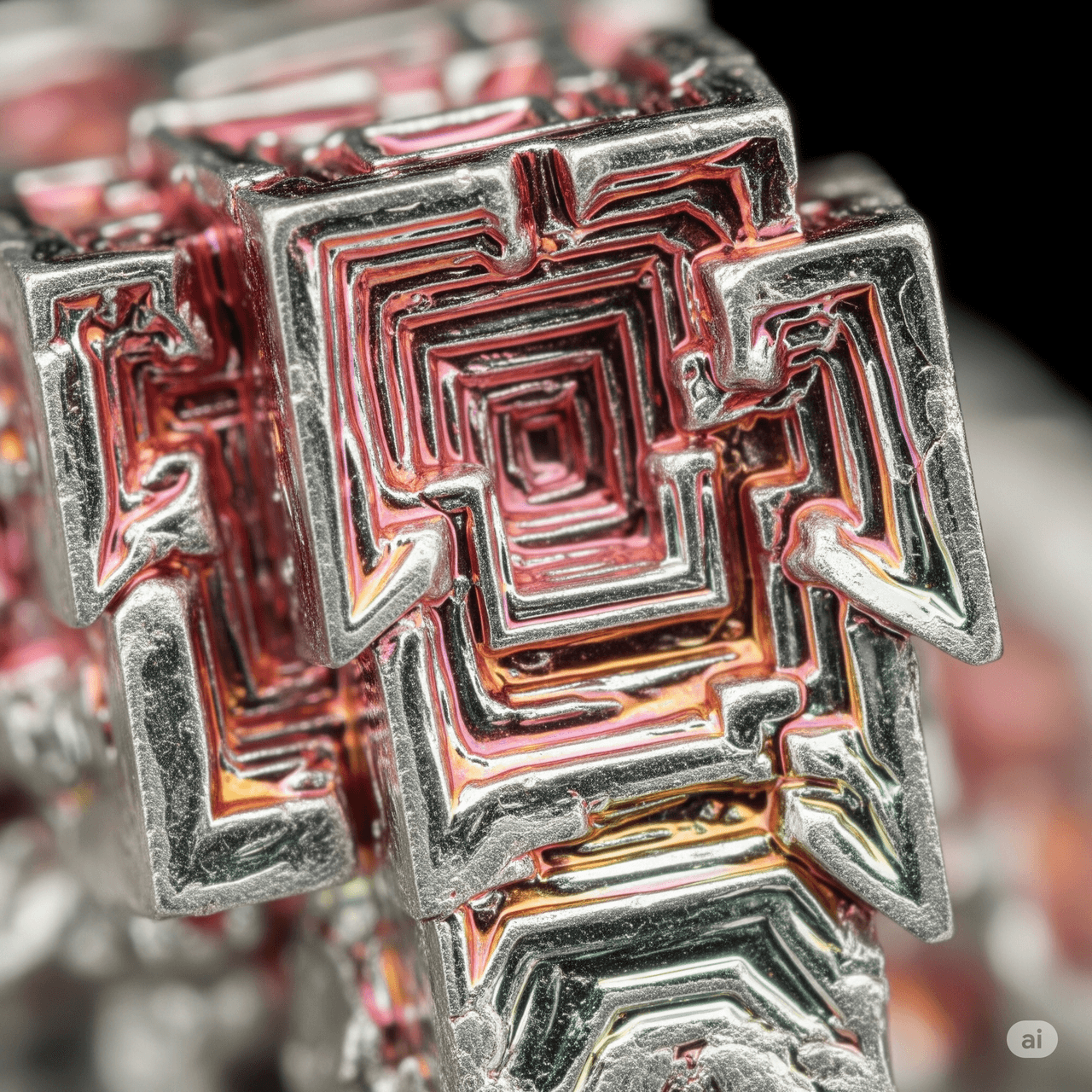
Appearance | Silvery white, pinkish metal | ||||||||
Phase | Solid | ||||||||
Density | 9.79 g/cm³ | ||||||||
Melting Point | 271.406 °C | ||||||||
Boiling Point | 1564 °C | ||||||||
Atomic Radius | ~207 pm | ||||||||
Electronegativity | 1.9 | ||||||||
Electron Affinity | 90.924 kJ/mol | ||||||||
Important Isotopes | ²⁰⁹Bi | ||||||||
Year of Discovery(ies) | Known since antiquity identified as an element in 1753 | ||||||||
Discoverer(s) | Claude François Geoffroy (who identified it as an element) | ||||||||
Bismuth is a brittle post-transition metal with atomic number 83, located in group 15 of the periodic table. It has a silvery-white color with a faint pinkish tinge. Although known since prehistoric times, it was first identified as a distinct element in 1753 by the French chemist Claude François Geoffroy.
Bismuth (Bi) is situated in period 6 and group 15 (the pnictogens) of the periodic table, directly below nitrogen, phosphorus, arsenic, and antimony. It is classified as a post-transition metal. Its electron configuration is [Xe] 4f¹⁴5d¹⁰6s²6p³. At room temperature, it exists as a solid. Despite its high density (approximately 9.79 g/cm³), it is quite brittle. One of its most notable properties is that it expands upon solidification, similar to water. Additionally, bismuth exhibits one of the highest diamagnetic properties among all metals (magnetization opposite to an applied magnetic field) and is the second metal with the lowest thermal conductivity.
Bismuth has been known since ancient times and was used by the Egyptians in cosmetics. For a long time, it was confused with other metals such as lead, antimony, and tin. Although the German monk Basil Valentine attempted to identify it in the 15th century, its scientific recognition as a distinct metal was only achieved in 1753 by the French chemist Claude François Geoffroy (also known as Young Geoffroy). Geoffroy demonstrated that bismuth had properties distinct from lead and tin.

Bismuth (Generated by Artificial Intelligence)
The origin of the word "bismuth" is not definitively established, but it is generally accepted to have Germanic roots. The most widely accepted theory suggests it derives from the German words "weisse masse" or "wisuth," meaning "white mass," referring to the appearance of the element or its oxides. Another possible origin is the German phrase "in den Wiesen muten," meaning "in the meadows of the mine," which may refer to the locations where bismuth was first mined.
Bismuth has a bright, silvery-white appearance and exhibits a faint pinkish hue when freshly fractured. Due to a thin oxide layer forming on its surface, it can display iridescent colors, especially when crystallized in the laboratory. Its melting point is 271.406 °C and its boiling point is 1564 °C. The atomic radius is approximately 207 pm and its electronegativity is 1.9. Its electron affinity is reported as 90.924 kJ/mol. As a brittle metal, it is rarely used in pure form; its alloys are more common. It is stable in dry air but slowly oxidizes in moist air. At high temperatures, it reacts with oxygen to form yellow bismuth(III) oxide (Bi₂O₃). It dissolves in acids. The most common and stable oxidation state in its compounds is +3, although the +5 oxidation state is also known (for example, in sodium bismuthate, NaBiO₃).
Bismuth is a relatively rare element in the Earth's crust, with an abundance comparable to that of silver. It occurs naturally both as a native metal and within various minerals. The most important bismuth minerals are bismuthinite (Bi₂S₃ — bismuth sulfide) and bismite (Bi₂O₃ — bismuth oxide). It can also be found as bismuth tellurides (e.g., tetradymite, Bi₂Te₂S). Commercially, the majority of bismuth is obtained as a byproduct during the smelting and refining of ores of lead, copper, tin, silver, and gold. Major producing countries include China, Mexico, Peru, and Bolivia.
Bismuth has one naturally occurring primordial isotope: bismuth-209 (²⁰⁹Bi). For a long time, ²⁰⁹Bi was considered the heaviest stable isotope known. However, in 2003, it was discovered that this isotope is in fact an alpha emitter with an extremely long half-life (approximately 1.9 × 10¹⁹ years — far longer than the age of the universe). Due to this extraordinarily long half-life, ²⁰⁹Bi is still considered stable for all practical purposes. The primary isotope listed in sources is ²⁰⁹Bi. Numerous artificial radioactive isotopes have also been synthesized.

Bismuth Representation (Generated by Artificial Intelligence)
Bismuth has various applications due to its unique properties and low toxicity:
Bismuth has no known biological role. Generally, its toxicity and that of its soluble compounds are significantly lower than those of other heavy metals such as lead, antimony, and cadmium. This low toxicity is one of the main reasons for its widespread use in medical and cosmetic applications. However, at very high doses or with prolonged exposure, some side effects may occur, such as kidney damage or skin discoloration. Inhalation of bismuth dust should be avoided, and general safety precautions should be observed when handling the element.
National Center for Biotechnology Information. "bismuth." *PubChem Compound Database CID 5359367*. Accessed May 31, 2025. https://pubchem.ncbi.nlm.nih.gov/compound/5359367
TÜBİTAK Bilim Genç. "Bizmut." *Bilim Genç.* Accessed May 31, 2025. https://bilimgenc.tubitak.gov.tr/periyodik-tablo/bizmut

Bismuth (Bi)
Periodic Table | 6 | ||||||||
|---|---|---|---|---|---|---|---|---|---|
Chemical Symbol | Bi | ||||||||
Atomic Number | 83 | ||||||||
Group | 15 (Pnictogens) | ||||||||
Atomic Weight | (208.98040) g/mol | ||||||||
Electron Configuration | [Xe] 4f¹⁴5d¹⁰6s²6p³ | ||||||||
Appearance | Silvery white, pinkish metal | ||||||||
Phase | Solid | ||||||||
Density | 9.79 g/cm³ | ||||||||
Melting Point | 271.406 °C | ||||||||
Boiling Point | 1564 °C | ||||||||
Atomic Radius | ~207 pm | ||||||||
Electronegativity | 1.9 | ||||||||
Electron Affinity | 90.924 kJ/mol | ||||||||
Important Isotopes | ²⁰⁹Bi | ||||||||
Year of Discovery(ies) | Known since antiquity identified as an element in 1753 | ||||||||
Discoverer(s) | Claude François Geoffroy (who identified it as an element) | ||||||||
Classification and Basic Properties
Discovery
Etimology
Physical and Chemical Properties
Natural Occurrence
Isotopes
Applications
Biological Role and Effects