This article was automatically translated from the original Turkish version.
+2 More
Length(s) | Approximately 4.4 m | ||||||||
|---|---|---|---|---|---|---|---|---|---|
Engine(s) | 3 x JetCat P200 turbojet engines (total thrust 160 lbs) | ||||||||
Name(s) | Boeing/NASA X-48B Blended Wing Body (BWB) | ||||||||
First Flight(s) | 20 July 2007 | ||||||||
Origin(s) | USA | ||||||||
Maximum Altitude | 3.048 m (10.000 feet) | ||||||||
Maximum Weight | 237 kg (523 lbs) | ||||||||
Maximum Speed | 218 km/h (118 knots) | ||||||||
Wingspan | 6.22 m (20.4 feet) | ||||||||
Crew | Unmanned / Remotely Controlled (from ground control station) | ||||||||
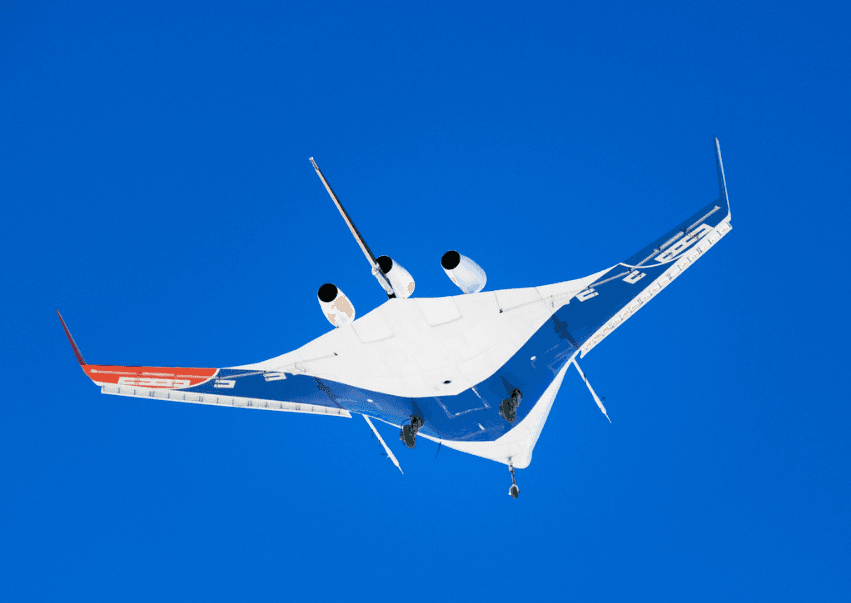
Boeing X-48 is an experimental unmanned aerial vehicle (UAV) series developed jointly by Boeing Phantom Works, NASA, and Cranfield Aerospace to test the Blended Wing Body (BWB) design, also known as "Combined Wing-Body." The X-48 program was conducted with the goal of improving fuel efficiency, reducing noise, and enhancing aerodynamic performance in future civil and military aircraft. The X-48 was not developed as an operational aircraft but rather to study aerodynamic behavior, flight control, and structural response under real flight conditions.

Boeing X-48 (Flickr)
Boeing X-48 program emerged as a response to the performance limitations of the traditional "tube-and-wing" design in aviation. The program's origins trace back to NASA's Advanced Air Vehicles program in the late 1990s and earlier work conducted by McDonnell Douglas before its merger with Boeing.
In conventional aircraft designs, the fuselage contributes minimally to lift generation and is primarily considered a source of aerodynamic drag. The Blended Wing Body architecture underlying the X-48, however, treats the entire structure as a lifting surface by shaping every part of the aircraft as an airfoil.airfoil.
The project was developed under an international engineering consortium involving multiple institutions.
To reduce costs and manage risk, Boeing opted to develop a 8.5 percent scale model rather than a full-scale aircraft.
The X-48 program progressed through three main phases as it evolved from a conceptual design to a flight-ready technology platform. Each variant was optimized to address a distinct aerodynamic or operational challenge of the Blended Wing Body (BWB) concept.
All X-48 variants are scaled-down replicas of a full-scale aircraft at 8.5 percent size. Key geometric parameters are as follows:
The initial variant planned at the program’s outset but later limited due to changes in test strategy. Its primary objective was to compare the low-speed lift and drag characteristics of the BWB geometry with wind tunnel data.
The X-48B variant, which made its first flight in 2007, served as one of the most intensively tested and data-generating platforms in the program.
The X-48C variant, which began flight testing in 2012, was used to evaluate environmental performance parameters such as noise and emissions of the BWB configuration.

Boeing X-48B(Flickr)
The X-48 program demonstrated that flight stability in a configuration without conventional vertical and horizontal stabilizers could be achieved through advanced control algorithms and high-speed actuators. This approach relies on a software-based flight control architecture that dynamically adjusts the aircraft’s responses in real time.
The X-48 is fully equipped with a digital Fly-by-Wire system. Pilot commands (from a ground operator) do not go directly to the control surfaces; instead, they are first processed by flight computers.
On the X-48 platform, a redundant flight control computer system was developed through collaboration between Cranfield Aerospace and Boeing.

Boeing X-48 Design (Generated by Artificial Intelligence)
The test program followed an incremental methodology aimed at progressively expanding the flight envelope.
While the X-48 platform is managed by a pilot from a ground control station during operations, the majority of flight control functions are executed by autonomous systems.
The X-48 platform was not developed as a production aircraft but as a research platform for technology demonstration. Its outputs were evaluated based on experimental data gathered during flight tests.
Boeing X-48B Flight (Nasa)
Research on Blended Wing Body (BWB) technology is not limited to the Boeing X-48. Manufacturers such as Lockheed Martin and Airbus have developed projects with similar aerodynamic advantages but differing control philosophies and operational applications.
Lockheed Martin’s Hybrid Wing Body (HWB) concept employs a hybrid architecture compared to the X-48’s fully blended design.
The European aerospace consortium Airbus began testing in this field in 2020 with its MAVERIC (Model Aircraft for Validation and Experimentation of Robust Innovative Controls) demonstrator.
The wide wingspan of BWB designs represented by the X-48 poses compatibility issues with standard taxiways and ramp systems at airports (ICAO Class E/F). The Lockheed Martin HWB design, by preserving conventional fuselage width, exhibits higher compatibility with existing hangars and ground service equipment. Boeing has addressed this constraint by incorporating foldable wing mechanisms as a parameter in subsequent designs.
Boeing X-48B Flight Test (Nasa)
The Boeing X-48 program generated experimental data demonstrating how a conceptual aircraft design can be implemented as a viable research platform. Outputs from the program are categorized under three main headings: generation of aerodynamic data sets, development of flight control and software systems, and evaluation of environmental performance criteria.【5】
The X-48 flight tests provided comprehensive and long-term experimental data sets for the Blended Wing Body (BWB) configuration.
Outputs from the project have provided technical contributions, particularly in the areas of flight control for aerodynamically unstable airframes and their software-assisted operation.
Technical Validation of Artificial Stability: Tests conducted under the X-48 program demonstrated that an aircraft with a tailless and inherently unstable aerodynamic structure can be flown safely and in compliance with aviation standards using active control surfaces and digital flight control software.
Development of Autonomous Systems: The autonomous flight algorithms and redundant computer architectures used during the program have served as technical references for control approaches adopted in subsequent unmanned aerial vehicles (UAVs) and autonomous aircraft systems.
Data collected under NASA’s Environmentally Responsible Aviation (ERA) program demonstrated that the configurations developed under the X-48 project meet established environmental performance criteria.
Following the conclusion of the program, its findings are directly applied in current projects led by the United States Air Force (USAF), such as next-generation strategic transport and tanker aircraft (e.g., JetZero initiatives). The X-48 is regarded as one of the research and demonstration platforms that successfully bridged the transition from conceptual aircraft design to experimental validation.
Cosentino, Gary B. “Flight Testing the X-48B at the NASA Dryden Flight Research Center.” *NASA Technical Reports Server.* Accessed December 27, 2025. https://ntrs.nasa.gov/api/citations/20100040481/downloads/20100040481.pdf
Free Public Domain Illustrations by rawpixel. “X-48B Blended Wing.” Flickr. Accessed February 4, 2026. https://www.flickr.com/photos/vintage_illustration/46363524101/in/photolist-7a8srZ-bKDQw6-2dCZbyM-2cehi9H-2dCZbmn-2dCZbrc-PSTamp-2aSs1TL-2aSs1LS-2dCZbi6-2dCZact
Free Public Domain Illustrations by rawpixel. “X-48B Blended Wing.” Flickr. Accessed February 4, 2026. https://www.flickr.com/photos/vintage_illustration/46363524101/
Gelzer, Christian. “X-48B Blended Wing Body.” NASA Aeronautics. Accessed December 27, 2025.
Larrimer, Bruce I. “Beyond Tube-and-Wing: The X-48 Blended Wing-Body and NASA’s Quest to Reshape Future Transport Aircraft.” NASA Aeronautics Book Series. Accessed December 27, 2025. https://www.nasa.gov/wp-content/uploads/2020/11/beyond_tube-and-wing_tagged.pdf#page=173
Liebeck, Robert H. “Design of the Blended Wing Body Subsonic Transport.” *Journal of Aircraft (AIAA)*. Accessed December 27, 2025. https://arc.aiaa.org/doi/10.2514/1.9084
NASA Video. “X-48B Test Flight Highlights.” YouTube. Accessed December 31, 2025. http://www.youtube.com/watch?v=xhT2xzw8_Uc
NASA Video. “X-48B: How Does it Fly?” YouTube. Accessed December 27, 2025. https://www.youtube.com/watch?v=pA3GNM3lJUs
[1]
Robert H. Liebeck, "Design of the Blended Wing Body Subsonic Transport," Journal of Aircraft 41, no. 1 (2004): 10-25, accessed 31 December 2025, https://ntrs.nasa.gov/citations/20050041753
[2]
Test of Futuristic X-48C is Historic Wind Tunnel's Swan Song," NASA, last updated 25 July 2011, accessed 31 December 2025, https://www.nasa.gov/aeronautics/test-of-futuristic-x-48c-is-historic-wind-tunnels-swan-song/.
[3]
X-48 Hybrid/Blended Wing Body Technology," NASA Armstrong Flight Research Center Fact Sheet, last updated 15 August 2015, accessed 31 December 2025, https://www.nasa.gov/wp-content/uploads/2021/09/171791main_fs-090-dfrc.pdf.
[4]
Campbell, Richard L., et al. “Design and Testing of a Blended Wing Body With Boundary Layer Ingestion Nacelles at High Reynolds Numbers.” 2005, 43rd AIAA Aerospace Sciences Meeting and Exhibit. ntrs.nasa.gov,accessed 31 December 2025,
[5]
X-48 Hybrid/Blended Wing Body Technology," NASA Armstrong Flight Research Center Fact Sheet, last updated 15 August 2015, accessed 31 December 2025, https://www.nasa.gov/wp-content/uploads/2021/09/171791main_fs-090-dfrc.pdf

Length(s) | Approximately 4.4 m | ||||||||
|---|---|---|---|---|---|---|---|---|---|
Engine(s) | 3 x JetCat P200 turbojet engines (total thrust 160 lbs) | ||||||||
Name(s) | Boeing/NASA X-48B Blended Wing Body (BWB) | ||||||||
First Flight(s) | 20 July 2007 | ||||||||
Origin(s) | USA | ||||||||
Maximum Altitude | 3.048 m (10.000 feet) | ||||||||
Maximum Weight | 237 kg (523 lbs) | ||||||||
Maximum Speed | 218 km/h (118 knots) | ||||||||
Wingspan | 6.22 m (20.4 feet) | ||||||||
Crew | Unmanned / Remotely Controlled (from ground control station) | ||||||||
Design and Development
Origins of the BWB Concept
Collaboration and Development Partners
Scaling and Prototyping Strategy
Technical Specifications and Variants
Physical and Structural Criteria
X-48A
X-48B
X-48C
Avionics and System Components
Fly-by-Wire (FBW) and Control Architecture
Flight Control Computer (FCC) and Software Layer
Autonomous Control and Navigation Systems
Flight Test Phases
Operational Control and Ground Station
Use of Collected Data
International Comparison
Technical Differences Between Boeing X-48 and Lockheed Martin HWB
Comparison with Airbus MAVERIC
Infrastructure and Logistical Constraints
Significance and Impact of the Program
Data Standardization in Aerospace Engineering
Contributions to Flight Control and Computer Science
Environmental and Economic Impacts
Industry Legacy