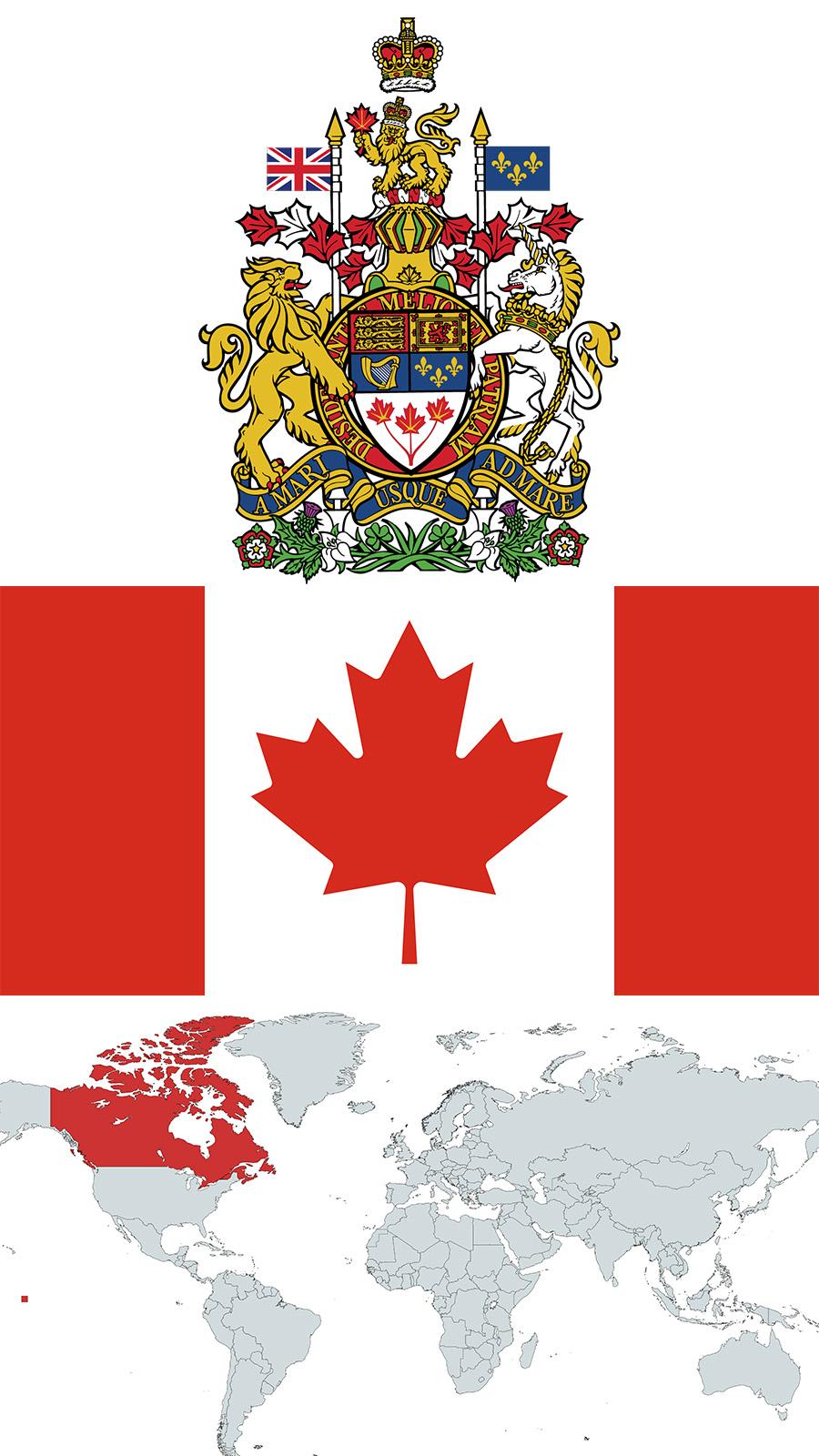


This article was automatically translated from the original Turkish version.
+2 More
Official Name | Canada | ||||||||
|---|---|---|---|---|---|---|---|---|---|
Capital | Ottawa | ||||||||
Prime Minister | Mark Carney | ||||||||
Form of Government | Constitutional Monarchy Parliamentary Democracy Federation (Confederate State) | ||||||||
Official Languages | English and French | ||||||||
Religious Structure | Christian 53%, Non-religious 34%, Muslim 4%, Hindu 2%, Sikh 2%, Other 5% | ||||||||
National Day | 1 July 1867 | ||||||||
Area | 9,985,000 km² | ||||||||
Population | Approximately 40.2 million (2024) | ||||||||
Climate | Interior regions are continental Boreal and Temperate British Columbia is humid Arctic | ||||||||
GDP | 2.241 trillion USD (2024) | ||||||||
GDP per Capita | 52,791 USD (2021 IMF) | ||||||||
Ethnic Groups | Canadian (32.3%), English (18.3%), Scottish (13.9%), French (13.6%), Irish (13.4%), German (9%), Chinese (~5%), Indigenous Peoples (5%), Other (~20%) | ||||||||
Telephone Code | +1 | ||||||||
Internet Domain Code | ca | ||||||||
Canada is a country that encompasses a large portion of the North American continent and is a member of the Commonwealth of Nations. Its system of government is a federation (confederate state) based on the principles of constitutional monarchy and parliamentary democracy. The head of state is His Majesty King Charles III, and the political system includes a bicameral parliament (the Senate and the House of Commons).
The country is divided into ten provinces and three territories and has a highly decentralized structure. It is bordered by the Arctic Ocean to the north, the Atlantic Ocean to the east, the Pacific Ocean to the west, and the United States of America to the south. Canada, whose official capital is Ottawa, is the second largest country in the world by area.

Ottawa, Canada (unsplash)
The music of O Canada, Canada’s national anthem, was composed by Calixa Lavallée and the original French lyrics were written by Adolphe-Basile Routhier. Although first performed in 1880, it was officially adopted as Canada’s national anthem a century later, in 1980. The version adopted in 1980 is based on Robert Stanley Weir’s 1908 edition, but in 2018, legislation changed the lyrics to remove gender bias; the line “In all thy sons command” was replaced with “In all of us command.”
In addition to English, French, bilingual, and instrumental versions, sign language versions in American Sign Language (ASL) and Langue des Signes Québécoise (LSQ) are also available. The National Anthem Act defines only the melody and lyrics; there is no copyright on either, and as they are declared public domain by law, they may be used without government permission; however, modifications to the melody may be subject to copyright. While the lyrics may be translated into languages other than English or French, only the English and French versions are recognized in the Act, and other translations have no official status.
The Royal Anthem, God Save the King, is also in the public domain. Although there is no law or regulation governing when the national anthem must be played, certain conventions serve as guidelines; out of respect and tradition, it is customary to stand when O Canada is played. While older traditions required civilian men to remove their hats, current practice does not enforce this requirement.
National Anthem of Canada (Ingen)
Canada’s history began thousands of years before the arrival of European explorers, with the presence of advanced societies such as the First Nations and Inuit, each with their own beliefs, ways of life, and histories on what is now Canadian territory. When the first European explorers arrived, they found all regions inhabited by Indigenous peoples.
Some of these Indigenous peoples sustained themselves through hunting and gathering, while others practiced agriculture; for example, the Huron-Wendat and Iroquois of the Great Lakes region were both farmers and hunters, the Cree and Dene of the Northwest were hunter-gatherers, the Sioux followed bison herds in a nomadic lifestyle, and the Inuit survived through Arctic wildlife. Warfare was common among Aboriginal groups competing for land, resources, and prestige. Although some settlers from Iceland and Greenland arrived between the 9th and 10th centuries, they eventually disappeared from the northern coasts where they settled.
Later explorations occurred during the Age of Discovery, including the voyages of Italian navigator Giovanni Caboto (Jean Cobot), who sailed under the English flag (1497–1498), and those commissioned by King Francis I of France: Italian Giovanni da Verrazzano (1524) and Frenchman Jacques Cartier (1534–1536; 1541–1542). The arrival of European traders, missionaries, soldiers, and colonists permanently altered Indigenous ways of life; many Aboriginal peoples died from European diseases, but over the first 200 years, strong economic, religious, and military ties were forged between Indigenous peoples and Europeans, laying the foundations of Canada. In the early 17th century, the French, who dominated eastern Canada, named these lands “New France” and founded Quebec City in 1608. Initially a small fur trading post, Quebec also became the center for missionaries seeking to convert Indigenous peoples to Christianity. However, French population growth was hindered by hostile Indigenous attitudes and freezing winters. Quebec fell into English hands in 1629, when English colonial authorities to the south seized it, but it was returned to France three years later under the Treaty of Saint-Germain-en-Laye.
Louis XIV showed interest in New France, established the Company of the Indies (1664), and sent soldiers to fight Indigenous groups. His first governor, Jean Talon (1665–1672), encouraged new settlements by bringing young women and unmarried women from France, revitalizing agriculture, fishing, and various crafts. Under his administration, the economy strengthened and territorial expansion accelerated through further geographic exploration. However, this growth brought France into direct competition with England, and after prolonged wars in Europe and North America, New France—with a population of only about 50,000—was defeated by its southern neighbor, the thirteen English colonies with over a million inhabitants, and ceded to Britain under the 1763 Treaty of Paris.
All of New France’s territories, except Quebec, were divided among British colonies; only Quebec remained as a separate colony under French-speaking control, and later granted religious (Catholic), linguistic (French), and legal (French civil law) freedoms (1774). In 1791, an act of the British Parliament divided the region into Upper Canada, predominantly English-speaking, and Lower Canada, predominantly French-speaking. However, in 1841, the two were reunited into a single colony.
The British North America Act of 1867 envisioned a confederated structure and established the new Dominion of Canada, initially composed of four provinces: Ontario, Quebec, Nova Scotia, and New Brunswick. Three years after Confederation, in 1870, Canada purchased Rupert’s Land—approximately 40 percent of today’s Canadian territory—from the Hudson’s Bay Company, which had held a royal charter for two centuries, for 300,000 pounds sterling. Britain also transferred the North-West Territories—previously under the Hudson’s Bay Company’s exclusive trading license—to Canada. The merger of Rupert’s Land and the North-West Territories formed the North-West Territories, from which the province of Manitoba was later created from a small portion of the area.
In subsequent years, British Columbia joined Confederation in 1871 with the promise of a transcontinental railway; Prince Edward Island became Canada’s seventh province in 1873; and in 1898, Yukon, previously part of the North-West Territories since 1895, became a separate territory. Meanwhile, immigrants from Eastern Canada, Europe, and the United States began settling the Prairies, part of the North-West Territories, and in 1905, the provinces of Saskatchewan and Alberta were created, completing the map of Western Canada. After lengthy debates and two referendums, the people of Newfoundland voted in 1949 to join Confederation, thereby becoming Canada’s tenth province.
In 1931, under the leadership of Prime Minister W. L. Mackenzie King and the Liberal Party, Canada became a sovereign state within the British Crown, and during World War II, it declared war on Germany for the first time in its history, joining the Allies. After the war, it severed its last constitutional ties with Britain and became a fully independent state, remaining only as a member of the Commonwealth of Nations. Finally, on April 1, 1999, Nunavut was created from the eastern portion of the North-West Territories, encompassing 1.9 million square kilometers of Canada’s Arctic region.
Canada’s geographical structure has been mapped according to regional climate gradients that determine its natural ecosystems, shaped by three continental-scale influences: the latitudinal gradient of net solar radiation, the prevailing westerly wind flow, and the physiographic region of the Cordillera in western North America.
The latitudinal gradient divides the country’s climate—and thus its geography—into three main macroclimatic zones: Arctic (polar), Boreal, and Temperate. The moist Pacific air from the west collides with the Cordillera, creating orographic effects (reduced moisture retention by clouds as temperature drops), resulting in humid and dry climate zones in British Columbia, Yukon, Alberta, and western Northwest Territories. East of the Cordillera, the primary longitudinal climate gradient is formed by precipitation and annual moisture balance, which increases toward the east due to the influence of Hudson Bay, the Great Lakes, and the Atlantic Ocean.
Physiographically, Canada includes the Cordillera region in the west, with mountains reaching up to 3,900 meters, parts of the Arctic Coastal Plain and Interior Plains, and the Arctic zone largely situated on the Precambrian Shield in the Kazan, James, and Davis regions. The geology of the Cordillera exhibits a complex structure composed of crystalline volcanic and metamorphic rocks (Coastal and Omineca Mountains) and faulted and folded Paleozoic, Mesozoic, or Tertiary sedimentary rocks (Rocky Mountains).
The Forest and Boreal Zone extends across the Cordillera and Interior Plains as well as a portion of the western Precambrian Shield, rarely exceeding 800 meters in elevation east of the Rocky Mountains; this geography is defined by its potential vegetation on “zonal sites”—regions with medium-depth, well-drained soils and medium-sloped, well-drained topographic positions—that best reflect the regional climate and are least affected by local topography or soil characteristics.

Northern (Boreal) Forest (Unsplash)
Canada’s economy is among the world’s ten largest and trade remains its primary engine of economic growth. Canadians assert that they cannot maintain their standard of living without international trade. Canada signed a free trade agreement with the United States in 1988 and joined the North American Free Trade Agreement (NAFTA) with Mexico in 1994. NAFTA was replaced on July 1, 2020, by the Canada–United States–Mexico Agreement (CUSMA / USMCA / T-MEC), which modernized trade rules among the three countries and introduced new provisions in areas such as the digital economy, environmental regulations, and the automotive sector.
Canada is a member of the G8 group of industrialized nations, which includes the United States, Germany, the United Kingdom, Italy, France, Japan, and Russia.
Canada’s economy comprises three main industrial sectors: services, manufacturing, and natural resources. The service sector now provides thousands of employment opportunities in fields such as transportation, education, health care, construction, banking, communications, retail, tourism, and public administration, employing more than 75 percent of Canadian workers. Manufacturing industries produce goods such as paper, advanced technology equipment, aerospace and space technology, automobiles, machinery, food, and clothing for sale in Canada and globally.
Canada and the United States are each other’s largest trading partners; more than three-quarters of Canada’s exports go to the United States, forming the world’s largest bilateral trading relationship. Integrated Canada–U.S. supply chains compete globally. Canada annually exports billions of dollars’ worth of energy products, industrial goods, machinery, equipment, automobiles, agricultural products, fisheries, forestry products, and consumer goods.
Canada’s demographic structure is shaped by migration dynamics and geographic distribution. As of the end of 2024 and beginning of 2025, the country’s population was recorded at approximately 40.2 million.【1】 Since the 1940s, the population has more than tripled to exceed 36 million, showing steady growth supported by immigration; natural population increase accounts for only about one-tenth of annual total growth. In Canada, natural population increase contributes only about one-tenth of total annual growth, with the remainder largely driven by immigration.
Canada is the G7 country with the highest per capita immigration rate, and approximately 22 percent of its population identifies as foreign-born or immigrant. At the same time, due to the largely uninhabitable nature of much of its territory, it is one of the world’s least densely populated countries, with a population density below four people per square kilometer.
In terms of religious belief, according to 2011 data, approximately 67 percent of the population identifies as Christian, 24 percent as non-religious, 3.2 percent as Muslim, 1.5 percent as Hindu, and 1.4 percent as Sikh. These proportions reflect the cultural diversity observed, especially in major urban centers.
Canada supports its social structure through a universal healthcare system, funded by high tax rates, with public spending accounting for approximately 40 percent of GDP. Additionally, approximately 2.8 million Canadian citizens, or about 9 percent of the total population, live outside the country.
Historically, before the major wave of European immigration between 1896 and the start of World War I, Canada’s population was primarily composed of people of British and French descent. For example, according to the 1871 Canadian Census, 60 percent of Canada’s 3.5 million population were of British origin and 30 percent were of French origin; other Europeans accounted for only 7 percent. This demographic structure remained largely unchanged until the turn of the century.
The immigration wave before World War I began increasing the number of Europeans who were neither British nor French. Between 1896 and 1914, over three million immigrants arrived; as immigration from Britain and Western Europe declined, Canada began accepting immigrants from Eastern and Southern Europe, including Poles, Ukrainians, Hutterites, and Doukhobors. Between 1915 and 1945, during the interwar period, another two million immigrants arrived.
According to Canadian census data, the proportion of Canadians of European origin other than British or French rose from 8.5 percent in 1901 to 17.8 percent in 1941. Meanwhile, the proportion of Canadians of British origin fell from 57 percent in 1901 to 50 percent in 1941, while those of French origin remained around 30 percent of the total population in both years. In short, between 1901 and 1941, the composition of Canadians of European origin other than British or French showed an increase in diversity, reflecting the emergence of ethnic pluralism.
However, as in 1871, Canada’s 1941 population was still overwhelmingly of European origin, accounting for 98 percent of the total population. Between 1941 and 1961, the proportion of Canadians of European origin other than British or French increased further, rising from 17.8 percent in 1941 to 22.6 percent in 1961. Conversely, the proportion of Canadians of British origin declined from 49.7 percent in 1941 to 43.8 percent in 1961. Thus, the increase in ethnic diversity between 1941 and 1961 was driven by rising proportions of Canadians of European origin other than British or French, while the proportion of Canadians of British origin decreased. However, even in 1971, Canada’s ethnic composition remained largely European, at 96 percent.
According to 2023 data, Canada’s ethnic composition now includes those identifying as Canadian (32.3 percent), as well as groups such as English (18.3 percent), Scottish (13.9 percent), French (13.6 percent), and Irish (13.4 percent).

Ethnic Structure Data Table (Generated by Artificial Intelligence.)
In Canada, education begins in elementary school, where children learn life skills in safe and inclusive classrooms; children typically begin kindergarten at age four or five, and this level continues through grade six. Middle school or junior high includes grades seven and eight, while high school (secondary education) generally runs from grade eight, nine, or ten to grade twelve; the only exception is Quebec, where high school begins in grade seven and ends in grade eleven.
The school year typically begins in September and ends in June, with classes held Monday through Friday. Public schools are free for Canadian citizens and permanent residents; international students may attend public or private/independent schools by paying tuition fees.
After high school, students may choose colleges, vocational schools, or universities. Colleges and vocational institutions offer over 10,000 programs across 127 publicly funded institutions, including certificates, diplomas, postgraduate diplomas, university transfer programs, and apprenticeships, providing practical learning opportunities such as internships and job placements. Colleges also provide access to more than 400 specialized research centers that support innovation and business incubators where students can develop entrepreneurial ideas. Universities, recognized globally as leading research institutions (with impact above the G7 average), offer graduate (one to two years) and doctoral (PhD, three to five years) degrees and are ranked as the world’s third most preferred destination for graduate education (QS 2021 Ranking included 26 Canadian universities).
Graduate programs are thesis-based, applied, research-paper-based, or course-based. At all educational levels, international students may pursue their studies in English, French, or both, and must demonstrate language proficiency through standardized tests such as TOEFL, IELTS, or CAEL.
Canada is a preferred destination for international students due to relatively affordable tuition and living costs compared to many global cities, as well as scholarship opportunities offered by the government and institutions.
Canada’s Capital Region, encompassing Ottawa and Gatineau, serves as a cultural showcase through its museums and galleries that house some of the nation’s cultural treasures. National museums and galleries include the Canada Science and Technology Museum and its affiliated institutions, the Canada Agriculture and Food Museum, the Canada Aviation and Space Museum, the Canadian Museum of History and its affiliated museum (the Canadian War Museum), the Canadian Museum of Nature, the National Gallery of Canada and its affiliated museum (the Canadian Museum of Contemporary Photography).
Other cultural sites include the Bytown Museum, the Canadian Children’s Museum, the Canadian Conservation Institute, the Bank of Canada Currency Museum, Library and Archives Canada, the National Arts Centre, the Royal Canadian Mint, the RCMP Musical Ride, and the Supreme Court of Canada. These sites and parks are managed under the Department of Canadian Heritage, led by the Minister of Canadian Heritage and Official Languages, the Honourable Steven Guilbeault.

Canada Aviation and Space Museum (flickr)
Canada’s tourism and cultural infrastructure encompasses a diverse heritage of historical, natural, and cultural sites managed and protected by Parks Canada. There are 1,004 national historic sites across all provinces and territories, 171 of which are managed by Parks Canada. These national historic sites can be found in nearly every environment, from rural and urban areas to wilderness, and include sacred sites, archaeological sites, battlefields, heritage homes, historic districts, scientific discovery sites, and more.
In terms of natural conservation areas, Canada has 37 national parks and 11 national park reserves, representing 31 of its 39 terrestrial natural regions and protecting approximately 343,377 square kilometers. These areas extend from mountains and plains to boreal forests and tundra, lakes and glaciers, aiming to preserve and present representative examples of natural landscapes and phenomena.
A national park reserve is an area managed like a national park but subject to one or more Indigenous land claims, which are negotiated between federal and Indigenous governments. Indigenous peoples continue to use the land for traditional hunting, fishing, and trapping.

Moraine Lake, Banff National Park (unsplash)
Canada is a federation governed by parliamentary democracy and constitutional monarchy, with its governance shaped by its geographic and demographic characteristics, the dynamics of its multicultural society, and its close political, economic, and cultural ties with its neighbor, the United States. The country is divided into ten provinces (Ontario, Quebec, Manitoba, British Columbia, Saskatchewan, Alberta, Newfoundland and Labrador, Nova Scotia, New Brunswick, and Prince Edward Island) and three territories (Northwest Territories, Yukon, and Nunavut). Powers are distributed between the provinces and the federal government under the Constitution; the federal government is responsible for international relations, immigration, criminal law, taxation, national defense, and foreign policy, while provinces manage education, taxation, natural resource use, property and civil rights, health and hospital systems, social security, and regional institutions.
The country has a highly decentralized administrative system, and provinces may even delegate authority to sub-regional entities. Canada is one of 15 member states of the Commonwealth of Nations. The head of state is King Charles III, represented in Canada by the Governor General (currently Mary May Simon), who holds the title of “King of Canada.”
The Governor General is appointed by the King on the advice of the Prime Minister, typically from among retired politicians or other distinguished Canadians. Although there is no fixed term, the appointment is usually for five years. King Charles III does not govern the country as a constitutional monarch but remains a fundamental part of Canada’s system of governance and national identity.
Canada’s legislative body, the federal Parliament, is a bicameral legislature based on the British Westminster model, consisting of the House of Commons and the Senate. The Senate’s 105 members are appointed by the Governor General on the advice of the Prime Minister and serve until mandatory retirement at age 75; appointments aim to ensure representation from each province and territory. The 338 members of the House of Commons are elected through a single-member plurality system, with one representative chosen from each electoral district, proportionally based on population.
The leader of the political party with the most seats in the House of Commons is appointed Prime Minister by the Governor General and tasked with forming the federal Cabinet. The Cabinet of Canada, appointed by the Governor General on the advice of the Prime Minister, serves as the Prime Minister’s advisory body for achieving consensus among ministers; nearly all members are drawn from the House of Commons, though occasionally a senator may be added to ensure regional representation. By constitutional convention, the Cabinet determines the federal government’s policies and priorities, and members are bound by the principle of collective ministerial responsibility: although they may speak freely within Cabinet, they are obligated to publicly support government decisions.
Each Cabinet member is normally responsible for a government department, receives confidential advice from the public service, and is accountable to Parliament and the public for their decisions; this is known as individual ministerial responsibility.
Canada’s judiciary consists of various courts at both federal and provincial levels; decisions from both federal and provincial courts may be appealed to the Supreme Court of Canada. The Supreme Court’s nine justices are appointed by the Governor General on the advice of the Prime Minister and Minister of Justice and serve until mandatory retirement at age 75; judges of other courts are appointed by the federal Cabinet.
Provincial and territorial governments have systems similar to the federal structure; each province’s head is the Lieutenant Governor, appointed by the Governor General on the advice of the Prime Minister and serving as the King’s representative in the province.
Canada and Türkiye have maintained long-standing diplomatic relations. Türkiye opened an embassy in Ottawa in 1944, and Canada appointed its first ambassador to Türkiye in 1947. In recent years, Canada and Türkiye, as friendly and allied nations, have strengthened bilateral relations as political, commercial, strategic, and security partners. The two countries work closely in forums such as the G20, the International Civil Aviation Organization (ICAO), the North Atlantic Treaty Organization (NATO), the Organisation for Economic Co-operation and Development (OECD), the Organization for Security and Co-operation in Europe (OSCE), the United Nations (UN), the United Nations Educational, Scientific and Cultural Organization (UNESCO), and the World Trade Organization (WTO) to address global challenges.
The armed forces of Türkiye and Canada have cooperated for many years within the NATO framework, actively participating in peace and security operations such as the Kosovo Force (KFOR) and NATO’s mission in Iraq.
In terms of trade, Türkiye is an attractive market for Canada; bilateral merchandise trade exceeded $4.3 billion in 2024. Canada’s merchandise exports to Türkiye reached $1.3 billion in 2024, while imports from Türkiye amounted to $3.1 billion. The two countries held the Canada–Türkiye Joint Economic and Trade Committee (JETCO) meeting in Istanbul in 2019 to promote economic relations and strengthen cooperation in trade and investment.
In Canada’s governance framework, close political, economic, and cultural ties with the neighboring United States play a significant role. Canada is home to a vibrant Turkish diaspora community of over 65,000 people, concentrated primarily in Toronto, Montreal, Vancouver, Ottawa, Hamilton, Calgary, and Edmonton.

President Recep Tayyip Erdoğan and Canadian Prime Minister Mark Carney (Anadolu Ajansı)
The Canadian Army consists of four divisions, one headquarters, and one doctrine and training center. Divisions include Regular and Reserve Force units. The Army comprises a national headquarters, four geographically defined divisions, and a doctrine and training center. The divisions are further divided into three regular force mechanized brigade groups, one combat support brigade, and ten reserve force brigades. In appropriate circumstances, divisions also include intelligence units, Canadian Ranger patrols, division support groups, and bases.
The Commander of the Canadian Army is a lieutenant general. The Army Headquarters consists of three main components: Army Operations, Army Strategy, and Army Reserve, each commanded by a major general.
The lieutenant general commands the Canadian Army Doctrine and Training Centre (CADTC). The four divisions command Regular and Reserve Force units within their respective areas, each led by a brigadier general. Although the 1st Canadian Division Headquarters is located in Kingston, it is not a land force formation; it was established in 2010 as a high-readiness joint organization responsible for managing maritime, land, and air operations for the Joint Operations Command.
Each of the Army’s three Regular Force mechanized brigade groups (CMBG) consists of an armored regiment, an artillery regiment, a combat engineer regiment, a headquarters and signals squadron, two mechanized and one light infantry battalion, and a service battalion; all brigade groups are commanded by colonels. The 6th Canadian Combat Support Brigade was established in April 2014 as the Canadian Army Support Group and became a combat support brigade in April 2018.
The Army Reserve (formerly the militia) consists of ten Canadian Brigade Groups (CBG), located in over 100 communities across Canada. Each CBG includes a series of armored reconnaissance, artillery, and infantry units, as well as a combat engineer regiment, a signals regiment, and a service battalion. Reserve Force brigade groups assist Regular Forces in domestic duties and provide trained reinforcement forces, particularly during overseas deployments.
The Canadian Rangers provide patrols and detachments for national security and public safety duties, with 194 Ranger patrols operating in over 220 remote northern, coastal, and isolated communities. As of early 2024, the Army comprised approximately 22,000 Regular Force personnel, 20,000 Reserve Force personnel, 5,000 Canadian Rangers, and 3,500 civilian staff.
About the Canadian Army Doctrine and Training Centre (32 CBG - 32 GBC)
Canada’s defense industry is a sector based on public-private collaboration, aimed at modernizing the country’s military capabilities, enhancing integration with allies, and contributing to economic development. Despite its tradition of peaceful foreign policy, Canada pursues a comprehensive defense industry policy with goals to develop defense technologies, build domestic production capacity, and conduct strategic exports. This structure is shaped by security parameters such as NATO membership, Arctic security, integration with the U.S.-led NORAD system, and active contributions to United Nations peacekeeping operations.
The foundation of Canada’s defense policy is the 2017 defense strategy document titled “Strong, Secure, Engaged” (SSE). This document set goals for modernizing the Canadian Armed Forces, increasing personnel capacity, strengthening the domestic defense industry, and enhancing contributions to global peace operations. Under SSE, the defense budget is projected to rise to an annual CAD 32.7 billion by 2026–2027, with a focus on long-term projects.
Canada’s defense industry is active primarily in the following areas:
Canada’s defense industry has a growth-oriented export structure. As of 2022, annual defense and security exports were approximately CAD 12 billion. Major export markets include the United States, Saudi Arabia, Australia, and European countries. Canada also shares intelligence and technology with NATO and Five Eyes countries.
The Government of Canada regulates defense exports through Global Affairs Canada. Legal frameworks such as the “Controlled Goods Program” and the “Export and Import Permits Act” ensure both domestic security and international obligations are upheld.
32 CBG - 32 GBC. "Canadian Army Reserve - Basic Military Qualification (BMQ) Course." YouTube. Accessed October 14, 2025.https://www.youtube.com/watch?v=Molu4mhVOLE
Anadolu Ajansı. "Cumhurbaşkanı Erdoğan'dan ABD'de yoğun diplomasi trafiği." Accessed October 14, 2025.https://www.aa.com.tr/tr/politika/cumhurbaskani-erdogandan-abdde-yogun-diplomasi-trafigi/3699431
Canada, Canadian Heritage. "The Monarch." Canada.ca. Accessed October 14, 2025.https://www.canada.ca/en/canadian-heritage/services/crown-canada/monarch.html
Canada, Canadian Heritage. “Museums and Galleries in Canada's Capital.” Canada.ca. Accessed October 14, 2025.https://www.canada.ca/en/canadian-heritage/services/museums-galleries-capital.html
Canada, Department of Justice. “Cultural Diversity in Canada: The Social Construction of Racial Difference, Part 2.” Justice Canada. Accessed October 14, 2025.https://www.justice.gc.ca/eng/rp-pr/csj-sjc/jsp-sjp/rp02_8-dr02_8/p2.html
Canada, Environment and Climate Change Canada. “Canadian Climate Normals 1991–2020 Calculation Information.” Canada.ca. Accessed October 14, 2025.https://collaboration.cmc.ec.gc.ca/cmc/climate/Normals/Canadian_Climate_Normals_1991_2020_Calculation_Information.pdf
Canada, Global Affairs. “Canada–Türkiye Relations.” Canada.ca. Accessed October 14, 2025.https://www.international.gc.ca/country-pays/turkiye/relations.aspx?lang=eng
Canada, Immigration, Refugees and Citizenship Canada. “Discover Canada: Canada’s Economy.” Canada.ca. Accessed October 14, 2025.https://www.canada.ca/en/immigration-refugees-citizenship/corporate/publications-manuals/discover-canada/read-online/canadas-economy.html
Canada, Immigration, Refugees and Citizenship Canada. “Discover Canada: Canada’s History.” Canada.ca. Accessed October 14, 2025.https://www.canada.ca/en/canadian-heritage/services/history-canada.html
Canada, Immigration, Refugees and Citizenship Canada. “Discover Canada: Canada’s History.” Canada.ca. Accessed October 14, 2025.https://www.canada.ca/en/immigration-refugees-citizenship/corporate/publications-manuals/discover-canada/read-online/canadas-history.html
Canada, Natural Resources Canada. “VEGETATION ZONES OF CANADA: a Biogeoclimatic Perspective.” Canada.ca. Accessed October 14, 2025.https://ostr-backend-prod.azure.cloud.nrcan-rncan.gc.ca/server/api/core/bitstreams/700e1413-005b-445b-b665-fc6d29fe95a6/content
Canada, Parks Canada. "National Historic Sites." Canada.ca. Accessed October 14, 2025.https://parks.canada.ca/lhn-nhs
Canada, Parks Canada. "National Parks." Canada.ca. Accessed October 14, 2025.https://parks.canada.ca/pn-np
Canada, Privy Council Office. "About the Cabinet." Canada.ca. Accessed October 14, 2025.https://www.canada.ca/en/privy-council/services/about-cabinet.html
Canada, Statistics Canada. "Demographic Estimates by Age and Gender, Provinces and Territories: Interactive Dashboard." Canada.ca. Accessed October 14, 2025.https://www150.statcan.gc.ca/n1/pub/71-607-x/71-607-x2020018-eng.htm
E, Izzy. “Boreal Forest JPG.” Unsplash. Accessed October 14, 2025.https://unsplash.com/photos/a-large-body-of-water-surrounded-by-trees-pFX0ASRtu48
Government of Canada. “Elementary School in Canada.” EduCanada. Accessed October 16, 2025.https://www.educanada.ca/study-plan-etudes/elementary-primaire.aspx?lang=eng
Government of Canada. “High School in Canada.” EduCanada. Accessed October 16, 2025.https://www.educanada.ca/study-plan-etudes/secondary-secondaire.aspx?lang=eng
Government of Canada. “Language Schools in Canada.” EduCanada. Accessed October 16, 2025.https://www.educanada.ca/study-plan-etudes/language-langue.aspx?lang=eng
Government of Canada. “State of Canada's Defence Industry 2024.” canada.ca. Accessed October 14, 2025.https://ised-isde.canada.ca/site/aerospace-defence/en/state-canadas-defence-industry
Government of Canada. “Universities in Canada.” EduCanada. Accessed October 16, 2025.https://www.educanada.ca/study-plan-etudes/university-universite.aspx?lang=eng
Huang, Jacky. “Moraine Gölü, Banff Ulusal Parkı JPG.” Unsplash. Accessed October 14, 2025.https://unsplash.com/photos/trees-near-a-mountain-beside-body-of-water-during-golden-hour-6rC8fmNW3pk
Ingen. "O Canada - National Anthem of Canada [Red Army Choir]." YouTube. Accessed October 14, 2025.https://www.youtube.com/watch?v=9jYgEb3wAVs
Ministry of Foreign Affairs of the Republic of Turkey. "Canada Country Profile." Ministry of Foreign Affairs of the Republic of Turkey Official Website. Accessed October 14, 2025.https://www.mfa.gov.tr/kanada-kunyesi.tr.mfa
Ministry of Foreign Affairs of the Republic of Turkey. "Kanada Siyasi Görünümü." *Ministry of Foreign Affairs of the Republic of Turkey Official Website.* Accessed October 14, 2025.https://www.mfa.gov.tr/kanada-siyasi-gorunumu.tr.mfa
Patron, Alessio. “bridge over river near city buildings under cloudy sky during daytime JPG.” Unsplash. Accessed October 14, 2025.https://unsplash.com/photos/bridge-over-river-near-city-buildings-under-cloudy-sky-during-daytime-YQNKKNLlybs
Recep Şentürk, Recep, and Dursun, Davut. “Kanada.” TDV İslâm Ansiklopedisi. Accessed October 14, 2025.https://islamansiklopedisi.org.tr/kanada
The Canadian Encyclopedia. "Canadian Army Organization." The Canadian Encyclopedia. Accessed October 14, 2025.https://thecanadianencyclopedia.ca/en/article/canadian-army-organization
Vasters, Clemens. “Canada Aviation and Space Museum JPG.” flickr. Accessed October 14, 2025.https://flic.kr/p/Vx4aBb
World Population Review. "Canada." World Population Review. Accessed October 26, 2025.https://worldpopulationreview.com/countries/canada
[1]
World Population Review, "Canada," World Population Review, erişim 26 Ekim 2025, https://worldpopulationreview.com/countries/canada

Official Name | Canada | ||||||||
|---|---|---|---|---|---|---|---|---|---|
Capital | Ottawa | ||||||||
Prime Minister | Mark Carney | ||||||||
Form of Government | Constitutional Monarchy Parliamentary Democracy Federation (Confederate State) | ||||||||
Official Languages | English and French | ||||||||
Religious Structure | Christian 53%, Non-religious 34%, Muslim 4%, Hindu 2%, Sikh 2%, Other 5% | ||||||||
National Day | 1 July 1867 | ||||||||
Area | 9,985,000 km² | ||||||||
Population | Approximately 40.2 million (2024) | ||||||||
Climate | Interior regions are continental Boreal and Temperate British Columbia is humid Arctic | ||||||||
GDP | 2.241 trillion USD (2024) | ||||||||
GDP per Capita | 52,791 USD (2021 IMF) | ||||||||
Ethnic Groups | Canadian (32.3%), English (18.3%), Scottish (13.9%), French (13.6%), Irish (13.4%), German (9%), Chinese (~5%), Indigenous Peoples (5%), Other (~20%) | ||||||||
Telephone Code | +1 | ||||||||
Internet Domain Code | ca | ||||||||
National Anthem of Canada
History
Geographical Structure
Economic Structure
Demography, Education, and Culture
Demographic Structure
Ethnic Structure
Education
Culture
Tourism
Political and Administrative Structure
International Relations with Türkiye
Military and Defense Industry
Military
Defense Industry
Institutional Structure and Planning Documents
Key Industry Sectors