


This article was automatically translated from the original Turkish version.
+1 More
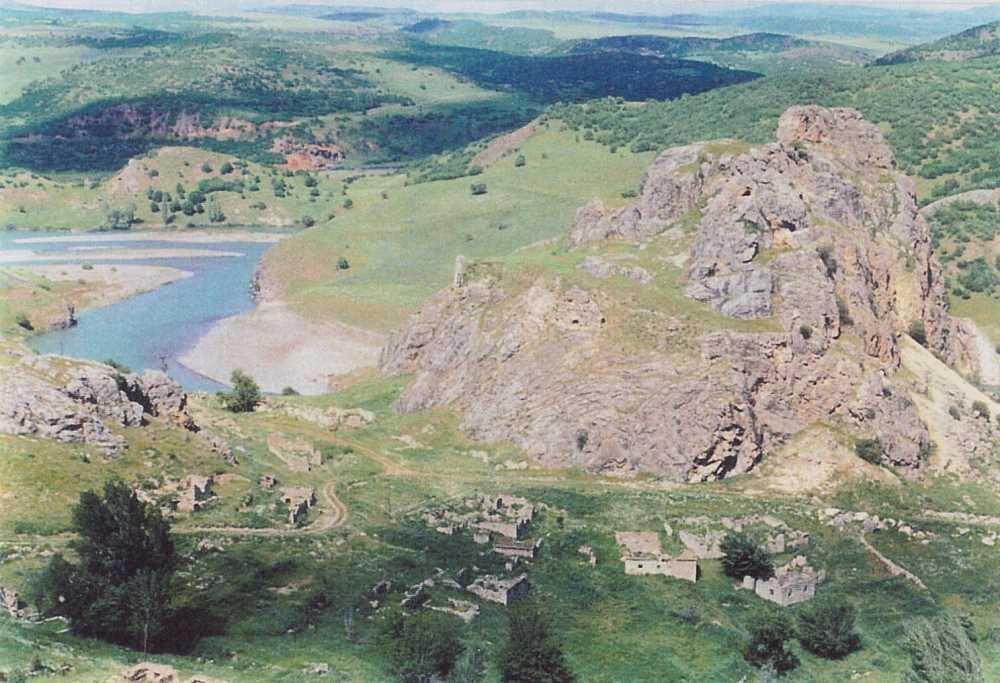
Bağın Kalesi(Kültürportalı)
Castle of Bağ
Location | Dedebağ Village Tunceli Mazgirt | ||||||||
|---|---|---|---|---|---|---|---|---|---|
Elevation(s) | Approximately 1 400 Meters | ||||||||
Historical Process | Urartu → Med → Pers → Roman → Byzantine → Islamic → Seljuk | ||||||||
Architectural Condition | wall remains and stone walls palace ruins observation tower niches and cisterns inscriptions rock tombs Rock-carved tunnel and 40-step passage | ||||||||
Usage Condition | Open to Visitors | ||||||||
Protection | Cultural Heritage Status | ||||||||
Bagın Castle is located near the village of Dedebağ (Bagın), in the Mazgirt district of Tunceli province, along the banks of the Peri River. The castle was constructed atop a steep and rugged rock formation, providing it with a natural defensive advantage. The valley system stretching along the Peri Valley, which connects the extensions of the Munzur Mountains with the Kert Mountains, has served throughout history as both a transit route and a defensive line.
Bagın Castle is believed to have been first constructed during the Urartian civilization in the 9th century BCE. Observations in the region reveal similarities between the castle and Urartian stonework and settlement planning. Furthermore, the rock tombs, inscriptions, and structural elements found around the castle parallel those of other Eastern Anatolian fortresses dated to the Urartian period.
After the Urartians, the castle was used by numerous civilizations including the Medes, Persians, Macedonians and Romans. During the Late Antiquity and Early Middle Ages, it came under the control of Byzantine and Islamic states, serving as an observation and garrison post. During the Seljuk period, the region was integrated into a new administrative system alongside the emerging Turkish settlements in Eastern Anatolia.

Bagın Castle. (Culture Portal)
The castle sits on a natural plateau accessible only through a narrow entrance with a single passage. To reach this entrance, one must pass through a tunnel carved into the rock, followed by a staircase of approximately 40 steps leading up to the fortress. This architectural arrangement was designed to enhance strategic defense and restrict access.
Remains at the summit are thought to belong to an observation tower, possibly a pavilion, a windmill foundation, and various small structural ruins. Additionally, the castle contains numerous carved features including cisterns, inscriptions, rock tombs, niches and rock-cut staircases. These elements indicate that the castle was not only a military installation but also served functions related to habitation, worship and water storage.
Due to its location, Bagın Castle was not merely a military defense point but also functioned as an administrative center, a trade route observation post and a ceremonial site. The Peri Valley lies along a historical route connecting the regions of Erzincan, Elazığ and Bingöl. As such, Bagın Castle played a vital role in securing nearby small settlements and controlling key trade routes.
Moreover, the rock tombs and inscriptions identified around the castle suggest that burial rituals were conducted here for local elites or members of the military aristocracy.
Although Bagın Castle is partially ruined today, a significant portion of its original structure remains intact. Sections of the rampart walls still stand; the tunnel, rock-cut staircase and observation areas are clearly identifiable.
In statements issued by the Tunceli Provincial Directorate of Culture and Tourism, it has been emphasized that due to the castle’s multi-layered settlement history, it must be evaluated as part of the cultural heritage.
Eren, Sidar Can. Anadolu Ajansı. “Tunceli’deki Bağın Kalesi, Urartulardan Kaldığı Değerlendirilen İzler Taşıyor.” Accessed July 15, 2025. https://www.aa.com.tr/tr/kultur/tuncelideki-bagin-kalesi-urartulardan-kaldigi-degerlendirilen-izler-tasiyor/2772227
Ministry of National Education of the Republic of Türkiye. “Mazgirt’in Tarihi.” Accessed July 15, 2025. https://mazgirt.meb.gov.tr/www/mazgirtin-tarihi/icerik/5
T.C. Ministry of Culture and Tourism. "Bağın Kalesi." Kültür Portalı. Accessed July 15, 2025. https://www.kulturportali.gov.tr/turkiye/tunceli/gezilecekyer/bagin-kalesi
T.C.Mazgirt Kaymakamlığı Governorship. "Mazgirt." Accessed July 15, 2025. http://www.mazgirt.gov.tr/mazgirt-1

Bağın Kalesi(Kültürportalı)
Castle of Bağ
Location | Dedebağ Village Tunceli Mazgirt | ||||||||
|---|---|---|---|---|---|---|---|---|---|
Elevation(s) | Approximately 1 400 Meters | ||||||||
Historical Process | Urartu → Med → Pers → Roman → Byzantine → Islamic → Seljuk | ||||||||
Architectural Condition | wall remains and stone walls palace ruins observation tower niches and cisterns inscriptions rock tombs Rock-carved tunnel and 40-step passage | ||||||||
Usage Condition | Open to Visitors | ||||||||
Protection | Cultural Heritage Status | ||||||||
Dating and Archaeological Significance
Architectural Structure and Layout Features
Socio-Cultural Function and Regional Role
Current Condition and Conservation Efforts