


This article was automatically translated from the original Turkish version.
+2 More
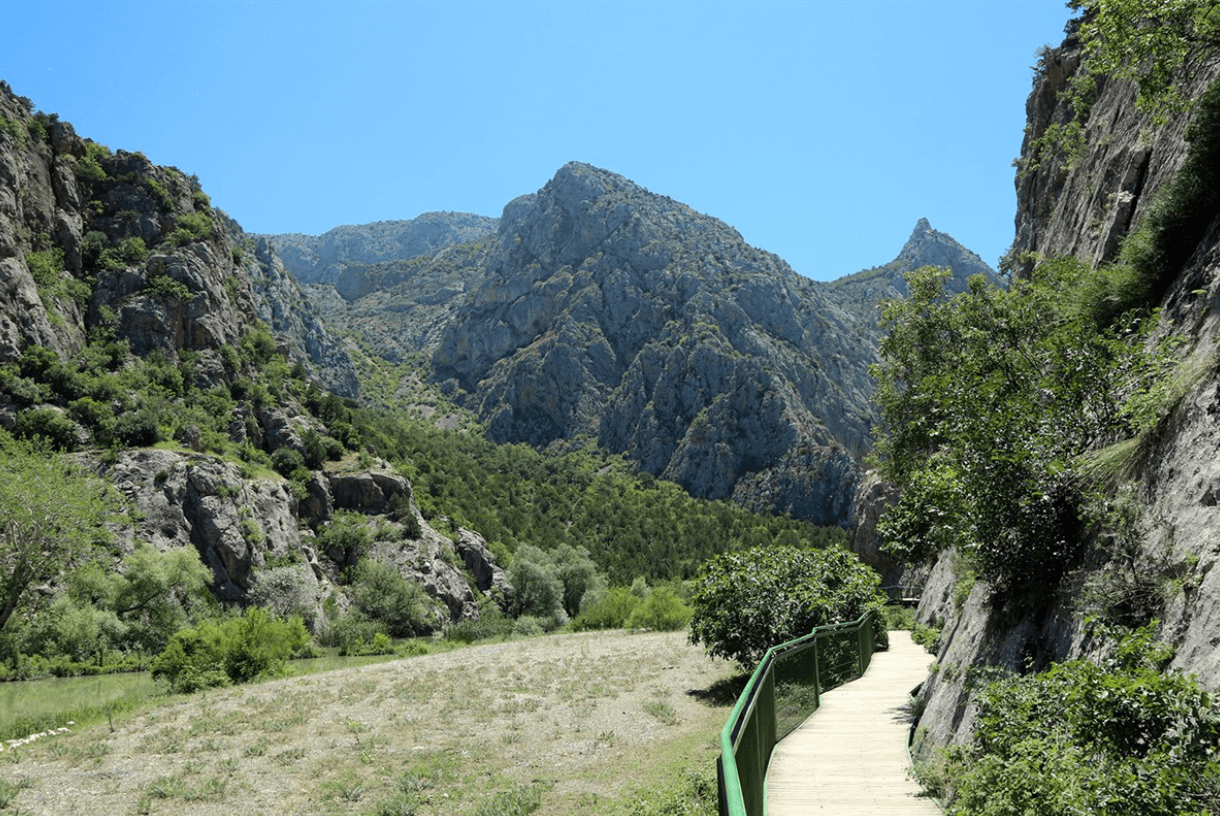
Kazankaya Canyon
Type(s) | Kanyon | ||||||||
|---|---|---|---|---|---|---|---|---|---|
Type of Tourism | Nature Tourism | ||||||||
Length(s) | 12 km | ||||||||
Vegetation Cover | Juniper Oak | ||||||||
Address | Kazankaya Village Türkiye Yozgat Aydıncık | ||||||||
Kazankaya Canyon is a canyon located within the boundaries of Kazankaya Village in the Aydıncık district of Yozgat Province, Türkiye, notable for its natural features and historical heritage. The canyon begins at Kazankaya Village and extends to the İncesu area of the Ortaköy district in Çorum Province, spanning approximately 12 kilometers. The Çekerek River, known in antiquity as Skylaks and a tributary of the Yeşilırmak, flows through the center of the canyon. The canyon’s geographical structure is characterized by high cliffs rising on both sides like a wall, with the Alan Mountains at 1363 meters elevation to the south and Malbelen Hill to the west.

Kazankaya Canyon (Türkiye Culture Portal)
Kazankaya Canyon is more than a natural wonder; it holds strategic importance due to its location between major ancient cities such as Alacahöyük, Boğazköy, Şapinuva, Zela (Zile), Maşat Höyük, Tavium, and Pteria (Kerkenes). The canyon’s structure features sections that narrow and widen alternately. At its narrowest point near Kazankaya, a defensive wall has been constructed to block the valley.
After passing through the wall, remains of various structures, terraces, and stepped open-air rock altars can be seen on the cliffs on both sides of the canyon. Among these remains, the most striking is a relief of the goddess Cybele, approximately 3.45 by 1.50 meters in size, carved within a niche and depicted seated on a throne wearing a chiton. This relief is considered one of the largest Hellenistic-era Cybele depictions in Anatolia and is dated to the 2nd century BCE. The Cybele relief and the stepped rock altars indicate that the canyon was used for religious purposes in antiquity, while the defensive wall attests to its military function.

Kazankaya Canyon (Türkiye Culture Portal)
To the southeast of Kazankaya Village lies Sarıbaba Hill, characterized by a rocky base and steep cliffs descending toward the river from the southwest. Archaeological evidence from the Hittite period has been identified on this hill. South of Sarıbaba Hill, separated by a deep valley, is another hill known as Rıdvan Kaya Tepe, Rıfat Tepe, or Gök Tepe, which descends steeply and vertically toward the river. Archaeological materials dated to the Chalcolithic period have been found in this area. Both hills command a dominant position over the Çekerek River, the Mümbet Plain, and the entrance to the pass, providing strong evidence of continuous settlement from early periods onward.
"Kazankaya Kanyonu." Kültür Portalı. Accessed June 7, 2025. https://www.kulturportali.gov.tr/turkiye/yozgat/gezilecekyer/kazankaya-kanyonu-kazankaya-vadisi.
"Mutlaka Görülmesi Gereken Bir Güzellik 'Kazankaya Kanyonu'." Yozgat Valiliği, July 2, 2017. Accessed June 7, 2025. http://www.yozgat.gov.tr/mutlaka-gorulmesi-gereken-bir-guzellik-kazankaya-kanyonu.
Sancaktar, Hacer, and Kudret Sezgin. "Kazankaya Kanyonu." Türkiye Turizm Ansiklopedisi, 2020. Accessed June 7, 2025. https://turkiyeturizmansiklopedisi.com/kazankaya-kanyonu.

Kazankaya Canyon
Type(s) | Kanyon | ||||||||
|---|---|---|---|---|---|---|---|---|---|
Type of Tourism | Nature Tourism | ||||||||
Length(s) | 12 km | ||||||||
Vegetation Cover | Juniper Oak | ||||||||
Address | Kazankaya Village Türkiye Yozgat Aydıncık | ||||||||
Historical and Archaeological Significance
Archaeological Sites in the Surrounding Area