This article was automatically translated from the original Turkish version.
Chechen Wars
Geography | Chechnya (within the Russian Federation) | ||||||||
|---|---|---|---|---|---|---|---|---|---|
War Periods | First Chechen War: 1994–1996, Second Chechen War: 1999–2009 | ||||||||
Basic Causes | Demand for independence (Chechens), Preservation of federal integrity (Russia), Energy routes and geopolitical importance | ||||||||
First Chechen War (1994–1996) | Leader: Dzhokhar Dudayev, Targeting of the capital Grozny, Hassavyurt Agreement (1996), Achievement of de facto independence | ||||||||
Second Chechen War (1999–2009) | Justification: Dagestan invasion and Moscow apartment bombings, Leader: Vladimir Putin, Representative of the Chechens: Ramzan Kadyrov, Outcome: Reintegration of Chechnya into Russia | ||||||||
Chechen Wars are a series of armed conflicts that took place in two main phases between 1994–1996 and 1999–2009 between the Russian Federation and Chechens seeking independence from Russia. These wars emerged within the context of Chechnya’s demand for independence from Russia and Russia’s efforts to preserve its political, military and economic integrity.
These conflicts, also known as the First and Second Chechen Wars, hold significance through their military, ethnic, religious, geopolitical and counter-terrorism dimensions.
The historical background of Chechen-Russian relations is rooted in a struggle spanning approximately two and a half centuries. This process began with the Russian Empire’s efforts to bring the North Caucasus under control from the 18th century onward and intensified after the collapse of the Soviet Union with Chechen demands for independence. Within this context, historical developments can be examined in three main periods:
1 – Russian Empire Period
2 – Soviet Union Period
3 – Post-Soviet Period and Chechen Independence Effort (1991–1994)
The Chechen territories in the North Caucasus were viewed by the Russian Empire as a geopolitically strategic region, and from the 18th century onward, military campaigns to assert dominance over the area accelerated. Resistance movements led by Sheikh Mansur (1785–1794) and later Sheikh Shamil (1834–1859) became emblematic figures of this era. These resistance movements were shaped around the ideology of Muridism, which occupies a central place in Chechen identity, and constituted a collective struggle against imperial authority with both religious and political dimensions.
To suppress resistance in the region, the Russians implemented policies of forced migration, inciting divisions among local populations and exploiting religious differences. The events of this period became deeply embedded in the collective memory of the Chechen people in the years that followed.
Although the Soviet regime established after the October Revolution of 1917 initially promised autonomy to the Chechens, it gradually adopted centralizing and repressive policies. Under Stalin’s leadership in the 1930s, increasing repression culminated in the mass deportation of 1944, known as the Likvidatsiya. Approximately 400,000 Chechens were forcibly relocated to Central Asia, and tens of thousands died during transit and in the aftermath.
The deportation was presented by Soviet authorities as a measure of ethnic cleansing; the Chechens, however, perceived it as an existential threat. Although Nikita Khrushchev’s de-Stalinization policies in 1957 allowed Chechens to return to their homeland, the losses and trauma suffered during this period fostered a lasting sense of identity-based resistance.
Following the collapse of the Soviet Union in 1991, while many former Soviet republics declared independence, the Chechens under General Dzhokhar Dudayev took a similar step and proclaimed the independence of the Chechen-Ingush Republic. However, Russia refused to recognize this independence. The strategic location of Chechnya, its energy resources and its position along the Baku-Novorossiysk oil pipeline rendered the region indispensable to Russia.
Although efforts were made during Dudayev’s rule to establish a constitutional state structure, serious internal problems emerged. Weak state authority, economic collapse, uncontrolled armed groups and the spread of externally supported radical Islamist currents created conditions that justified Russian military intervention in Chechnya.
The Chechen-Ingush Republic, which declared independence in 1991 under General Dzhokhar Dudayev following the collapse of the Soviet Union, was not recognized by Russia. Under Dudayev’s administration, a new constitution was proclaimed with Grozny as its center, and efforts were made to establish an independent state through a separate currency and foreign policy initiatives. However, this process failed due to both internal administrative instability and increasing Russian pressure.
In 1994, the Russian Federation under Boris Yeltsin launched a comprehensive military operation against Chechnya. Russia’s official justification was to restore constitutional order and suppress separatist rebellion. However, underlying the operation were Chechnya’s geopolitical importance, the security of energy pipelines and the risk that separatist movements might spread to other republics.
In the initial phase of the war, the Russian army attacked Grozny with ground and air operations, but Russian forces, lacking experience in urban warfare, suffered heavy casualties. Chechen militias proved effective in defending both mountainous terrain and urban centers like Grozny. Both sides were accused of serious human rights violations during the conflict. International public opinion, particularly critical of the Russian military’s bombardments of civilians, led to declining domestic support within Russia. As a result, prior to the Second Chechen War, a series of agreements were signed in Grozny on 30 July 1995 between Russia and Chechnya as part of a move toward peace.
The Khasavyurt Accord, signed between the parties in 1996, brought the First Chechen War to an end. The accord deferred the determination of Chechnya’s status to a later date. Although this effectively amounted to de facto independence, Chechnya’s state structure after the war exhibited serious weaknesses. Corruption, the threat of internal conflict, the growing power of armed groups and the rise of radical currents created an unstable quasi-state structure.
In 1999, Chechen militants launched an attack on Dagestan, followed by bombings in multi-story apartment buildings in Moscow, which were attributed to Chechen groups. These developments provided the pretext for Russia to launch a new military intervention. These events played a significant role in the rise of Vladimir Putin, who had recently been appointed prime minister; the war gained public support in Russia as aligned with his “strong state” rhetoric.
The Second Chechen War was conducted not as a campaign against separatism, as the first had been, but explicitly under the framework of “counter-terrorism.” This shift coincided with the global transformation in security dynamics following the September 11, 2001 attacks. The rise of Wahhabi and jihadist currents in Chechnya helped legitimize Russia’s narrative on the international stage. During this war, the Russian military subjected Grozny to bombardments so intense that the city was almost entirely destroyed. In 2003, Grozny was listed in the Guinness Book of World Records as “the most destroyed city on Earth.”
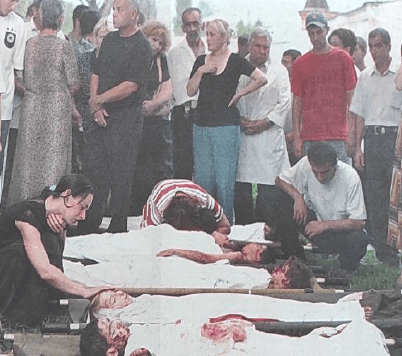
The war was not confined to the front lines but extended into civilian areas. Chechen groups increasingly employed tactics such as tunnel warfare, hostage-taking and suicide attacks, resulting in a conflict structure that directly targeted civilians. The 2002 Moscow theater hostage crisis and the 2004 Beslan school siege vividly exposed the devastating impact of the war on civilians.
The Putin administration pursued a strategy known as “Chechenization,” aiming to govern the region not through direct military control but via local leaders. In this context, former mufti Akhmad Kadyrov was brought to power with Moscow’s support. After his assassination in 2004, his son Ramzan Kadyrov succeeded him, establishing a harsh regime characterized by loyalty to the Kremlin. The Ramzan Kadyrov era is remembered for human rights abuses, authoritarianism, political assassinations and repressive security apparatuses.
In 2009, Russia officially declared the end of its “counter-terrorism” operations in Chechnya. However, stability in the region rests on Ramzan Kadyrov’s personal power, his dependence on the Kremlin and his authoritarian methods.
Video About Ramazan Kadirov (GZT)
The Chechen Wars produced significant regional and global consequences. As a result of the wars, Chechnya was physically devastated, tens of thousands of civilians lost their lives and hundreds of thousands were displaced.
The de facto independence achieved after the First Chechen War was replaced during the Second War by a Moscow-aligned but authoritarian “Chechenization Regime.” The wars demonstrated Russia’s determination to preserve its federal integrity to the international community and served as a “power test” that strengthened Putin’s hold on power. At the same time, the excessive harshness of policies pursued during the wars—including human rights violations, arbitrary detentions, enforced disappearances and attacks on civilians—undermined the international legitimacy of both Russia and the Chechen resistance movements.
From Türkiye’s perspective, public sympathy toward the Chechen resistance during the 1990s was particularly notable. Turkish public opinion closely followed the Chechen struggle due to historical and cultural ties, and Turkish media extensively covered the events, especially during the first war. In this context, nationalist, conservative and Islamist newspapers supported Chechen demands for independence, while more secular or centrist media framed the conflict within a human rights perspective. Content analyses indicate that Turkish media portrayed the First Chechen War in a more idealistic light, while coverage of the Second War became more cautious due to rising radicalism and terrorist incidents. This shift in Turkish public opinion is directly linked to the transformation of the Chechen movement from a nationalist cause to one dominated by radical Islamist rhetoric.
Aktaş, Hayati, and Keisuke Wakizaka. “Çeçenistan’da Yeni Dönem ve Kadirov Yönetimi.” Karadeniz Araştırmaları 16, no. 62 (2019): 231–238. https://dergipark.org.tr/tr/pub/karadearas/issue/68525/1072896
Anadolu Ajansı. "Çeçenistan’da bağımsızlık mücadelesinin sembolü Cahar Dudayev'in ölümünün üzerinden 26 yıl geçti." Accessed July 29, 2025. https://www.aa.com.tr/tr/dunya/cecenistan-da-bagimsizlik-mucadelesinin-sembolu-cahar-dudayevin-olumunun-uzerinden-26-yil-gecti/2570120
Budak, Muhammet Cihad and İsmail Ermağan. “Tarihten Günümüze Çeçenistan-Rusya İlişkileri: Putin ve Kadirovlar Dönemi.” *Türk Dünyası Araştırmaları* 119, no. 235 (July–August 2018): 185–204. https://dergipark.org.tr/en/download/article-file/1483100
Demir, Etkin. *Çeçen Sorununun Terörizme Evrilme Süreci ve Rusya Federasyonu’nun Çeçen Politikası*. Master's thesis, Aydın Adnan Menderes Üniversitesi, 2022. https://tez.yok.gov.tr/UlusalTezMerkezi/TezGoster?key=kIrIdtdJ31bRgjb6fHvMUczWuK0j-b-2O__-HfgNlvndRIdqnpogkc4grB1YNeh-
GZT Youtube Kanalı. "Çeçenistan Cumhurbaşkanı Ramazan Kadirov kimdir?" Accessed July 29, 2025. https://www.youtube.com/watch?v=TLRD0vjasio
Güney, Beyza Gülin. *Rus-Çeçen İlişkileri Bağlamında Çatışma ve İşbirliği Dinamikleri*. Master's thesis, İstanbul Üniversitesi, 2017. https://tez.yok.gov.tr/UlusalTezMerkezi/TezGoster?key=q3-d9QtLoVA2OMExHSkJpbNqWNvugXmG-YVBlFXGaEgwzS2bduOEVVPyArmYrnds
Soğancıoğlu, Şeyma. *Çeçen-Rus Savaşları ve Türk Basınına Yansımaları*. Master's thesis, Karabük Üniversitesi, 2023. https://acikerisim.karabuk.edu.tr/items/68341e26-e157-4738-b174-146ccf675594

Chechen Wars
Geography | Chechnya (within the Russian Federation) | ||||||||
|---|---|---|---|---|---|---|---|---|---|
War Periods | First Chechen War: 1994–1996, Second Chechen War: 1999–2009 | ||||||||
Basic Causes | Demand for independence (Chechens), Preservation of federal integrity (Russia), Energy routes and geopolitical importance | ||||||||
First Chechen War (1994–1996) | Leader: Dzhokhar Dudayev, Targeting of the capital Grozny, Hassavyurt Agreement (1996), Achievement of de facto independence | ||||||||
Second Chechen War (1999–2009) | Justification: Dagestan invasion and Moscow apartment bombings, Leader: Vladimir Putin, Representative of the Chechens: Ramzan Kadyrov, Outcome: Reintegration of Chechnya into Russia | ||||||||
Historical Background
Russian Empire Period (18th century – 1917)
Soviet Union Period (1917–1991)
Post-Soviet Period and Chechen Independence Effort (1991–1994)
First Chechen War (1994–1996)
Second Chechen War (1999–2009)
Consequences of the Wars
Türkiye’s Approach