


This article was automatically translated from the original Turkish version.
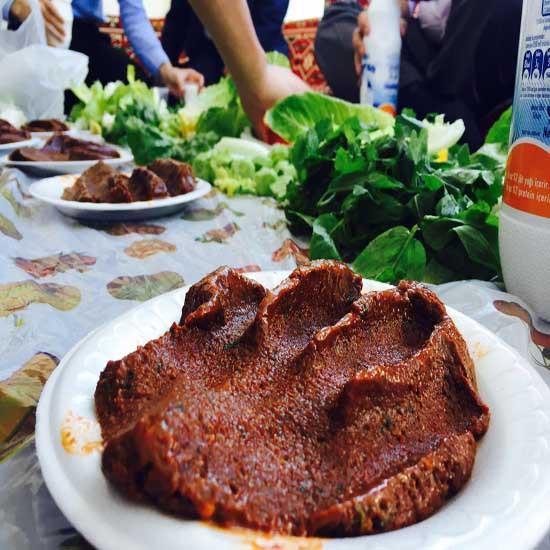
Çiğ Köfte
Food Type | Traditional Dish | ||||||||
|---|---|---|---|---|---|---|---|---|---|
Origin(s) | Şanlıurfa Türkiye | ||||||||
Registration Type | Mahreç Sign | ||||||||
Registration Number | 109 | ||||||||
Registration Date | 2008-06-30 | ||||||||
Basic Ingredients | baharatlar isot köftelik bulgur Kara et | ||||||||
Çiğ köfte is a traditional dish native to the Southeastern Anatolian cuisine of Türkiye, prepared by kneading bulgur, isot, meat, and various spices in specific proportions. Particularly in Şanlıurfa, its meat-based version is distinguished by its historical origins, unique production method, and cultural significance. At the initiative of the Şanlıurfa Chamber of Commerce and Industry, “Şanlıurfa Çiğ Köftesi” was officially registered as a geographical indication in 2008. The registered version must be prepared exclusively using materials meeting specified criteria, following regional traditional methods, and adhering to defined texture standards.

Çiğ Köfte (generated by artificial intelligence)
According to folk narratives, the origins of çiğ köfte trace back to the time of Prophet Ibrahim. It is said that during a period when fire was forbidden, the need arose to consume raw meat safely by mixing it with ingredients such as bulgur and isot; this necessity evolved over time into a culinary tradition. In this sense, çiğ köfte is not merely a food product but also a cultural memory. Traditionally prepared fresh and consumed immediately in domestic settings in Şanlıurfa, çiğ köfte today is widely produced commercially; however, the geographically protected version includes only those prepared using traditional methods.
The ingredients used in çiğ köfte production are precisely defined in the geographical indication certificate with specified ratios and technical characteristics. The authenticity of the product depends on the adherence of these ingredients to the required standards. For a batch serving six people, the basic ingredients are as follows:

Çiğ Köfte Ingredients (generated by artificial intelligence)
The preparation of çiğ köfte is based on a step-by-step, controlled kneading process. The registered production method includes the following steps:
Isot is moistened with cold water before kneading and preferably stored in the refrigerator. The meat is pounded on a stone or with a special tool to remove sinews and achieve a paste-like consistency. Onion and garlic are finely chopped and set aside. Tomato paste will be added during the kneading process according to the mixture’s progress.
Initial Mixture: Isot, chopped dried onion, garlic, salt, and spices are added to a tin-lined copper kneading trough and mixed. Then, the ground meat is added and kneaded with approximately half a teacup of cold water.
The texture of çiğ köfte is assessed by pressing it by hand: it should stick slightly to the trough but not be so cohesive that it lifts the trough when lifted. The kneaded mixture is portioned into clumps or rolls for serving.
The registered Şanlıurfa çiğ köfte is prepared only fresh and intended for immediate consumption. It is not suitable for prolonged storage. Çiğ köfte is served with the following accompaniments:
Herbs: Lettuce, mint, mustard greens, sorrel, purslane, cabbage, watercress, dandelion, saltwort, bendik, tomato, cucumber, radish.
Beverage: Traditionally, ayran is preferred.
Note: In Şanlıurfa style, lemon is not used and is never squeezed over the dish.
Çiğ köfte may be served in clumps or as rounded portions on plates. This form reflects its texture and kneading quality. Local belief holds that çiğ köfte prepared by individuals whose hands sweat excessively is considered undesirable.
Compliance of çiğ köfte with geographical indication standards is monitored by a six-member commission established by the Şanlıurfa Chamber of Commerce and Industry and the Şanlıurfa Social Services Association. Inspections are conducted at least once annually and may be carried out at any time upon complaint. Inspection reports are submitted to the Turkish Patent Institute.
Ministry of Culture and Tourism of the Republic of Türkiye. “Çiğköfte.” *Kültür Portalı*. Accessed June 3, 2025. https://www.kulturportali.gov.tr/turkiye/sanliurfa/neyenir/cgkofte
Turk Patent and Trademark Office. *Şanlıurfa Çiğköftesi Coğrafi İşaret Tescil Belgesi*. Ankara: Turk Patent and Trademark Office, 2008. Accessed June 3, 2025. https://ci.turkpatent.gov.tr/Files/GeographicalSigns/109.pdf
Şanlıurfa Büyükşehir Municipality. "Çiğköfte." Şanlıurfa Metropolitan Municipality. Accessed June 3, 2025. https://www.sanliurfa.bel.tr/icerik/133/64/cigkofte
Çiğ Köfte
Food Type | Traditional Dish | ||||||||
|---|---|---|---|---|---|---|---|---|---|
Origin(s) | Şanlıurfa Türkiye | ||||||||
Registration Type | Mahreç Sign | ||||||||
Registration Number | 109 | ||||||||
Registration Date | 2008-06-30 | ||||||||
Basic Ingredients | baharatlar isot köftelik bulgur Kara et | ||||||||
No Discussion Added Yet
Start discussion for "Çiğ Köfte (Şanlıurfa)" article
History and Cultural Context
Ingredients
Production Process
Preparation Stage
Kneading Process
Consumption and Presentation
Geographical Indication and Oversight
Registration Details
Oversight Mechanism