


This article was automatically translated from the original Turkish version.
+3 More
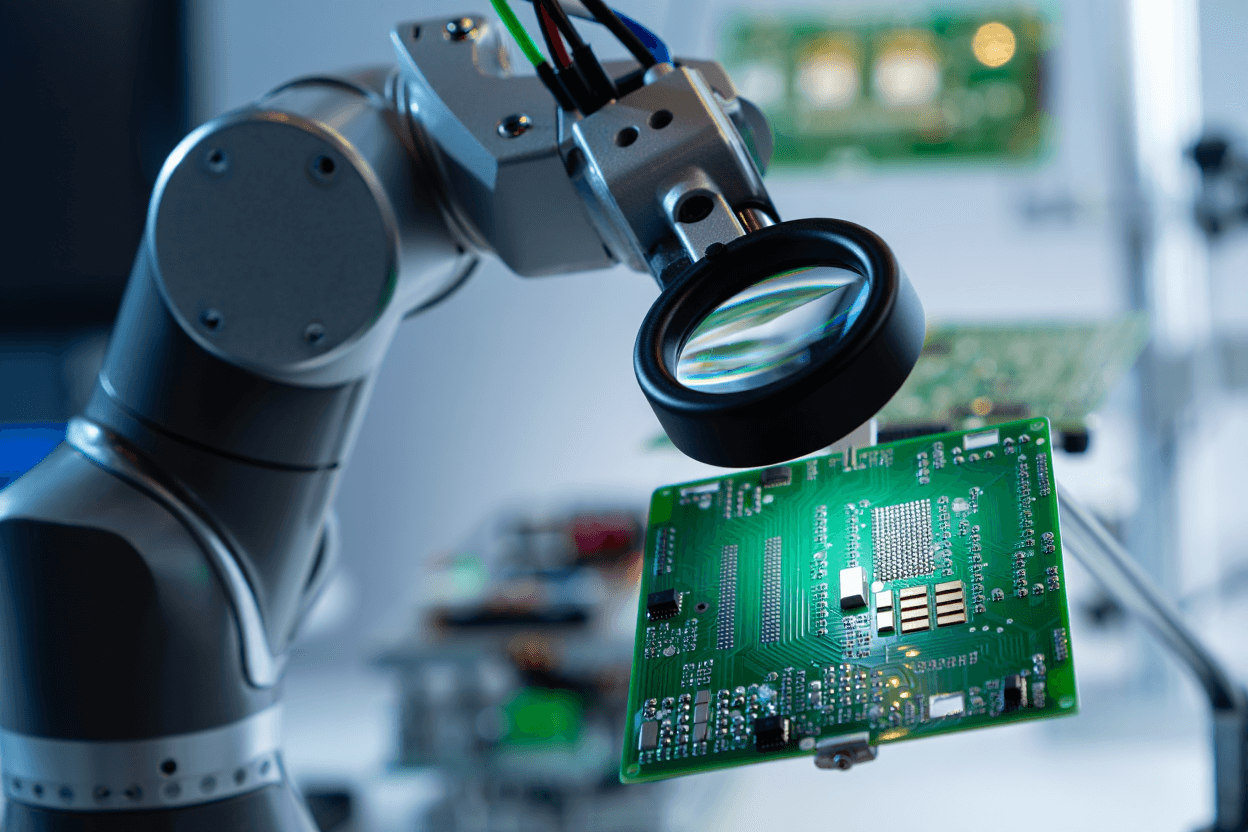
Fault Diagnosis with Artificial Intelligence (Generated with Artificial Intelligence)
Basic Technology | Machine Learning, Deep Learning, Big Data Analytics | ||||||||
|---|---|---|---|---|---|---|---|---|---|
Purpose(s) | Predicting and Preventing Failures Before They Occur Diagnosing | ||||||||
Application Area(s) | Electrical grids Automotive Electronic components Industrial motors | ||||||||
Data Sources | Sensor data (temperature, vibration), X-ray images, Operational data | ||||||||
Key Benefit | Increased operational efficiency, Cost reduction, Reduced downtime | ||||||||
Artificial intelligence-based fault diagnosis is the process of automatically detecting, identifying, and predicting faults in electrical and electronic systems using artificial intelligence (AI) technologies such as machine learning, deep learning, and big data analytics. This approach analyzes large datasets—including sensor data, operational parameters, or images collected from systems—to identify deviations and anomalies from normal operating conditions. Unlike traditional methods, AI-based systems can predict faults not only after they occur but also during their early stages or even before they develop, enabling the implementation of proactive maintenance strategies. As a result, operational efficiency increases, unexpected downtime is reduced, and maintenance costs are lowered.
AI-assisted fault diagnosis is a complex system that operates through the integration of various technological components. Its foundation is formed by predictive maintenance strategies focused on anticipating faults before they occur. The process begins with sensors that continuously monitor the real-time condition of equipment. Physical parameters such as temperature, vibration, pressure, and humidity, or electrical parameters such as current and voltage, are constantly collected. Internet of Things (IoT) technology enables the transmission of data from these sensors to a central platform for real-time monitoring.
During the data interpretation phase, artificial intelligence and machine learning come into play. Algorithms trained on historical fault records and normal operating data analyze patterns in incoming data to detect anomalies that may indicate an impending fault. Various machine learning methods are employed in this field, including Multilayer Perceptrons (MLP), Support Vector Machines (SVM), k-Nearest Neighbors (kNN), Decision Trees (DT), and Random Forest (RF). These models, empowered by big data analytics, process millions of data points to uncover subtle correlations and trends that human observation might miss. Another advanced technology, digital twins, creates a virtual replica of a physical asset, allowing simulation of system behavior under different scenarios. This enables the prediction of fault probabilities and the development of preventive measures in advance.
AI-based fault diagnosis is applied across a wide range of sectors, from energy production to manufacturing, and from electronics to automotive. Each industry adapts this technology to its specific needs to achieve significant gains.
Fault detection in large and complex infrastructures such as electrical grids is critical. For instance, electricity distribution companies use AI units to proactively identify lighting and transformer faults. The developed 'Lighting Fault Detection System' identifies unnecessary lighting during daylight hours, preventing energy losses. The 'Transformer Fault Detection System' anticipates overloads in transformers, preventing both major failures and damage to consumer devices. These systems operate by analyzing big data collected via the Automatic Meter Reading System (AMRS)—for example, daily data of 100 gigabytes from 1.2 million meters. AI automates manual processes, reduces workload, and shortens response times to faults.
An unexpected fault in industrial machines and electric motors—the backbone of production lines—can halt entire operations. Predictive maintenance is used to minimize this risk. AI algorithms continuously monitor motor characteristics such as vibration, temperature, and electrical signals. By analyzing this data, they learn the characteristic variations of motors under different load and speed conditions and automatically classify fault severity or type. As a result, issues such as bearing failure or winding faults are detected at their initial stages, allowing maintenance to be planned proactively. This approach prevents unplanned downtime, extends equipment lifespan, and reduces maintenance costs.
Fault detection at the microelectronic level, especially in high-density packaging, is particularly challenging. Ensuring the quality of solder joints in advanced semiconductor packages such as Ball Grid Array (BGA) is a major challenge in this field. Traditional optical inspection methods are inadequate because solder balls are located beneath the package, while X-ray images are often noisy and low-contrast. AI-based deep learning models provide a solution to this problem. An AI system trained on thousands of labeled X-ray images can detect defects such as insufficient solder, solder ball bridging, cold solder joints, and short circuits with high precision. This delivers accurate results even in noisy images where traditional rule-based systems struggle, thereby improving production quality and product reliability.

Use of Artificial Intelligence in Electronic Circuit Faults (Generated by Artificial Intelligence)
Modern vehicles are complex systems managed by numerous Electronic Control Units (ECUs). Artificial intelligence is used to facilitate fault diagnosis and performance optimization in these vehicles. AI-supported platforms such as MetaECU analyze vehicle ECU data to rapidly and accurately diagnose faults. These systems read and interpret diagnostic trouble codes (DTCs) to identify the root cause of problems and can even automate the clearing of these codes. Additionally, AI supports optimization tasks such as enhancing engine performance or managing emission systems. This accelerates service processes and ensures vehicles operate more efficiently and safely.
The integration of artificial intelligence into fault diagnosis processes offers numerous advantages over traditional methods. These benefits make systems smarter, more efficient, and more reliable.
AI automates repetitive and time-consuming tasks such as regression testing or image inspection. In the case of an electricity distribution company, the 'Switch-On Photo Inspection Project' reduced the number of photos requiring manual review from 40,000 to 4,000. This allows human resources to focus on more strategic tasks and significantly accelerates processes.
AI algorithms are more successful than humans at detecting hidden patterns and subtle anomalies in large datasets. This reduces the likelihood of human error and increases diagnostic accuracy. For example, in BGA solder inspection, AI identifies defects with high precision even in noisy X-ray images, minimizing false positive rates.
The most significant advantage is the shift from reactive (post-failure repair) to proactive (pre-failure prevention) approaches. Predicting when systems are likely to fail eliminates unplanned downtime, ensures production continuity, and prevents the substantial costs associated with large-scale failures.
Predictive maintenance extends equipment lifespan, eliminates unnecessary maintenance activities, and prevents energy losses.
Budak, Serkan, and Bahadır Akbal. "Görüntü işleme ve yapay sinir ağları ile iletim hatlarında arıza yeri belirleme." *Konya Teknik Üniversitesi Mühendislik ve Doğa Bilimleri Dergisi* 8, no. 2 (2020): 293-300. Accessed July 11, 2025. https://dergipark.org.tr/tr/download/article-file/1273105.
Costa Brito, Lucas, et al. “Fault Diagnosis Using eXplainable AI: A Transfer Learning-Based Approach for Rotating Machinery.” *arXiv*, October 6, 2022. Accessed July 11, 2025. https://arxiv.org/abs/2210.02974.
Dicle Elektrik uses artificial intelligence for fault detection. *Enerji Gündemi*, August 12, 2024. Accessed July 11, 2025. https://enerjigundemi.com/dicle-elektrik-ariza-tespiti-icin-yapay-zeka-kullaniyor/.
Liu, Chuang, Lei Kou, Guowei Cai, Zihan Zhao, and Zhe Zhang. "Review for AI-based open-circuit faults diagnosis methods in power electronics converters." *arXiv preprint* arXiv:2209.14058 (2022). Accessed July 11, 2025. https://doi.org/10.48550/arXiv.2209.14058.
Maged, Ahmed, et al. “Explainable Artificial Intelligence Techniques for Accurate Fault Detection and Diagnosis: A Review.” *arXiv*, April 18, 2024. Accessed July 11, 2025. https://arxiv.org/abs/2404.11597.
Zhang, Shen, et al. “Machine Learning and Deep Learning Algorithms for Bearing Fault Diagnostics – A Comprehensive Review.” *arXiv*, January 25, 2019. Accessed July 11, 2025. https://arxiv.org/abs/1901.08247.
Zhou, Jing, et al. “A Research Agenda of AI-Based Analog Circuit Fault Diagnosis with Bibliometric Analysis.” *EWA Direct Proceedings*, 2023. Accessed July 11, 2025. https://www.ewadirect.com/proceedings/ace/article/view/2052.
Çıra, Ferhat. “Elektrik Motorlarının Arıza Tespitinin Otomatik Olarak Yapılmasında Kullanılan Yapay Öğrenme Yöntemleri.” *Dicle Üniversitesi Fen Bilimleri Enstitüsü Dergisi* 6, no. 2 (2017): 95–103. Accessed July 11, 2025. https://www.indexacademicdocs.org/pdf/370/52851/698193.
Çıra, Ferhat. “Elektrik Motorlarının Arıza Tespitinin Otomatik Olarak Yapılmasında Kullanılan Yapay Öğrenme Yöntemleri.” Ulusal Elektrik-Elektronik ve Biyomedikal Mühendisliği Konferansı (ELECO), 2017. Accessed July 11, 2025. https://dergipark.org.tr/en/download/article-file/991923.
Özgür Yayınları. “Asenkron Motorlarda Arıza Tespiti ve Akıllı Sınıflandırma Teknikleri.” Accessed July 11, 2025. https://www.ozguryayinlari.com/site/catalog/download/629/3102/7128.
İksad Yayınevi. *Yapay Zekâ ve Makine Öğrenimi ile Mühendislikte Yenilikçi Yaklaşımlar*. Ankara: İksad Yayıncılık, 2024. Accessed July 11, 2025. https://iksadyayinevi.com/wp-content/uploads/2024/12/YAPAY-ZEKA-VE-MAKINE-OGRENIMI-ILE-MUHENDISLIKTE-YENILIKCI-YAKLASIMLAR.pdf.

Fault Diagnosis with Artificial Intelligence (Generated with Artificial Intelligence)
Basic Technology | Machine Learning, Deep Learning, Big Data Analytics | ||||||||
|---|---|---|---|---|---|---|---|---|---|
Purpose(s) | Predicting and Preventing Failures Before They Occur Diagnosing | ||||||||
Application Area(s) | Electrical grids Automotive Electronic components Industrial motors | ||||||||
Data Sources | Sensor data (temperature, vibration), X-ray images, Operational data | ||||||||
Key Benefit | Increased operational efficiency, Cost reduction, Reduced downtime | ||||||||
No Discussion Added Yet
Start discussion for "Circuit Fault Diagnosis with Artificial Intelligence" article
Core Concepts and Technologies
Application Areas
Electrical Distribution Systems
Industrial Machines and Motors
Electronic Circuits and Components
Automotive Industry
Advantages of AI-Assisted Fault Diagnosis
Speed and Efficiency
Accuracy and Reliability
Predictive Capability
Cost Savings