


This article was automatically translated from the original Turkish version.
+4 More
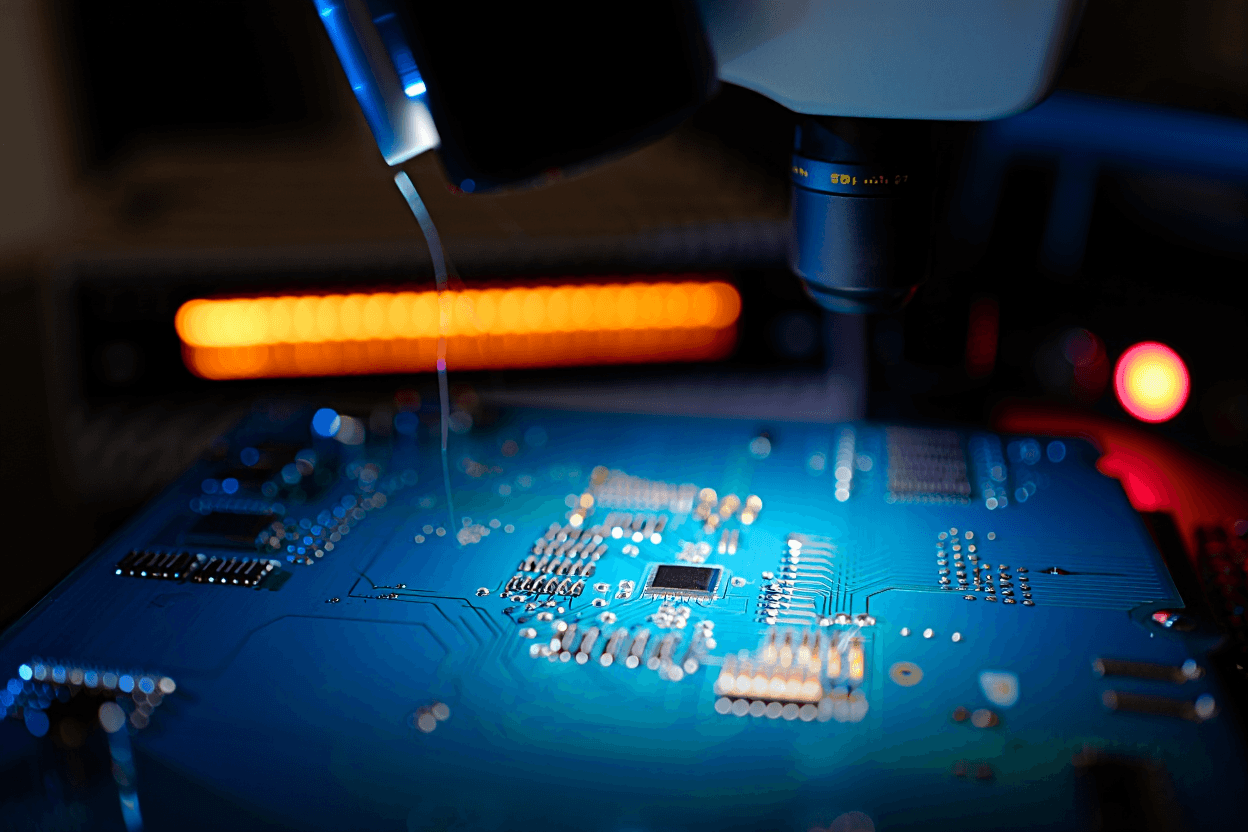
Electronic Fault Analysis (Generated with Artificial Intelligence)
Definition(s) | The systematic process of detecting and diagnosing errors in electronic systems. locating | ||||||||
|---|---|---|---|---|---|---|---|---|---|
Basic Objective | Restoring a faulty device or system to operational condition. | ||||||||
Basic Methods | Signal Tracking, Block Diagram Analysis, Sensory Control, Measurement and Testing. | ||||||||
Main Tools | Multimeter, Oscilloscope, Function Generator, Test Equipment. | ||||||||
Related Field(s) | Electrical and Electronics Engineering Consumer Electronics. Industrial Control Biomedical | ||||||||
Electronic fault analysis is the systematic process of detecting, locating, and diagnosing errors or failures in electronic circuits, devices, and systems. This process aims to restore the system to functional operation by repairing or replacing the faulty unit or component. Fault analysis is an applied discipline that requires not only theoretical knowledge of electronics but also significant experience, observation, and logical reasoning skills. In particular, for systems sourced from abroad where manufacturers do not provide fault-finding diagrams or manuals, a skilled analysis process is critical. Uninformed interventions can cause minor faults to escalate and lead to irreversible damage to the system.
Before beginning the fault analysis process, it is essential to implement safety measures. This is necessary both to ensure the technician’s personal safety and to prevent further damage to the device under test. First, the work environment must be confirmed as safe. The system’s power must be disconnected to prevent electric shock, power sources must be inspected, and grounding connections must be verified as properly installed. Other important safety steps include avoiding inhalation of fumes generated during soldering, using protective equipment when handling chemicals, and exercising caution when working with mechanical parts. Preventing electrostatic discharge (ESD) during device handling and repair is also crucial for protecting sensitive electronic components.
Effective fault analysis requires a systematic approach rather than random trial-and-error methods. The primary goal is to isolate the source of the fault as quickly and accurately as possible. This process typically relies on several fundamental approaches.
This approach aims to narrow down the fault progressively and generally consists of three main stages:

Electronic Circuit Fault Analysis (Generated by Artificial Intelligence)
To reach accurate conclusions during fault analysis, various test instruments and specialized techniques are employed. These tools cover a wide range from simple measurements to complex system diagnostics.
The most fundamental instrument used for measuring voltage (AC/DC), current, and resistance. Short circuits (low resistance) and open circuits (high resistance) are checked using a multimeter, as well as the integrity of semiconductor components such as diodes and transistors.
A powerful analytical tool that visualizes electrical signals as waveforms over time. It provides detailed information about signal amplitude, frequency, period, and shape. It is indispensable for analyzing dynamic signals and timing errors.
Automated systems designed to test entire electronic circuit boards. Using computer software, these systems apply power and signals to the board to simulate its functions and detect faulty components with high accuracy.
Used to test individual components on a board. These are more economical than ATE systems and can be applied to the repair of any type of electronic board.
A method applied without powering the circuit. The impedance (voltage-current) curves at corresponding points on a known good board and a faulty board are compared to identify the defective component.
Specialized instruments or methods are used to detect short circuits in the circuit. This test is particularly useful for identifying short circuits that are difficult to locate in multilayer boards.
The process of testing an electronic board or component under actual operating conditions by applying power within the circuit. This test may require multiple pieces of equipment and is often a costly method.
Circuit design and simulation programs such as Proteus allow virtual testing of a circuit’s behavior under normal operating conditions. Simulation results can be compared with actual measurements taken on the real circuit to identify deviations and potential faults.
To perform fault analysis, it is necessary to understand the operating principles and typical failure modes of circuit components. Each component has its own characteristic failure patterns.
When these components are found to be faulty, it is critical that the replacement component has identical or compatible specifications—such as value, tolerance, power rating, and package structure—to the original. At this stage, semiconductor catalogs and datasheets become essential references.

Electronic Circuit Component Failure (Generated by Artificial Intelligence)
The general principles of fault analysis are applied with circuit-specific approaches to different types of electronic circuits.
As they form the foundation of electronic devices, faults in power supplies are frequently investigated. Failures in linear or switching (SMPS) power supplies commonly occur in rectifier diodes, filter capacitors, regulator ICs, or switching elements (transistors/MOSFETs). Overvoltage and overcurrent protection circuits must also be checked.
When troubleshooting amplifiers, the first step is to check the DC biasing voltages of the transistors or op-amps. Anomalies in these voltages often provide critical clues about the fault’s source. If the biasing voltages are correct, a test signal is applied to the circuit to examine gain and waveform shape.
Fault analysis in such complex systems is typically performed using a modular approach. Subunits such as sensors, switching elements, and processor boards are evaluated individually. In computer systems, both software and hardware faults—including driver issues, hard drive errors, and network connectivity problems—are examined together.
Ahmed, Maged, Salah Haridy, and Herman Shen. "Explainable Artificial Intelligence Techniques for Accurate Fault Detection and Diagnosis: A Review." *arXiv preprint* arXiv:2404.11597 (2024). Accessed July 11, 2025. https://doi.org/10.48550/arXiv.2404.11597.
Arıkan, Şerafettin. *Elektronik Devrelerde Hata/Arıza Arama (Arıza Analizi)*. Seçkin Yayıncılık, 2018. Accessed July 11, 2025. https://www.seckin.com.tr/kitap/elektronik-devrelerde-hata-ariza-arama-ariza-analizi-serafettin-arikan-s-p-428867891.
Arıkan, Şerafettin. *Elektronik Devrelerde Hata/Arıza Arama (Arıza Analizi)*. Seçkin Yayıncılık, 2018. Turcademy. Accessed July 11, 2025. https://www.turcademy.com/en/kitap/elektronik-devrelerde-hata-ariza-arama-ariza-analizi-9789750249815.
Habyarimana, Mathew, and Abayomi A. Adebiyi. "A Review of Artificial Intelligence Applications in Predicting Faults in Electrical Machines." *Energies* 18, no. 7 (2025): 1616. Accessed July 11, 2025. https://doi.org/10.3390/en18071616.
Kang, Tae Yeob, Haebom Lee, and Sungho Suh. "Non-Destructive Fault Diagnosis of Electronic Interconnects by Learning Signal Patterns of Reflection Coefficient in the Frequency Domain." *arXiv preprint* arXiv:2304.10207 (2023). Accessed July 11, 2025. https://doi.org/10.48550/arXiv.2304.10207.
Lirov, Y. "Electronic Circuit Diagnostic Expert Systems—A Survey." *Computers & Mathematics with Applications* 18, no. 4 (1989): 381–398. Accessed July 11, 2025. https://doi.org/10.1016/0898-1221(89)90223-X.
Liu, Chuang, Lei Kou, Guowei Cai, Zihan Zhao, and Zhe Zhang. "Review for AI-Based Open-Circuit Faults Diagnosis Methods in Power Electronics Converters." *arXiv preprint* arXiv:2209.14058 (2022). Accessed July 11, 2025. https://doi.org/10.48550/arXiv.2209.14058.
Moradzadeh, Arash, Behnam Mohammadi-Ivatloo, Kazem Pourhossein, and Amjad Anvari Moghaddam. "Data Mining Applications to Fault Diagnosis in Power Electronic Systems: A Systematic Review." *IEEE Transactions on Power Electronics* (2022). Accessed July 11, 2025. https://doi.org/10.1109/TPEL.2021.3131293.
Nasim, Syeda Faiza, Sidra Aziz, Asma Qaiser, and Umm E Kulsoom. "Fault Detection and Fault Diagnosis in Power System Using AI: A Review." *Sir Syed University Research Journal of Engineering & Technology* 14, no. 1 (2024): 27–32. Accessed July 11, 2025. https://doi.org/10.33317/ssurj.598.

Electronic Fault Analysis (Generated with Artificial Intelligence)
Definition(s) | The systematic process of detecting and diagnosing errors in electronic systems. locating | ||||||||
|---|---|---|---|---|---|---|---|---|---|
Basic Objective | Restoring a faulty device or system to operational condition. | ||||||||
Basic Methods | Signal Tracking, Block Diagram Analysis, Sensory Control, Measurement and Testing. | ||||||||
Main Tools | Multimeter, Oscilloscope, Function Generator, Test Equipment. | ||||||||
Related Field(s) | Electrical and Electronics Engineering Consumer Electronics. Industrial Control Biomedical | ||||||||
No Discussion Added Yet
Start discussion for "Electronic Fault Analysis" article
Safety Precautions
Systematic Fault Finding Approaches
Step-by-Step Process
Other Systematic Methods
Fault Detection Methods and Instruments
Basic Measurement Instruments
Multimeter
Oscilloscope
Advanced Test Instruments and Techniques
ATE (Automated Test Equipment) Systems
Electronic Component Testers
Impedance Testing (V-I Test)
Short Circuit Testing
Functional Testing
Simulation Software
Circuit Components and Common Faults
Passive Circuit Components
Semiconductor Circuit Components
Fault Analysis in Specific Circuits
Power Supply Circuits
Amplifier Circuits
Industrial Control and Computer Systems