


This article was automatically translated from the original Turkish version.
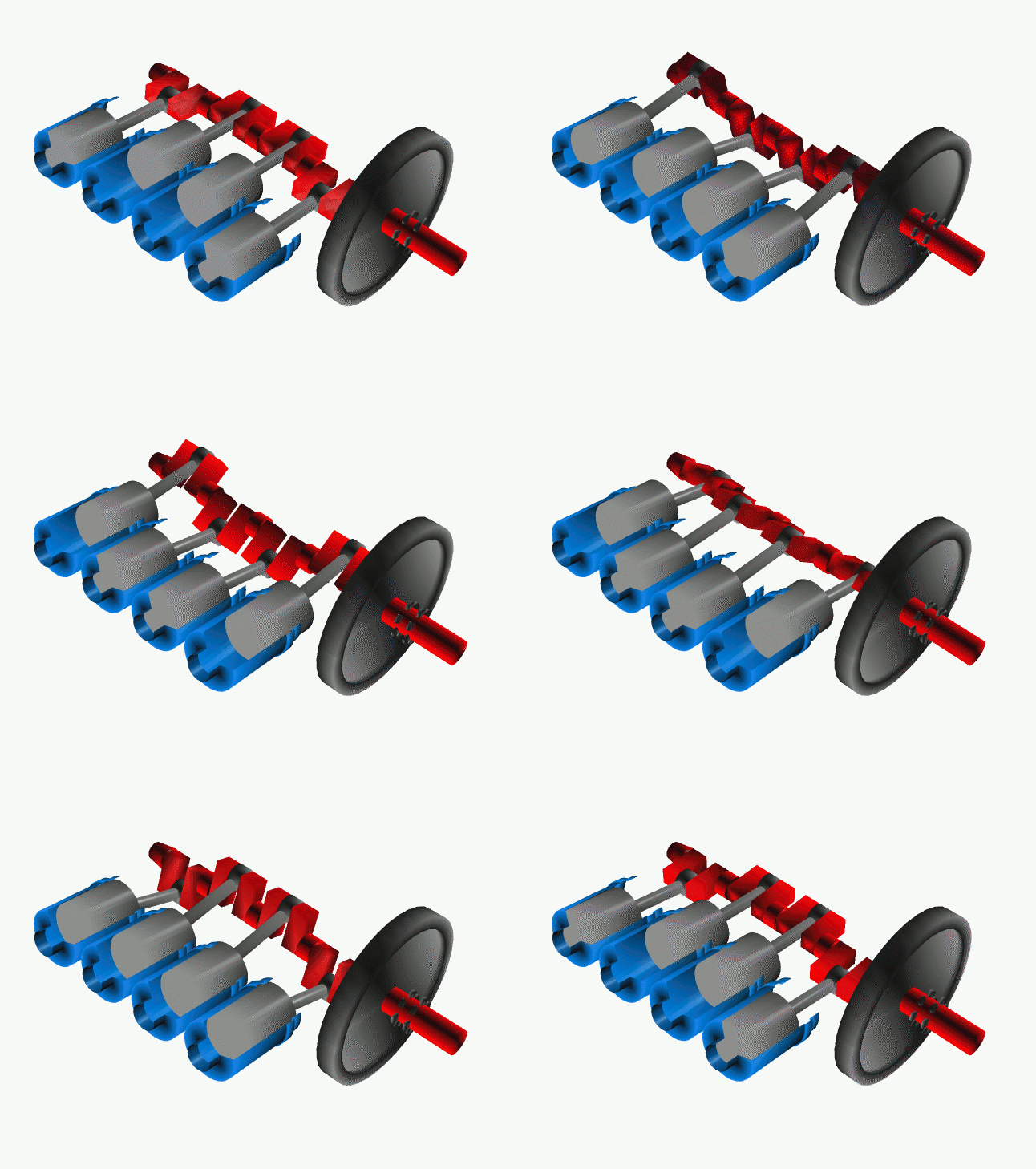
Figure 1 | Crankshaft Operating Principle | ||||||||
|---|---|---|---|---|---|---|---|---|---|
Crankshaft is a eccentric shaft located at the bottom of internal combustion engines that converts the linear motion of pistons into rotational motion. This motion is transmitted to the transmission via the flywheel and then to the wheels, enabling the vehicle to move. As the engine’s primary rotating component, the crankshaft works in harmony with many other parts to ensure the engine operates smoothly and efficiently.

【1】
The crankshaft receives linear motion from the pistons via connecting rods and converts it into rotational torque using its eccentric (off-center) cranks. These cranks are positioned at specific angles relative to the crankshaft’s axis, transforming the force generated by the pistons’ up-and-down motion into circular motion.
The shaft’s end is typically connected to a heavy disk known as the flywheel. The flywheel regulates the rotational motion coming from the crankshaft, transmitting it to the transmission, then to the differential and wheels. It also reduces vibrations by balancing the engine’s moment of inertia, contributing to smoother engine operation.
Crankshafts are generally manufactured as single-piece components from high-strength forged steel. This manufacturing method eliminates the risk of welding defects and ensures the component’s long service life.
The crankshaft consists of the following key components:

Crankshaft Sections (AI-Generated Image)
The crankshaft is not only responsible for transmitting motion but also plays a crucial role in balance and vibration control. Its counterweights dampen torque imbalances caused by the pistons’ abrupt movements. In unbalanced systems, these vibrations can cause damage to bearings and the engine block.
Additionally, the crankshaft works in conjunction with the camshaft. The camshaft is driven by the crankshaft via a gear or chain and controls the opening and closing of the engine valves. Precise timing between these two shafts ensures efficient engine operation.
The flywheel is a heavy metal disc attached to the end of the crankshaft and plays a key role in maintaining torque and reducing engine vibrations. In particular, in manual transmission vehicles, the flywheel also interacts with the clutch mechanism.
While transmitting rotational motion from the crankshaft to the transmission, the flywheel also provides the necessary moment of inertia to prevent the engine from stopping abruptly. As a result, even when the driver removes their foot from the accelerator pedal, the vehicle continues to move for a short duration.
1. Crankshaft Breakage
Crankshaft breakage is a rare but extremely costly failure for the engine. Although the shaft is made from high-strength materials such as forged steel, breakage typically results from indirect causes:
The most noticeable sign of such failures is unusual knocking or scraping noises coming from the engine. A broken crankshaft can also cause damage to other engine components.
2. Crankshaft Sensor Failure
Failures in the crankshaft sensor are more common and are generally electronic in nature. Primary symptoms of sensor failure include:
Crankshaft sensor is an electronic component that detects the position and rotational speed of the crankshaft. This sensor transmits data to the engine control unit (ECU), enabling precise control of ignition timing and fuel injection. This ensures all engine components operate in synchronized fashion.
The main failures that can occur in the crankshaft are shaft breakage and sensor malfunction. Although crankshaft breakage is rare, it can result from indirect causes such as insufficient engine oil, bearing wear, or crankshaft bearing deformation. In case of breakage, abnormal noises may be heard from the engine and operation may cease entirely.
Sensor failures are more common and usually stem from malfunctions in the electronic or magnetic system. In such cases, the following symptoms may be observed:
These symptoms can lead to incorrect ignition timing and reduced engine performance, indicating a potential issue with the crankshaft or its sensor.
The crankshaft is one of the most important components of an internal combustion engine. Its role extends beyond merely transmitting motion; it also maintains overall engine balance, controls vibrations, and operates in sync with the ignition system. Due to its structural integrity and electronic monitoring capabilities, the crankshaft is regarded as a critical engineering component in engine technology.
AutoProToWay. "What Is Crankshaft?" Accessed March 31, 2025.https://autoprotoway.com/what-is-crankshaft/
Cars.com. “Crankshaft.” *Cars.com Glossary*. Accessed March 31, 2025.https://www.cars.com/auto-repair/glossary/crankshaft/
Counterman. “A Closer Look at Crankshafts.” Counterman. Accessed March 31, 2025.https://www.counterman.com/a-closer-look-at-crankshafts/
Ekip Motor. "Krank Mili." Ekip Motor. Accessed March 31, 2025.https://www.ekipmotor.com.tr/krank-mili.html
Haynes. “What Is a Car Crankshaft?” Haynes. Accessed March 31, 2025.https://haynes.com/en-gb/tips-tutorials/what-is-car-crankshaft
Willard W. Pulkrabek, İçten Yanmalı Motorlar: Mühendislik Temelleri, trans. Bülent Uluışık, Hakan Serhat Soyhan, and İmdat Taymaz, ed. Halit Yüksel (Ankara: Güven Bilimsel, 2013).
[1]
Haynes. “What Is a Car Crankshaft?” Haynes. Erişim tarihi 31 Mart 2025. https://haynes.com/en-gb/tips-tutorials/what-is-car-crankshaft

Figure 1 | Crankshaft Operating Principle | ||||||||
|---|---|---|---|---|---|---|---|---|---|
Structure and Working Principle
Technical Details
Role of the Crankshaft in Engine Performance
Relationship Between the Crankshaft and Flywheel
Crankshaft Failures
Crankshaft Sensor
Possible Failures and Their Effects
Conclusion