


This article was automatically translated from the original Turkish version.
+1 More
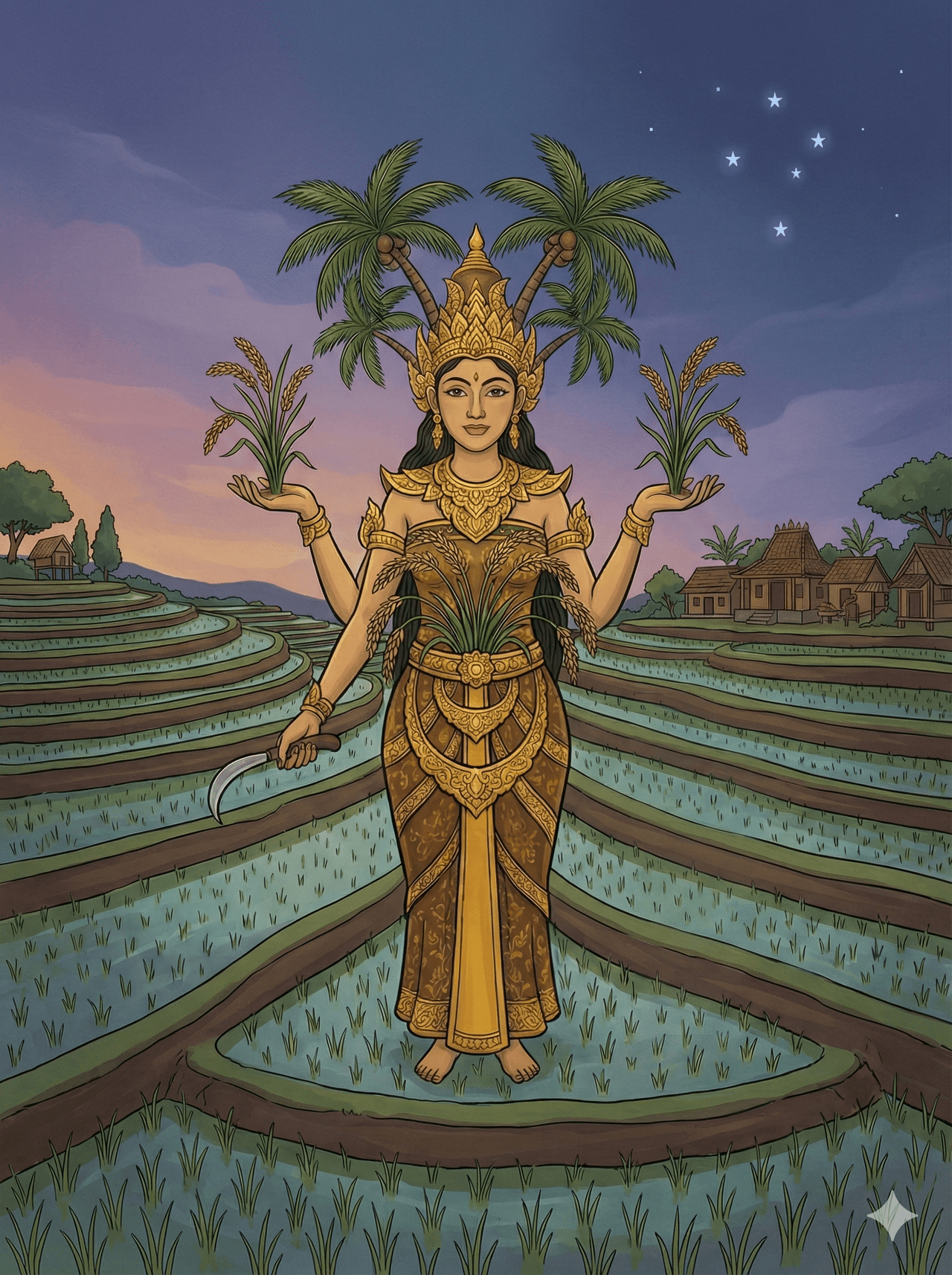
(Yapay Zeka ile Üretilmiştir.)
Dewi Sri
Other Name(s) | Lanjar Maipit Shridevi Mbok Sri Ayu Sangiang Serri Nyi Pohaci Sanghiang Sri | ||||||||
|---|---|---|---|---|---|---|---|---|---|
Basic Role | Goddess of Rice, Fertility, Wealth and Prosperity | ||||||||
Culture/Region | Indonesia (Java, Sunda, Bali, Bugis), Southeast Asia | ||||||||
Dewi Sri (or in local variations Sri, Sangiang Serri, Nyi Pohaci Sanghiang Sri, Mbok Sri Ayu) is a goddess figure representing rice, fertility, and prosperity in agricultural societies across Indonesia and Southeast Asia, particularly in the cultures of Java, Sunda, Bali, and Bugis. The name “Sri” (or Shridevi), associated with the Hindu goddess Lakshmi, carries meanings of fertility, wealth, and family prosperity.【1】
Narratives concerning the origins of Dewi Sri and rice vary according to regional and oral or written traditions. A common theme (topos) across these stories is the death of a goddess or sacred figure, from whose body agricultural plants emerge.
Wawacan Sulanjana and other Sunda texts, as well as Javanese works such as Manik Maya, recount a story that begins in the heavens. After the god Batara Guru orders the construction of a new palace, the tears of Antaboga (Ananta Boga), the serpent god who cannot work due to lacking limbs, fall to earth and transform into three eggs. Two of the eggs crack open and become wild boars, while the third hatches into a beautiful girl named Nyi Pohaci Sanghyang Asri. As Nyi Pohaci grows up, her adoptive father Batara Guru falls in love with her. To preserve cosmic order and her purity, the gods poison and kill her, burying her body on Earth. From her grave emerge beneficial plants for humanity: coconut trees sprout from her head, spices from her nose and lips, and rice from her navel. In some versions, the transformation is detailed as white rice emerging from her right eye and red rice from her left eye.
In village myths from the Tuban region, a female figure from outside the community, Mbok Sri Ayu or Lanjar Maipit, plays a central role. In this version, the goddess is killed or symbolically “eaten” by the villagers. Mbok Sri Ayu voluntarily offers herself and her “child” (the rice) through an agreement with her aggressors. This narrative emphasizes a social contract in which fertility and rice are shared by the community, in contrast to the “single ownership” model found in court-based traditions.
The Bugis epic I La Galigo also treats a similar sacrifice theme. According to this version, rice emerges from the grave of We Oddangriu, the child of Batara Guru who died shortly after birth, and the child is reincarnated as Sangiang Serri, the Rice Goddess.
Another narrative, distinct from the sacred sacrifice motif, holds that rice originally existed only in the heavens as food for the gods. A young person ascends to the sky, learns how to cultivate rice from Dewi Sri, and steals rice seeds to bring them to Earth to save starving people. Dewi Sri forgives the youth but imposes strict rules as punishment: humans are forbidden from returning to the heavens, and they must now follow rigorous rituals for rice cultivation—including irrigation, weeding, and offering portions to birds.
Rituals dedicated to Dewi Sri are interwoven with the agricultural calendar (planting and harvest) and the human life cycle (birth, marriage, death). In agricultural practice, farmers observe natural signs in accordance with Dewi Sri’s teachings—for example, the blooming of jasmine flowers or the appearance of the Orion constellation (Waluku) signals the time for planting. During harvest, small knives called ani-ani are used in the fields to avoid damaging rice grains and to show respect to the goddess.
Rituals also occupy a central place in social life. In the Tuban region, after harvest, the Manganan ritual is performed at ancestral graves; women bring vessels filled with rice (dhondhang), symbolizing Dewi Sri, which are then distributed among the men of the community. Similarly, during wedding ceremonies, the bride and groom are honored as the legendary couple Sri and Sedono, embodying rice and prosperity, and are granted the title of “king and queen for a day” (raja sehari). Rice granaries and fields are regarded as sacred spaces, and harvest thanksgiving ceremonies such as Seren Taun in West Java and Metri Dusun in Java are held to honor Dewi Sri.
Dewi Sri is identified with the concept of the “Mother Goddess,” symbolizing the earth and the source of life. This analogy between woman and land is seen in agricultural societies as the origin of fertility. The widespread Asian mythic theme of “sacrifice,” as seen in the stories of Nyi Pohaci or Mbok Sri Ayu, illustrates how the end of one life gives rise to a new one—food. Furthermore, in the mythic dichotomy between the “Upper World” (Sky/Gods) and the “Lower World” (Earth/Humans), rice serves as a unifying link, descending from the heavens to grow on Earth and connecting the two realms.
Heringa, Rens. "Dewi Sri in Village Garb: Fertility, Myth, and Ritual in Northeast Java". *Asian Folklore Studies* 56, no. 2 (1997): 355-377. Accessed January 6, 2026. https://www.jstor.org/stable/pdf/1178731.pdf?refreqid=fastly-default%3A55ccf47ddffb9bef2381cc60389eb232&ab_segments=&initiator=&acceptTC=1
Sonawane, Shilpa V. "Diaspora of Bhuta (Daiva) worshipping cult—India and Indonesia: Part 10 - Dewi Sri: Indonesia." *Wisdom Library*. 2019. Accessed January 6, 2026. https://www.wisdomlib.org/history/essay/bhuta-daiva-worshipping-cult/d/doc1238871.html.
Sunarti, Sastri, Ninawati Syahrul, Atisah, and Erli Yetti. "The Rice Myths in Asia: The Comparative Literature Study". *ICON-DEMOST 2021*. Semarang: EAI, 2022. Accessed January 6, 2026. Accessed Adresi
UNESCO APCEIU. "The Goddess of Rice - Telling Tales from Southeast Asia and Korea". *Asian Folktales*. Accessed January 6, 2026. http://asianfolktales.unescoapceiu.org/folktales/read/indonesia_2.htm.
[1]
Shilpa V. Sonawane, "Diaspora of Bhuta (Daiva) worshipping cult—India and Indonesia: Part 10 - Dewi Sri: Indonesia," Wisdom Library, 2019, accessed 6 January 2026, https://www.wisdomlib.org/history/essay/bhuta-daiva-worshipping-cult/d/doc1238871.html.

(Yapay Zeka ile Üretilmiştir.)
Dewi Sri
Other Name(s) | Lanjar Maipit Shridevi Mbok Sri Ayu Sangiang Serri Nyi Pohaci Sanghiang Sri | ||||||||
|---|---|---|---|---|---|---|---|---|---|
Basic Role | Goddess of Rice, Fertility, Wealth and Prosperity | ||||||||
Culture/Region | Indonesia (Java, Sunda, Bali, Bugis), Southeast Asia | ||||||||
Mythological Origins and Variations
Sunda and Central Java Tradition (Nyi Pohaci / Retna Jumilah)
Northeast Java and Village Tradition (Mbok Sri Ayu)
South Sulawesi (Bugis) Tradition
Folk Tale Version (Helping Humanity)
Rituals and Worship
Symbolism and Conceptualization