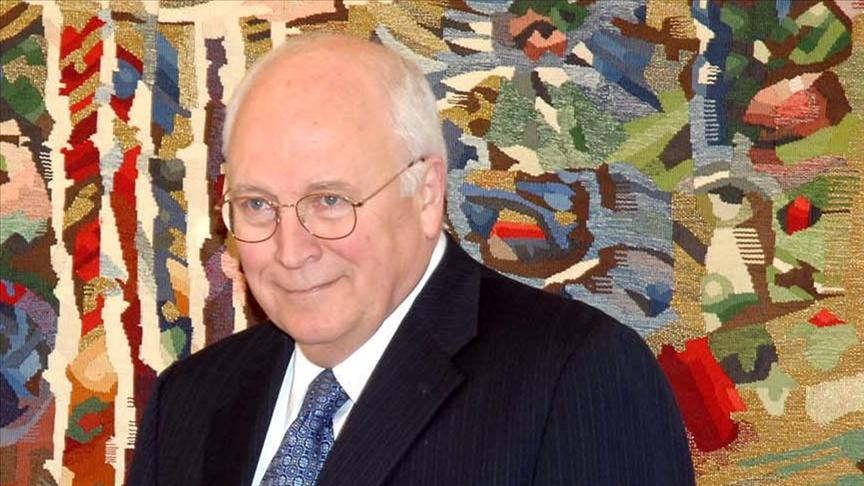



Richard Bruce Cheney
Doğum tarihi | 1941-01-30 | ||||||||
|---|---|---|---|---|---|---|---|---|---|
Eş | Lynne Vincent Cheney | ||||||||
Place of Birth | Lincoln / USA | ||||||||
Ölüm tarihi | 2025-11-04 | ||||||||
Dick Cheney (Richard Bruce Cheney) is an American politician and public official born on January 30, 1941, in Lincoln, Nebraska. He served as the 46th Vice President of the United States from 2001 to 2009. Prior to this, he held positions as a member of the Wyoming House of Representatives, Secretary of Defense during the George H. W. Bush administration, and as a senior executive at Halliburton Company. Cheney played a significant role in shaping the United States’ military and security policies following the September 11 attacks in 2001. He died on November 4, 2025, at the age of 84, due to complications from pneumonia and cardiovascular disease.

Richard Bruce Cheney, March 19, 2002 – (Anadolu Ajansı)
Richard Bruce Cheney was born on January 30, 1941, in Lincoln, Nebraska. His mother was Marjorie Lorraine (Dickey) and his father was Richard Herbert Cheney. His family moved to Casper, Wyoming, where Cheney spent his childhood and youth.
Cheney attended Yale University from 1959 to 1960 but did not complete his degree due to academic difficulties. He later enrolled at Casper College in 1963 and earned a bachelor’s degree in political science from the University of Wyoming in 1965, followed by a master’s degree in 1966. In 1968, he became a doctoral candidate at the University of Wisconsin.
After leaving Yale, Cheney worked on electrical transmission lines and coal power plant construction projects in Wyoming, Colorado, and Utah. In 1961, he laid cables between Minuteman missile silos near Cheyenne. He married Lynne Vincent in 1964.
Cheney stated in his memoirs that he was influenced by the speeches of President John F. Kennedy during his university years. In the early 1960s, he opposed student movements aligned with Vietnam War and expressed support for military interventions.
Richard B. Cheney’s public service career began in 1969 when he first served as a congressional fellow. That same year, he was appointed as a special assistant to the Director of the Office of Economic Opportunity, where he worked on the implementation of social and economic programs.
In 1971, he served as a staff assistant to White House. From 1971 to 1973, he was deputy chairman of the Cost of Living Council. From 1973 to 1974, he worked as deputy president at the private firm Bradley, Woods & Co.
Cheney joined President Gerald Ford’s transition team following President Richard Nixon’s resignation in 1974. Later that year, Ford appointed him as Assistant to the President. In 1975, after Donald Rumsfeld was appointed Secretary of Defense, Cheney was named White House Chief of Staff. He held this position from 1975 to 1977.
Richard B. Cheney ran for and was elected to the United States House of Representatives from Wyoming in 1978. He took office on January 3, 1979, and served six consecutive terms until March 17, 1989. He represented Wyoming as its sole representative during the 96th through 101st Congresses.
During the 101st Congress, Cheney served as Republican Minority Whip. He voted on legislation related to lawmaking, budgetary matters, and defense policy. Throughout his decade in the House, he consistently cast conservative votes. He opposed abortion rights, voted against gun control measures, opposed funding for environmental protection, and opposed increased education funding. Cheney also voted against legislation calling for the release of South African leader Nelson Mandela.
In 1989, Cheney resigned from Congress after being appointed Secretary of Defense by President George H. W. Bush.
Richard B. Cheney was appointed Secretary of Defense by President George H. W. Bush in 1989. His nomination was confirmed by the Senate by a vote of 92 to 0. He served in this role until 1993.
During his tenure, Cheney was responsible for directing the U.S. military operation in Panama in 1989. He also oversaw the “Desert Storm” operation during the Gulf War of 1990–1991. Cheney argued that military intervention against Iraq was justified, but stated that occupying the country would require the United States to act alone.
Cheney participated in decision-making processes regarding nuclear strategy, disarmament, and the end of the Cold War. He led efforts to reduce the U.S. nuclear arsenal under the Strategic Arms Reduction Treaty (START I).
During the 1991 coup attempt in the Soviet Union, Cheney, who was in British Columbia, maintained communication with the Pentagon via satellite. He monitored developments in Moscow through Defense Department channels and informed President Bush after the coup failed. He left office in 1993 after completing his term as Secretary of Defense.
After leaving the Department of Defense, Richard B. Cheney entered the private sector. From 1993 to 1995, he served as a senior fellow at the American Enterprise Institute. That same year, he became chairman of the board and chief executive officer (CEO) of Halliburton Company, an energy and petroleum services firm.
Cheney held this position from 1995 to 2000. The company’s headquarters were in Dallas, Texas. During his tenure, he was responsible for managing investments in the energy sector. Halliburton also carried out engineering and service contracts for the defense industry during this period.
Before joining the 2000 vice presidential selection process, Cheney resigned from Halliburton and received a $35 million retirement package. At the time, the company later became one of the U.S. government’s leading contractors during the Iraq War process.
In July 2000, Cheney chaired the committee tasked with selecting George W. Bush’s vice presidential candidate and was himself chosen for the role.
Richard B. Cheney was selected as the Republican Party’s vice presidential candidate alongside George W. Bush in the 2000 presidential election. He was sworn in on January 20, 2001, and was re-elected in 2004, serving two terms as Vice President of the United States until January 20, 2009.
During his tenure, Cheney advocated for expanding executive power. He believed that the presidency had been weakened after Watergate scandal and supported policies aimed at restoring and strengthening presidential authority.
During September 11, 2001 attacks, Cheney was in the White House in Washington. He played an active role in the immediate crisis management response. He was deeply involved in planning and executing the U.S. military operations in Afghanistan and Iraq and was regarded as one of the principal architects of the administration’s “aggressive policies.”
During the 2003 invasion of Iraq, Cheney supported claims that Iraq possessed weapons of mass destruction and defended the decision to invade on this basis. However, no such weapons were found after the invasion. The occupation of Iraq led to the deaths of hundreds of thousands of civilians and displaced millions, though exact figures remain uncertain.
Cheney defended the use of “enhanced interrogation techniques” in counterterrorism operations, including methods such as waterboarding and sleep deprivation. These practices were labeled as torture by the U.S. Senate Select Committee on Intelligence and the United Nations Special Rapporteur on Human Rights.
During his presidency, Cheney established an independent advisory team on national security that operated as a separate decision-making network within the administration. However, documented disagreements occurred between Cheney and other White House officials, particularly Secretary of State Colin Powell and National Security Advisor Condoleezza Rice.
Cheney left office in 2009 after completing his term as Vice President.
Richard B. Cheney struggled with cardiovascular disease for much of his adult life. He suffered his first heart attack in 1978 at age 37. He had subsequent heart attacks in 1984, 1988, and 2000. In November 2000, while the outcome of the presidential election in Florida remained uncertain, he suffered another heart attack.
After leaving office, he suffered his fifth heart attack in 2010. In 2011, a mechanical heart pump was implanted to maintain cardiac function until a transplant could be arranged. In 2012, Cheney received a heart transplant.
Richard Bruce Cheney died on November 4, 2025, at the age of 84. His family announced that his death resulted from complications due to pneumonia and cardiovascular disease. At the time of his death, he was surrounded by his wife Lynne Cheney and his daughters Liz and Mary.
Anadolu Ajansı. “ABD’de Bush Döneminin Saldırgan Politikalarının En Önemli Mimarlarından Dick Cheney Öldü.” Accessed November 4, 2025. https://www.aa.com.tr/tr/dunya/abdde-bush-doneminin-saldirgan-politikalarinin-en-onemli-mimarlarindan-dick-cheney-oldu/3734787#
Biographical Directory of the United States Congress. "Cheney, Richard B." Biographical Directory of the United States Congress. Accessed November 4, 2025. https://bioguide.congress.gov/search/bio/C000344
CNN. “Dick Cheney, influential Republican vice president to George W. Bush, dies.” *CNN Politics.* Accessed November 4, 2025. https://edition.cnn.com/2025/11/04/politics/dick-cheney-death-obit
George W. Bush White House Archives. “Vice President Richard B. Cheney.” White House Archives. Accessed November 4, 2025. https://georgewbush-whitehouse.archives.gov/vicepresident/vpbio.html
History Office, U.S. Department of Defense. “Richard B. Cheney.” Historical Office of the Office of the Secretary of Defense. Accessed November 4, 2025. https://history.defense.gov/Multimedia/Biographies/Article-View/Article/571284/richard-b-cheney/
National Park Service. “Dick Cheney.” U.S. National Park Service. Accessed November 4, 2025. https://www.nps.gov/people/dickcheney.htm
Reuters. “Dick Cheney, powerful former US vice president who pushed for Iraq war, dies at 84.” Accessed November 4, 2025. https://www.reuters.com/world/us/former-us-vp-dick-cheney-dead-84-punchbowl-news-says-2025-11-04/

Richard Bruce Cheney
Doğum tarihi | 1941-01-30 | ||||||||
|---|---|---|---|---|---|---|---|---|---|
Eş | Lynne Vincent Cheney | ||||||||
Place of Birth | Lincoln / USA | ||||||||
Ölüm tarihi | 2025-11-04 | ||||||||
Early Life and Education
Beginning of Political Career (1969–1977)
Congressional Service (1979–1989)
Secretary of Defense (1989–1993)
Private Sector and Halliburton Years (1993–2000)
Vice Presidency (2001–2009)
Health and Death