

This article was automatically translated from the original Turkish version.
Place(s) | United Nations Security Council United States New York | ||||||||
|---|---|---|---|---|---|---|---|---|---|
Connection to the Iraq War | The presentation is regarded as one of the diplomatic turning points leading to the Iraq invasion that began on 19 March 2003; following the speech, the United States and its allies invaded Iraq without obtaining a new resolution for war from the United Nations. | ||||||||
Nature of Intelligence | The speech was based on assessments by U.S. intelligence agencies; however, after the war, the failure to find weapons of mass destruction led to the intelligence used being characterized as "incorrect," "misleading," and "a major intelligence failure." | ||||||||
Legal/Political Framework | Following the UN Security Council’s Resolution 1441, which gave Iraq a “final opportunity,” an argument for legitimacy was constructed on the claim that Iraq had failed to comply with the resolution; although a new explicit authorization for war could not be obtained from the Security Council, this effort aimed to generate political support for the coalition led by the United States. | ||||||||
Types of Evidence Used | Satellite images, intelligence reports, transcripts of phone interceptions, drawings, and schematics; a representation of a biological agent symbolized by a small glass bottle; graphics related to mobile laboratory allegations | ||||||||
Core Claims | The existence of chemical and biological weapons stockpiles in Iraq; mobile biological weapons laboratories; materials and equipment associated with the nuclear program; concealment of weapons of mass destruction programs from inspectors; and links between the Iraqi regime and terrorist organizations | ||||||||
Official Purpose | Demonstrating to the Security Council with evidence that Iraq was not complying with United Nations resolutions, hiding weapons of mass destruction, and posing a threat to international security; to secure international support for tougher measures and actual intervention against Iraq. | ||||||||
Context | During the post-9/11 period, the presentation made as the United States sought justification for regime change and military intervention in Iraq on the claim that the country possessed weapons of mass destruction. | ||||||||
Speaker | U.S. Secretary of State Colin Powell | ||||||||
History | February 5, 2003 | ||||||||
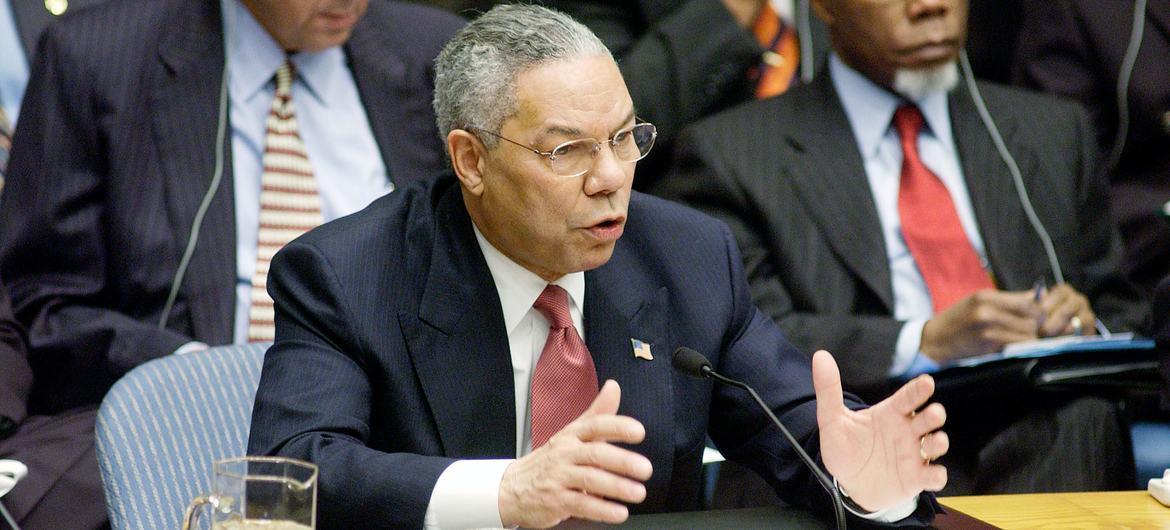
Colin Powell’s presentation to the United Nations Security Council on 5 February 2003 was a historic diplomatic intervention aimed at establishing legal and political legitimacy for the U.S.-led Iraq War by presenting to the international community claims that Iraq possessed weapons of mass destruction, supported by satellite imagery, intelligence reports, and symbolic visual elements. However, it was later revealed that the presentation relied heavily on faulty intelligence.
On 5 February 2003, Colin Powell became the most prominent diplomatic face of the United States in the lead-up to the war against Iraq. The presentation sought to convey to the international community the U.S. government’s claims that Iraq possessed weapons of mass destruction and that the Ba’ath regime was concealing them. 【1】
This speech occupied a central position in efforts to establish both legal and political legitimacy for the imminent Iraq War. 【2】 Over the years that followed, many of the claims made in the speech were shown to be based on false or fabricated intelligence, and Powell’s address has since been remembered as a controversial turning point in Iraq’s recent history.
Powell’s presentation was shaped as part of the broader transformation in U.S. security doctrine following the 11 September 2001 attacks and the George W. Bush administration’s policies toward Iraq.【3】 Having served in the State and Defense bureaucracies since the 1970s, and later as Chairman of the Joint Chiefs of Staff and Secretary of State, Powell was regarded during this period as one of Washington’s most respected figures. Iraq, meanwhile, had been subjected since the 1991 Gulf War to comprehensive sanctions, monitoring mechanisms, and pressure to disarm, while questions persisted over whether Saddam Hussein’s regime was complying with UN resolutions.【4】 In 2002, UN Security Council Resolution 1441 granted Iraq a “final opportunity” to fully disclose its weapons of mass destruction programs and provide unrestricted access to inspectors. However, Washington argued that Baghdad had failed to meet these obligations and used Powell’s Security Council presentation to substantiate this claim.
Powell opened his address to the UN Security Council on 5 February 2003 by emphasizing that Iraq had violated numerous UN resolutions over a 12-year period. He argued that while Resolution 1441 had offered Iraq a “last chance,” Baghdad had not engaged in genuine cooperation. 【5】 Using slides, he presented to Council members satellite imagery, wiretap transcripts, and intelligence reports that the U.S. administration labeled as “compelling evidence.” A small vial placed on the table before Powell became a symbolic representation of Iraq’s alleged biological weapons program and emerged as one of the most memorable visual elements of the presentation.

Powell attempted to support his claims with the small glass vial — United Nations
These visual tools were intended to reinforce the U.S. argument that Iraq was hiding weapons of mass destruction. Powell claimed that Iraq was using mobile laboratories for biological weapons production, and that these facilities, mounted on trucks and train cars, had been identified through satellite imagery. 【6】 He further asserted that Iraq was storing chemical and biological munitions, rapidly emptying and refilling storage facilities to conceal them from inspectors. He also argued that heat-resistant “aluminum tubes” were linked to Iraq’s nuclear program and could be used for uranium enrichment. 【7】 The presentation also claimed operational links between the Iraqi regime and al-Qaeda through figures such as Abu Musab al-Zarqawi, an argument that positioned Iraq as a central target in the global war on terror. This portrayal of Iraq as possessing an “active, hidden, and ongoing” weapons of mass destruction program formed the backbone of the speech.
Powell’s speech was shaped by intelligence reports, technical assessments, and political revisions prepared by U.S. intelligence agencies. The final text emerged after intense consultations among the White House, the Department of Defense, and the State Department. It has been reported that Powell expressed reservations about certain elements of the text but ultimately assumed responsibility for defending it. In later years, Powell emphasized that every sentence in the speech had been vetted by the intelligence community and approved by these institutions.【8】 This process played a decisive role in the speech’s later characterization as a “major intelligence failure.”
In this context, it has been noted that internal reports indicating that the Niger uranium documents linked to Iraq’s nuclear program were forgeries were not adequately considered, yet arguments continued to be constructed implying that Iraq was close to acquiring nuclear capability. 【9】 Subsequent documents and testimonies revealed that Powell had voiced doubts about some claims prior to the speech, warning they “could blow up in their faces.” Nevertheless, as U.S. Secretary of State addressing the Security Council, he did not voice these concerns and presented the speech as a forceful articulation of the U.S. government’s official position. This has since become a central reference point in debates over Powell’s responsibility and role.
Excerpt from Powell’s UN speech — UN Storys
Powell’s presentation is recorded as the most comprehensive effort by the UN Security Council to present the U.S. case for military intervention against Iraq. While it strengthened the view among some allied nations that Iraq had failed to meet its obligations, the Security Council did not authorize war.【10】 Countries such as France, Germany, and Russia advocated for continuing inspections as an alternative to military action, leading to deep divisions within the Council. This dynamic sparked new debates about the effectiveness of the UN’s collective security mechanism and the limits of power balances among major states. Ultimately, the United States and the United Kingdom launched their intervention without a further Security Council resolution, relying instead on their own coalition.
U.S.-led coalition forces invaded Iraq on 19 March 2003; Baghdad fell shortly thereafter, and Saddam Hussein’s regime was overthrown.【11】 However, despite extensive searches after the war, no weapons of mass destruction program matching the scale claimed by Powell was found. This outcome raised serious questions about the reliability of the intelligence underpinning the speech and placed the “faulty intelligence” debate at the center of the global agenda.【12】 Former Iraqi intelligence officials emphasized that Powell’s speech marked a turning point for the Iraqi people, leading to war and its devastating humanitarian consequences. In the long term, the occupation created deep fractures in the country’s political structure, security environment, and social fabric.【13】
Numerous reports and assessments have documented that hundreds of thousands of Iraqis lost their lives during the war and subsequent occupation, millions were displaced, and critical infrastructure systems were severely damaged. 【14】 Faulty intelligence contributed to hundreds of thousands of Iraqi children becoming orphans due to war, violence, and societal collapse, and the long-term demographic and social impacts of the war have become widely recognized.
The deepening security vacuum, the rise of sectarian conflict, and the strengthening of radical groups plunged Iraq into a prolonged cycle of instability. In this context, Powell’s speech, based on faulty intelligence, is viewed not merely as a diplomatic statement but as a critical turning point directly associated with the destruction Iraq experienced during and after the war.
The failure to find weapons of mass destruction subjected Powell’s 5 February 2003 speech to intense criticism both within the United States and internationally. Some commentators characterized the claims in the speech as “lies” or “systematic deception,” arguing that it was part of a deliberate effort to manufacture justification for war.【15】 Powell, in subsequent years, acknowledged that the intelligence used was flawed and described the speech as one of the greatest “stains” on his career.【16】 He stated that he had acted in good faith based on the assumption that the information presented to him was accurate and complete, yet he also acknowledged the weight of political and moral responsibility. In this light, Powell has been viewed in public discourse as both a “victim of faulty intelligence” and the “key actor who legitimized it.”【17】
Some news and commentary have argued that Powell limited himself to expressions of “regret” or “apology” in the face of the humanitarian devastation in Iraq, while the material and human costs of the war were far more severe. Critical analyses contend that Powell’s speech functioned as a powerful propaganda tool used by the U.S. administration to suppress domestic and international opposition to its Iraq policy.

Immediately after the claims, U.S. forces entered Iraq — Anadolu Ajansı
The fact that Powell’s presentation to the United Nations Security Council was based on false and contested intelligence, when viewed alongside the humanitarian toll of the Iraq occupation, has firmly placed it at the center of the debate over “wars based on faulty intelligence.” The United States invaded Iraq in 2003 with the stated goals of regime change and the elimination of weapons of mass destruction; however, over the years it became clear that these claims lacked foundation.【18】 In contrast, the occupation and its aftermath resulted in massive civilian casualties, widespread destruction across the country, and prolonged instability. Analyses emphasize that the process, launched under the banners of “democracy” and “stability,” left behind “destruction, blood, and chaos.” In this framework, a direct link is drawn between Powell’s speech and the mass deaths in Iraq through the faulty intelligence and misjudgments that shaped decision-making.【19】
The Iraq invasion and the years of internal conflict that followed produced a severe human toll. Multiple reports and assessments indicate that hundreds of thousands of people lost their lives, millions were displaced, and major cities and infrastructure facilities were severely damaged. Long-term evaluations highlight that, despite the rhetoric of “democracy,” Iraq endured years of violence, suicide bombings, sectarian conflict, and de facto war conditions. Civilians were caught between sectarian violence, militia clashes, and terrorist attacks; the collapse of healthcare, education, and public services amplified the indirect deaths and humanitarian costs of the war. In this context, the war, legitimized by inaccurate and unverified intelligence, is assessed not merely as a military regime change but as a process that inflicted lasting casualties and trauma on broad segments of Iraqi society. 【20】
The dissolution of state institutions, the disbanding of security forces, and the resulting power vacuum paved the way for the emergence of new armed groups and deepened the cycle of violence. Sectarian fault lines fostered a security environment in which death became commonplace; as civilian casualties mounted, Iraq’s political structure became permanently fragile. Analyses conducted years later emphasize that although the occupation was presented as a mission of “democracy and stability,” it produced enduring instability, poverty, and mass fatalities for the Iraqi people. On the twentieth anniversary of the invasion, the U.S. Congress’s consideration of repealing the 2002 authorization for war has reopened legal and political debates over past decisions and the human losses they caused. These discussions have reaffirmed the symbolic weight of Powell’s UN speech — as an event inextricably linked to faulty intelligence and a stark reminder of Iraq’s immense human cost.
Al Jazeera. “‘Blot’ on Powell’s record: Lies to the UN about Iraq’s weapons.” Al Jazeera. Accessed February 3, 2026. https://www.aljazeera.com/news/2021/10/18/stain-on-powells-record-lies-to-the-un-about-iraqs-weapons
Anadolu Ajansı. “ABD’nin 18 Yıl Önce Demokrasi ve İstikrar Vaadiyle Başlattığı Irak İşgalinden Geriye Yıkım, Kan ve Kaos Kaldı.” Accessed February 3, 2026. https://www.aa.com.tr/tr/dunya/abdnin-18-yil-once-demokrasi-ve-istikrar-vaadiyle-baslattigi-irak-isgalinden-geriye-yikim-kan-ve-kaos-kaldi/2181544
Anadolu Ajansı. “Birleşmiş Milletlerin Kaderi.” Anadolu Ajansı. Accessed February 3, 2026. https://www.aa.com.tr/tr/analiz-haber/birlesmis-milletlerin-kaderi/1257742
Anadolu Ajansı. “Irak İşgalinin 20’nci Yılında ABD’de Başkana Verilen Savaş Yetkisinin Kaldırılması Gündemde.” Accessed February 3, 2026. https://www.aa.com.tr/tr/dunya/irak-isgalinin-20-nci-yilinda-abd-de-baskana-verilen-savas-yetkisinin-kaldirilmasi-gundemde/2850490
Anadolu Ajansı. “Irak’ta ABD’nin Demokrasi Vaadiyle Başlattığı İşgalin Olumsuz Yansımaları 20 Yıldır Sürüyor.” Accessed February 3, 2026. https://www.aa.com.tr/tr/dunya/irakta-abdnin-demokrasi-vaadiyle-baslattigi-isgalin-olumsuz-yansimalari-20-yildir-suruyor/2850666
BBC Türkçe. "Powell'dan Irak itirafı." Accessed February 3, 2026. https://www.bbc.co.uk/turkish/news/story/2004/04/printable/040403_powell_cia.shtml
BBC Türkçe. “Irak Savaşı 20 yıl önce nasıl başladı, ABD ve bazı müttefikleri ülkeyi neden işgal etti?” Accessed February 3, 2026. https://www.bbc.com/turkce/articles/cgreyr87gr4o
Borger, Julian. “Colin Powell’s UN speech: a decisive moment in undermining US credibility.” The Guardian. Accessed February 3, 2026. https://www.theguardian.com/us-news/2021/oct/18/colin-powell-un-security-council-iraq
Boz, Ümmügülsüm. “ABD’nin 2003 Irak Müdahalesinin Uluslararası Hukuk Açısından Değerlendirilmesi.” Aksaray Üniversitesi İktisadi ve İdari Bilimler Fakültesi Dergisi 16, no. 1 (2024): 51–64. Accessed February 3, 2026. https://dergipark.org.tr/en/download/article-file/3607604
Ekonomim. "Trump, Powell’ın Ölümünden Sonra Medyayı Topa Tuttu." Accessed February 3, 2026. https://www.ekonomim.com/dunya/trump-powellin-olumunden-sonra-medyayi-topa-tuttu-haberi-637116
George W. Bush White House Archives. “U.S. Secretary of State Colin Powell Addresses the U.N. Security Council.” George W. Bush White House Archives. Accessed February 3, 2026. https://georgewbush-whitehouse.archives.gov/news/releases/2003/02/20030205-1.html
Haber7. “5 Milyon Çocuğun Yetim Kaldığı Irak’ta Dönemin ABD’li Bakanı Sadece ‘Pardon’ Diyebilmişti.” Accessed February 3, 2026. https://www.haber7.com/guncel/haber/3311067-5-milyon-cocugun-yetim-kaldigi-irakta-donemin-abdli-bakani-sadece-pardon-diyebilmisti
Hürriyet. "Colin Powell Kitle İmha Silahları Yalanları İçin Açıklama İstedi." Accessed February 3, 2026. https://www.hurriyet.com.tr/gundem/colin-powell-kitle-imha-silahlari-yalanlari-icin-aciklama-istedi-17046649
NPR. “20 years ago, the U.S. warned of Iraq's alleged 'weapons of mass destruction'.” Accessed February 3, 2026. https://www.npr.org/2023/02/03/1151160567/colin-powell-iraq-un-weapons-mass-destruction
Office of the United Nations High Commissioner for Human Rights (OHCHR). “Briefing Security Council, US Secretary of State Powell presents evidence of Iraq’s failure to disarm.” United Nations Human Rights. Accessed February 3, 2026. https://www.ohchr.org/en/press-releases/2009/10/briefing-security-council-us-secretary-state-powell-presents-evidence-iraqs
Oregon Public Broadcasting (OPB). “20 Years Ago, the U.S. Warned of Iraq’s Alleged Weapons of Mass Destruction.” OPB. Accessed February 3, 2026. https://www.opb.org/article/2023/12/11/20-years-ago-the-u-s-warned-of-iraq-s-alleged-weapons-of-mass-destruction/
PBS Frontline. “Colin Powell’s U.N. Speech Was a Great Intelligence Failure.” PBS. Accessed February 3, 2026. https://www.pbs.org/wgbh/frontline/article/colin-powell-u-n-speech-was-a-great-intelligence-failure/
Rice, Susan E. “Colin Powell’s Speech to the UN Security Council.” Brookings Institution. Accessed February 3, 2026. https://www.brookings.edu/articles/colin-powells-speech-to-the-un-security-council/
Sputnik Türkiye. "Powell’ın Yanlış İstihbarata Dayanan Konuşmasının Üzerinden 20 Yıl Geçti: Irak Neler Yaşadı?" Sputnik Türkiye. Accessed February 3, 2026. https://anlatilaninotesi.com.tr/20230205/powellin-yanlis-istihbarata-dayanan-konusmasinin-uzerinden-20-yil-gecti-irak-neler-yasadi-1066588751.html
Sputnik Türkiye. “Iraklı Eski İstihbaratçı: Powell’ın BM Güvenlik Konseyi’ndeki Konuşması Irak Halkının Kara Günüydü.” Accessed February 3, 2026. https://anlatilaninotesi.com.tr/20230205/irakli-eski-istihbaratci-powellin-bm-guvenlik-konseyindeki-konusmasi-irak-halkinin-kara-gunuydu-1066600512.html
The Intercept. “Lie After Lie: What Colin Powell Knew About Iraq Fifteen Years Ago and What He Told the UN.” The Intercept. Accessed February 3, 2026. https://theintercept.com/2018/02/06/lie-after-lie-what-colin-powell-knew-about-iraq-fifteen-years-ago-and-what-he-told-the-un/
The New York Times. “Colin Powell, Former Secretary of State, Dies at 84.” *New York Times*. Accessed February 3, 2026. https://www.nytimes.com/2021/10/18/us/politics/colin-powell-dead.html
The New York Times. “The Iraq War and Colin Powell.” Accessed February 3, 2026. https://www.nytimes.com/2021/10/18/us/politics/iraq-war-colin-powell.html
United Nations News. “Stories from the UN Archive: The presentation that launched a war.” UN News. Accessed February 3, 2026. https://news.un.org/en/story/2024/02/1146332
United States Department of State. “Remarks to the United Nations Security Council.” Accessed February 3, 2026. https://2001-2009.state.gov/secretary/former/powell/remarks/2003/17300.htm
United States Department of State. “Secretary Powell at the UN: Iraq's Failure to Disarm.” Accessed February 3, 2026. https://2001-2009.state.gov/p/nea/disarm/
World Socialist Web Site (WSWS). "5 Şubat 2003: Colin Powell ve Irak’ın işgalinin önünü açan yalanlar." Accessed February 3, 2026. https://www.wsws.org/tr/articles/2023/03/03/auyq-m03.html
YouTube. "Behind Colin Powell's Weapons of Mass Destruction Claim." *UN Story*. Accessed February 3, 2026. https://www.youtube.com/watch?v=nyyhvgZpleo
[1]
George W. Bush White House Archives. “News Release 2003/02/05-1.” United States White House Archives, 5 February 2003. Accessed 3 February 2026. https://georgewbush-whitehouse.archives.gov/news/releases/2003/02/20030205-1.html
[2]
Brookings Institution. “Colin Powell’s Speech to the UN Security Council.” Brookings, n.d. Accessed 3 February 2026. https://www.brookings.edu/articles/colin-powells-speech-to-the-un-security-council/
[3]
OPB. “‘20 Years Ago the U.S. Warned of Iraq’s Alleged Weapons of Mass Destruction’.” Oregon Public Broadcasting, 11 December 2023. Accessed 3 February 2026. https://www.opb.org/article/2023/12/11/20-years-ago-the-u-s-warned-of-iraq-s-alleged-weapons-of-mass-destruction/
[4]
Anadolu Ajansı. “The Fate of the United Nations.” Anadolu Ajansı, 2018. Accessed 3 February 2026. https://www.aa.com.tr/tr/analiz-haber/birlesmis-milletlerin-kaderi/1257742
[5]
George W. Bush White House Archives. “News Release 2003/02/05-1.” United States White House Archives, 5 February 2003. Accessed 3 February 2026. https://georgewbush-whitehouse.archives.gov/news/releases/2003/02/20030205-1.html
[6]
State.gov (Disarmament). “Disarmament and Iraq.” U.S. Department of State. Accessed 3 February 2026. https://2001-2009.state.gov/p/nea/disarm/
[7]
George W. Bush White House Archives. “News Release 2003/02/05-1.” United States White House Archives, 5 February 2003. Accessed 3 February 2026. https://georgewbush-whitehouse.archives.gov/news/releases/2003/02/20030205-1.html
[8]
Al Jazeera. “Stain on Powell’s Record: Lies to the UN About Iraq’s Weapons.” Al Jazeera, 18 October 2021. Accessed 3 February 2026. https://www.aljazeera.com/news/2021/10/18/stain-on-powells-record-lies-to-the-un-about-iraqs-weapons
[9]
The Intercept. “Lie After Lie: What Colin Powell Knew About Iraq Fifteen Years Ago and What He Told the UN.” The Intercept, 6 February 2018. Accessed 3 February 2026. https://theintercept.com/2018/02/06/lie-after-lie-what-colin-powell-knew-about-iraq-fifteen-years-ago-and-what-he-told-the-un/
[10]
Anadolu Ajansı. “The Fate of the United Nations.” Anadolu Ajansı, 2018. Accessed 3 February 2026. https://www.aa.com.tr/tr/analiz-haber/birlesmis-milletlerin-kaderi/1257742
[11]
Oregon Public Broadcasting (OPB). “20 Years Ago, the U.S. Warned of Iraq’s Alleged Weapons of Mass Destruction.” OPB, 11 December 2023. Accessed 3 February 2026. https://www.opb.org/article/2023/12/11/20-years-ago-the-u-s-warned-of-iraq-s-alleged-weapons-of-mass-destruction/
[12]
BBC Türkçe. “Powell Blames CIA.” BBC Türkçe, 3 April 2004. Accessed 3 February 2026. https://www.bbc.co.uk/turkish/news/story/2004/04/printable/040403_powell_cia.shtml
[13]
Anlatılanın Ötesi. “Iraqi Former Intelligence Officer: Powell’s UN Security Council Speech Was the Iraqi People’s Black Day.” Anlatılanın Ötesi, 5 February 2023. Accessed 3 February 2026. https://anlatilaninotesi.com.tr/20230205/irakli-eski-istihbaratci-powellin-bm-guvenlik-konseyindeki-konusmasi-irak-halkinin-kara-gunuydu-1066600512.html
[14]
Anlatılanın Ötesi. “Twenty Years Since Powell’s Speech Based on Faulty Intelligence: What Has Iraq Endured?” Anlatılanın Ötesi, 5 February 2023. Accessed 3 February 2026. https://anlatilaninotesi.com.tr/20230205/powellin-yanlis-istihbarata-dayanan-konusmasinin-uzerinden-20-yil-gecti-irak-neler-yasadi-1066588751.html
[15]
The Intercept. “Lie After Lie: What Colin Powell Knew About Iraq Fifteen Years Ago and What He Told the UN.” The Intercept, 6 February 2018. Accessed 3 February 2026. https://theintercept.com/2018/02/06/lie-after-lie-what-colin-powell-knew-about-iraq-fifteen-years-ago-and-what-he-told-the-un/
[16]
NPR. “Colin Powell’s UN Speech on Iraq and Weapons of Mass Destruction.” NPR, 3 February 2023. Accessed 3 February 2026. https://www.npr.org/2023/02/03/1151160567/colin-powell-iraq-un-weapons-mass-destruction
[17]
PBS Frontline. “Colin Powell’s U.N. Speech Was a Great Intelligence Failure.” PBS, 2013. Accessed 3 February 2026. https://www.pbs.org/wgbh/frontline/article/colin-powell-u-n-speech-was-a-great-intelligence-failure/
[18]
Anadolu Ajansı. “Eighteen Years After the U.S.-Led Iraq Invasion, Initiated with Promises of Democracy and Stability, Only Destruction, Blood, and Chaos Remain.” Anadolu Ajansı, 20 March 2021. Accessed 3 February 2026. https://www.aa.com.tr/tr/dunya/abdnin-18-yil-once-demokrasi-ve-istikrar-vaadiyle-baslattigi-irak-isgalinden-geriye-yikim-kan-ve-kaos-kaldi/2181544
[19]
Anlatılanın Ötesi. “Twenty Years Since Powell’s Speech Based on Faulty Intelligence: What Has Iraq Endured?” Anlatılanın Ötesi, 5 February 2023. Accessed 3 February 2026. https://anlatilaninotesi.com.tr/20230205/powellin-yanlis-istihbarata-dayanan-konusmasinin-uzerinden-20-yil-gecti-irak-neler-yasadi-1066588751.html
[20]
Anadolu Ajansı. “The Negative Consequences of the U.S.-Led Iraq Invasion, Launched with a Promise of Democracy, Have Continued for 20 Years.” Anadolu Ajansı, 20 March 2023. Accessed 3 February 2026. https://www.aa.com.tr/tr/dunya/irakta-abdnin-demokrasi-vaadiyle-baslattigi-isgalin-olumsuz-yansimalari-20-yildir-suruyor/2850666

Place(s) | United Nations Security Council United States New York | ||||||||
|---|---|---|---|---|---|---|---|---|---|
Connection to the Iraq War | The presentation is regarded as one of the diplomatic turning points leading to the Iraq invasion that began on 19 March 2003; following the speech, the United States and its allies invaded Iraq without obtaining a new resolution for war from the United Nations. | ||||||||
Nature of Intelligence | The speech was based on assessments by U.S. intelligence agencies; however, after the war, the failure to find weapons of mass destruction led to the intelligence used being characterized as "incorrect," "misleading," and "a major intelligence failure." | ||||||||
Legal/Political Framework | Following the UN Security Council’s Resolution 1441, which gave Iraq a “final opportunity,” an argument for legitimacy was constructed on the claim that Iraq had failed to comply with the resolution; although a new explicit authorization for war could not be obtained from the Security Council, this effort aimed to generate political support for the coalition led by the United States. | ||||||||
Types of Evidence Used | Satellite images, intelligence reports, transcripts of phone interceptions, drawings, and schematics; a representation of a biological agent symbolized by a small glass bottle; graphics related to mobile laboratory allegations | ||||||||
Core Claims | The existence of chemical and biological weapons stockpiles in Iraq; mobile biological weapons laboratories; materials and equipment associated with the nuclear program; concealment of weapons of mass destruction programs from inspectors; and links between the Iraqi regime and terrorist organizations | ||||||||
Official Purpose | Demonstrating to the Security Council with evidence that Iraq was not complying with United Nations resolutions, hiding weapons of mass destruction, and posing a threat to international security; to secure international support for tougher measures and actual intervention against Iraq. | ||||||||
Context | During the post-9/11 period, the presentation made as the United States sought justification for regime change and military intervention in Iraq on the claim that the country possessed weapons of mass destruction. | ||||||||
Speaker | U.S. Secretary of State Colin Powell | ||||||||
History | February 5, 2003 | ||||||||
No Discussion Added Yet
Start discussion for "Colin Powell's Presentation on Iraq's Weapons at the United Nations Security Council" article
Historical and Political Context
The 5 February 2003 Presentation: Content and Visual Elements
Preparation Process and Intelligence Basis
International Reactions and the UN Process
War, the Absence of Weapons of Mass Destruction, and Impacts on Iraq
Faulty Intelligence, the “Lie” Debate, and Powell’s Later Statements
Casualties and Long-Term Destruction in Iraq