


This article was automatically translated from the original Turkish version.
+2 More
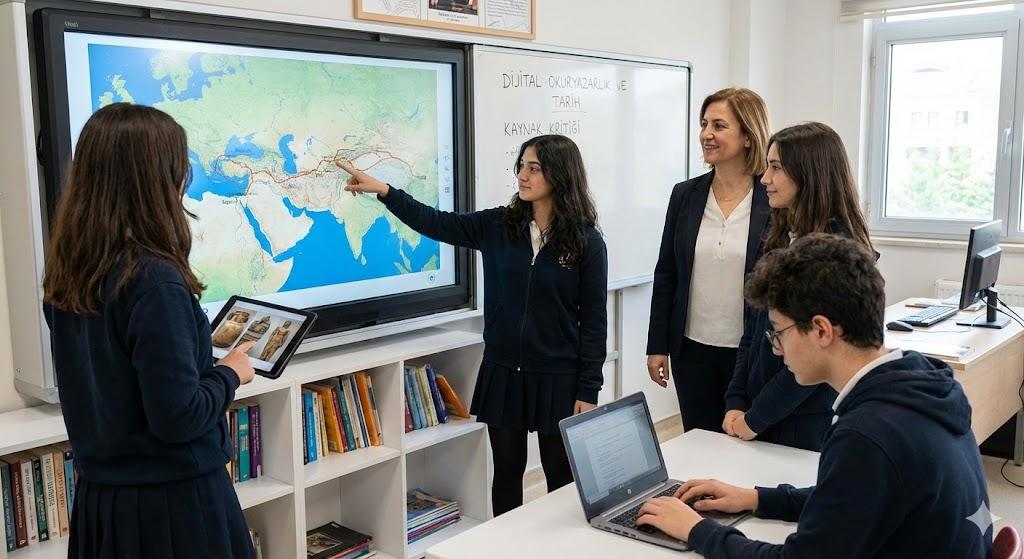
Digital Literacy in History Education (Generated with Artificial Intelligence)
Subject(s) | Digital Literacy in History Education | ||||||||
|---|---|---|---|---|---|---|---|---|---|
Goal | Digitizing historical thinking | ||||||||
Basic Problem | Disinformation, Echo chambers, Historical anachronism | ||||||||
Basic Components | Access to information, Critical evaluation, Content creation | ||||||||
English Equivalent | Digital Literacy in History Education | ||||||||
Digital literacy in history education encompasses the ability to access historical information through digital technologies, critically evaluate this information using historical methodology (critique), analyze it, and construct new digital historical narratives. This concept, examined within the framework of 21st century skills, is an interdisciplinary field that goes beyond the use of technological tools to investigate how historical thinking skills—such as time, chronology, cause and effect, change and continuity—are reconfigured within digital ecosystems. In the transition from traditional history education’s “memorization and transmission” model to a “inquiry and evidence-based” approach, digital tools function as instruments of epistemological transformation.
Digital literacy, within the context of history education, diverges from general literacy. Historical information is inherently interpretive and evidence-based. In the digital age, the cumulative increase of such evidence—primary sources, maps, documents—on the internet creates a “data overload” problem for students. The theoretical model that addresses this challenge is the TPACK (Technological Pedagogical Content Knowledge) model. According to this model developed by Mishra and Koehler, a competent history educator must simultaneously possess content knowledge of history, pedagogical knowledge of how to teach it, and technological knowledge to support the teaching process.【1】
Digital history involves using databases, Geographic Information Systems (GIS), and network analysis to process data from the past, while history education focuses on how students interpret these data. The “Lateral Reading” technique, developed by Sam Wineburg and his Stanford History Education Group, forms the foundation of digital historical literacy. In this technique, users do not scroll down on a webpage to verify information; instead, they open new tabs to cross-check the source of the information.
Digital literacy gains functionality in history classrooms through concrete tools that offer pedagogical opportunities to make the abstract world of the past tangible and foster historical empathy:
The greatest risk digitalization brings to history education is the reliability of information. With Web 2.0 technologies, everyone has become a content producer (prosumer), potentially turning the internet into a “historical landfill.” Historical revisionism, conspiracy theories, and pseudo-history narratives spread rapidly through social media algorithms.
Digital historical literacy aims to prompt students to ask the following questions:
The ultimate goal of digital literacy is to enable students to move beyond “echo chambers”—where they only consume sources that reinforce their own views—and develop a multiperspectival understanding of history.
Literacy encompasses not only reading but also writing. In digital history education, students transition from passive consumers of information to active producers of content. Activities such as blog writing, podcast creation, digital storytelling, or short documentary production enable students to synthesize historical knowledge and reconstruct it in their own words. This process activates the higher-order skills of Bloom’s Taxonomy: evaluation and creation. However, during this production process, principles of respect for copyright (Creative Commons) and academic integrity (avoiding plagiarism) are also taught as part of digital citizenship education.【2】
Recent advances in Large Language Models (LLMs) and artificial intelligence (AI) technologies signal a new paradigm in history education. AI’s ability to summarize historical texts, translate ancient languages, or simulate “conversations” with historical figures through chatbots offers personalized learning opportunities. However, historical hallucinations in AI-generated texts—fabricating events that never occurred—and biases embedded in training datasets further underscore the importance of digital literacy. The historian of the future will be someone who collaborates with AI but does not accept its output as absolute truth, instead verifying and critically assessing its claims.
European Commission. "Digital Education Action Plan (2021-2027)." Accessed December 1, 2025. https://education.ec.europa.eu/focus-topics/digital-education/action-plan
Mishra, Punya, and Matthew J. Koehler. "Technological Pedagogical Content Knowledge: A Framework for Teacher Knowledge". *Teachers College Record* 108, no. 6 (2006): 1017-1054. Accessed December 1, 2025. http://punya.educ.msu.edu/publications/journal_articles/mishra-koehler-tcr2006.pdf
Safran, Mustafa. Tarih Nasıl Öğretilir?. İstanbul: Yeni İnsan Yayınevi, 2019.
Türkiye Cumhuriyeti Cumhurbaşkanlığı Devlet Arşivleri Başkanlığı. "Dijital Arşivlere Accessed." Accessed December 1, 2025. https://www.devletarsivleri.gov.tr
Wineburg, Sam. *Why Learn History (When It’s Already on Your Phone)*. Chicago: University of Chicago Press, 2018. Accessed December 1, 2025. https://press.uchicago.edu/ucp/books/book/chicago/W/bo23022136.html
[1]
Punya Mishra and Matthew J. Koehler, "Technological Pedagogical Content Knowledge: A Framework for Teacher Knowledge", Teachers College Record 108/6 (2006): 1020.
[2]
Sam Wineburg, Why Learn History (When It’s Already on Your Phone) (Chicago: University of Chicago Press, 2018), 45-50.

Digital Literacy in History Education (Generated with Artificial Intelligence)
Subject(s) | Digital Literacy in History Education | ||||||||
|---|---|---|---|---|---|---|---|---|---|
Goal | Digitizing historical thinking | ||||||||
Basic Problem | Disinformation, Echo chambers, Historical anachronism | ||||||||
Basic Components | Access to information, Critical evaluation, Content creation | ||||||||
English Equivalent | Digital Literacy in History Education | ||||||||
No Discussion Added Yet
Start discussion for "Digital Literacy in History Education" article
Conceptual Framework and Theoretical Foundation
Integration of Digital Tools into History Education
Information Pollution and the Challenge of Critical Evaluation
Web 2.0 and Historical Content Production
Future Perspective: Artificial Intelligence and History