


This article was automatically translated from the original Turkish version.
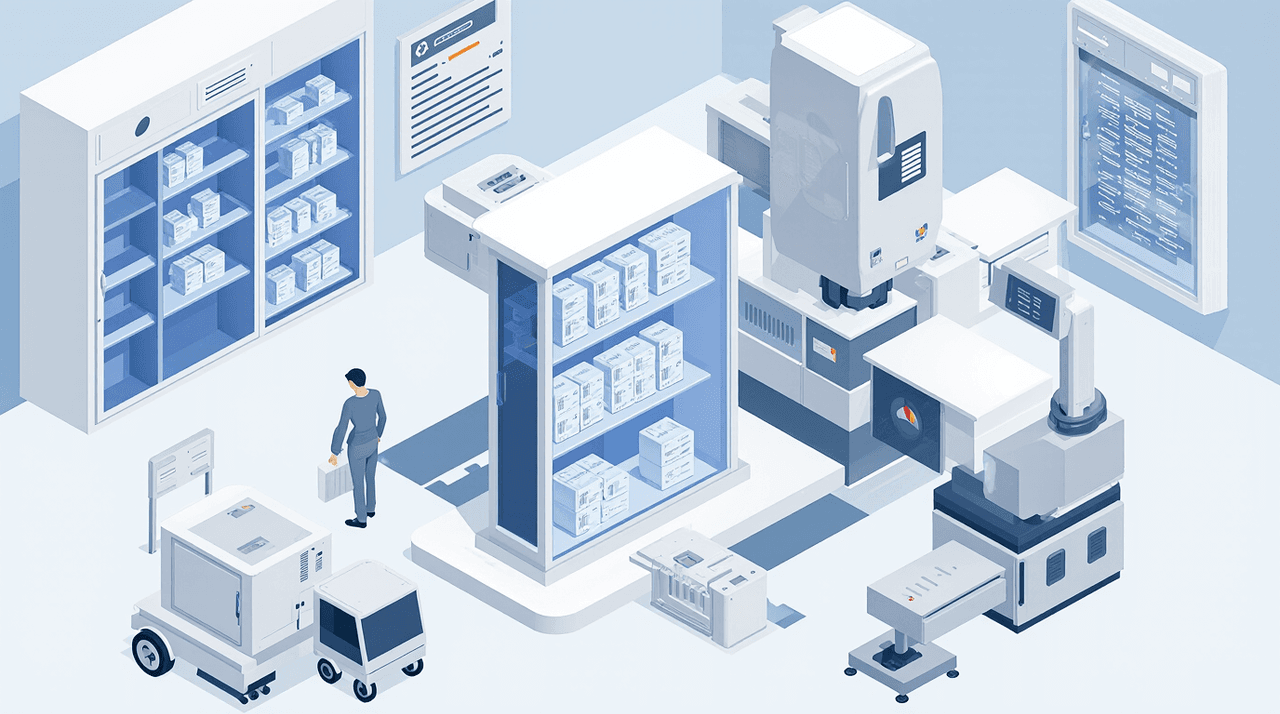
Drug Distribution Robot (Generated with Artificial Intelligence)
Main Functions | distribution of medications according to patients storage of medications Automatic packaging of medications | ||||||||
|---|---|---|---|---|---|---|---|---|---|
Advantage(s) | Patient safety inventory management reduction of error rates increased efficiency | ||||||||
Application Area(s) | quarantine areas laboratories pharmacies Hospitals | ||||||||
Core Technologies | Robotic arms, barcode readers, magnetic encoders, HBYS integration | ||||||||
Drug distribution robots are advanced mechatronic systems that automate the medication supply chain in healthcare services. These systems play a role in all stages of medication preparation, packaging, storage, and delivery to patients, offering significant advantages in both accuracy and speed. Particularly in large hospitals, pharmacies, and healthcare institutions, these robots have been developed to reduce human error in medication management, enhance patient safety, optimize inventory control, and redirect healthcare staff time toward clinical care activities.
Their operational principles are typically integrated with Hospital Information Management Systems (HIMS) or similar digital infrastructures. The system receives medication requests transmitted electronically by doctors or nurses, then ensures that the relevant medication is prepared according to the correct type, dose, and timing parameters. Some advanced models are equipped with modules such as barcode reading, RFID labeling, automated rack management, and online inventory tracking. As a result, medication traceability increases, risks of incorrect medication or dosage are minimized, and distribution processes achieve a more sustainable structure.
The integration of drug distribution robots also promotes standardization in pharmaceutical logistics and enables analysis of medication usage data within hospitals, contributing to the development of enterprise-level decision support systems.
The operation of drug distribution robots is structured around principles of full automation, data integrity, and precise motion control. The process typically begins with a medication order transmitted via the Hospital Information Management System (HIMS) and approved by clinical staff. The robotic system receives this request, automatically selects the required medications from the storage unit, and initiates the distribution process. This approach provides an integrated digital infrastructure that enhances both the security and speed of medication management.
Advanced systems such as Swisslog PillPick, a unit-dose medication management robot, execute the preparation and distribution process through a multi-stage structure. In the first stage, medications in ampoules, vials, or blister packs are introduced into the system, and appropriate processing steps are defined according to each formulation’s characteristics. The robot uses specialized “Blister Cutter” modules to precisely cut tablets from their packaging without contamination, separating them into single-dose units. Each unit dose is then packaged with a unique barcode assigned to it. This barcode system ensures traceability throughout the entire lifecycle of the medication—from production to patient administration—significantly reducing dosage errors and medication mistakes.
Maintaining hygiene standards is one of the primary objectives of these systems. Operations performed without direct human contact minimize contamination risks. Packaged unit-dose medications are placed into automated storage units called DrugNest via robotic arms. These modular storage systems are optimized according to medication type, dosage, and frequency of use. Since distribution operations can be conducted simultaneously with the storage process, the system operates continuously, preventing delays in medication delivery to patients.
When a new medication request is received via the HIMS, robotic arms collect the required medications from the storage unit and assemble them into patient-specific “PickRing” carriers. Automatic label printers apply labels to these carriers containing critical information such as the medication name, dose, expiration date, patient identity, and administration time. This labeling process is integrated with patient-specific verification systems, ensuring that a final security check via barcode scanning occurs before the medication is administered to the patient.
The ability of robots to perform high-precision tasks is made possible by advanced positioning technologies. Magnetic encoded tapes and encoder systems developed by Balluff enable robotic arms to move with millimeter-level accuracy. These non-contact systems are durable and require minimal maintenance since they are not subject to mechanical wear. Additionally, industrial robotic arms with 3, 4, or 5-axis mobility can rapidly identify and place medication packages of various sizes and shapes.
This multilayered automation architecture brings together traceability, security, precision, and efficiency in drug distribution processes. As a result, drug distribution robots are positioned as integrated healthcare technologies that enhance patient safety and operational effectiveness in modern hospitals.

Drug Distribution Robots (Generated by Artificial Intelligence)
Medical robots are advanced technological systems developed to perform diverse functions in healthcare services. These robots have a broad application range extending from surgery and rehabilitation to laboratory analysis and medication management. Within this spectrum, drug distribution systems stand out as a critical subcategory that automates treatment processes in healthcare institutions. Different models designed for varying scales and tasks are used across multiple domains, from hospital pharmacies to in-service delivery processes.
These systems are integrated automation solutions covering every stage of medication management. They carry out medication packaging, barcoding, storage, and patient-specific dose preparation within a single closed system. One of the most advanced examples in this category, Swisslog PillPick, has been specifically developed for use in hospitals with high patient volumes. The system fully automates pharmacy workflows, eliminating medication errors, dosage mix-ups, and delays caused by manual procedures. Additionally, by assigning a unique identifier to each medication unit, it ensures traceability and elevates patient safety to the highest level.
These robots are used not only for transporting medications but also for moving various hospital logistics items such as meals, medical waste, sterile supplies, and textiles. Thanks to autonomous navigation capabilities, they can move independently through corridors and elevators, open doors, and avoid environmental obstacles. These features eliminate human contact, particularly in quarantine areas or zones with high infection risk, ensuring a safe and efficient distribution process.
Modern models incorporate ultraviolet (UV-C) disinfection systems within their cabins, preserving the sterility of transported items. Additionally, remote voice and video communication features enable robots to interact contactlessly with both patients and staff. These attributes represent advanced automation solutions that integrate hospital logistics into the digital health ecosystem.
These systems, relatively smaller and more compact in design, are used in laboratory or pharmacy environments for high-precision dosing and mixing tasks. Industrial robots such as the LOCTITE D Series, originally developed for adhesive or liquid dispensing, can be adapted to pharmaceutical applications due to their modular architecture.
With three-axis mobility, precise dose control, and plug-and-play features, these robots offer practical solutions especially for personalized medication preparation or small-scale clinical research. Thanks to user-friendly programming interfaces, they can be rapidly deployed and ensure high repeatability.
The subsystems of drug distribution robots are designed with high levels of automation to enhance efficiency and safety:
When these building blocks are combined, drug distribution robots transcend their role as mere automated storage and delivery devices; they function as a seamless digital bridge between hospital logistics, pharmacy management, and patient safety. Thus, clinical efficiency and medication safety standards in medical processes are sustainably elevated.
Drug distribution robots have a wide range of applications, from central hospital pharmacies to outpatient clinics, quarantine zones to large-scale retail pharmacies. Thanks to their 24-hour uninterrupted operation capacity, these systems support continuity in healthcare services and reduce dependence on human labor in medication management. Their high accuracy, traceability, and hygiene standards have made them indispensable components of modern healthcare systems.
One of the most significant contributions of drug distribution robots is their ability to enhance patient safety by minimizing human errors. Automated recognition, selection, and dosing mechanisms largely eliminate critical mistakes such as wrong medication, wrong dose, or administration to the wrong patient. Each medication unit is identified by a unique barcode or RFID label, which is scanned at every stage of its lifecycle for verification. Integrated with the HIMS, the system ensures that every medication is delivered to the correct patient, at the correct time, and in the correct dose. This layered verification mechanism increases the reliability of pharmaceutical processes and meets international quality standards for patient safety.
These robots assume repetitive, time-consuming, and attention-intensive tasks from healthcare staff, enabling pharmacists and nurses to focus more on direct patient care. Parallel execution of automated medication selection, barcode verification, packaging, and delivery significantly increases overall system efficiency. As a result, medication preparation and delivery times are reduced, enabling rapid and accurate medication access—especially in emergency departments or intensive care units. Additionally, automatic logging of these processes simplifies auditing and reporting procedures.
Drug distribution robots are equipped with integrated management systems that dynamically monitor medication inventory. Each medication unit is barcoded with information such as batch number, expiration date, and storage conditions. This allows the system to track stock levels in real time and automatically initiate replenishment processes when supplies run low.
Medications returned by patients in unopened packaging are scanned by the robot and safely reintroduced into the system. Return data automatically transmitted to the HIMS updates billing, inventory, and accounting records instantly. This feature prevents medication waste and ensures cost-effectiveness.
Drug distribution robots are designed to preserve sterile conditions. By minimizing human contact, they reduce contamination risks and protect medications from microbial exposure. This feature provides a major advantage in environments where infection control is critical, such as quarantine areas, operating rooms, and intensive care units. Some systems include ultraviolet (UV-C) sterilization modules or HEPA-filtered air circulation systems, further ensuring sterility during transportation and storage.
In conclusion, drug distribution robots are not merely automation tools but integrated technological systems that provide strategic value to healthcare institutions in terms of patient safety, operational efficiency, economic sustainability, and hygiene management. As fundamental building blocks of digital hospital ecosystems, these robots play a central role in the intelligent healthcare infrastructure of the future.
The effectiveness of drug distribution robots largely depends on the level of integration with hospital information technology infrastructure. At the core of this integration is the Hospital Information Management System (HIMS), which manages all clinical, administrative, and logistical processes within the hospital. The bidirectional data exchange between robots and this system is critical for ensuring accuracy and traceability in medication management.
Drug distribution robots receive approved medication orders directly from the HIMS. This digital communication eliminates the need for manual entry of prescriptions or medication requests into the system, thereby reducing human error risk and accelerating the medication preparation process.
Based on the data received from the HIMS, the robot selects the appropriate medications from the storage unit, packages them in the correct dosages, and categorizes them by patient. All these operations are recorded in real time by the system, and digital records are maintained of who requested the medication, when, and for what purpose.
Once the preparation process is complete, the system not only transmits medication distribution data but also returns information on returns and inventory to the HIMS. This ensures the entire process is conducted through true bidirectional data communication.
The transmitted data includes quantities of medications used, identification numbers of returned medications, current inventory status, and patient-specific consumption data. As a result, inventory, billing, and patient records are always kept current, accurate, and synchronized. This integrity ensures high transparency in both logistical and clinical medication management.
Labels generated by drug distribution robots are configured to be fully compatible with Bedside Verification Systems. These systems create a final verification layer before medication is administered to the patient.
Before administering medication, the nurse scans the patient’s wristband barcode and the medication package barcode using the system. If the two data sets match, administration is approved; if any discrepancy exists, the system issues an alert and halts the procedure. This method, known as “closed-loop medication management,” represents the highest international standard for patient safety.
Closed-loop medication management aims to make every step of the medication process—from ordering to administration—digitally traceable and automatically verifiable. Drug distribution robots are a central component of this loop because they ensure data integrity and eliminate manual interventions. This approach not only prevents medication errors but also strengthens the culture of clinical safety in healthcare institutions, fulfills legal traceability requirements, and enhances operational efficiency.
In conclusion, the integrated structure established by drug distribution robots with the HIMS and other digital systems forms the foundation of intelligent medication management infrastructure in modern hospitals. Thanks to this integration, medications are guaranteed to reach the right person, in the right dose, at the right time, and via the right pathway, elevating patient safety and operational effectiveness to the highest level.
Basile, Karen, Monserrat Martínez, Julia D. Lucaci, Claudia Goldblatt, and Idal Beer. “Enhancing Operational Efficiency and Service Delivery through a Robotic Dispensing System: A Case Study from a Retail Pharmacy in Brazil.” *Pharmacy* 12, no. 5 (2024): 130. Accessed October 18, 2025. https://doi.org/10.3390/pharmacy12050130
Batson, S., A. Herranz, N. Rohrbach, M. Canobbio, S. A. Mitchell, and P. Bonnabry. “Automation of In-Hospital Pharmacy Dispensing: A Systematic Review.” *European Journal of Hospital Pharmacy* 28, no. 2 (March 2021): 58–64. Accessed October 18, 2025.
Meknassi Salime, G., N. Bhirich, A. Cherif Chefchaouni, O. El Hamdaoui, S. El Baraka, and Y. Elalaoui. “Assessment of Automation Models in Hospital Pharmacy: Systematic Review of Technologies, Practices, and Clinical Impacts.” *Hospital Pharmacy* (February 27, 2025): 00185787251315622. Accessed October 18, 2025. https://doi.org/10.1177/00185787251315622
Orsini, Federico Filippo, Daniele Bellavia, Fabrizio Schettini, and Emanuela Foglia. “The Impact of Automation and Digitalization in Hospital Medication Management: Economic Analysis in the European Countries.” *Healthcare* 13, no. 13 (2025): 1604. Accessed October 18, 2025. https://doi.org/10.3390/healthcare13131604
Shermock, Steven B., Kristen M. Shermock, and Linda L. Schepel. “Closed-Loop Medication Management With an Electronic Health Record System in U.S. and Finnish Hospitals.” *International Journal of Environmental Research and Public Health* 20, no. 17 (August 30, 2023): 6680. Accessed October 18, 2025. https://doi.org/10.3390/ijerph20176680
Takase, T., N. Masumoto, N. Shibatani et al. “Evaluating the Safety and Efficiency of Robotic Dispensing Systems.” *Journal of Pharmaceutical Health Care and Sciences* 8 (2022): 24. Accessed October 18, 2025. https://doi.org/10.1186/s40780-022-00255-w

Drug Distribution Robot (Generated with Artificial Intelligence)
Main Functions | distribution of medications according to patients storage of medications Automatic packaging of medications | ||||||||
|---|---|---|---|---|---|---|---|---|---|
Advantage(s) | Patient safety inventory management reduction of error rates increased efficiency | ||||||||
Application Area(s) | quarantine areas laboratories pharmacies Hospitals | ||||||||
Core Technologies | Robotic arms, barcode readers, magnetic encoders, HBYS integration | ||||||||
No Discussion Added Yet
Start discussion for "Drug Dispensing Robots" article
Operating Principle and Technology
Types of Drug Distribution Robots and System Components
Unit-Dose Medication Management Robots
Hospital Delivery Robots
Benchtop Distribution Robots
Core Components
Application Areas and Advantages
Enhanced Patient Safety
Efficiency and Time Savings
Advanced Inventory and Returns Management
Hygiene and Security
System Integration
HIMS Integration and Process Flow
Bidirectional Data Flow
Compatibility with Bedside Verification Systems
Closed-Loop Medication Management Approach