


This article was automatically translated from the original Turkish version.
+3 More
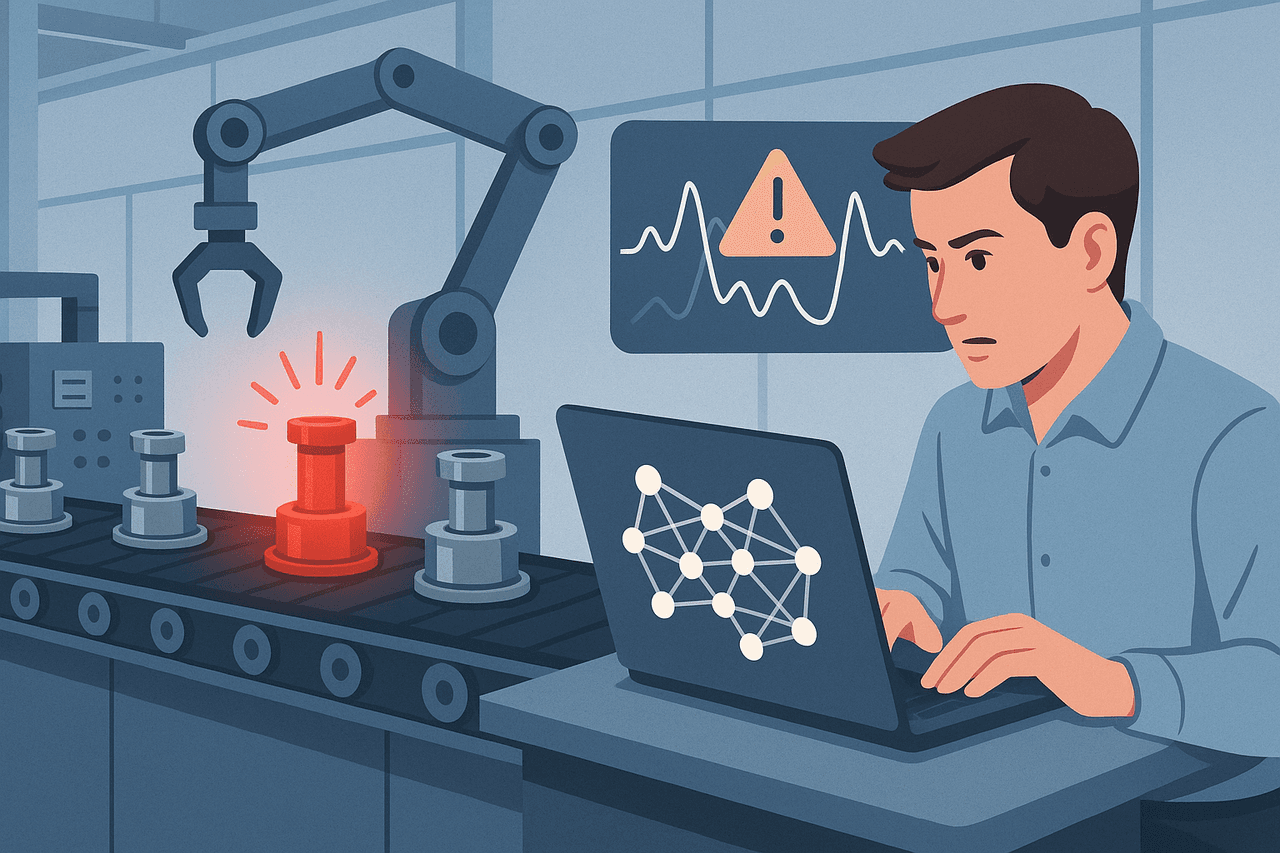
Generated with artificial intelligence.
Fault Prediction with Machine Learning
Definition(s) | A technology that uses artificial intelligence algorithms to predict failures in systems before they occur. | ||||||||
|---|---|---|---|---|---|---|---|---|---|
Primary Objective | Transition from reactive maintenance to predictive maintenance to increase operational efficiency and reduce costs. | ||||||||
Data Sources | Sensor data (temperature, vibration, pressure), operational records, maintenance history, meteorological data. | ||||||||
Technologies Used | Machine Learning, Internet of Things (IoT), Big Data, Cloud Computing, Digital Twin. | ||||||||
Important Application Areas | Production, Energy, Telecommunications, Transportation, Health | ||||||||
Failure Prediction with Machine Learning is a technology that employs algorithms and statistical models to anticipate potential failures in industrial machines, energy grids, telecommunications networks, and other complex systems before they occur, as a subfield of artificial intelligence. The primary objective of this approach is to shift from traditional, time-based or reactive maintenance strategies to a data-driven, proactive model known as predictive maintenance. By analyzing large volumes of data collected from systems, it detects hidden patterns and anomalies that signal impending failures. This enables organizations to increase operational efficiency by minimizing unexpected downtime, reduce maintenance costs, and extend equipment lifespan. The failure prediction process typically begins with continuous data collection from various sources such as sensors, system logs, and operational history. This collected data is used to train machine learning models, which learn the subtle differences between normal operating conditions and pre-failure states. Once training is complete, the model analyzes new incoming data in real time to predict the likelihood or timing of a failure. These predictions allow maintenance teams to be alerted in advance, enabling interventions to be scheduled without disrupting production processes.
Machine learning-based failure prediction is a systematic process operating within a specific methodology. This process consists of several fundamental steps, from data collection to the generation of failure alerts. Its success is directly dependent on high-quality data and appropriate algorithm selection. The system’s working principle involves the following steps:
The first step of the process is gathering relevant data from the monitored system or equipment. This data is obtained from sensors measuring physical parameters such as temperature, vibration, pressure, and current; from Internet of Things (IoT) devices; or from system operational records. The raw data collected is cleaned, missing values are imputed, and normalized to make it suitable for analysis. This stage is critical to the accuracy of the model.
The prepared dataset is used to train machine learning algorithms. In this phase, a model is built using historical data on normal operation and past failures. In supervised learning methods, data is labeled—for example, as “faulty” or “normal”—and the model learns patterns based on these labels. In unsupervised learning, the model learns to identify abnormal deviations or clusters on its own without labeled data.
The trained model analyzes new, real-time data from the system to predict potential future failures. The accuracy of the model’s predictions is continuously evaluated using test data, and its hyperparameters are optimized as needed to improve performance.
When the model detects a potential failure, it automatically sends an alert to operators or maintenance teams. This alert may include information about the type, location, and estimated timing of the failure. This proactive approach ensures that maintenance activities are scheduled at the most optimal time. The system continuously learns from new data, improving its ability to make more accurate predictions over time.

Failure Prediction with Machine Learning (Generated by Artificial Intelligence)
In failure prediction applications, different machine learning algorithms are selected based on the nature of the problem, the structure of the dataset, and the type of prediction required. These algorithms typically perform fundamental tasks such as regression, classification, or clustering.
Used to predict continuous values such as the remaining useful life of equipment. For example, they can estimate how many hours until a specific machine component will fail. Linear regression and Support Vector Regression (SVR) are common models in this category.
Used to categorize the current condition of equipment into distinct classes. For instance, a system can be classified as “healthy,” “high risk,” or “urgent maintenance required.” Decision trees, random forest, support vector machines (SVM), and logistic regression are frequently used classification algorithms.
Advanced algorithms that deliver high prediction accuracy. Models such as Extreme Gradient Boosting (XGBoost) and Light Gradient Boosting Machine (LGBM) are known for their success with complex and large datasets. Studies in critical systems such as electrical distribution networks have reported accuracy rates exceeding 95%.
Especially used for analyzing multi-layered and complex data structures. Deep learning models, particularly Long Short-Term Memory (LSTM) networks, are preferred for tasks such as detecting microscopic cracks on product surfaces in image-based quality control or identifying complex patterns in time-series data like vibration analysis.
Used to detect anomalous behavior in unlabeled data. For example, they can flag unexpected data points that deviate from a machine’s normal operating profile as anomalies. k-Nearest Neighbors (k-NN) is one algorithm that can be used for this purpose.
Failure prediction with machine learning is widely used across many sectors where operational continuity and safety are critical. This technology provides adaptable solutions tailored to the specific needs of different industries.
This is the most common application area. Unexpected downtime of machines on production lines leads to significant costs and production losses. Predictive maintenance applications analyze sensor data to detect machine failures in advance and enable planned maintenance. Research shows that these applications can reduce unplanned downtime by up to 50%, lower maintenance costs by up to 10%, and increase equipment availability by up to 20%. Additionally, models integrated with image processing can instantly detect process deviations or defects that affect product quality.
Continuous operation is vital in electrical distribution networks and power plants. Machine learning is used to predict failures in transformers, generators, and other critical equipment. These predictions incorporate operational data along with meteorological data such as storms or extreme temperatures to achieve more accurate results. This helps prevent power outages and optimizes maintenance scheduling.
The increasing complexity of modern telecommunications networks makes failure management more challenging. AI-based systems analyze anomalies in network traffic, hardware faults, or signs of cyberattacks to provide early warnings of potential disruptions. This enhances network reliability and performance while enabling operators to use resources more efficiently.
In sectors such as aviation, rail, and maritime transport, safety is the top priority. The condition of critical components such as aircraft engines, train wheels, or ship engines is continuously monitored using machine learning models. This ensures that potential failures are detected before they lead to disasters and that maintenance is performed on time.
This technology is also applied in diverse fields such as improving the efficiency of HVAC (heating, ventilation, and air conditioning) systems in buildings, ensuring the reliability of medical devices in healthcare, and preventing equipment failures in agricultural machinery in the field.
For machine learning-based failure prediction systems to function effectively, a range of advanced technologies must be integrated. These components play a critical role in every stage of the process, from data collection to analysis and simulation.
They form the foundation of predictive maintenance. Industrial sensors collect critical data such as vibration, temperature, pressure, humidity, and acoustics from machines. IoT devices transmit this data in real time to centralized systems or cloud platforms, enabling real-time monitoring and analysis.
Production facilities and other industrial environments can generate millions of data points per second. Big data technologies enable the storage, processing, and analysis of these massive and complex datasets. This allows the identification of failure patterns too complex to be detected by traditional methods.
Provides a scalable and flexible infrastructure for storing large volumes of data and running machine learning models that require high computational power. Cloud-based platforms make it easier for enterprises in different locations to access and manage their predictive maintenance systems remotely.
A technology that creates a virtual replica of a physical asset or process. Digital twins are continuously updated with sensor data from the real world. Different operational scenarios and failure conditions can be simulated on these virtual models. This allows potential failure impacts to be tested without damaging physical equipment and enables the development of preventive strategies.
Machine learning-based failure prediction provides organizations with significant operational and strategic advantages. The adoption of this technology leads to tangible improvements in efficiency, cost, and safety.
The most prominent benefit is the substantial reduction in unplanned downtime caused by unexpected equipment failures. Smoother and uninterrupted operation of production lines increases overall production capacity and efficiency.
Since failures are predicted in advance, the need for emergency repairs and expensive spare part orders decreases. Maintenance activities are scheduled at the most cost-effective times. Additionally, preventing production losses and optimizing energy consumption further reduces overall costs.
Equipment failures can cause serious workplace accidents, particularly in heavy industry and transportation. Early detection of potential failures prevents hazardous situations and creates a safer working environment for employees.
Regular and properly timed maintenance slows down equipment wear and allows it to operate longer under optimal conditions. This maximizes the return on capital investments.
A machine beginning to fail typically produces non-conforming or defective products. Predictive maintenance prevents such quality deviations at the source, reducing scrap rates and increasing customer satisfaction.
Failure prediction systems provide organizations with valuable data not only for maintenance planning but also for strategic decision-making. Insights gained on equipment performance, failure causes, and operational bottlenecks shape future investment and improvement initiatives.
Cabus, J. E. U., and İ. H. Altaş. "Machine Learning Model Applications for Fault Detection and Classification in Distributed Power Networks." DataSCI, Volume 4, no. 2, pp. 11–18, 2021. Accessed July 9, 2025. Accessed Adresi.
Ciaburro, Giuseppe. “Machine Fault Detection Methods Based on Machine Learning Algorithms: A Review.” *Mathematical Biosciences & Engineering* 19, no. 11 (August 2022): 11453–11490. Accessed July 9, 2025. Accessed Adresi.
Geyikoğlu, Ali, and Mete Yağanoğlu. “Makine Öğrenmesi Algoritmaları ile Elektrik Dağıtım Şebekeleri Arıza Tahmini.” Karadeniz Fen Bilimleri Dergisi 15, no. 1 (2025): 73–98. Accessed July 9, 2025.
Lee, Jay, Hung-An Kao, and Shanhu Yang. “Service Innovation and Smart Analytics for Industry 4.0 and Big Data Environment.” *Procedia CIRP* 16 (2014): 3–8. Accessed Adresi.
Lo, Ndeye Gueye, Jean-Marie Flaus, and Olivier Adrot. “Review of Machine Learning Approaches in Fault Diagnosis Applied to IoT System.” HAL Open Science, 2018. Accessed July 9, 2025. Accessed Adresi.

Generated with artificial intelligence.
Fault Prediction with Machine Learning
Definition(s) | A technology that uses artificial intelligence algorithms to predict failures in systems before they occur. | ||||||||
|---|---|---|---|---|---|---|---|---|---|
Primary Objective | Transition from reactive maintenance to predictive maintenance to increase operational efficiency and reduce costs. | ||||||||
Data Sources | Sensor data (temperature, vibration, pressure), operational records, maintenance history, meteorological data. | ||||||||
Technologies Used | Machine Learning, Internet of Things (IoT), Big Data, Cloud Computing, Digital Twin. | ||||||||
Important Application Areas | Production, Energy, Telecommunications, Transportation, Health | ||||||||
No Discussion Added Yet
Start discussion for "Fault Prediction with Machine Learning" article
Core Concepts and Working Principle
Data Collection and Preparation
Model Development and Training
Failure Prediction and Evaluation
Proactive Intervention and Continuous Improvement
Machine Learning Algorithms Used
Regression Models
Classification Models
Gradient Boosting Machines
Neural Networks and Deep Learning
Clustering Algorithms (Unsupervised Learning)
Application Areas
Manufacturing and Industry
Energy Sector
Telecommunications and Network Management
Transportation
Other Sectors
Technological Infrastructure and Components
Sensors and Internet of Things (IoT)
Big Data Analytics
Cloud Computing
Digital Twin
Benefits and Impacts
Operational Efficiency
Cost Savings
Enhanced Safety
Extended Equipment Lifespan
Improved Product Quality
Data-Driven Decision Making