


This article was automatically translated from the original Turkish version.
+4 More
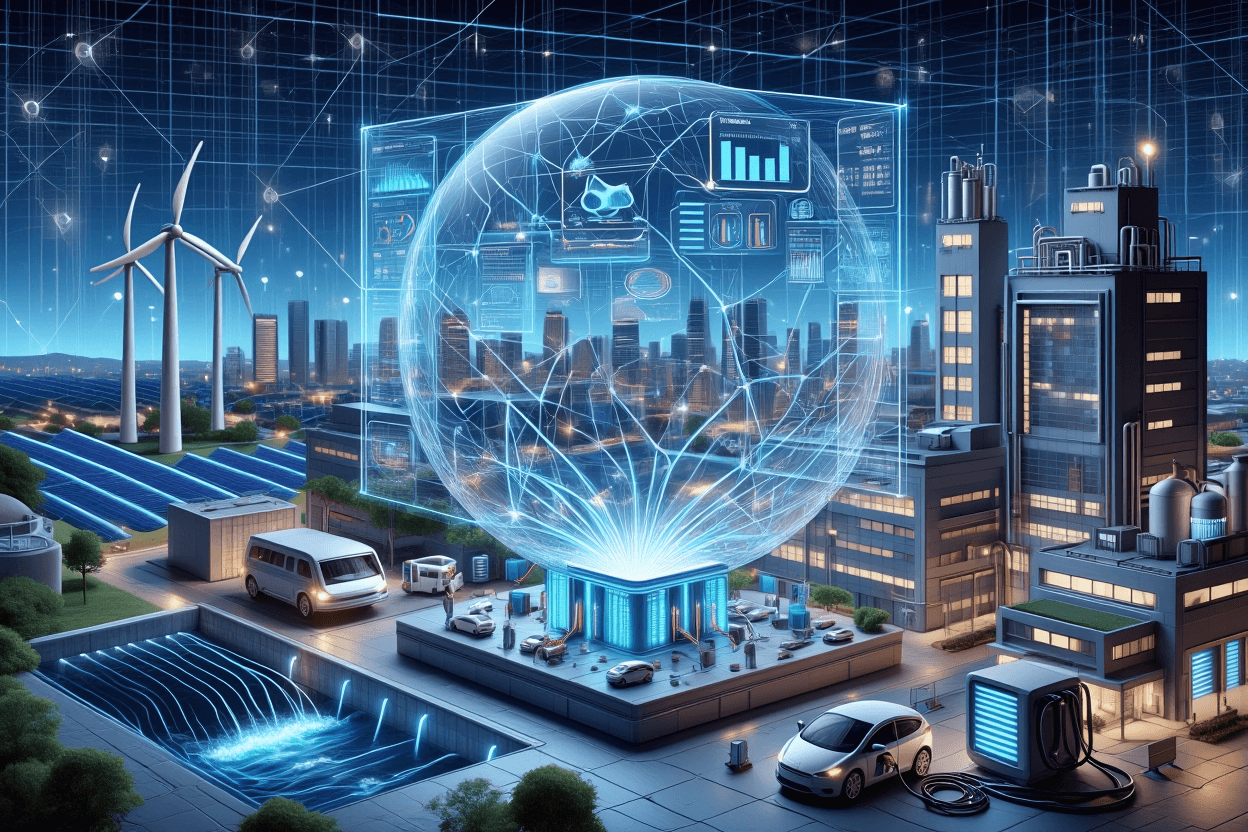
Artificial Intelligence-Assisted Energy Management (Generated by Artificial Intelligence)
Core Technologies | Artificial Intelligence, Machine Learning, Internet of Things (IoT), Big Data | ||||||||
|---|---|---|---|---|---|---|---|---|---|
Main Application Area(s) | Smart Grids Energy Storage Renewable Energy Integration Predictive Maintenance Demand Forecasting | ||||||||
Key Benefits | Energy efficiency, cost savings, grid reliability, emission reduction, sustainability | ||||||||
Related Concept(s) | Smart Grid Predictive Maintenance Energy Storage Systems (ESS) Demand Response Management (DRM) | ||||||||
Artificial intelligence-assisted energy management is a technological approach aimed at making the production, distribution, storage, and consumption processes of energy systems more efficient, secure, and sustainable. In this approach, artificial intelligence (AI), machine learning, and the Internet of Things (IoT) are leveraged as advanced digital technologies. These systems enable real-time monitoring of energy flows, balancing of supply and demand, prediction of failure risks, and reduction of environmental impacts through analysis of large-scale data. The rising global demand for energy, the intermittent nature of renewable energy sources, and the complexity of energy infrastructure are increasingly positioning these technologies at the center of the energy sector. AI-assisted energy management can be applied across diverse use cases, from individual buildings to industrial facilities. As a result, decision-making processes in the energy sector become more data-driven, costs are reduced, and energy supply security is strengthened.
Smart grids are traditional electricity networks enhanced with digital technologies. In these systems, AI algorithms continuously analyze vast amounts of data collected from sensors and smart meters installed across the grid to optimize energy flow. Key parameters such as voltage, current, and frequency are monitored in real time; potential faults or overloads are identified in advance to minimize outage risks. This enhances grid reliability. Additionally, AI-based balancing mechanisms enable smoother integration of variable renewable energy sources such as solar and wind into the system.

Smart Grid Management (Generated by Artificial Intelligence)
Accurate forecasting of energy demand is critical for both production planning and efficient resource utilization. AI and machine learning-based models process variables such as historical consumption data, meteorological forecasts, economic indicators, and market prices to generate highly accurate demand predictions. These forecasts assist energy companies in planning their production and distribution activities more efficiently.
Additionally, demand response management (DRM) systems automatically adjust consumer electricity usage in response to grid conditions. In industrial facilities, production activities during high-cost peak hours can be shifted to lower-cost time periods. Such applications provide cost advantages to consumers while contributing to load balancing on the grid.
Renewable energy sources such as solar and wind exhibit unpredictable fluctuations in output. AI analyzes satellite imagery, meteorological data, and historical production statistics to forecast future generation with high accuracy, thereby reducing this uncertainty. These forecasts enable grid operators to manage supply-demand balance with greater precision. As demonstrated in various international projects, big data and AI-based forecasting methods facilitate the larger-scale integration of renewable energy without compromising grid security.
Energy storage systems play a critical role in the integration of renewable sources into the grid. AI analyzes market prices, demand projections, and grid conditions to determine the optimal times for charging or discharging storage units such as battery systems. This optimization yields both economic benefits and support for grid stability. For example, charging batteries during low-price periods and discharging them during high-price periods creates cost advantages for both operators and consumers.
Equipment failures in energy production and distribution infrastructure can lead to significant economic losses. AI-assisted predictive maintenance systems continuously analyze parameters such as vibration, temperature, and pressure collected via sensors to monitor equipment health. Deviations from normal operating patterns are detected before failures occur, enabling proactive maintenance scheduling. This approach reduces repair costs and enhances system reliability and continuity.
A significant portion of global energy consumption occurs in buildings. AI is effectively used to manage heating, ventilation, air conditioning (HVAC), lighting, and other energy-consuming devices within buildings. These systems apply optimal usage scenarios by considering variables such as weather conditions, building occupancy rates, historical consumption patterns, and energy prices. As a result, energy consumption is reduced while maintaining comfort levels. Additionally, device-level consumption data is monitored to detect abnormal energy usage, and concrete recommendations for energy savings are provided to facility managers.

Energy Efficiency in Buildings (Generated by Artificial Intelligence)
AI-assisted energy management is a holistic system arising from the integration of multiple technological components. It enables efficient and reliable control of processes spanning from energy production and distribution to final consumption points. Its technological foundations are built upon data collection, data analysis, forecasting, and decision-making mechanisms.
Machine learning allows computer systems to learn from historical data, predict future conditions, and continuously improve performance. In energy management, this technology is applied in areas such as demand forecasting, consumption pattern analysis, energy price prediction, and fault anticipation. Deep learning, a more advanced subset of machine learning, enables the analysis of complex patterns through multi-layered neural networks. This technology uncovers hidden patterns in large-scale energy data, leading to more accurate decision-making. For example, Google’s DeepMind project used deep learning algorithms to optimize cooling systems in data centers, achieving up to a 40% reduction in energy consumption. This example clearly demonstrates the economic and environmental benefits of AI technologies in energy management.【1】
The Internet of Things (IoT) is one of the most critical components of energy management. IoT devices and sensors enable continuous data generation from various components of the energy infrastructure and facilitate real-time processing of this data. Smart meters, grid voltage and current sensors, smart thermostats, and industrial control devices provide a constant stream of data to AI algorithms.
Without this data, AI would lack sufficient information to assess the status of energy systems. IoT enables high-precision monitoring of instantaneous grid fluctuations, consumption patterns, and failure risks. As a result, energy systems become more flexible and reliable.
Another factor enhancing the effectiveness of AI in energy management is big data analytics and cloud computing infrastructure. The volume, variety, and velocity of data generated in the energy sector are extremely high. To process this data, high-capacity cloud-based storage solutions and advanced analytical tools are employed.
Through cloud computing, energy companies can store large-scale data, apply AI algorithms to broader data pools, and develop scalable analytical processes. This enables systems to learn faster and improves the accuracy of decision-making.
With the digitalization of energy systems, cybersecurity has become a critical concern. AI-assisted energy management introduces new security risks beyond efficiency and sustainability considerations. AI-based security solutions are deployed to prevent IoT devices and smart grids from being vulnerable to cyberattacks. AI-powered cybersecurity systems detect anomalous network behavior to identify potential attacks in advance and accelerate response processes. This safeguards energy supply security.
The advantages offered by AI-assisted energy management play a decisive role in the transformation of the energy sector.
The future of the energy sector is evolving toward a more autonomous, decentralized, and flexible structure driven by the widespread adoption of AI-based systems. The International Energy Agency (IEA) anticipates that AI solutions will play a critical role in achieving energy supply security, carbon reduction, and sustainable development goals in the coming years.
Advancing algorithms, increasing data diversity, and enhanced processing capabilities will deepen the decision-making capacity of AI systems. This will pave the way for the broader adoption of new applications such as autonomous microgrids, digital twins, fully automated demand management systems, and intelligent storage solutions in the energy sector.
Adelakun, Najeem, and Samuel Omolola. *Predictive Maintenance for Energy Systems in Built Environments Using Deep Learning Models*. 2025. https://doi.org/10.2139/ssrn.5133721.
Aslam, S., P. P. Aung, A. S. Rafsanjani, et al. “Machine Learning Applications in Energy Systems: Current Trends, Challenges, and Research Directions.” *Energy Informatics* 8 (2025): 62. https://doi.org/10.1186/s42162-025-00524-6.
Ejiyi, C. J., D. Cai, D. Thomas, et al. “Comprehensive Review of Artificial Intelligence Applications in Renewable Energy Systems: Current Implementations and Emerging Trends.” *Journal of Big Data* 12 (2025): 169. https://doi.org/10.1186/s40537-025-01178-7.
International Energy Agency (IEA). *Energy and AI*. Accessed August 16, 2025. https://www.iea.org/reports/energy-and-ai.
Javed, H., F. Eid, S. El-Sappagh, et al. “Sustainable Energy Management in the AI Era: A Comprehensive Analysis of ML and DL Approaches.” *Computing* 107 (2025): 132. https://doi.org/10.1007/s00607-025-01485-0.
Onwusinkwue, Shedrack, Femi Osasona, Islam Ahmad, Anthony Anyanwu, Samuel Dawodu, Ogugua Obi, and Ahmad Hamdan. “Artificial Intelligence (AI) in Renewable Energy: A Review of Predictive Maintenance and Energy Optimization.” _World Journal of Advanced Research and Reviews_ 21, no. 1 (2024): 2487–2799. https://doi.org/10.30574/wjarr.2024.21.1.0347.
Safari, Ashkan, Mohammadreza Daneshvar, and Amjad Anvari-Moghaddam. “Energy Intelligence: A Systematic Review of Artificial Intelligence for Energy Management.” *Applied Sciences* 14, no. 23 (2024): 11112. https://doi.org/10.3390/app142311112.
Shah, Jaymin. “Integration of AI-Based Predictive Maintenance for Energy-Efficient Mechanical Systems.” World Journal of Advanced Engineering Technology and Sciences 11 (2024): 664–673. https://doi.org/10.30574/wjaets.2024.11.2.0153.
[1]
DeepMind. “DeepMind AI Reduces Google Data Centre Cooling Bill by 40%.” DeepMind Blog, July 20, 2016. Erişim Tarihi: 16 Ağustos 2025. .

Artificial Intelligence-Assisted Energy Management (Generated by Artificial Intelligence)
Core Technologies | Artificial Intelligence, Machine Learning, Internet of Things (IoT), Big Data | ||||||||
|---|---|---|---|---|---|---|---|---|---|
Main Application Area(s) | Smart Grids Energy Storage Renewable Energy Integration Predictive Maintenance Demand Forecasting | ||||||||
Key Benefits | Energy efficiency, cost savings, grid reliability, emission reduction, sustainability | ||||||||
Related Concept(s) | Smart Grid Predictive Maintenance Energy Storage Systems (ESS) Demand Response Management (DRM) | ||||||||
No Discussion Added Yet
Start discussion for "Artificial Intelligence-Assisted Energy Management" article
Key Application Areas
Smart Grid Management
Demand Forecasting and Management
Renewable Energy Integration and Forecasting
Energy Storage Optimization
Predictive Maintenance and Fault Detection
Energy Efficiency in Buildings and Facilities
Technological Foundations of AI-Assisted Energy Management
Machine Learning and Deep Learning
Internet of Things (IoT) and Sensors
Big Data and Cloud Computing
Cybersecurity and Data Protection
Advantages
Future Perspectives