This article was automatically translated from the original Turkish version.
The 28 February Process refers to the period of political and institutional intervention that began following the decisions made at the National Security Council (NSC) meeting on 28 February 1997, and significantly influenced Turkish politics, civil-military relations, and social life, particularly between 1997 and 2002.
The 28 February Process (TRT News)
The process took shape during the term of the Refah-Yol Government, formed by the coalition of the Welfare Party (Refah Partisi) and the True Path Party (Doğru Yol Partisi) under Prime Minister Necmettin Erbakan, following assessments that the state’s secular principle was under threat. Throughout this period, debates based on secularism and the rhetoric of “threat of reaction” gained widespread public attention; political and administrative pressure on the government intensified. In this context, on 28 February 1997, the NSC meeting concluded that the military establishment viewed the country’s secular republican order as under threat and presented the government with an 18-point advisory decision. These decisions included measures particularly in the areas of the education system, religious visibility in public institutions, and civil society activities.
Amid growing social and political tensions, on 19 June 1997, Necmettin Erbakan submitted the government’s resignation to President Süleyman Demirel. Following the resignation, President Süleyman Demirel assigned the task of forming a new government to Mesut Yılmaz. Thus, the 54th Government ended, and administrative and legal measures aimed at implementing the 28 February decisions continued under the newly formed coalition government.
At the end of the process, the Refah-Yol Government was dissolved, the Welfare Party was shut down, and prolonged debates emerged in Türkiye regarding secularism, democracy, and civil-military relations.
In the General Elections held on 31 March 1995, the Welfare Party received 21.37% of the total votes and emerged as the leading party.【1】 Thus, for the first time in its history, the National Vision Movement led by Necmettin Erbakan in Turkish politics since 1969 gained the authority to form a government. However, the election results also triggered a government crisis. Necmettin Erbakan, entrusted with forming a government, failed to secure sufficient support from other parties during coalition negotiations and returned the mandate.

Milliyet Newspaper Headline of 29 June 1996 (Gaste Archive)
In response, President Süleyman Demirel assigned the task of forming a government to Mesut Yılmaz, the General Chairman of the Motherland Party (ANAP), which had 132 members of parliament. Since ANAP did not hold an absolute majority, its General Chairman Mesut Yılmaz signed a coalition protocol with Tansu Çiller, General Chairman of the True Path Party (DYP), forming a coalition known as ANA-YOL, and with external support from the Democratic Left Party (DSP), the 53rd Government was officially established on 6 March 1996. This government began its duties after receiving a vote of confidence in parliament, but soon experienced internal dynamics and political tensions that led to its collapse.
On 7 June, President Süleyman Demirel again entrusted the task of forming a government to Necmettin Erbakan, General Chairman of the Welfare Party. Consequently, coalition negotiations began between the Welfare Party and the True Path Party. On 28 June 1996, the coalition government formed between the Welfare Party and the True Path Party, publicly known as the “Refahyol Government,” assumed office. Necmettin Erbakan became Prime Minister and Tansu Çiller became Deputy Prime Minister and Minister of Foreign Affairs.【2】
The Refah-Yol Government gained prominence through economic reforms, salary increases for public employees, and initiatives to strengthen relations with Islamic countries in foreign policy. However, secularism debates, military-political tensions, and the NSC decisions of 28 February 1997 led to increased political pressure; the government ended with Erbakan’s resignation in June 1997.
During the Refah-Yol government, several key developments laid the groundwork for the 28 February Process:
4 October: On 4 October 1996, Erbakan initiated efforts to enhance economic and political cooperation with Muslim countries in Türkiye’s foreign policy. In this context, diplomatic contacts were launched for the D-8 (Developing Eight) initiative, viewed as an alternative to European Union-centered cooperation models.【3】
6 October: Erbakan’s visit to Libya generated widespread public reaction. During the visit, Libyan leader Muammar Gaddafi’s criticisms of Türkiye’s relations with Israel and the Kurdish issue were reported in the media. In his statement, Erbakan affirmed that Türkiye and Libya were friendly and brotherly countries and indicated that terrorism stemmed from external ideological factors.【4】

15 June 1997 D-8 Leaders Summit Commemorative Photo (D-8)
21 October: The D-8 formation, comprising eight Muslim countries under Türkiye’s leadership, was publicly announced through a meeting held in Istanbul. Erbakan described this initiative as an alternative economic cooperation model to the G-8 and brought forward ideas for deeper economic and defense cooperation among Islamic countries.【5】
3 November: A traffic accident near Susurluk district of Balıkesir triggered widespread debate regarding the links between the state, politics, security bureaucracy, and organized crime. The presence of DYP Şanlıurfa MP Sedat Bucak, Police Chief Hüseyin Kocadağ, and Abdullah Çatlı, wanted by Interpol via a red notice, in the same vehicle led to the incident being known in public opinion as the “Susurluk Scandal.” This development initiated an intense political and social debate on informal structures and security policies within the state.
26 December: A police operation was conducted at the Istanbul home of Aczimendi leader Müslüm Gündüz; the media accompanying the operation broadcast images of Fadime Şahin present in the house. The incident generated significant public reaction, and some newspapers began publishing critical series on Sufi orders.【6】
11 January: Prime Minister Necmettin Erbakan held an iftar program with certain religious leaders at the Prime Minister’s Residence. The program was covered by some media outlets within the context of secularism debates. In his statement on the issue, Erbakan contested the criticism by noting that President Süleyman Demirel had also held similar contacts with religious representatives from other countries.
16 January: CHP General Secretary Adnan Keskin and 33 members of parliament filed a criminal complaint against the Prime Minister’s Office at the Ankara Republic Public Prosecutor’s Office over the iftar program.
31 January: During the “Solidarity with Palestine and Jerusalem Night” organized by RP Sincan Mayor Bekir Yıldız, Iran’s Ambassador to Ankara, Muhammad Reza Bagheri, delivered a speech and exhibits were displayed, further intensifying “regime debates.” The Ankara State Security Court launched an investigation into the Jerusalem Night event in Sincan, Ankara. Bekir Yıldız was removed from office by then Interior Minister Meral Akşener on the day tanks passed through Sincan. Yıldız and nine others were arrested on charges of “aiding an illegal armed gang” and “inciting hatred and enmity among the public.”【7】
1 February: Prime Minister Erbakan submitted a decree to the Council of Ministers allowing the wearing of headscarves in universities, despite objections from some ministers of his coalition partner, the True Path Party.【8】
3 February: A physical altercation between a television reporter filming near the tent organized by Sincan Municipality for the Jerusalem Night and a municipal employee was broadcast to the public and drew criticism from secular circles.
4 February: Prime Minister Necmettin Erbakan, during a group meeting, stated that things done mistakenly as provocations would not destroy the country, but these remarks failed to calm the debates.【9】

Tanks Passed Through Sincan, Ankara on 4 February 1997 Anadolu Agency
4 February: Soldiers moved 15 tanks and 20 armored vehicles through Sincan. The incident triggered debates on military intervention.
Prime Minister’s coalition partner Tansu Çiller said, “We cannot ignore or underestimate the incident in Sincan,” while BBP General Chairman Muhsin Yazıcıoğlu stated, “We will never salute tanks turned against the people,” opposing the deployment of tanks within the city. 【10】 President Süleyman Demirel sent a warning letter to Prime Minister Necmettin Erbakan during this period. The letter emphasized the need for full implementation of existing laws to protect the secular order and prevent infiltration of fundamentalist currents into state institutions.【11】
Later, at a Turkish-US Council meeting in Washington, then Deputy Chief of the General Staff, General Çevik Bir, referring to the events in Sincan, stated: “We calibrated the balance for democracy in Sincan.”【12】
25 February: The Commander of the Naval Forces, Admiral Güven Erkaya, made a statement to the press: “Excessive religious currents have now become a greater threat than the PKK.” This statement was widely reported in the media.【13】
On 28 February 1997, the National Security Council convened under the chairmanship of President Süleyman Demirel. The approximately 8-hour and 45-minute meeting was one of the longest in the NSC’s history up to that date. At its conclusion, a 20-point decision list was prepared for the government.

NSC Meeting (TRT)
The decisions included extending compulsory basic education to eight years and prohibiting the employment of individuals dismissed from the Turkish Armed Forces due to involvement in reactionary activities in municipal institutions.
The 28 February NSC decisions were as follows:【14】
"1. The principle of secularism, which is among the fundamental characteristics of the Republic as stipulated in our Constitution and guaranteed under Article 4 of the Constitution, must be protected with great care and sensitivity; existing laws must be applied without any discrimination, and if they are found insufficient in application, new regulations must be enacted.
2. Private dormitories, foundations, and schools linked to Sufi orders must be brought under the supervision of state authorities and transferred to the Ministry of National Education in accordance with the Unification of Education Law.
3. To ensure the awakening of the young generation’s minds primarily to the values of the Republic, Atatürk, love of homeland and nation, and the ideal and purpose of elevating the Turkish nation to the level of modern civilization, and to protect them from the influence of various mystical groups;
4- An uninterrupted eight-year education must be implemented throughout the country,
5- Qur’an courses, which children who have completed basic education may attend upon their families’ request, must operate under the responsibility and control of the Ministry of National Education, with necessary administrative and legal regulations enacted.
6. National Education Institutions, responsible for training religious personnel loyal to the Republican regime and Atatürk’s principles and reforms, must be maintained at the necessary level in accordance with the spirit of the Unification of Education Law.
7. Religious facilities constructed in various parts of the country must not be used as political instruments to send messages to specific circles; if such facilities are needed, they must be reviewed by the Directorate of Religious Affairs and coordinated among local administrations and relevant authorities.
8. Activities of Sufi orders and all elements specified in Law No. 677, which have been prohibited, must be terminated, and any damage to the country’s democratic, political, and social legal order must be prevented.
9. Media groups that attempt to portray the Turkish Armed Forces as anti-religious by exploiting the dismissal of personnel due to reactionary activities, as decided by the Supreme Military Council, must be brought under control.
10. Personnel dismissed from the Turkish Armed Forces due to reactionary activities, indiscipline, or links to illegal organizations must not be employed or granted incentives in other public institutions.
11. Measures taken under existing legislation to prevent infiltration by extremist religious elements into the Turkish Armed Forces must also be applied across all other public institutions, particularly universities and other educational institutions and at all levels of the bureaucracy and judiciary.
12. To protect our country from an archaic regime and potential conflict arising from religious exploitation, measures must be taken to prevent the anti-regime activities, attitudes, and behaviors of the Islamic Republic of Iran in Türkiye, without disrupting our neighborly relations or economic ties with Iran, but by preparing and implementing a package of measures to prevent destructive and harmful activities.
13. Extremely dangerous activities by extremist religious groups aimed at inciting sectarian divisions in Türkiye, thereby causing societal polarization and dividing the nation into hostile camps, must be prevented by legal and administrative means.
14. Legal and administrative procedures concerning incidents violating the Turkish Constitution, the Political Parties Law, the Turkish Penal Code, and especially the Municipalities Law must be concluded promptly, and strict measures must be taken at all levels to prevent recurrence of such incidents.
15. Practices violating the law on clothing and leading Türkiye toward an archaic appearance must be prevented; laws and decisions of the Constitutional Court on this matter must be strictly implemented, especially in public institutions.
16. Licenses for short- and long-barreled firearms must be reorganized based on police and gendarmerie jurisdictions, with restrictions imposed; demand for pump-action rifles must be carefully evaluated.
17. The collection of sacrificial animal hides must be prevented when done by regime-opposing organizations and institutions aiming to generate financial resources, and collection must not occur beyond the authority granted by law.
18. Legal procedures concerning private security personnel wearing unauthorized uniforms and those responsible for such practices must be concluded promptly, and all private security personnel not provided for by law must be removed, considering the alarming scale such illegal practices may reach.
19. Initiatives that seek to resolve national problems based on the concept of “ummah” rather than “nation,” and which approach separatist terrorist organizations on the same basis, thereby encouraging them, must be prevented by legal and administrative means.
20. Opportunities must not be given for the exploitation of Law No. 5816 concerning disrespect toward the Great Liberator Atatürk and crimes committed against him.
Prime Minister Necmettin Erbakan refused to sign some of the 20-point NSC decisions. On 3 March 1997, several leading members of the True Path Party called for withdrawal from the government. During this period, Tansu Çiller attempted to persuade Erbakan to sign the NSC decisions during a meeting at the Prime Ministry.
Following the 28 February NSC decisions, Tansu Çiller and Necmettin Erbakan held discussions on the parliamentary debate and implementation of the decisions. However, due to opposition from other parties and rising political tensions, the plans were not fully implemented. President Süleyman Demirel emphasized that the NSC was a constitutional body and stressed the importance of implementing its decisions.
On 3 March 1997, some members of parliament and party officials from the DYP called for withdrawal from the government. During the same period, Çiller continued discussions with Erbakan at the Prime Ministry regarding signing the NSC decisions.【15】
During this period, various civil society organizations also issued public statements. The Atatürkist Thought Association, Confederation of Revolutionary Workers’ Unions (DİSK), Confederation of Public Employees’ Unions (KESK), Union of Chambers and Commodity Exchanges of Türkiye (TOBB), Confederation of Turkish Employers’ Unions (TİSK), Confederation of Turkish Craftsmen and Artisans (TESK), and Confederation of Turkish Labor Unions (Türk-İş) declared their support for the NSC decisions in their statements. 【16】
Other developments during the process included:
17 April: Fethullah Gülen, participating in a program broadcast on Kanal D, stated that those governing Türkiye had failed to demonstrate adequate performance, saying, “We failed in this task and got our hands dirty,” and that they should step aside. Gülen argued that the eight-year uninterrupted education would not harm Imam Hatip schools and said that some soldiers were more democratic than certain civilians.【17】
17 April: A speech by Erzurum Gendarmerie Regional Commander Brigadier General Osman Özbek, targeting Prime Minister Necmettin Erbakan without naming him and containing profanity, was reported in the media.【18】 In response, a Welfare Party member of parliament requested an investigation against Özbek from the General Staff. The file prepared for investigation permission reached Prime Minister Erbakan, but Erbakan refused to grant permission to avoid further escalation of tensions.
11 May: A historic rally attended by hundreds of thousands took place in Sultanahmet against the path leading to the closure of Imam Hatip schools under the eight-year uninterrupted education policy.【19】
13 May: In accordance with the NSC decisions, an operation targeting individuals violating the Clothing Law was launched. Under the operation named “Sarık Operation,” individuals wearing sarık and cübbe in Fatih Çarşamba and Sultanbeyli were taken into custody.【20】
21 May: Chief Public Prosecutor of the Court of Cassation Vural Savaş filed a case at the Constitutional Court seeking the closure of the Welfare Party on grounds that it “was dragging Türkiye into civil war” and “was the focal point of actions contrary to the principle of secular republic.”【21】

Judicial Officials Received Briefing from General Staff Headquarters (Gaste Archive)
26 May: An extraordinary Supreme Military Council was convened. 161 officers and non-commissioned officers were dismissed from the military.
9 June: Justice Minister Şevket Kazan denied permission for judges and prosecutors to attend the General Staff’s briefing on reaction. The General Staff responded: “The prosecutors of the Constitutional Monarchy will not come.”
10 June: The General Staff conducted a briefing on reaction for judges and prosecutors. Four hundred judges and prosecutors, including senior judicial leaders, attended the briefing held at the General Staff Headquarters. This incident undermined the democratic justice understanding of the Republic by showing that those responsible for applying the law received briefings through unlawful means.【22】
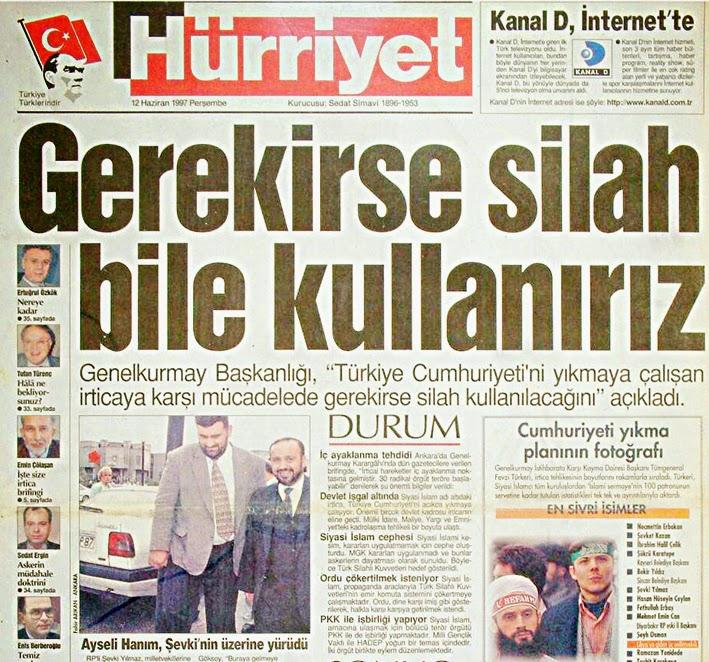
11 June: The General Staff conducted a briefing on reaction for the media after the judicial officials. In the briefing, which echoed the rhetoric of the 12 March and 12 September coups, it was stated that the threat of reaction had declared jihad against the Republic, and “defending the regime with weapons” was discussed.【23】
14 June: Rumors spread that tanks from armored units in Ankara Etimesgut passed through Sincan again during the afternoon.
18 June: Amid rising political tensions, on 19 June 1997, Necmettin Erbakan submitted his government’s resignation to President Süleyman Demirel, proposing to hand over the premiership to Tansu Çiller and hold early elections.
President Süleyman Demirel did not assign the task of forming a government on 20 June 1997 to Tansu Çiller, the General Chairman of the True Path Party, which held the numerical majority in the Turkish Grand National Assembly. The task was entrusted to Mesut Yılmaz, the General Chairman of the Motherland Party. Demirel later explained this choice: “Had I given the mandate to Çiller, the tensions would have continued. I exercised my discretion.”
A coalition government (55th Government) comprising the Motherland Party (ANAP), the Democratic Left Party (DSP), and the Democratic Turkey Party (DTP) under Prime Minister Yılmaz assumed office. During this period, measures were implemented to enforce the 28 February 1997 National Security Council decisions.
16 August: The law on eight years of uninterrupted education was adopted by the Turkish Grand National Assembly.【24】 This regulation made eight years of primary education compulsory and closed the middle school sections of Imam Hatip High Schools.
11 September: Private Onbaşı Kadir Sarmusak, who was on trial for leaking documents belonging to the Western Working Group, claimed in court that the phones of 3,800 people, including the military prosecutor who was trying him, had been monitored. He said, “The military monitored everyone. If I explain how the 55th Government was formed, many people will be in trouble.” 【25】
31 October: The National Security Council restructured the 1992 National Security Policy Document. The phrase “reaction has become the primary threat” was added to the document.【26】
18 November: The closure case against the Welfare Party began at the Constitutional Court. Necmettin Erbakan delivered a 4.5-hour defense on the first day.
6 December: Istanbul Metropolitan Mayor Recep Tayyip Erdoğan, accompanied by a group of 20 businesspeople, visited Siirt. Addressing the public in Republic Square, Erdoğan recited Ziya Gökalp’s poem titled “Soldier’s Prayer.”
23 December: At an NSC meeting, the military requested the acceleration of social and economic sanctions against reactionary activities and the close monitoring of companies labeled as “Islamic capital.”
25 December: President Süleyman Demirel received the “National Reconciliation Award” from the Journalists and Writers Foundation at a ceremony honoring Fethullah Gülen.【27】
1998 was a period in which the legal and administrative consequences of the 28 February 1997 National Security Council decisions became more evident. Important developments during this period included:
16–18 January: The Welfare Party was shut down in the lawsuit filed by Chief Public Prosecutor of the Court of Cassation Vural Savaş, on grounds that it was “the focal point of actions contrary to the principle of secular republic.” A five-year ban on political activity was imposed on Necmettin Erbakan and six other party members.【28】

Newspaper Headline Showing the Political Ban Imposed on Recep Tayyip Erdoğan (Gaste Archive)
10 February: Prime Minister Mesut Yılmaz issued a circular requesting that civil servants’ attire be continuously monitored by their supervisors.
11 February: Prime Minister Yılmaz issued a circular appointing governors and district governors as members of the Civil Working Group, established to combat separatism and reaction.<kure-citation citation-content='<p class="paragraph"><span style="white-space: pre-wrap;">Hürriyet Newspaper “Yılmaz’s Attire Circular.” 29 March 1998.
[1]
Republic of Turkey Supreme Election Council, “General Elections for Members of Parliament Between 1983 and 2007,” Accessed 27 February 2025, https://www.ysk.gov.tr/tr/1983-2007-yillari-arasi-milletvekili-genel-secimleri/3008
[2]
Anadolu Agency, "Former Prime Minister Tansu Çiller Explains the 28 February Process," Accessed 27 February 2025.https://www.aa.com.tr/tr/28-subat/eski-basbakan-tansu-ciller-28-subat-surecini-anlatti/2159584
[3]
D-8 Organization for Economic Cooperation, ‘’Brief History of D-8,’’ Accessed: 27 February 2025, https://developing8.org/about-d-8/brief-history-of-d-8/
[4]
Sinan Çetinkaya. “Erbakan’s Response to Kaddafi (Not Shown on TV).” YouTube. 27 October 2011. https://www.youtube.com/watch?v=E5aFjCUaWsk.
[5]
D-8 Organization for Economic Cooperation. “Brief History of D-8.” 2023. https://developing8.org/about-d-8/brief-history-of-d-8/.
[6]
Coups in Türkiye and the World. “Chronology of 28 February.” June 2021. https://darbeler.com/28-subatin-kronolojisi/.
[7]
Budak , Cemil Murat . 2026. “29 Years Have Passed Since the 28 February ‘Postmodern Coup.’” Anadolu Agency. 2026. https://www.aa.com.tr/tr/28-subat/28-subat-postmodern-darbesinin-uzerinden-29-yil-gecti/3841544.
[8]
Anadolu Agency, "Postmodern Coup: 28 February
[9]
32.Gün Documentary. “28 February Documentary, Episode 7 | 32nd Day Archive.” YouTube. 1 September 2017. https://www.youtube.com/watch?v=JQRXu0M9Tdo.
[10]
GZT, Muhsin Yazıcıoğlu’s 10 Statements Reflecting His Political Stance, Accessed: 27 February 2025. https://www.gzt.com/jurnalist/muhsin-yazicioglunun-siyasi-durusunu-yansitan-10-sozu-2932586
[11]
NTV. “Demirel’s Letter to Erbakan on 28 February.” 27 February 2012. https://www.ntv.com.tr/turkiye/demirelden-erbakana-28-subat-mektubu,j8eLjpoPKkOMKNvPyXxRzw.
[12]
Yeni Şafak Newspaper. “The Dark Days of the 28 February ‘Postmodern Coup’: ‘We Calibrated the Balance for Democracy’ Was Said.” 28 February 2023. https://www.yenisafak.com/gundem/28-subat-postmodern-darbesinin-karanlik-gunleri-demokrasiye-balans-ayari-yaptik-denilmisti-4511473.
[13]
Milliyet. "We Love Democracy,” 25 February 1997, Accessed: 27 February 2025, https://www.milliyet.com.tr/yazarlar/demokrasiyi-seviyoruz-5386712
[14]
Anadolu Agency. “The NSC’s ‘28 February’ Minutes in Court.” 2026. https://www.aa.com.tr/tr/turkiye/mgknin-28-subat-tutanaklari-mahkemede/216613.
[15]
Tosun, Mehmet. “25 Years Have Passed Since the 28 February ‘Postmodern Coup’.” 1 March 2022. https://www.aa.com.tr/tr/28-subat/28-subat-postmodern-darbesinin-uzerinden-25-yil-gecti/2516611.
[16]
Öztürk, Mehmet. “The 28 February Coup and Legal Evaluations.” Turkish Law Research Journal 12, no. 1 (2015): 45–68. https://dergipark.org.tr/tr/download/article-file/3964658
[17]
Yeni Şafak, "Fethullah Gülen Supported 28 February Like This," Video Gallery, last access: 28 February 2025, https://www.yenisafak.com/video-galeri/gundem/fetullah-gulen-28-subata-boyle-destek-olmustu-2084920
[18]
Yenişafak. “General Osman Özbek insulted Erbakan like this,” YouTube video, last access: 28 February 2025, https://www.youtube.com/watch?v=1OfTVlMNvfs
[19]
Milliyet Newspaper. “Mass Demonstration in Sultanahmet.” Milliyet. 11 May 1997. https://www.milliyet.com.tr/the-others/sultanahmette-govde-gosterisi-5383630.
[20]
Milliyet Newspaper, “Sarık Ban, Çarşaf Allowed.” 13 May 1997. https://www.milliyet.com.tr/siyaset/sarik-yasak-carsaf-serbest-5383489.
[21]
Constitutional Court, "Political Party Decisions, 1998/1/1," last access: 28 February 2025, https://siyasipartikararlar.anayasa.gov.tr/SP/1998/1/1
[22]
Milliyet Newspaper, "The Sources of Reaction Were Revealed," 11 June 1997, last access: 28 February 2026, https://www.milliyet.com.tr/siyaset/irticanin-kaynaklari-acikladi-5381519
[23]
Arpacık, Cihat. “23 Years Have Passed Since the Famous Media Briefing of 28 February; The General Who Delivered It, Çetin Doğan, Says, ‘There Have Always Been More Kings Than the King.’” Independent Turkish. 29 April 2020. https://www.indyturk.com/node/171206/medya/28-%C5%9Fubat%E2%80%99%C4%B1n-me%C5%9Fhur-medya-brifinginin-%C3%BCzerinden-23-y%C4%B1l-ge%C3%A7ti-brifingi-veren.
[24]
Gündüz, Mustafa. 2022. “EIGHT YEARS OF UNINTERRUPTED EDUCATION .” Turkish Education Encyclopedia. 2022. https://turkmaarifansiklopedisi.org.tr/sekiz-yillik-kesintisiz-egitim.
[25]
Anadolu Agency, "We monitored almost everyone," last access: 28 February 2025, https://www.aa.com.tr/tr/turkiye/-hemen-hemen-herkesi-dinliyorduk/436111
[26]
Ergin, Sedat. 1997. “The Threat of Reaction in the State’s Most Important Document.” 2 November 1997. https://www.hurriyet.com.tr/yazarlar/sedat-ergin/irtica-tehdidi-devletin-en-onemli-belgesinde-39271634.
[27]
Hürriyet, "Reconciliation Awards," last access: 28 February 2025, https://www.hurriyet.com.tr/gundem/uzlasma-odulleri-39280723
[28]
Republic of Türkiye Constitutional Court Decision Database. "Political Party Decisions, 1998/1/1."" Last access: 28 February 2026. https://siyasipartikararlar.anayasa.gov.tr/SP/1998/1/1

Towards the 28 February Process
1995 General Elections
Refah-Yol Government
1997 Developments
Tanks Passing Through Sincan
28 February National Security Council Meeting and Decisions
The Process Following the NSC Decisions
Developments After the Resignation of the Refah-Yol Government
1998