


This article was automatically translated from the original Turkish version.
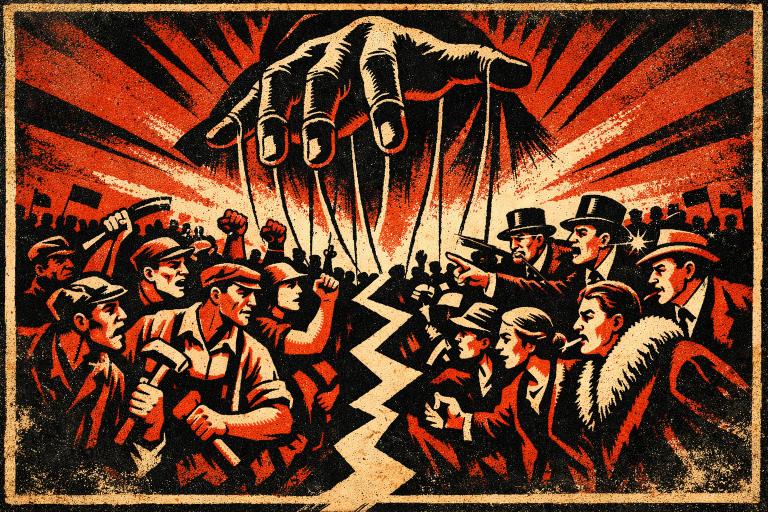
Beşinci Kol (Yapay Zekâ ile Oluşturulmuştur.)
Fifth Column is a concept referring to individuals, groups, or organizations operating within a state’s borders to support an external power, providing internal assistance during times of war or intense political crisis. The term encompasses methods such as sabotage, espionage, propaganda, morale disruption, secret communications, and internal destabilization. It became conceptualized during the major military and ideological conflicts of the 20th century and has since expanded in scope.
What Is Fifth Column Activity? (TRT News)
The concept of the fifth column gained prominence during the Spanish Civil War, which began in 1936. According to the narrative associated with Nationalist General Emilio Mola, forces advancing on Madrid from four directions were expected to be aided by secret sympathizers within the city, who were termed the “fifth column.”【1】
In Republican press and political discourse, the term was used to describe secret networks within Republican-held territories perceived as sympathetic to or connected with the Nationalist movement. Thus, the fifth column became not merely a military support mechanism but also a political category defining the perception of internal threat.
Fifth column activities during the Spanish Civil War were particularly organized within Republican-controlled areas. A cell-based structure became widespread; members operated with limited contact and employed coded communication methods. These organizations were typically concentrated in urban centers and operated behind the front lines.
During this period, fifth column activities were categorized under the following headings:
From the Republican government’s perspective, these activities created an “internal front” as dangerous as the battlefield itself.
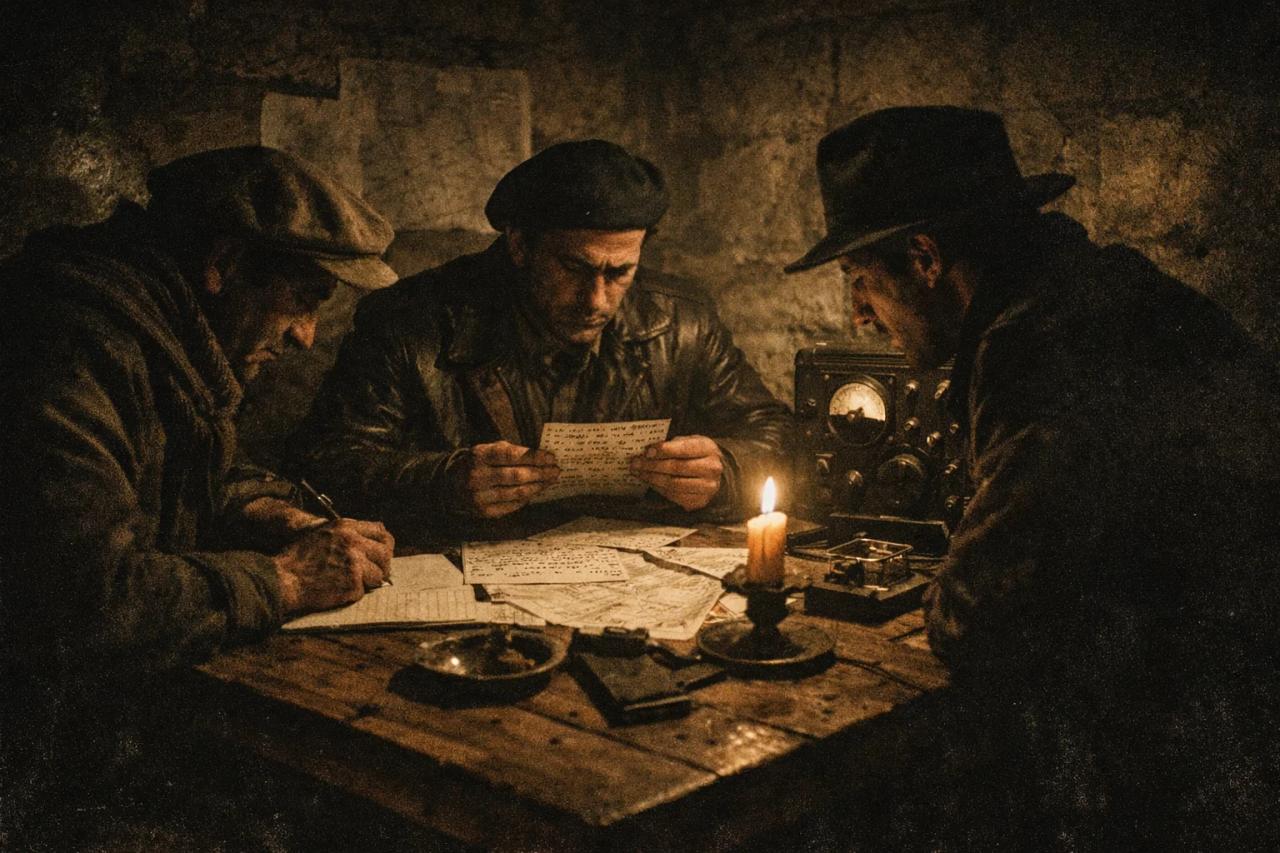
Representative Depiction of Fifth Column Activities in the Spanish Civil War (Generated by Artificial Intelligence.)
It has been suggested that during the war, indirect contacts were established between fifth column networks and certain diplomatic missions engaged in asylum and protection activities. It has been alleged that diplomatic immunity zones were, in some cases, used for organizational coordination and communication.
Republican media launched campaigns alleging that diplomatic missions facilitated fifth column activities, creating tension between the Republican government and foreign missions. Some diplomats faced decisions of persona non grata or investigations.【2】
During World War II, the concept of the fifth column acquired a broader range of usage. Nazi Germany’s invasion strategies, which involved exploiting local elements, infiltration under civilian identities, and securing internal support, were analyzed within this framework.【3】
In Britain, the threat of a fifth column was treated as a serious security concern, prompting the reorganization of security structures. MI5 intensified its efforts in internal threat detection and counterintelligence during this period.【4】 Tens of thousands of individuals were interrogated and detained on suspicion of fifth column activity.
In the United States, the fifth column was associated with sabotage and espionage threats. President Franklin D. Roosevelt defined the fifth column as a new form of espionage; following the attack on Pearl Harbor, widespread detentions and internment camps were established targeting the Japanese-American population.【5】 This period demonstrated how the concept of the fifth column could be transformed into a political narrative justifying mass security measures.

Representative Depiction of Fifth Column Activities in World War II (Generated by Artificial Intelligence.)
In Türkiye, the concept of the fifth column was particularly employed in the context of ideological struggle following World War II. 【6】 It has been noted that after Germany’s defeat, the focus shifted from German fifth column activities to those attributed to the Soviet Union or communist networks.【7】
During this period, assessments were made regarding the influence of Soviet Union propaganda activities through radio broadcasts and printed materials.【8】 However, it has been argued that these activities remained limited due to the banning of communist parties in Türkiye and the security measures implemented.【9】
In this context, the concept of the fifth column became a discursive element encompassing both externally linked espionage and claims of internal political propaganda and ideological influence.
In the modern era, the concept of the fifth column has been reinterpreted in light of the growing role of civil society organizations within the international system. Some analyses suggest that certain NGOs could be used as instruments for pressure, perception management, or intelligence operations aligned with foreign policy objectives.【10】 Discussions regarding the funding and organizational structures of NGOs within the context of color revolutions and regime change processes have become part of contemporary uses of the fifth column concept.【11】
With technological advancements, fifth column activities have extended into digital domains. The internet and social media have become new tools for conducting propaganda, disinformation, and perception management. Electoral processes, public opinion campaigns, and digital manipulation efforts are now evaluated within contemporary debates on the fifth column.

Representative Depiction of Digitalization and Fifth Column Activities (Generated by Artificial Intelligence.)
Originally referring to military collaboration and sabotage, the concept of the fifth column has evolved to encompass:
making it a multilayered security concept. From the major wars of the 20th century through the Cold War and into today’s hybrid conflict environment, the concept has persisted as a political and security category defining the perception of internal threat.
[1]
Emine Çelik and Göktuğ Sönmez. “The Role of Civil Society Organizations in Fifth Column Activities.” Journal of Political Sciences (İSMUS) 7, no. 2 (2022): 1–24. Accessed 25 February 2026. https://dergipark.org.tr/tr/download/article-file/3424095
[2]
Núñez de Prado Clavell, Sara, and Javier Rodríguez Abengozar. “La Quinta Columna y el Cuerpo Diplomático en la Guerra Civil Española.” Pasado y Memoria. Revista de Historia Contemporánea 19 (2019): 183–203. Accessed 25 February 2026. https://pasadoymemoria.ua.es/article/view/2019-n19-la-quinta-columna-y-el-cuerpo-diplomatico-en-la-guerra
[3]
Emine Çelik and Göktuğ Sönmez. “The Role of Civil Society Organizations in Fifth Column Activities.” Journal of Political Sciences (İSMUS) 7, no. 2 (2022): 1–24. Accessed 25 February 2026. https://dergipark.org.tr/tr/download/article-file/3424095
[4]
Emine Çelik and Göktuğ Sönmez. “The Role of Civil Society Organizations in Fifth Column Activities.” Journal of Political Sciences (İSMUS) 7, no. 2 (2022): 1–24. Accessed 25 February 2026. https://dergipark.org.tr/tr/download/article-file/3424095
[5]
Emine Çelik and Göktuğ Sönmez. “The Role of Civil Society Organizations in Fifth Column Activities.” Journal of Political Sciences (İSMUS) 7, no. 2 (2022): 1–24. Accessed 25 February 2026. https://dergipark.org.tr/tr/download/article-file/3424095
[6]
Engin Çağdaş Bulut. “Communist Fifth Column Activities in Türkiye (1945–1950).” 2019. Accessed 25 February 2026. https://www.academia.edu/49854900/T%C3%9CRK%C4%B0YE_DE_KOM%C3%9CN%C4%B0ST_BE%C5%9E%C4%B0NC%C4%B0_KOL_FAAL%C4%B0YETLER%C4%B0_1945_1950_
[7]
Engin Çağdaş Bulut. “Communist Fifth Column Activities in Türkiye (1945–1950).” 2019. Accessed 25 February 2026. https://www.academia.edu/49854900/T%C3%9CRK%C4%B0YE_DE_KOM%C3%9CN%C4%B0ST_BE%C5%9E%C4%B0NC%C4%B0_KOL_FAAL%C4%B0YETLER%C4%B0_1945_1950_
[8]
Engin Çağdaş Bulut. “Communist Fifth Column Activities in Türkiye (1945–1950).” 2019. Accessed 25 February 2026. https://www.academia.edu/49854900/T%C3%9CRK%C4%B0YE_DE_KOM%C3%9CN%C4%B0ST_BE%C5%9E%C4%B0NC%C4%B0_KOL_FAAL%C4%B0YETLER%C4%B0_1945_1950_
[9]
Engin Çağdaş Bulut. “Communist Fifth Column Activities in Türkiye (1945–1950).” 2019. Accessed 25 February 2026. https://www.academia.edu/49854900/T%C3%9CRK%C4%B0YE_DE_KOM%C3%9CN%C4%B0ST_BE%C5%9E%C4%B0NC%C4%B0_KOL_FAAL%C4%B0YETLER%C4%B0_1945_1950_
[10]
Emine Çelik and Göktuğ Sönmez. “The Role of Civil Society Organizations in Fifth Column Activities.” Journal of Political Sciences (İSMUS) 7, no. 2 (2022): 1–24. Accessed 25 February 2026. https://dergipark.org.tr/tr/download/article-file/3424095
[11]
Emine Çelik and Göktuğ Sönmez. “The Role of Civil Society Organizations in Fifth Column Activities.” Journal of Political Sciences (İSMUS) 7, no. 2 (2022): 1–24. Accessed 25 February 2026. https://dergipark.org.tr/tr/download/article-file/3424095


Beşinci Kol (Yapay Zekâ ile Oluşturulmuştur.)
Origin and Historical Emergence of the Concept
Fifth Column in the Spanish Civil War
Organizational Structure
Areas of Activity
Relationship with Diplomatic Missions
Fifth Column in World War II
The British Example
The United States Example
Fifth Column Discourse in Türkiye (1945–1950)
Civil Society Organizations and Fifth Column Debates
Digitalization and the Fifth Column
Expansion of the Concept’s Meaning