
Doğum tarihi | 1804-11-23 | ||||||||
|---|---|---|---|---|---|---|---|---|---|
Eş | Jane Means Appleton Pierce (m. 1834 – d. 1863) | ||||||||
Place of Birth | Hillsborough County, New Hampshire - USA | ||||||||
Ölüm tarihi | 1869-10-08 | ||||||||
Place of Death | Concord, New Hampshire - USA | ||||||||
Parents | Benjamin Pierce, Anna Kendrick Pierce | ||||||||
Presidential Order | 14th President of the United States (1853–1857) | ||||||||
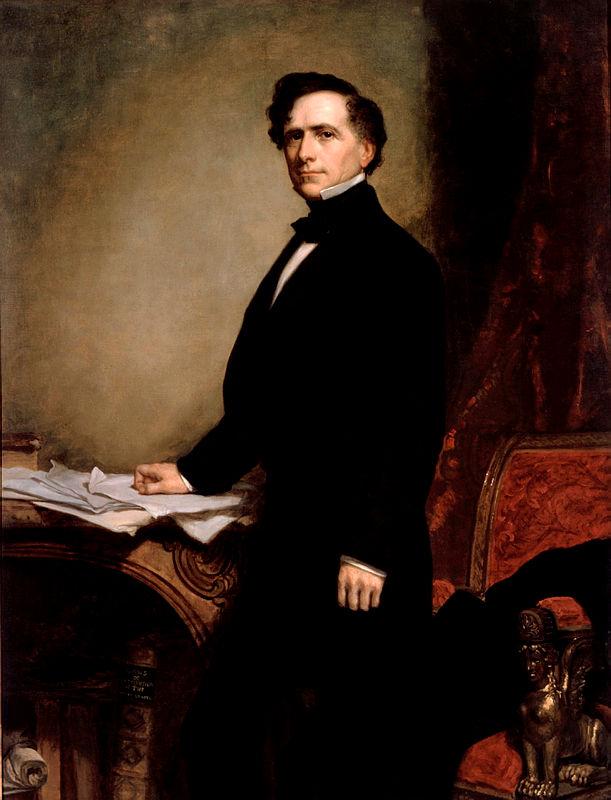
Franklin Pierce was born on November 23, 1804, in the town of Hillsborough, New Hampshire. His father, Benjamin Pierce, was a militia leader who served during the American Revolution and held two terms as governor, thereby exerting considerable influence on local politics. Pierce received his higher education at Bowdoin College, where he formed friendships with figures such as Nathaniel Hawthorne. After graduating in 1824, he studied law and was admitted to the New Hampshire bar in 1827.
He began his political career in 1829 when he was elected to the New Hampshire House of Representatives and was appointed its speaker two years later. He served in the United States House of Representatives from 1833 to 1837 and in the Senate from 1837 to 1842. During this period, he aligned himself with the Jacksonian Democratic line, supporting policies such as hard currency, opposition to the Bank of the United States, and a cautious approach to federal internal improvement projects. In 1841, he resigned from the Senate to distance himself from politics and spend more time with his family.
Pierce volunteered for military service during the Mexican-American War, which began in 1846. At the behest of President James K. Polk, he was appointed colonel and later brigadier general. He was wounded during the campaign from Veracruz to Mexico City, an incident that led to him being nicknamed “Fainting Frank” in the public eye. His military service strengthened his political image.
At the Democratic Party’s convention in Baltimore in 1852, after 48 ballots, he emerged as a compromise candidate and was nominated for president. He defeated the Whig Party’s candidate, Winfield Scott, in the general election. Before assuming office in 1853, his family was involved in a train accident in which their only surviving son, Benjamin, died. This tragic event deeply affected both Franklin and Jane Pierce; as a result, his wife did not participate in any activities at the White House during his presidency.
Franklin Pierce’s presidency (1853–1857) unfolded against the backdrop of rising sectional tensions in American politics. As president, he heeded the advice of Southern advisors and adopted a stance against federal intervention in the issue of slavery. One of his most controversial actions was his support for the Kansas-Nebraska Act, which repealed the Missouri Compromise and allowed the status of slavery in new territories to be determined by popular vote. This act contributed to an escalation of violence in Kansas, giving rise to the period known as “Bleeding Kansas.”
In foreign policy, Pierce secured the Gadsden Purchase, which added southern Arizona and New Mexico to U.S. territory. He also attempted to acquire Cuba and took steps to expand American influence in Central America. However, these initiatives were viewed in the North as strategies to extend slavery and met with strong opposition. In 1856, the Democratic Party declined to renominate him; instead, it nominated James Buchanan.
After leaving office, Pierce traveled extensively in Europe and the Caribbean. Although he declared his loyalty to the Union during the American Civil War, he opposed the administration of Abraham Lincoln and particularly its policies aimed at abolishing slavery. This position cost him public support and alienated many in his personal circle. In his later years, he struggled with alcoholism. He died on October 8, 1869, in Concord, New Hampshire.
American Battlefield Trust. “Franklin Pierce.” Accessed July 15, 2025. https://www.battlefields.org/learn/biographies/franklin-pierce
Miller Center, University of Virginia. “Franklin Pierce: Life Before the Presidency.” Author Jean H. Baker. Accessed July 15, 2025. https://millercenter.org/president/pierce/life-before-the-presidency
Miller Center, University of Virginia. “Franklin Pierce: Life in Brief.” Author Jean H. Baker. Accessed July 15, 2025. https://millercenter.org/president/pierce/life-in-brief
The American Presidency Project, University of California, Santa Barbara. “Franklin Pierce.” Accessed July 15, 2025. https://www.presidency.ucsb.edu/people/president/franklin-pierce
The Papers of Abraham Lincoln. "Franklin Pierce." Accessed July 15, 2025. https://papersofabrahamlincoln.org/persons/PI38460
The White House. “Franklin Pierce.” Obama White House Archives. Accessed July 15, 2025. https://obamawhitehouse.archives.gov/1600/presidents/franklinpierce
White House Historical Association. “Franklin Pierce.” Accessed July 15, 2025. https://www.whitehousehistory.org/bios/franklin-pierce

Doğum tarihi | 1804-11-23 | ||||||||
|---|---|---|---|---|---|---|---|---|---|
Eş | Jane Means Appleton Pierce (m. 1834 – d. 1863) | ||||||||
Place of Birth | Hillsborough County, New Hampshire - USA | ||||||||
Ölüm tarihi | 1869-10-08 | ||||||||
Place of Death | Concord, New Hampshire - USA | ||||||||
Parents | Benjamin Pierce, Anna Kendrick Pierce | ||||||||
Presidential Order | 14th President of the United States (1853–1857) | ||||||||
Military Service and Presidential Candidacy
Presidential Policies and Later Life