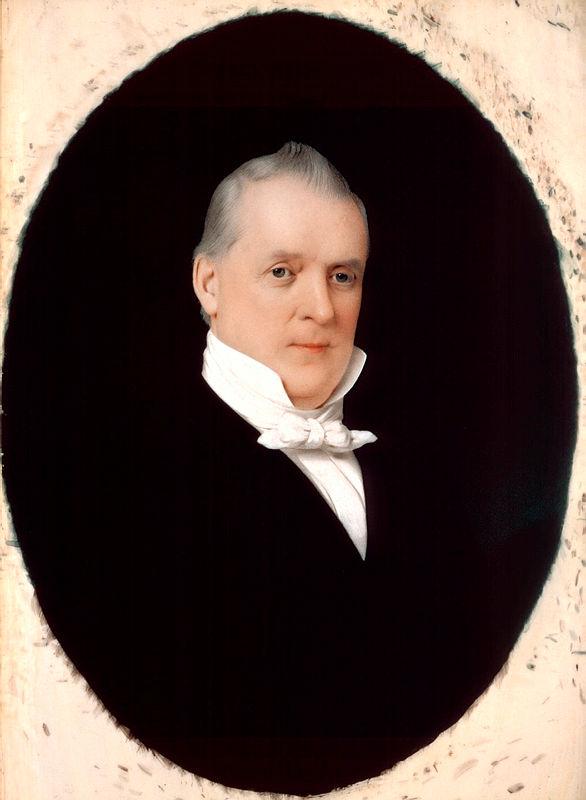
Doğum tarihi | 1791-04-23 | ||||||||
|---|---|---|---|---|---|---|---|---|---|
Place of Birth | Cove Gap, Pennsylvania – USA | ||||||||
Ölüm tarihi | 1868-06-01 | ||||||||
Place of Death | Lancaster, Pennsylvania – USA | ||||||||
Parents | James Buchanan Sr. Elizabeth Speer Buchanan | ||||||||
Presidential Order | 15th President of the United States (1857–1861) | ||||||||
James Buchanan was born on April 23, 1791, in the town of Cove Gap, located in Franklin County, Pennsylvania. The son of a merchant who had emigrated from Ireland, Buchanan spent his childhood at his family’s trading post in Stony Batter. With his interest in education and the support of his family, he was admitted to Dickinson College and graduated in 1809. That same year, he began studying law and was admitted to the Pennsylvania bar in 1812. Buchanan launched his legal career in Lancaster and focused primarily on his professional activities, with only brief military service interrupting his practice.
He began his political career in 1814 when he was elected to the Pennsylvania House of Representatives. He served in the United States House of Representatives from 1821 to 1831, during which time he worked extensively on the Committee on the Judiciary. In 1832, he was appointed by President Andrew Jackson as ambassador to Russia. Two years later, he returned to the United States and represented Pennsylvania in the U.S. Senate from 1834 to 1845. Known for his active role in foreign affairs, Buchanan also served as chairman of the Senate Committee on Foreign Relations.
In 1845, he was appointed Secretary of State by President James K. Polk. In this role, he played a part in negotiations with Britain over the Oregon boundary. He also supported the peace treaty that ended the Mexican-American War. After leaving office in 1849, he withdrew from politics for a time, but in 1853, President Franklin Pierce appointed him as ambassador to the United Kingdom. During his tenure in London, he collaborated with other diplomats to draft the Ostend Manifesto, which argued that the United States should acquire Cuba from Spain by force if necessary. This initiative drew strong criticism from anti-slavery factions but was supported by Southern politicians.
Buchanan’s absence from domestic politics during his overseas postings shielded him from the heated debates surrounding issues such as the Kansas-Nebraska Act and contributed to his selection as the Democratic Party’s candidate in the 1856 presidential election. Running against Republican candidate John C. Frémont and Know-Nothing Party candidate Millard Fillmore, Buchanan won a majority of the electoral votes and took office on March 4, 1857.
Buchanan served as the 15th president of the United States from 1857 to 1861. During his presidency, the nation’s division accelerated, with the issue of slavery dominating the political agenda. Upon assuming office, he believed the Supreme Court’s impending decision in the Dred Scott case would resolve the issue, but the ruling instead ignited widespread public controversy. The Court declared that slavery could not be restricted by federal law and that enslaved people were not citizens.
Another major development during his presidency was the debate over Kansas’s status. Buchanan supported Kansas’s admission to the Union under the pro-slavery Lecompton Constitution, a stance that drew criticism from both Republicans and Northern Democrats. His political disagreement with Illinois Senator Stephen Douglas became public during this period. In the 1860 election, the Democratic Party split, and following Abraham Lincoln’s victory, Southern states began seceding from the Union one by one.
Buchanan rejected the notion that states had a legal right to secede, yet he argued that the federal government lacked the constitutional authority to prevent it. This passive stance contributed to the deepening of the crisis. After handing over power to Abraham Lincoln on March 4, 1861, Buchanan retired to his estate, Wheatland, in Pennsylvania. In the final years of his life, he sought to counter the negative public perception of his presidency by writing his memoirs, which were published in 1866. He died on June 1, 1868.
American Battlefield Trust. “James Buchanan.” American Battlefield Trust. Accessed July 20, 2025. https://www.battlefields.org/learn/biographies/james-buchanan
Biographical Directory of the United States Congress. "BUCHANAN, James." Biographical Directory of the United States Congress. Accessed July 20, 2025. https://bioguide.congress.gov/search/bio/B001005
George W. Bush White House Archives. “James Buchanan.” The White House. Accessed July 20, 2025. https://georgewbush-whitehouse.archives.gov/history/presidents/jb15.html
History.state.gov. "Biographies of the Secretaries of State: James Buchanan (1791–1868)." Office of the Historian, U.S. Department of State. Accessed July 20, 2025. https://history.state.gov/departmenthistory/people/buchanan-james
Miller Center. “James Buchanan: Life Before the Presidency.” Miller Center, University of Virginia. Accessed July 20, 2025. https://millercenter.org/president/buchanan/life-before-the-presidency
Miller Center. “James Buchanan: Life in Brief.” Miller Center, University of Virginia. Accessed July 20, 2025. https://millercenter.org/president/buchanan/life-in-brief
PA Center for the Book. "James Buchanan." Pennsylvania Center for the Book, Penn State University. Accessed July 20, 2025. https://pabook.libraries.psu.edu/literary-cultural-heritage-map-pa/bios/buchanan__james
The American Presidency Project. “James Buchanan.” The American Presidency Project, University of California, Santa Barbara. Accessed July 20, 2025. https://www.presidency.ucsb.edu/people/president/james-buchanan
White House Historical Association. “James Buchanan.” *White House History*. Accessed July 20, 2025. https://www.whitehousehistory.org/bios/james-buchanan

Doğum tarihi | 1791-04-23 | ||||||||
|---|---|---|---|---|---|---|---|---|---|
Place of Birth | Cove Gap, Pennsylvania – USA | ||||||||
Ölüm tarihi | 1868-06-01 | ||||||||
Place of Death | Lancaster, Pennsylvania – USA | ||||||||
Parents | James Buchanan Sr. Elizabeth Speer Buchanan | ||||||||
Presidential Order | 15th President of the United States (1857–1861) | ||||||||
Diplomatic Assignments and the Path to the Presidency
Presidency and Later Life