


This article was automatically translated from the original Turkish version.
+1 More
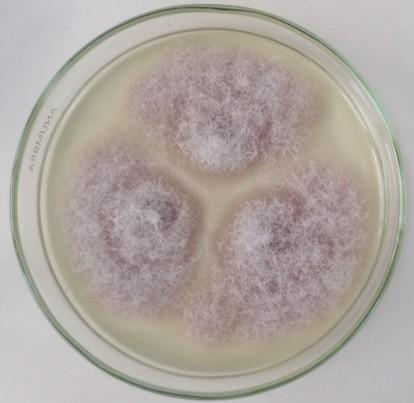
Fusarium Proliferatum (Pınar Güner)
Fusarium proliferatum is a fungal species belonging to the phylum Ascomycota, widely known for causing plant diseases and producing mycotoxins. This species has been identified as a pathogen in numerous agricultural crops including maize, wheat, rice, onion, garlic, banana, and dates. It can also survive as a saprophyte in soil, plant debris, and seeds. Moreover, Fusarium proliferatum is of significant importance in both agricultural and public health contexts due to its ability to produce toxins that affect human and animal health.
Under laboratory conditions, it grows rapidly on culture media such as PDA (Potato Dextrose Agar) or MEA (Malt Extract Agar). Colonies typically exhibit colors ranging from white to pale pink or purplish tones and gradually secrete violet or purple pigments. Microscopically, F. proliferatum produces long, slender, and usually 3–5 septate macroconidia. It is also characterized by the abundant production of microconidia and monophialidic conidiophores. One of its distinguishing morphological features is the branched conidiophore structure and microconidia arranged in chains.
Fusarium proliferatum is distributed worldwide in tropical, subtropical, and temperate regions. It multiplies rapidly in warm and humid environments. Although it is a soil-borne fungus, it is most commonly found endophytically or pathogenically within plant tissues. It can also develop in stored cereal products, leading to economic losses and toxic contamination.
This species has a broad host range. It causes diseases such as Fusarium ear rot in maize, head blight in wheat, and bulb rot in onion. It can also induce root and stem rots in many plants including banana, date palm, grape, and tomato. Rare cases of opportunistic infections in humans have been reported, such as keratitis, onychomycosis, or systemic infections. Therefore, F. proliferatum is considered both a plant pathogen and a potential opportunistic human pathogen.
Fusarium proliferatum produces various toxic secondary metabolites. The most important include fumonisins (particularly B₁, B₂, B₃), fusaric acid, beauvericin, and moniliformin. These toxins can cause damage to the liver, kidneys, and nervous system. Fumonisin B₁ is particularly associated with carcinogenic potential and poses a serious threat to food safety. The European Union and the World Health Organization have established limits on the levels of fumonisins in cereal products.
Although primarily known as a harmful species, Fusarium proliferatum is being explored for biotechnological applications in the production of certain enzymes and secondary metabolites. It shows particular potential in the production of lignocellulolytic enzymes such as cellulase and xylanase. Additionally, research is ongoing into non-toxin-producing strains for use in biocontrol and bioremediation efforts.
Although disease control is challenging, cultural practices such as crop rotation, use of clean seeds, and proper storage conditions remain the most effective methods. Chemical fungicides generally have limited efficacy. Current research focuses on biological control agents, such as Trichoderma species, and natural compounds that suppress mycotoxin production.
Bacon, C. W., and P. E. Nelson. “Fumonisin Production in Corn by Toxigenic Strains of Fusarium moniliforme and Fusarium proliferatum.” Journal of Food Protection 57, no. 6 (1994): 514–21. Accessed October 19, 2025. https://doi.org/10.4315/0362-028X-57.6.514
Gálvez, L., and D. Palmero. “Fusarium Dry Rot of Garlic Bulbs Caused by Fusarium proliferatum: A Review.” Horticulturae 8, no. 7 (2022): 628. Accessed October 19, 2025. https://doi.org/10.3390/horticulturae8070628

Fusarium Proliferatum (Pınar Güner)
No Discussion Added Yet
Start discussion for "Fusarium proliferatum" article
Morphological Characteristics
Ecology and Distribution
Pathogenicity and Host Range
Mycotoxin Production and Public Health Significance
Industrial and Biotechnological Significance
Control and Management Methods