This article was automatically translated from the original Turkish version.
Other Materials | lemon juice (optional) water sugar butter Thinly rolled phyllo | ||||||||
|---|---|---|---|---|---|---|---|---|---|
Type(s) | Dessert | ||||||||
Origin(s) | Türkiye Ottoman Empire Gaziantep | ||||||||
Main Ingredient | Gaziantep pistachio | ||||||||
Cuisine | Turkish Cuisine | ||||||||
Consumption Areas | Guest visits Weddings Special occasions Holidays | ||||||||
Service | served with tea or Turkish coffee Typically cut into square or diamond shapes at room temperature | ||||||||
Prominent Features | combination of crisp and soft texture golden-yellow color and glossy appearance intense pistachio aroma butter between layers Thinly rolled phyllo sheets | ||||||||
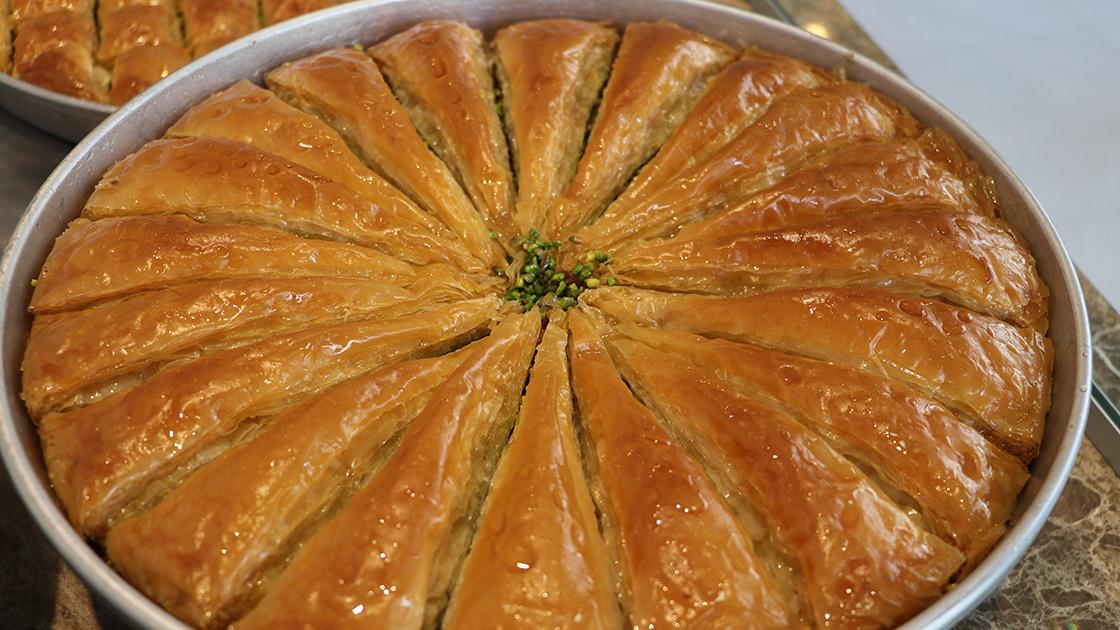
Antep pistachio baklava is one of the most famous and beloved desserts of Turkish cuisine. This sweet, specifically associated with the province of Gaziantep, has gained fame across world and become synonymous with the region. As both a culinary and cultural icon, Antep pistachio baklava is a rich and satisfying dessert made with thin layers of phyllo dough layered with abundant Antep pistachios and soaked in syrup.
The origins of Antep pistachio baklava trace back to the Ottoman Empire. However, it was in Gaziantep that baklava began to be produced in its distinctive form and was refined with great mastery. City is known for the use of Antep pistachios in baklava production, and this pistachio is the fundamental component of its flavor. Antep pistachios are carefully selected by baklava makers and impart a distinctive original flavor to the dessert.
Antep pistachio baklava is made with four key ingredients: thinly rolled phyllo dough, butter, Antep pistachios, and sugar syrup.
Dough: The dough is made from flour, water, salt, and egg. This dough is kneaded until it can be rolled into extremely thin layers and assembled in sheets.
Filling: The filling consists of Antep pistachios. The nuts are finely ground and mixed with sugar before being spread between the layers of phyllo.
Layering: During baklava preparation, thinly rolled dough layers are stacked one on top of another, with butter brushed between each layer. The layers are arranged to create a crisp texture.
Syrup: After baking, on sugar syrup is poured over the baklava. The syrup typically contains water, sugar, and sometimes lemon juice.
Baking: Baklava is baked at high heat until its top turns a golden color.
Serving: Once baked, the baklava is allowed to rest at room temperature after absorbing the hot syrup, and is usually cut into square or diamond shapes.
One of the most distinctive features of Antep pistachio baklava is the extreme thinness of its dough. The butter applied between each layer gives the dessert both softness and crispness. Antep pistachios provide a unique flavor and color to the baklava. Additionally, the syrup balances the sweetness without making the dessert overly sugary.
As Gaziantep is the center of Antep pistachio production, baklava here is made with the highest quality ingredients. Gaziantep baklava has been recognized as part of the culinary heritage since the city became the first Turkish member of UNESCO’s Creative Cities Network. Baklava is a symbol of the city’s cultural identity and offers visitors a unique dessert experience. At the same time, baklava produced in Gaziantep is renowned worldwide.
Antep pistachio baklava is not only known throughout only Türkiye but also in many countries around the world. It has a large following particularly in Central East, Europe, and North America. Through Turkish diaspora communities, baklava has spread to west countries and has become an indispensable treat during holidays and special occasions. Moreover, baklava producers have expanded the boundaries of this traditional dessert by creating modern variations in recent times.
Antep pistachio baklava is typically served as a dessert after meals, accompanied by tea or Turkish coffee. It is also commonly consumed during special occasions such as weddings, holidays, and guest visits. Due to its high caloric content, baklava is usually served in small small portions.
Flavor: The dessert has a rich and intense flavor profile, with the fresh and natural taste of Antep pistachios forming its core flavor.
Texture: Baklava has a melt-in-the-mouth texture, combining the delicate crispness of the thin dough with the richness of the butter.
Color: When baked, it takes on a golden hue and acquires a glossy appearance from the syrup poured over it.
Anadolu Ajansı. "Antep Baklavası Farklı Çeşitleriyle Hem Göze Hem Damağa Hitap Ediyor." September 17, 2022. Accessed March 19, 2026. https://www.aa.com.tr/tr/yasam/antep-baklavasi-farkli-cesitleriyle-hem-goze-hem-damaga-hitap-ediyor/2686822
Arslan, Filiz. "Gastronomi Turizmi Açısından Coğrafi İşaretli Ürünlerin Algılanma Düzeyi: Antalya Örneği." Uluslararası Güncel Turizm Araştırmaları Dergisi 7, no. 1 (2026): 1-8. Accessed March 19, 2026. https://dergipark.org.tr/tr/pub/ijctr/article/1106011.
Baycar, Abdullah. "Antep Fıstığı ve Türevlerinin Gaziantep Yerel Gastronomik Kimliğindeki Yeri." Abant Sosyal Bilimler Dergisi 22, no. 2 (2022): 749–64. Accessed March 19, 2026. https://doi.org/10.11616/asbi.1097983.
Department for Environment, Food and Rural Affairs (DEFRA). "Antep Baklavası / Gaziantep Baklavası: Protected Food Name with Protected Geographical Indication (PGI)." January 4, 2021. Accessed March 19, 2026. https://assets.publishing.service.gov.uk/media/6655d631d470e3279dd332c5/Antep_Baklavasi.pdf
Kayaalp, Beste. "Antep Baklavası." Gaziantep Sanayi Odası. Accessed March 19, 2026. https://www.gso.org.tr/tr/genel-sayfa/cografi-tescil-isaretli-urunlerimiz/antep-baklavasi-16.html
Ministry of Foreign Affairs of the Republic of Türkiye, Directorate General for European Union. "Antep Baklava Registered as a Geographical Indication in the European Union." Press Release. Accessed March 19, 2026. https://www.ab.gov.tr/_49345.html
Süzer, Özkan, and Oya Özkanlı. "Bölge Mutfaklarının Kullanılan Malzemeler Bağlamında Değerlendirilmesi: Gaziantep Yemekleri Üzerine Bir İnceleme." Safran Kültür ve Turizm Araştırmaları Dergisi 3, no. 2 (2020): 117–38. Accessed March 19, 2026. https://dergipark.org.tr/tr/download/article-file/1152372
Taş, Nurdane, Mehmet Düzgün, and Atınç Olcay. "Coğrafi İşaret İle Tescil Edilmiş Antep Baklavasının Turistik Destinasyon Tanıtımına Yönelik Etkisi." Seyahat ve Otel İşletmeciliği Dergisi 20, no. 3 (2023): 406–26. Accessed March 19, 2026. https://doi.org/10.24010/soid.1308480.
Turk Patent and Trademark Office. "Antep Baklavası: Geographical Indication Registration Certificate." Registration No. 95. January 4, 2008. Accessed March 19, 2026. https://ci.turkpatent.gov.tr/Files/GeographicalSigns/0cbbdd44-8cae-4ef4-af94-b2889a94f28c.pdf
Çılgınoğlu, Hakkı. "Coğrafi İşaretli Türk Baklavaları." Süleyman Demirel Üniversitesi Vizyoner Dergisi 15, no. 44 (2024): 1181–96. Accessed March 19, 2026. https://dergipark.org.tr/tr/download/article-file/3975625


Other Materials | lemon juice (optional) water sugar butter Thinly rolled phyllo | ||||||||
|---|---|---|---|---|---|---|---|---|---|
Type(s) | Dessert | ||||||||
Origin(s) | Türkiye Ottoman Empire Gaziantep | ||||||||
Main Ingredient | Gaziantep pistachio | ||||||||
Cuisine | Turkish Cuisine | ||||||||
Consumption Areas | Guest visits Weddings Special occasions Holidays | ||||||||
Service | served with tea or Turkish coffee Typically cut into square or diamond shapes at room temperature | ||||||||
Prominent Features | combination of crisp and soft texture golden-yellow color and glossy appearance intense pistachio aroma butter between layers Thinly rolled phyllo sheets | ||||||||
No Discussion Added Yet
Start discussion for "Gaziantep Pistachio Baklava" article
History and Origin
Ingredients and Preparation
Characteristics
Regional Connection and Cultural Significance
Popularity and Prevalence
Consumption
Qualities