This article was automatically translated from the original Turkish version.
Location | Adıyaman | ||||||||
|---|---|---|---|---|---|---|---|---|---|
Construction Date(s) | 2nd century BC | ||||||||
Historical Use | the sacred sanctuary The first administrative center of Commagene | ||||||||
Strategic Importance | a control point for Euphrates crossings The eastern boundary of the Kingdom of Commagene | ||||||||
Architectural Feature(s) | foundation structures towers water cisterns Built on steep cliffs | ||||||||
Gerger Castle is located within the boundaries of Oymaklı Village, in the Gerger district, in the northeastern part of Adıyaman Province, on the western bank of the Euphrates River. Built on steep cliffs in a strategic position, the castle consists of two sections: Upper Castle and Lower Castle. Since the era of the Kingdom of Commagene, the castle has been used by various civilizations.

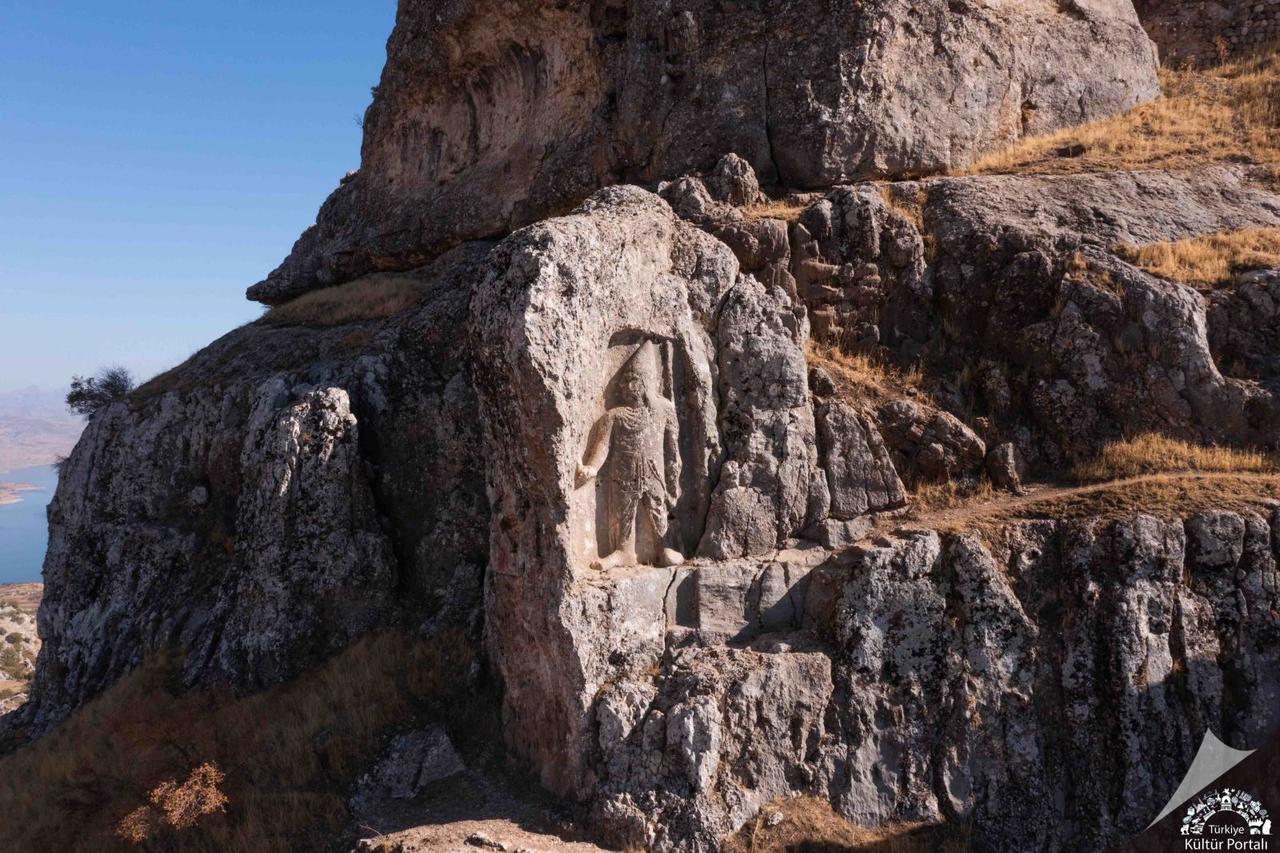
Gerger Kalesi (Türkiye Culture Portal)
The history of Gerger Castle dates back to the 2nd century BCE. Built by Arsames, the founder of the Kingdom of Commagene, the castle was constructed to safeguard the eastern frontier of the kingdom and control crossings over the Euphrates River. It also served as the first administrative center and a sacred sanctuary of the Kingdom of Commagene.
During the Roman period, the castle remained actively in use. It was repaired and expanded during the Seljuk and Ottoman periods with the addition of walls, gatehouses, and vaulted structures, allowing it to maintain its function.
Gerger Castle consists of two main sections:
Upper Castle: The Upper Castle has three separate entrances. Near the first entrance, staircases, corridors, and tomb structures have been carved into the rock. Around the third entrance, six inscriptions commissioned by King Samos of Commagene and his grandson Antiochus I are located. In the upper sections of the Upper Castle, foundations and towers have been identified, while in the lower sections, water cisterns and residential remains have been discovered.
Lower Castle: This section contains foundations of Islamic structures from the medieval period, though the remains are not in good condition today. However, staircases, corridors, and water cisterns carved into the rock are still visible. When viewed from outside the western walls of the Lower Castle, a four-meter-high relief of King Samos is carved into the cliff. The relief depicts the king standing in ceremonial attire, armed, with his right hand extended forward.
A significant portion of Gerger Castle has survived to the present day. However, the difficulty of access to the site has prevented its full exploitation for tourism. Due to its rugged and mountainous terrain, the castle has been largely protected from invasions throughout history.
The region of Gerger and its surroundings has been under the control of various political authorities throughout history. The area came under the rule of the Byzantines, Abbasids, Hamdanids, Seljuks, Artuqids, Ayyubids, Anatolian Seljuks, Mongols, Mamluks, Timurids, and Dulkadirids, and was incorporated into Ottoman territory after the Battle of Turnadağ in 1515.
During the Republican period, Gerger was a village under the district of Malatya-Pütürge until it was attached to Adıyaman Province in 1954 and became a district center in its current location in 1958.
Gerger Castle is an important archaeological heritage site reflecting the early administrative structure and sacred spaces of the Kingdom of Commagene. It is regarded as one of the most prominent historical monuments in the region due to its architectural features, preserved structural elements, and historical context.
Adıyaman Kültür and Tourism Provincial Directorate. "Gerger." _Ministry of Culture and Tourism of the Republic of Turkey_. Accessed July 7, 2025. https://adiyaman.ktb.gov.tr/TR-61338/gerger.html
Adıyamanlılar Vakfı. “Gerger.” *Adıyamanlılar Vakfı Resmî Web Sitesi*. Accessed July 7, 2025. https://www.adiyamanlilarvakfi.org.tr/modul/icerik/320
Ministry of Culture and Tourism of the Republic of Türkiye. "Gerger Kalesi." *Kültür Portalı*. Accessed July 7, 2025. https://www.kulturportali.gov.tr/turkiye/adiyaman/gezilecekyer/gerger-kales

Location | Adıyaman | ||||||||
|---|---|---|---|---|---|---|---|---|---|
Construction Date(s) | 2nd century BC | ||||||||
Historical Use | the sacred sanctuary The first administrative center of Commagene | ||||||||
Strategic Importance | a control point for Euphrates crossings The eastern boundary of the Kingdom of Commagene | ||||||||
Architectural Feature(s) | foundation structures towers water cisterns Built on steep cliffs | ||||||||
History
Architectural Structure
Conservation Status and Access
Historical and Political Context of the Region