

This article was automatically translated from the original Turkish version.
+2 More
Location | İhsaniye Türkiye Afyonkarahisar | ||||||||
|---|---|---|---|---|---|---|---|---|---|
Period(s) | Phrygians | ||||||||
Character | Sacred Area (Cult Center), Necropolis (Burial Area), Settlement Traces | ||||||||
Works | Aslantaş, Yılantaş, Maltaş, Kumcaboğaz Monuments | ||||||||
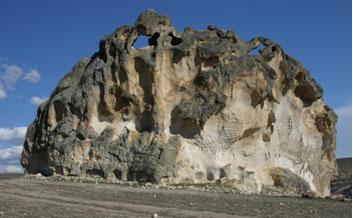
Göynüş Valley is an archaeological landscape area located within the boundaries of İhsaniye district, Afyonkarahisar province, distinguished by rock monuments, tombs, settlement areas, and religious structures dating to the Phrygian period. Recognized as one of the most intensively used cult areas of Phrygia, the valley features structures carved into rock blocks, open-air temples, tomb chambers, and monumental arrangements. The region has acquired a cultural texture through the modification of natural rock formations, created by the erosion of volcanic tuff deposits, by Phrygian artisans. The valley contains the monuments of Aslantaş, Yılantaş, Maltaş, and Kumcaboğaz.
The valley is situated near the town of Kayahan (Kayıkhan), within the northern section of Afyonkarahisar. Geomorphologically, the area is dominated by tuff-based rocky formations, constituting an archaeological landscape where natural and cultural elements coexist. This natural rock structure was carved by the Phrygians to create spaces for habitation, burial, and worship.
Göynüş Valley is one of the significant centers of the Phrygian cultural geography. The rock monuments and tomb architecture provide insights into the Phrygians’ belief systems and social practices. The monumental examples in the valley demonstrate long-term use for ritual and monumental purposes. Moreover, the valley presents a sacred landscape arrangement representative of the Middle Phrygian cult approach.
Göynüş Valley exhibits a broad archaeological diversity, including rock monuments, tomb chambers, and niches. Monumental tombs carved into the rock faces, religious rock-carved structures, and localized spatial arrangements indicate that the valley was used as a sacred complex. The scale and positioning of the monuments reveal that the area functioned not only as a settlement but also as a ritual center.
Göynüş Valley is regarded as a cultural heritage site requiring protection due to its cultural landscape and Phrygian rock monuments. Preserving the archaeological fabric against both natural and human-induced damage is of critical importance given the region’s historical significance. This area, evaluated within the framework of Phrygian valleys in Türkiye, holds a position as a cultural heritage site of both scientific and touristic value.
T.C. Ministry of Culture and Tourism Afyonkarahisar Provincial Directorate of Culture and Tourism. "İhsaniye/Kayıhan Kasabası Göynüş Vadisi Ören Yeri." *afyon.ktb.gov.* Accessed October 18, 2025. https://afyon.ktb.gov.tr/TR-63483/ihsaniyekayihan-kasabasi-goynus-vadisi-oren-yeri.html
Türkiye Kültür Portalı. "Frigya - Göynüş Vadisi - Afyonkarahisar." kulturportali.gov. Accessed October 18, 2025. https://www.kulturportali.gov.tr/turkiye/afyonkarahisar/gezilecekyer/frigya--goynus-vadisi

Location | İhsaniye Türkiye Afyonkarahisar | ||||||||
|---|---|---|---|---|---|---|---|---|---|
Period(s) | Phrygians | ||||||||
Character | Sacred Area (Cult Center), Necropolis (Burial Area), Settlement Traces | ||||||||
Works | Aslantaş, Yılantaş, Maltaş, Kumcaboğaz Monuments | ||||||||
Geographical Features
Historical Context
Archaeological Elements
Conservation Status