


This article was automatically translated from the original Turkish version.
+1 More
Group D
Founding Date | 1933 | ||||||||
|---|---|---|---|---|---|---|---|---|---|
Founding Location | Istanbul | ||||||||
Founding Members | Zühtü Müridoğlu Abidin Dino Elif Naci Cemal Tollu Nurullah Berk Zeki Faik İzer | ||||||||
Primary Artistic Goal | to bring modern art to Türkiye | ||||||||
Influencing Movements | Fauvism Cubism Expressionism | ||||||||
Artistic Approach | to base composition on cubist and constructivist principles | ||||||||
Dissolution Date | 1947 | ||||||||
D Group is an artistic collective that holds a significant place in the process of Westernization in Turkish painting art. The group was established in Istanbul in 1933. Its founding members include the painters Zeki Faik İzer, Nurullah Berk, Cemal Tollu, Elif Naci, Abidin Dino and the sculptor Zühtü Müridoğlu. The group chose the letter “D” from the alphabet as its name because it was the fourth association formed after the Ottoman Society of Painters, the Sanayi-i Nefise Union, and the Independent Painters and Sculptors Union.

The artists of D Group believed that Turkish painting art had lagged behind European artistic movements. They aimed to elevate Turkish painting to a new stage by applying the academic awareness and influences of modern art they had acquired in Europe. The group’s artistic foundation was built on a strong compositional structure inspired by Cubist and Constructivist currents. They opposed naturalistic imitation and the increasingly academic approaches that had taken hold. The group members argued that the main deficiency in Turkish plastic arts lay in its intellectual dimension and sought to remedy this gap. They approached art as an “intellectual” pursuit and aimed to introduce modern art, which had emerged and developed in the West, to Turkey. The crystallization of the Republic’s modern forms within Turkish painting art began with the emergence of this group. There was no stylistic uniformity among the artists of D Group. They did not see themselves merely as representatives of a single movement or produce works solely in that direction. Instead, each member created paintings based on a completely individual approach to form and color. Nevertheless, a shared commitment to revolutionizing art and introducing advanced artistic trends to the country sustained the group for many years.

Musicians – Halil Dikmen. (KültürPortalı)
Most members of D Group were trained at the Sanayi-i Nefise Mektebi as students of İbrahim Çallı and his colleagues. They furthered their education in Europe in the ateliers of artists such as André Lhote, Ernest Laurent, Fernand Léger, and Hans Hofmann. During their time in European art circles, they were heavily influenced by Fauvism, Cubism, and Expressionism.

Bursa Muradiye Camii – Arif Bedii Kaptan. (KültürPortalı)
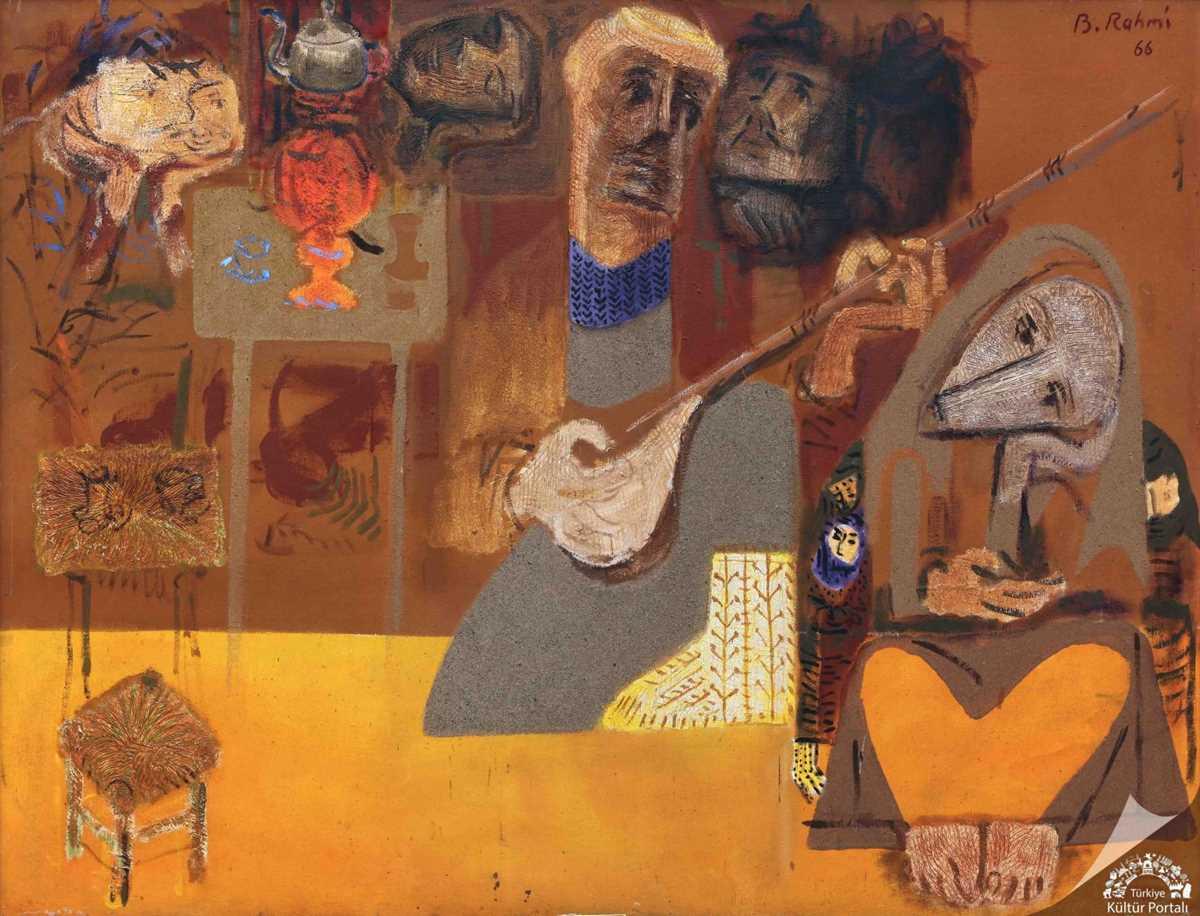
The group drew upon Turkish folkloric formal elements and the traditional artistic heritage as sources for their work. They believed that Turkish painting art needed to develop a distinct identity. By creatively reinterpreting traditional folk motifs and patterns, they developed their own unique visual language. Nurullah Berk focused on abstracting miniature painting techniques, while Cemal Tollu selected Hittite reliefs as his source of inspiration based on his observations of Anatolian civilizations. Elif Naci translated calligraphic forms into large-scale lettering on canvas. Bedri Rahmi Eyüboğlu reinterpreted traditional folk motifs within his own creative imagination.

Beşiktaş Gebze Pier – Cemal Tollu. (KültürPortalı)
D Group held its first exhibition in 1933 in a hat shop in Beyoğlu. Through subsequent exhibitions, the group gained recognition and expanded its reach. Exhibitions were typically inaugurated with lectures and held in various venues including the Taksim Mountaineering Club, Galatasaraylılar Yurdu, Şehir Tiyatrosu, Beyoğlu Halkevi, and the French Consulate. As advocates of modern art, group members incorporated talks and debates on modern art into their exhibitions. The artists’ writings in journals and newspapers played a significant role in shaping the culture and literature of art. They also established the tradition of free admission to exhibitions.
D Group sought to bring Western artistic movements to Türkiye and put an end to Turkish painting’s role as a follower of European trends. It was the first group to initiate a search for identity in Turkish painting. They enriched the Western artistic heritage they encountered at an academic level with new values. The dynamic impact generated by the group influenced subsequent generations of painters to seek novelty and originality. D Group accelerated the modernization process of Turkish painting and is regarded as a pioneering movement in Turkish painting art. The group disbanded in 1947. Its dissolution was not due to internal conflict but rather because the artists wished to develop their individual artistic identities independently of collective support.
Başar, Cansu. "Türkiye’de Somut Olmayan Kültürel Miras Unsurlarının Tespiti, Korunması ve Yaşatılmasında Belediyelerin Rolü: Konya Örneği." Master's thesis, Selçuk Üniversitesi Sosyal Bilimler Enstitüsü, 2013. https://acikbilim.yok.gov.tr/bitstream/handle/20.500.12812/708502/yokAcikBilim_149965.pdf?sequence=-1&isAllowed=y
Koçyiğit, Mahmut. “Somut Olmayan Kültürel Mirasın Aktarılmasında Eğitim Sürecinin Rolü.” *Karadeniz Sosyal Bilimler Dergisi* 16, no. 31 (2024): 451–465. https://dergipark.org.tr/tr/download/article-file/3481280
Turkish Ministry of Culture and Tourism. "D Group (Handicrafts, Natural Resources, Architectural Structures, and Traditional Products)." Accessed June 1, 2025. https://www.kulturportali.gov.tr/portal/d-grubu
Çakır, Merve, and Fatma Aydoğdu. “Somut Olmayan Kültürel Mirasın Korunmasında Müze Uygulamaları: Ankara Somut Olmayan Kültürel Miras Müzesi.” *Uluslararası Anadolu Sosyal Bilimler Dergisi* 5, no. 3 (2021): 111–127. https://dergipark.org.tr/en/download/article-file/1658549

Group D
Founding Date | 1933 | ||||||||
|---|---|---|---|---|---|---|---|---|---|
Founding Location | Istanbul | ||||||||
Founding Members | Zühtü Müridoğlu Abidin Dino Elif Naci Cemal Tollu Nurullah Berk Zeki Faik İzer | ||||||||
Primary Artistic Goal | to bring modern art to Türkiye | ||||||||
Influencing Movements | Fauvism Cubism Expressionism | ||||||||
Artistic Approach | to base composition on cubist and constructivist principles | ||||||||
Dissolution Date | 1947 | ||||||||
Founding Objectives and Artistic Approach
Educational Background and Influences
Orientation Toward Local Elements
Activities and Influence