



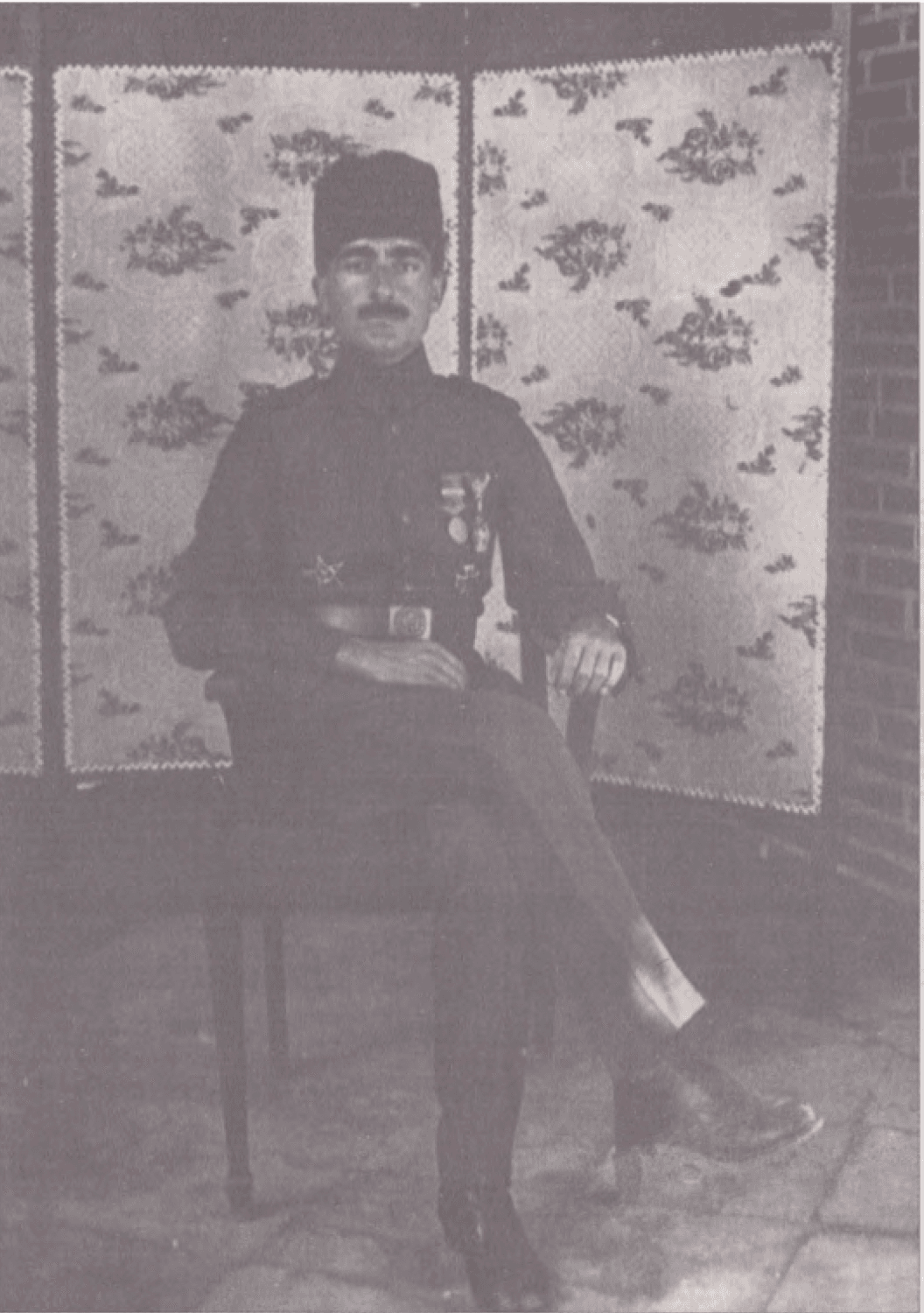
Halil Kut Paşa (Mehmet Emin Dinç)
Halil Kut Pasha
Year of Birth | 1882 | ||||||||
|---|---|---|---|---|---|---|---|---|---|
Place of Birth | Istanbul, Ottoman Empire | ||||||||
Date of Death | 20 August 1957 | ||||||||
Place of Death | Istanbul, Türkiye | ||||||||
Place of Burial | Yahya Efendi Dergâhı Mezarlığı, Beşiktaş, Istanbul | ||||||||
Surname | Kut (after the 1934 Surname Law) | ||||||||
Military Rank | Mirliva (Brigadier General) | ||||||||
Affiliated Army | Ottoman Army | ||||||||
Wars Participated In | Caucasus Campaign (Baku Operation) Mesopotamian Campaign (Siege of Kut) World War I (1914–1918) Balkan Wars (1912–1913) Tripolitanian War (1911–1912) | ||||||||
Notable Achievements | Capture of Baku by Ottoman-Azerbaijani forces (1918) Victory at Kut (1916) | ||||||||
Halil Kut Pasha was an Ottoman pasha who held military posts during the final years of the Ottoman State and the First World War, particularly known for the Victory of Kut al-Amara, which he achieved on the Iraqi Front. Halil Pasha was also an influential figure within the Committee of Union and Progress. Beyond his military successes, his memoirs of the National Struggle and subsequent experiences extended the historical scope of his life story across a broad period.

"Commander of the Sixth Army, Halil Pasha", Harp Mecmuası, Issue 8.
【1】
Halil Pasha was born in Istanbul in 1882. His family originated from Crimea and traced its lineage to the Gagauz Turks. His great-great-grandfather, Abdullah Ağa, lived in the village of Kili in the Bessarabia region of Crimea. Abdullah Ağa, originally a Christian Gagauz, converted to Islam and migrated to Ottoman lands. As a result, the family adopted the epithet “Kilili,” and their descendants were known as “Kililioğulları” or “Kililigiller.”
The family, having migrated from Crimea to Anatolia, settled in the village of Perşembepazarı near Abana, Kastamonu. Halil Pasha’s paternal grandfather, Kililioğlu Hüseyin Ağa, had a son named Hacı Mustafa Kaptan, who arranged the family’s relocation to Istanbul. Hacı Mustafa Kaptan spent many years engaged in maritime trade and died at the age of 97.
After settling in the Ottoman capital, the family continued their lives within Istanbul’s social and cultural environment. Halil Pasha was born into this milieu. Another significant figure within the family was his nephew Nuri Killigil, the son of Halil Pasha’s brother Ali Rıza Bey. In later years, Nuri Killigil became a prominent figure in the Ottoman and Republican periods in the field of military industry.
Another important familial connection for Halil Pasha was his uncle-nephew relationship with Enver Pasha. However, due to their relatively small age difference, their bond evolved over time into one resembling brotherhood. Within the family structure, traditions of military service and state administration were strongly maintained.
Halil Pasha began his primary education at the Beşiktaş Abbasağa Neighborhood School in Istanbul. He later attended the Hamidiye Neighborhood School. The education provided in these neighborhood schools followed the traditional Ottoman system, emphasizing religious knowledge, basic literacy, Arabic, and Ottoman Turkish.
After completing his neighborhood schooling, Halil Pasha turned to military education and enrolled at the Beşiktaş Military Secondary School. Military secondary schools were institutions established to train officers for the Ottoman Army. At Beşiktaş Military Secondary School, he studied mathematics, geography, history, military discipline, and basic military knowledge. His academic performance during this period attracted attention.
After completing his military secondary education, Halil Pasha transferred to the Kuleli Military High School. Kuleli Military High School was a prestigious institution established to prepare officer candidates for the Ottoman Army. During his time at the high school, Halil Pasha studied French as a foreign language. Advanced mathematics, physics, chemistry, military tactics, and strategy also formed a significant part of the curriculum.
After successfully completing his high school education, Halil Pasha was admitted to the War School (Mekteb-i Harbiye). The War School was the highest military educational institution in the Ottoman Army, responsible for training general staff officers. The education he received there extended beyond classical military knowledge to include modern warfare techniques, artillery, fortification, and personnel administration.
Throughout his time at the War School, students were also taught about the modern military technologies of the era and the structure of European armies. Halil Pasha reinforced his theoretical knowledge through practical training. The program, which focused on battlefield command, troop deployment, and administration, aimed to produce young officer candidates capable of both leading on the front lines and developing strategic thinking.
Halil Pasha graduated from the War School in 1904 with the rank of “Mümtaz Yüzbaşı” (Distinguished Captain), an honor awarded only to students demonstrating exceptional academic achievement and military competence. Following graduation, he began active service in the Ottoman Army.
After graduating from the War School in 1904 with the rank of “Mümtaz Yüzbaşı,” Halil Pasha began his duties in the Ottoman Army. His first assignment was within the III Corps stationed in Macedonia. At the time, Macedonia was a region marked by political turmoil, nationalist uprisings, and intensified bandit activity. Halil Pasha was assigned to maintain public order and combat banditry in this environment.
During operations in Macedonia, particularly those directed against Serbian, Bulgarian, and Greek bands, Halil Pasha played an active role. During his service in Macedonia, he received several promotions. In 1907, he was promoted to the rank of “Kolağası” (Senior Captain).
In 1908, following the proclamation of the Second Constitutional Monarchy, Halil Pasha was appointed Commander of the Salonica Mobile Gendarmerie Units. In this role, he was responsible for ensuring security and public order, bringing local resistance groups under control, and preserving public peace.
While serving in Salonica, his ties with the Committee of Union and Progress strengthened. Halil Pasha embraced the society’s goals and provided support.
In 1909, after the 31 March Incident in Istanbul, he was assigned to the capital to restore security and order. Upon his transfer to Istanbul, he assumed command of the Palace Guard Units.
Among the responsibilities he undertook at the Istanbul Central Command were ensuring the internal security of the capital, protecting key state institutions, and coordinating military measures during emergencies. During this period, he maintained direct contact with officers of various ranks within the army and enhanced his administrative experience.
During this time, Halil Pasha engaged in activities such as enforcing discipline within the military units he commanded, organizing their training, and planning military exercises. The military and political developments surrounding the 31 March Incident and its aftermath further elevated the importance of his duties in Istanbul.
In 1911, Italy declared war on the Ottoman State and launched an invasion of Tripolitania and Benghazi. Unable to send regular troops to the region, the Ottoman State secretly dispatched small groups of young officers to Tripolitania. Halil Pasha was among the officers selected for this mission. Departing from Istanbul, he traveled secretly to Tripolitania.
Upon arrival in Tripolitania, Halil Pasha was appointed commander of the Homs Front. Homs was a strategic location on the eastern coast of Tripolitania and one of the key centers of resistance against Italian occupation. Halil Pasha organized the local population in the Homs region to conduct resistance operations against Italian forces.
Ottoman officers operating in Tripolitania, in cooperation with the local population, waged guerrilla-style warfare in small units. Halil Pasha, following this approach, organized defensive operations in the Homs region using limited military resources. In addition to Homs, he contributed to strengthening Ottoman resistance in the regions of Misrata, Benghazi, Tobruk, and Derna.
The units under Halil Pasha’s command in the Homs Front primarily consisted of volunteers recruited from local tribes and small forces led by Ottoman officers. Despite the Italian army’s superior modern weaponry and organized units, Halil Pasha’s defensive and resistance activities significantly hindered Italian advances into the interior.
During battles around Homs, Halil Pasha’s forces conducted various raids and defensive operations against Italian troops. These engagements prevented Italian forces from expanding beyond the coastal strip. Halil Pasha’s activities in the region played a decisive role in limiting Italian territorial control during the Tripolitania War.
During his time in Tripolitania, Halil Pasha also ensured coordination among Ottoman officers. Other notable officers who arrived in Tripolitania included Enver Pasha, Mustafa Kemal Pasha, and Nuri Pasha (later Nuri Killigil). Nuri Killigil, Halil Pasha’s nephew, became a prominent figure in Ottoman and Republican military industry in later years. During the Tripolitania War, Nuri Pasha also operated in the same fronts as Halil Pasha and supported resistance efforts.
Halil Pasha’s activities on the Tripolitania Front were not limited to military operations; they also encompassed sustaining local loyalty to the Ottoman State, maintaining the spirit of resistance, and mobilizing logistical resources.
In 1912, following the signing of the Treaty of Ouchy between Italy and the Ottoman State, Tripolitania was formally ceded to Italy, and Halil Pasha and other Ottoman officers withdrew from the region. The Tripolitania War provided Halil Pasha with significant experience in organizing resistance under limited resources, cooperating with local elements, and conducting guerrilla warfare under modern combat conditions.
Following the Tripolitania War, Halil Pasha was recalled by the Ottoman State in 1912 as the Balkan Wars began. After returning from Tripolitania under the terms of the Ouchy Treaty, Halil Pasha rejoined the Ottoman Army on the Western Front to participate in the Balkan Wars.
The Balkan Wars comprised a series of battles that resulted in the Ottoman State losing its territories in the Balkans and had profound military, political, and social consequences. The Ottoman Army was forced to fight on multiple fronts against the Balkan League, composed of Serbia, Montenegro, Greece, and Bulgaria. During this conflict, Halil Pasha held various roles, particularly in military operations in Western Thrace and its surroundings.
The units under Halil Pasha’s command participated in defensive operations against the Bulgarian Army during the early phase of the war. The rapid advance of Bulgarian forces forced the Ottoman Army into retreat. Halil Pasha played an active role during the retreat, managing the orderly withdrawal of regular units and reorganizing those left behind.
In the later stages of the war, the defense of Edirne became a critical issue. When Bulgarian forces besieged Edirne, Halil Pasha contributed to the deployment of reinforcement units and the preparation of the city’s defenses. However, after enduring a prolonged siege, Edirne surrendered to Bulgarian forces in March 1913, prompting further Ottoman retreats in the region.
During the Balkan Wars, Halil Pasha did not limit himself to frontline combat; he also undertook administrative duties such as logistical support, securing supply lines, and reorganizing retreating units. This period demanded initiative and flexibility from officers on the ground due to severe military challenges, particularly logistical shortages, inadequate equipment, and organizational problems.
When the Balkan Wars ended in 1913, the Ottoman State had lost the majority of its Balkan territories, retaining only Edirne and Kırklareli. Halil Pasha continued his service in the Ottoman Army after the war and was promoted in rank and awarded various honors for his service during the conflict.
With the outbreak of the First World War in 1914, the Ottoman State joined the Central Powers. The Ottoman Army was compelled to fight on multiple fronts. Halil Pasha assumed active duties within the Ottoman Army during the early months of the war. In line with plans to assign experienced officers to critical positions following the reorganization of the army after the Balkan Wars, Halil Pasha was deployed to the Iraqi Front, one of the war’s key theaters.
The Iraqi Front held significant strategic and economic importance for the Ottoman State. British advances through the Persian Gulf threatened Ottoman authority in Mesopotamia. Additionally, due to its oil reserves and proximity to the Persian Gulf, the region was a vital target for the Allied Powers.
Britain, seeking to secure the safety of its Indian colonies and gain control over oil fields, began advancing into Iraq from the Persian Gulf. The British campaign, initiated with the occupation of Fao on 6 November 1914, quickly spread to Basra and its surroundings. British forces advanced upstream along the Shatt al-Arab, achieving a series of successes against Ottoman troops.
In response to these developments, the Ottoman General Staff decided to send reinforcements to the region. Halil Pasha was assigned to the Iraqi Front within this context. Initially serving as a corps commander, Halil Pasha played an active role in the deployment and management of Ottoman forces in the region.
Upon arriving at the Iraqi Front, the state of Ottoman forces was weak. Most units consisted of local militias and a limited number of regular troops. There were severe shortages of weapons, ammunition, and supplies. Under these difficult conditions, Halil Pasha began efforts to restore order, boost troop morale, and strengthen the defensive line.
Initially, command of Ottoman forces in the region rested with Colonel Süleyman Askerî Bey. After his death, command passed to Nurettin Bey. During Nurettin Bey’s tenure, Ottoman forces pursued the withdrawing British units toward Kut al-Amara. Halil Pasha actively participated in operations aimed at reorganizing existing Ottoman units and halting the British advance.
As the campaign on the Iraqi Front progressed, Halil Pasha rapidly became one of the most authoritative commanders in the region. He played a decisive role especially after the British forces withdrew to the town of Kut al-Amara and the subsequent siege began.
At this time, Ottoman forces on the Iraqi Front aimed to achieve a major military success by besieging the British 6th Division under General Townshend in Kut al-Amara. Halil Pasha took the initiative in organizing the siege, securing logistical support, and managing the front.
Halil Pasha’s responsibilities following his deployment to the Iraqi Front proved decisive in securing a significant Ottoman victory against the British in the later stages of the war. Developments in the region increased the strategic importance of the Iraqi Front within the overall Ottoman war strategy.
The Siege of Kut al-Amara was a major military success achieved by Ottoman forces on the Iraqi Front during the First World War, when they besieged the British 6th Division under General Charles Townshend. Halil Pasha, as the overall commander of the siege, played an active and decisive role.

Halil Pasha during a reconnaissance mission.
【2】
By late 1915, British forces, having suffered heavy losses in the Battle of Selman-ı Pak, were forced to retreat. Under General Townshend’s command, British units halted their advance along the route to Baghdad and withdrew to the town of Kut al-Amara. Due to its geographical location on the banks of the Tigris River and its defensible terrain, the town was chosen by the British as a suitable defensive position.
On 5 December 1915, Ottoman forces encircled Kut al-Amara. Initially, the siege was led by Nurettin Bey. However, Halil Pasha assumed command during the siege and took direct control of the operation. Throughout the siege, Halil Pasha managed coordination among units, secured supply lines, fortified the front, and planned attacks.

Halil Pasha with his staff officers.
【3】
During the siege, British forces began experiencing severe supply shortages. Halil Pasha brought the crossing points along the Tigris River under control to prevent external aid from reaching the British. The British launched several relief operations to break the siege and support Townshend’s troops. In January 1916, British reinforcement forces under General Aylmer attacked Ottoman positions in the Battle of Sheikh Saad but were repelled with heavy losses.
In February and March, British forces failed to break through Ottoman defenses in the battles of Hanna and Dujaila. Each failed attempt resulted in heavy British casualties, and they were unable to lift the siege. Halil Pasha strengthened the defensive lines in the region and ensured timely deployment of reinforcement units.
In April 1916, the British launched a final relief operation. However, they were again defeated by Ottoman defenses in the Battle of Fallahiye. Following this failure, the British command acknowledged that the troops in Kut al-Amara could not be rescued.
During the siege, General Townshend established contact with Halil Pasha to negotiate surrender terms. The British commander offered large sums of money in exchange for the release of his troops. Halil Pasha rejected all British proposals for release in return for money or weapons. Correspondence with the Ottoman General Staff consistently upheld the demand for unconditional surrender.
On 29 April 1916, after approximately five months of siege, General Townshend’s British 6th Division surrendered to Ottoman forces. Among the surrendered troops were five generals, 481 officers, and 13,300 soldiers. Halil Pasha did not take Townshend’s sword, stating that he was received not as a prisoner of war but as a guest.

Commander of the Sixth Army Halil Pasha (1) and British General Townshend (2), captured at Kut al-Amara.
【4】
The Siege of Kut al-Amara was recorded in Ottoman history as the greatest military victory after the Gallipoli Victory during the First World War. The surrender was also regarded as a major defeat in British military history. The defeat caused a serious morale collapse in British public opinion and particularly within British colonies.
Following the Victory of Kut al-Amara, Halil Pasha was promoted to the rank of brigadier general (Mirliva) and officially appointed commander of the Sixth Army. Additionally, in commemoration of the victory, he was granted the honorific title “Kut,” which he later formally adopted as his surname after the Surname Law was enacted.
Ottoman forces also suffered heavy losses during the siege and victory. Approximately 10,000 Ottoman soldiers were killed during the siege. However, the scale of British losses and the mass surrender significantly enhanced the historical importance of the victory.
The command skills, disciplined troop management, and strategic moves to cut off enemy supply lines demonstrated by Halil Pasha during the siege were decisive factors in its successful outcome.

The Kut al-Amara Victory Monument erected in 1916 in commemoration of the victory. Later destroyed by the British.
【5】
After the Victory of Kut al-Amara, Halil Pasha continued serving as commander of the Ottoman Sixth Army on the Iraqi Front. The major victory of 29 April 1916 provided Ottoman forces with a significant boost in morale and prestige. However, the military and strategic situation in the region presented challenges that made it difficult for the Ottoman Army to convert this success into lasting superiority.
Following the Victory of Kut al-Amara, Halil Pasha implemented various defensive arrangements to prevent further British advances into Iraq. Ottoman forces began constructing a defensive line along the Tigris River extending northward and westward. The defense of Baghdad became a strategic objective. However, logistical and supply difficulties hampered the continuity of military operations.
Ottoman forces under Halil Pasha established defensive positions along the Shatt al-Arab and around the Tigris River after Kut al-Amara. However, Britain, following its defeat at Kut al-Amara, sent significant reinforcements to strengthen its military presence in the region. British forces, reorganized under General Maude and designated as the Mesopotamian Expeditionary Force, set the capture of Baghdad as their primary objective.
In late 1916, the British began advancing northward from Basra. Improved supply lines, the deployment of modern equipment, and the reinforcement of units composed of Indian soldiers enhanced the operational capacity of the British Army. In contrast, Ottoman forces began weakening due to supply shortages, manpower losses, and disease.
In October 1916, following the death of Marshal Colmar Freiherr von der Goltz, Halil Pasha officially assumed command of the Sixth Army. He undertook various reorganizations to rebuild the army and strengthen resistance on the front. However, limited resources and increasing British pressure forced Ottoman forces into a defensive posture.
In early 1917, the British launched another major offensive. Advancing along the Tigris River, British units breached Ottoman defensive lines and moved toward Baghdad. Although Ottoman forces engaged in fierce battles near Selman-ı Pak in February 1917, they could not halt the British advance.
Halil Pasha implemented various measures to defend Baghdad. He established defensive lines to the north and south of the city. However, these measures proved insufficient due to manpower shortages and lack of logistical support. Ottoman defenses weakened under intense British artillery bombardment and superior numbers.
On 7 March 1917, Halil Pasha assessed that Baghdad could no longer be defended and ordered its evacuation. Ottoman forces withdrew from Baghdad and moved northward toward Samarra and Mosul. On 11 March 1917, British forces entered and occupied Baghdad.
After the loss of Baghdad, Halil Pasha worked to maintain the order of retreating Ottoman units. New defensive lines were established along the Tigris River as far as Samarra. However, Ottoman forces remained under constant British pressure.
These developments on the Iraqi Front marked a turning point in Halil Pasha’s military career. The great victory at Kut al-Amara was offset by the loss of Baghdad. Halil Pasha continued serving on the Iraqi Front after the fall of Baghdad, but the overall situation of the front had become predominantly defensive.
New defensive lines established around Samarra and Mosul temporarily slowed the British advance. During this period, Halil Pasha worked to sustain military resistance and ensure the security of the local population. However, the overall condition of the Ottoman Army necessitated a defensive strategy on the Iraqi Front.
After the loss of Baghdad on the Iraqi Front, Halil Pasha was assigned by the Ottoman General Staff to the Caucasus Front. In mid-1917, he was placed in command of units under the Eastern Army Group. In this new role, Halil Pasha managed Ottoman military operations in the Caucasus region.
The primary objective of the Ottoman State on the Caucasus Front was to exploit the power vacuum created by the Bolshevik Revolution in Russia in 1917 and establish Ottoman control in the Caucasus, asserting dominance over Turkic-Muslim communities in the region. To this end, military and political activities were conducted to exert influence over South Caucasus, particularly Azerbaijan.
Halil Pasha’s initial responsibilities in the Caucasus included restoring order after the Russian withdrawal, bringing Armenian and Georgian units under control, and securing control over the Baku oil region. Additionally, strengthening Ottoman influence in the region through cooperation with Azerbaijani Turks was a key strategic goal.
Halil Pasha began military preparations in early 1918 to establish an active presence in Baku and its surroundings. He also played a significant role in the formation of the Islamic Army of the Caucasus. This force was organized as a unit composed of Ottoman officers and Azerbaijani Turks. Halil Kut assumed a vital role within this army, coordinating military operations and overseeing administrative and political arrangements in the region.
In the summer of 1918, the Islamic Army of the Caucasus accelerated its operations toward Baku. During this campaign, Halil Pasha worked to secure logistical support, organize local elements, and gain the support of the Muslim population in the region. The objective was to capture Baku, then held by Armenian and Bolshevik forces, through Ottoman-Azerbaijani cooperation.
Halil Pasha was responsible for the deployment and command of units during military operations around Baku. As a result of the general offensive launched in August 1918, the city of Baku was captured by Ottoman-Azerbaijani forces on 15 September 1918. The Islamic Army of the Caucasus achieved significant successes during the capture of Baku, neutralizing Bolshevik and Armenian forces in the city.
The capture of Baku by Ottoman-Azerbaijani forces enhanced Ottoman influence in the region. After the conquest, Halil Pasha contributed to establishing Ottoman military and administrative order in Baku and its surroundings. He also worked to restore public order, ensure the functioning of public services, and regulate relations with the local population.
The Baku Campaign is recorded as one of the most important military successes of the Ottoman State in the Caucasus. However, the signing of the Armistice of Mudros led to the decision for Ottoman forces to withdraw from the region. In accordance with the terms of the armistice signed on 30 October 1918, the Ottoman Army was required to evacuate Baku.
After the armistice, Halil Pasha managed the orderly evacuation of Ottoman units from Baku. Ottoman forces withdrew from the region in compliance with the armistice terms and returned to Anatolia. Thus, Halil Pasha’s military activities in the Caucasus and the Baku Campaign came to an end.
Following the signing of the Armistice of Mudros on 30 October 1918, the Ottoman State came under the occupation and control of the Allied Powers. In accordance with the armistice terms, Ottoman armies were disbanded, and key centers were placed under Allied control. In this context, Halil Pasha left active military service and returned to Istanbul.
After his return to Istanbul, Halil Pasha became one of the figures attracting the attention of the Allied Powers due to his military activities on the Iraqi and Caucasus Fronts during the First World War. In 1919, under Allied pressure, the Ottoman government arrested him and imprisoned him in Bekirağa Barracks alongside other former military and political officials. The grounds for his arrest included allegations of war crimes related to his military operations during the war, particularly his activities in the Caucasus. However, no formal trial process was initiated against him.
During his imprisonment, Halil Pasha was held under surveillance at Bekirağa Barracks. The British, seeking to pressure Ottoman officers through accusations related to the Armenian deportations and military actions in the Caucasus, maintained these detentions. Halil Pasha’s situation was assessed within this broader political climate of pressure.
In early 1920, Halil Pasha managed to escape from Bekirağa Barracks. During the period he remained in Istanbul, he closely followed the National Struggle movement. He established contact with nationalist circles in Istanbul and explored ways to support the independence struggle that had begun in Anatolia. However, due to the occupation conditions in Istanbul and the strict control of the Allied Powers, he could not directly travel to Anatolia.
Halil Pasha’s activities in Istanbul did not involve direct combat on the front. Instead, he contributed to the National Struggle indirectly by facilitating the shipment of military supplies and logistical support to Anatolia and strengthening secret nationalist organizations in Istanbul. He participated in activities such as sending weapons and ammunition to Anatolia through contacts with former members of the Committee of Union and Progress.
It is known that he maintained indirect relations with secret organizations active in Istanbul at the time, such as the Karakol Society. However, Halil Pasha was not an active member of any organizational structure; his contact with nationalist circles occurred at the level of support and coordination.
By the end of 1919, Halil Pasha assessed that remaining in Istanbul had become increasingly difficult. Unable to find a direct route to Anatolia, he chose an alternative path. In 1920, he secretly left Istanbul and first traveled to the Caucasus. In the Caucasus, particularly in Azerbaijan, he engaged in activities amid the political vacuum left after the Ottoman withdrawal.
During his time in Azerbaijan, Halil Pasha played a role in the founding process of the Turkish Communist Party. The aim of this initiative was to establish an ideological and political link between the National Struggle movement in Anatolia and the Soviet Union to secure international support for Anatolia. The Turkish Communist Party operated from Baku with this objective.
After completing his activities in Azerbaijan, Halil Pasha moved to the Soviet Union and engaged in contacts in Moscow. During his time in Moscow, he conducted official and unofficial discussions aimed at securing Soviet support for the National Struggle movement. He participated in efforts to establish diplomatic ties between the Soviet Union and Anatolia.
By 1921, due to internal political changes in the Soviet Union and the establishment of formal relations between Anatolia and the Soviets, Halil Pasha left the Soviet Union and moved to Europe. He first went to Germany, where he resided for a period, and then moved to Switzerland. During these years in Europe, he did not engage in any political activities and did not assume a visible public role.
During his residence in Europe, Halil Pasha closely followed developments in Turkey. After the proclamation of the Republic of Turkey by the Grand National Assembly of Turkey in 1923, he decided to return to Turkey.
In 1923, after the proclamation of the Republic of Turkey, Halil Pasha returned from Europe to Turkey. After completing formal procedures, he was officially retired from military service. After retirement, he did not assume any military or political position. Halil Pasha, who did not play a direct role in the establishment of the new regime, fully withdrew from active military and political life and chose a civilian lifestyle.
In the early years of the Republic’s formation, like many former high-ranking Ottoman military officers and politicians, Halil Pasha was not included in the central cadres of the new regime. As part of the military and bureaucratic purges carried out by the Republican government, he was removed from the army’s ranks. During this period, he voluntarily retired and turned his focus to private life in Istanbul.
Residing in Istanbul, Halil Pasha maintained occasional contact with former friends and military acquaintances. However, he did not join any political organization or engage in active political activities. He did not emerge as a prominent public figure; his name rarely appeared in the press or official records. He neither directly clashed with the Republican regime nor openly opposed its fundamental policies.
In accordance with the Surname Law enacted in 1934, he adopted the surname “Kut.” This surname referenced his most significant military achievement, the Victory of Kut al-Amara in 1916. Thus, the Victory of Kut al-Amara, the most important milestone of his military career, became part of his official identity as Halil Kut.
In his retirement years, Halil Kut devoted himself primarily to personal projects. He documented his military experiences and the historical events he witnessed during the Ottoman period and the First World War. He wrote his memoirs, recording his personal recollections and developments on the fronts where he served. His memoirs gave extensive attention to significant phases such as the Tripolitania War, the Balkan Wars, the Siege of Kut al-Amara on the Iraqi Front, and his activities in the Caucasus.
In his later years, Halil Kut began experiencing health problems. Due to chronic illnesses associated with old age, he underwent prolonged medical treatment. After being discharged from Gülhane Military Medical Academy Hospital, he returned home to rest.
He passed away on 20 August 1957 in Istanbul. His funeral was held at the Yahya Efendi Dergâhı Cemetery in the Beşiktaş district of Istanbul. After his death, Halil Kut’s military career, particularly the Victory of Kut al-Amara, was occasionally mentioned. However, for many years, his name received limited attention in public opinion and official historical narratives.
Throughout his life in the Republican era, Halil Kut remained a figure removed from active duties, preferring a civilian life and maintaining a connection to his military past. His activities on the fronts during the final years of the Ottoman State, especially his success on the Iraqi Front, established him as an important figure in modern Turkish military history.
Albayrak, Muzaffer and Vahdettin Engin. Kutulamare Zaferi 1916. Istanbul: Yeditepe Yayınevi, 2017.
Anadolu Ajansı. "Türk Tarihinin Büyük Zaferi: Kut'ül Amare." Anadolu Ajansı (AA). Accessed April 28, 2025. https://www.aa.com.tr/tr/turkiye/turk-tarihinin-buyuk-zaferi-kutul-amare/2223000.
Arslanyürek, Yaşar. “Halil (Kut) Bey’in Trablusgarp Savaşı’ndaki Faaliyetleri.” *Belgi Dergisi* 2, no. 18 (2019): 1563–1586. https://doi.org/10.33431/belgi.567071.
Atatürk Kültür, Dil ve Tarih Yüksek Kurumu Atatürk Araştırma Merkezi Yayınları. Kûtü’l-Amâre Zaferi’nin 100. Yılı Münasebetiyle I. Dünya Savaşı’nda Irak Cephesi Uluslararası Sempozyumu: 28–29 Nisan 2016 Mardin, Bildiriler. Ed. Orhan Neçare. Ankara: Atatürk Kültür, Dil ve Tarih Yüksek Kurumu Atatürk Araştırma Merkezi, 2016.
Derin Tarih Dergisi. "Halil Kut Paşa Unutkanlığımızın Kurbanlarından." Accessed April 28, 2025. https://www.gzt.com/derin-tarih/halil-kut-pasa-unutkanligimizin-kurbanlarindan-2647056.
Dinç, Mehmet Emin. Kutü’l-Amâre’nin Muzaffer Komutanı Halil Kut Paşa. Istanbul: Kronik Kitap, 2017.
Islam Encyclopedia. "Kûtül‘Amâre." Author: Mustafa L. Bilge. *Türkiye Diyanet Vakfı İslam Ansiklopedisi.* Accessed April 28, 2025. https://islamansiklopedisi.org.tr/kutulamare.
Küçükvatan, Mahir. "İngiliz Basınında Osmanlının Kut’ül-Amare Zaferi." Çağdaş Türkiye Tarihi Araştırmaları Dergisi 13, no. 26 (June 2013): 55–85.
Kızılay Tarih Belge ve Arşiv Yönetimi Müdürlüğü. "Kût'ül Amare Zaferi ve Hilal-i Ahmer." Kızılay Tarih. Accessed April 28, 2025. https://kizilaytarih.org/dosya006.html.
Marttin, Volkan. “Halil Paşa’nın Hatıralarının Tarihî Kıymeti.” *Tarih İncelemeleri Dergisi* 33, no. 1 (July 2018): 69–89. https://doi.org/10.18513/egetid.443312.
Yeni Şafak. "Son Osmanlı Paşası: Halil Kut." Accessed April 28, 2025. https://www.yenisafak.com/hayat/son-osmanli-pasasi-halil-kut-2464576.
[1]
Mehmet Emin Dinç, Kutü’l-Amare’nin Muzaffer Komutanı Halil Kut Paşa (İstanbul: Kronik Kitap, 2017).
[2]
Mehmet Emin Dinç, Kutü’l-Amare’nin Muzaffer Komutanı Halil Kut Paşa (İstanbul: Kronik Kitap, 2017).
[3]
Mehmet Emin Dinç, Kutü’l-Amare’nin Muzaffer Komutanı Halil Kut Paşa (İstanbul: Kronik Kitap, 2017).
[4]
Mehmet Emin Dinç, Kutü’l-Amare’nin Muzaffer Komutanı Halil Kut Paşa (İstanbul: Kronik Kitap, 2017).
[5]
Mehmet Emin Dinç, Kutü’l-Amare’nin Muzaffer Komutanı Halil Kut Paşa (İstanbul: Kronik Kitap, 2017).

Halil Kut Paşa (Mehmet Emin Dinç)
Halil Kut Pasha
Year of Birth | 1882 | ||||||||
|---|---|---|---|---|---|---|---|---|---|
Place of Birth | Istanbul, Ottoman Empire | ||||||||
Date of Death | 20 August 1957 | ||||||||
Place of Death | Istanbul, Türkiye | ||||||||
Place of Burial | Yahya Efendi Dergâhı Mezarlığı, Beşiktaş, Istanbul | ||||||||
Surname | Kut (after the 1934 Surname Law) | ||||||||
Military Rank | Mirliva (Brigadier General) | ||||||||
Affiliated Army | Ottoman Army | ||||||||
Wars Participated In | Caucasus Campaign (Baku Operation) Mesopotamian Campaign (Siege of Kut) World War I (1914–1918) Balkan Wars (1912–1913) Tripolitanian War (1911–1912) | ||||||||
Notable Achievements | Capture of Baku by Ottoman-Azerbaijani forces (1918) Victory at Kut (1916) | ||||||||
Family and Childhood
Educational Life
Early Military Career
Activities in the Tripolitania War
Activities in the Balkan Wars
Outbreak of the First World War and Deployment to the Iraqi Front
The Siege and Victory of Kut al-Amara
Developments on the Iraqi Front After the Victory of Kut al-Amara
Activities in the Caucasus and Baku Campaign
Armistice Period and Istanbul Years
Republican Period and Final Years