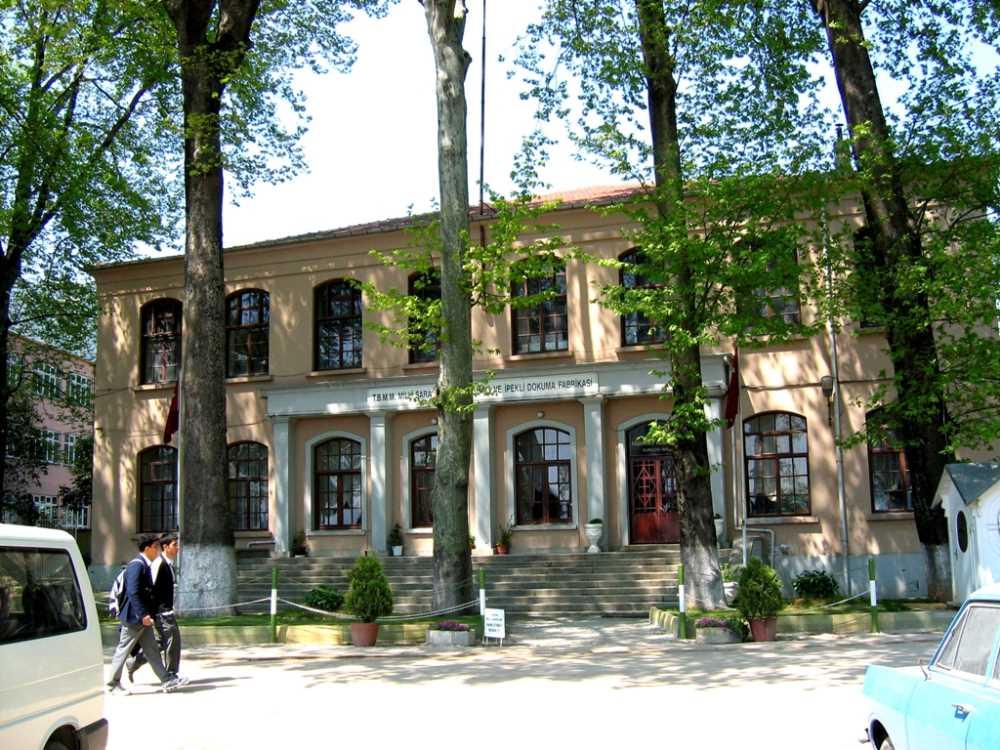
This article was automatically translated from the original Turkish version.
+2 More
Location | Hereke - Kocaeli / Türkiye | ||||||||
|---|---|---|---|---|---|---|---|---|---|
Year of Establishment | 1843 | ||||||||
Founder(s) | Sultan Abdülmecid | ||||||||
Carpet Technical Feature | Hand-woven, double Turkish knot (Gördes), approximately 360,000 knots per square meter | ||||||||
Main Products Produced | Carpet, Velvet, Diba, Seraser, Atlas, Silken floor coverings | ||||||||
Historical Uses | Ottoman palaces, pavilions and mansions (e.g. Dolmabahçe Sarayı, Yıldız Şale Köşkü) | ||||||||
Management (Present Day) | Türkiye Büyük Millet Meclisi – Millî Saraylar İdaresi Başkanlığı | ||||||||
Hereke Carpet and Silk Weaving Factory was established in the town of Hereke, Kocaeli, as one of the symbolic structures of the 19th century Ottoman industrialization process. Built in 1843 by order of Sultan Abdülmecid to meet the palace flooring and carpet needs, the factory is an original production center where traditional handcraft techniques and modern weaving technologies converge.
Known for its finely woven carpets using the double knot technique and silk fabrics produced on jacquard looms, the facility also laid the foundation for the emergence of the aesthetic style later known as the “Hereke style.” Over the Republican era, the factory underwent various institutional transformations and today continues to operate as a museum-factory under the National Palaces Administration, affiliated with the Presidency of Türkiye, maintaining both production and cultural promotion functions.
The facility was originally established in 1843 as a private initiative, presented to Sultan Abdülmecid under the guidance of Rıza Pasha, and officially registered in his name as “Fabrika-i Hümâyûn,” becoming a formal imperial factory. Its purpose was to supply the Ottoman palaces with flooring and curtain fabrics. In 1845, production began with looms and master weavers brought from France, establishing a modern weaving system. In its early years, fabrics such as velvet, diba, atlas, and seraser were woven. The carpet designs of Hereke were created by court painter Emil Meinz, taking spatial characteristics into account; the production of these designs was personally monitored by Sultan Abdülmecid.

Fabrika-i Hümâyûn (Republic of Türkiye, Kocaeli Governorship)
The factory won awards at international exhibitions including Paris 1851, London 1862, Vienna 1892, Lyon 1894, Brussels 1910, and Turin 1911. Carpet weaving began in 1891 under the direction of Sultan Abdülhamid II. Initially, carpets with palace designs were woven by master weavers brought from cities such as Sivas, Manisa, and Ladik; over time, the development of original motifs and color palettes gave rise to the “Hereke style.”
After the proclamation of the Republic, the factory was first transferred to the Sanayi ve Maadin Bankası, repaired after a fire in 1932, attached to Sümerbank in 1938, and finally incorporated into the National Palaces Administration under the Grand National Assembly of Türkiye in 1995. Today it functions both as an active production facility and as a museum open to visitors, preserving its historical identity.
The Wilhelm Köşkü within the factory complex was prefabricated in two days at Yıldız Palace in 1898, prior to the visit of German Emperor Wilhelm II, and transported to Hereke where it was assembled in a single day.

Hereke Carpet and Silk Weaving Factory (
Hereke carpets are produced using the traditional hand-weaving technique known as the double knot (Gördes knot), which ensures both durability and long-term usability. On average, there are about 100 knots per square centimeter, or approximately one million knots per square meter. This high knot density enhances the clarity of the carpet patterns and ensures that the designs become more distinct over time. The yarn used in carpet production is the finest filature silk in the world, derived from the cocoons of silkworms fed on mulberry leaves in Bursa. The production of a small carpet takes several months, while large-scale pieces may require over a year to complete.

Hereke Carpet (Government of Kocaeli, Republic of Türkiye)
Historically, Hereke carpets were not only used within Ottoman palaces, kiosks, and mansions but also gained international recognition through awards at global fairs and became diplomatic gifts abroad. The factory’s production capacity is exemplified by large-scale works such as the 468-square-meter single-piece carpet for the Yıldız Şale Köşkü and the 124-square-meter carpet for the Muayede Salonu of Dolmabahçe Palace. Additionally, the factory continues to produce silk floor fabrics using traditional jacquard and armül systems.
This production tradition has been officially registered by the Turkish Patent and Trademark Office, and Hereke carpets have received geographical indications in three distinct categories: Hereke Silk Carpet (100x100), Hereke Wool-Silk Handmade Carpet (80x80), and Hereke Wool Handmade Carpet. These registrations serve as official recognition of both their technical qualities and their cultural heritage value.

Hereke Carpet and Silk Weaving Factory (Anadolu Agency)
In addition to its production activities, the facility also fulfills functions related to the preservation and promotion of cultural heritage. Operating under the National Palaces Administration, it serves as a center for the dissemination and transmission of traditional weaving arts. The museum-factory is open to visitors, offering both domestic and international audiences the opportunity to observe the weaving process firsthand.

Hereke Carpet and Silk Weaving Factory (ı (Presidency of the National Palaces of the Republic of Türkiye))
Anadolu Ajansı. “Basıldıkça Güzelleşen Halıların Üretildiği Fabrika: Hereke.” Anadolu Ajansı. Accessed June 20, 2025. https://www.aa.com.tr/tr/yasam/basildikca-guzellesen-halilarin-uretildigi-fabrika-hereke/1356508
Ministry of Culture and Tourism of the Republic of Türkiye. “Hereke Halı and Silk Weaving Factory - Kocaeli.” *Turkey Culture Portal*. Accessed June 20, 2025. https://www.kulturportali.gov.tr/turkiye/kocaeli/gezilecekyer/hereke-hali-ve-pekli-dokuma-fabrikasi
T.C. Millî Saraylar İdaresi Başkanlığı. "Hereke Halı ve İpekli Dokuma Fabrikası." T.C. Millî Saraylar İdaresi Başkanlığı Resmî Web Sitesi. Accessed June 20, 2025. https://www.millisaraylar.gov.tr/Lokasyon/19/Hereke-Hali-ve-Ipekli-Dokuma-Fabrikasi
T.C.Kocaeli Valiliği. “İlimizin Eski Yerleşim Yerlerinden Hereke...” *T.C. Kocaeli Governorship Official Website.* Accessed June 20, 2025. http://kocaeli.gov.tr/hereke

Location | Hereke - Kocaeli / Türkiye | ||||||||
|---|---|---|---|---|---|---|---|---|---|
Year of Establishment | 1843 | ||||||||
Founder(s) | Sultan Abdülmecid | ||||||||
Carpet Technical Feature | Hand-woven, double Turkish knot (Gördes), approximately 360,000 knots per square meter | ||||||||
Main Products Produced | Carpet, Velvet, Diba, Seraser, Atlas, Silken floor coverings | ||||||||
Historical Uses | Ottoman palaces, pavilions and mansions (e.g. Dolmabahçe Sarayı, Yıldız Şale Köşkü) | ||||||||
Management (Present Day) | Türkiye Büyük Millet Meclisi – Millî Saraylar İdaresi Başkanlığı | ||||||||
No Discussion Added Yet
Start discussion for "Hereke Carpet and Silk Weaving Factory" article
History
Production Characteristics
Cultural and Institutional Role