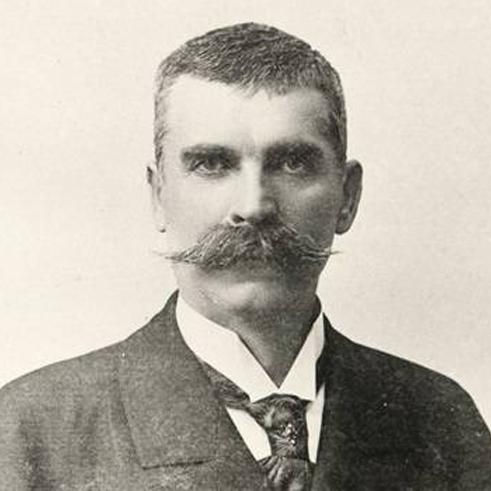
Birth | 1850, Sopot | ||||||||
|---|---|---|---|---|---|---|---|---|---|
Death | 1921, Sofia | ||||||||
Burial Place | Beside St. Sofia Church, Sofia | ||||||||
Nationality | Bulgarian | ||||||||
Occupation(s) | Poet teacher and politician playwright novelist | ||||||||
Ivan Vazov is one of the key figures of the period during which Bulgarians separated from the Ottoman Empire and the subsequent years. Through his works, he contributed not only to Bulgarian literature but also to world literature. His writings have been translated into 52 languages.
Vazov was born in 1850 in Sopot into a merchant family. He received his early education in his hometown and later attended the Bulgarian High School in Plovdiv. His family environment and teachers supported his aspirations during childhood. He worked as an assistant teacher in Kalofer, where he discovered Russian literature in the school library—a formative experience in his development as a writer. In 1872 he taught in Mustafa Pasha (modern-day Svilengrad), where he emphasized visual methods and outdoor education in his lessons.
In 1875 he joined a secret revolutionary committee in Sopot. Between 1876 and 1877 he lived in exile in Romania and became a member of the Bulgarian Benevolent Society. During the Russo-Turkish War of 1877–78, he served as a special officer in the Russian army. After Bulgaria’s separation from the Ottoman Empire, he lived in Plovdiv and was a member of the Permanent Committee of the Regional Assembly between 1880 and 1885. Under the Stambolov regime, he faced repression due to his pro-Russian stance and lived in exile in Odessa from 1887 to 1889. He served as a member of the Eighth and Ninth National Assemblies between 1894 and 1899 and held the position of Minister of Education from 1897 to 1898.
Vazov’s literary career began in 1870. His poetry collections “The Flag and the Harp” (1876), “The Sorrows of Bulgaria” (1877), and “Liberation” (1878) gained widespread acclaim by reflecting the popular desire for separation from the Ottoman Empire. His poems on the April Uprising of 1876 and the Batak massacre became central to Bulgaria’s national memory.
In the 1880s he published the series “The Epic of the Forgotten”, dedicated to leading figures of the Bulgarian uprising. His first novel, Poor Folk (1883–84), and his most renowned work, Under the Yoke (1889–90), are considered classics of Bulgarian literature. This novel poetically depicts the Bulgarian people’s struggle to establish an independent state during the final years of Ottoman rule and is the first major Bulgarian novel to present the populace as a historical subject.
Vazov also wrote plays, short stories, travelogues, textbooks, and pedagogical works. Together with K. Velichkov, he compiled the Bulgarian Anthology (1884), which remained a foundational textbook in Bulgarian education for many years.
Vazov also made significant contributions to education. He prepared poetry books and teaching materials for children that emphasized moral values, diligence, love of nature, and patriotism. His works explored the educational roles of family, school, and society. Examples from his novels and stories illuminate the pedagogical thought of his time.
In 1921 he was awarded an honorary doctorate in philology by Sofia University and an honorary membership by the Bulgarian Academy of Sciences. He died the same year in Sofia. His grave is located near St. Sofia Church, beneath a stone brought from his beloved Vitosha Mountain.
Ivan Vazov is regarded as the most important representative of Bulgarian literature. Known as the “patriarch of Bulgarian literature,” his literary legacy played a foundational role in shaping Bulgarian national identity. He was nominated for the Nobel Prize in Literature in 1916, and his works have been translated into world languages, achieving global resonance.
Ivan Vazov National Theatre. "National Theatre Launches a Rereading Vazov Campaign." nationaltheatre.bg. Accessed September 30, 2025. https://www.nationaltheatre.bg/en/news/narodniyat-teatr-startira-kampaniya-preprochitame-vazov
Smolyaninova, Marina G. "The Father of Bulgarian Literature, Ivan Vazov." *Materials for the Virtual Museum of Slavic Cultures* II, (2020): 242-246. Accessed September 30, 2025. https://inslav.ru/sites/default/files/2020_kaligangl_vazov.pdf
Sofia Opera and Ballet. "Ivan Vazov." *operasofia.bg.* Accessed September 30, 2025. https://www.operasofia.bg/index.php/en/staff/ivan-vazov
Vergilov, Valentin Kostadinov. "Pedagogical Ideas in Creativity of Ivan Vazov." PhD thesis, Sofia University “St. Kliment Ohridski”, Faculty of Educational Studies and the Arts, 2020. Accessed September 30, 2025. https://share.google/Ol3rZOHbuRmca1dw3

Birth | 1850, Sopot | ||||||||
|---|---|---|---|---|---|---|---|---|---|
Death | 1921, Sofia | ||||||||
Burial Place | Beside St. Sofia Church, Sofia | ||||||||
Nationality | Bulgarian | ||||||||
Occupation(s) | Poet teacher and politician playwright novelist | ||||||||
Youth and Education
Political and Social Activities
Literary Works
Pedagogical Contributions
Final Years and Death
Legacy and Influence