


This article was automatically translated from the original Turkish version.
+1 More
June 12 World Day Against Child Labour is an international day observed annually at the global level through events and activities aimed at raising awareness against the exploitation of child labour that negatively affects children’s physical, mental and emotional development. This special day is organized by United Nations agencies, primarily the International Labour Organization (ILO), civil society organizations and trade unions to defend children’s rights and prevent child labour.
Child labour refers to the employment of children under conditions that are inappropriate for their age, developmental level and right to education. According to the ILO, child labour encompasses forms of work that hinder children’s physical and mental development, endanger their health and safety, and deprive them of their right to education. Examples include prolonged exposure to heavy workloads, work with hazardous machinery or chemicals, employment on the streets or in unregulated environments, and inability to attend school.
The fight against child labour emerged as part of the workers’ rights movement that began in Western Europe during the Industrial Revolution of the 19th century. However, the inclusion of children in the labour force remains a widespread global issue. To draw attention to this problem, the ILO declared June 12 as the “World Day Against Child Labour” in 2002.
According to 2023 data from the ILO and UNICEF, approximately 160 million children worldwide — one in every ten children — are engaged in labour without access to education. About half of these children work under hazardous conditions.
The underlying causes of child labour are multifaceted. Key factors include poverty, parental unemployment or low income, barriers to accessing education, crises such as conflict, migration, war and natural disasters, social norms and traditional roles, inadequate oversight and legal gaps.
During crises, particularly in periods of war and mass migration, the risk of children being forced into labour increases significantly. In Türkiye, areas where child labour is most prevalent include seasonal agricultural work, industrial workshops, and the footwear and textile sectors, as well as street vending.
The most important international instruments in the fight against child labour are:
These instruments aim to prevent the forced employment of children, their exploitation in hazardous work, and their denial of the right to education. Türkiye has ratified both ILO conventions.
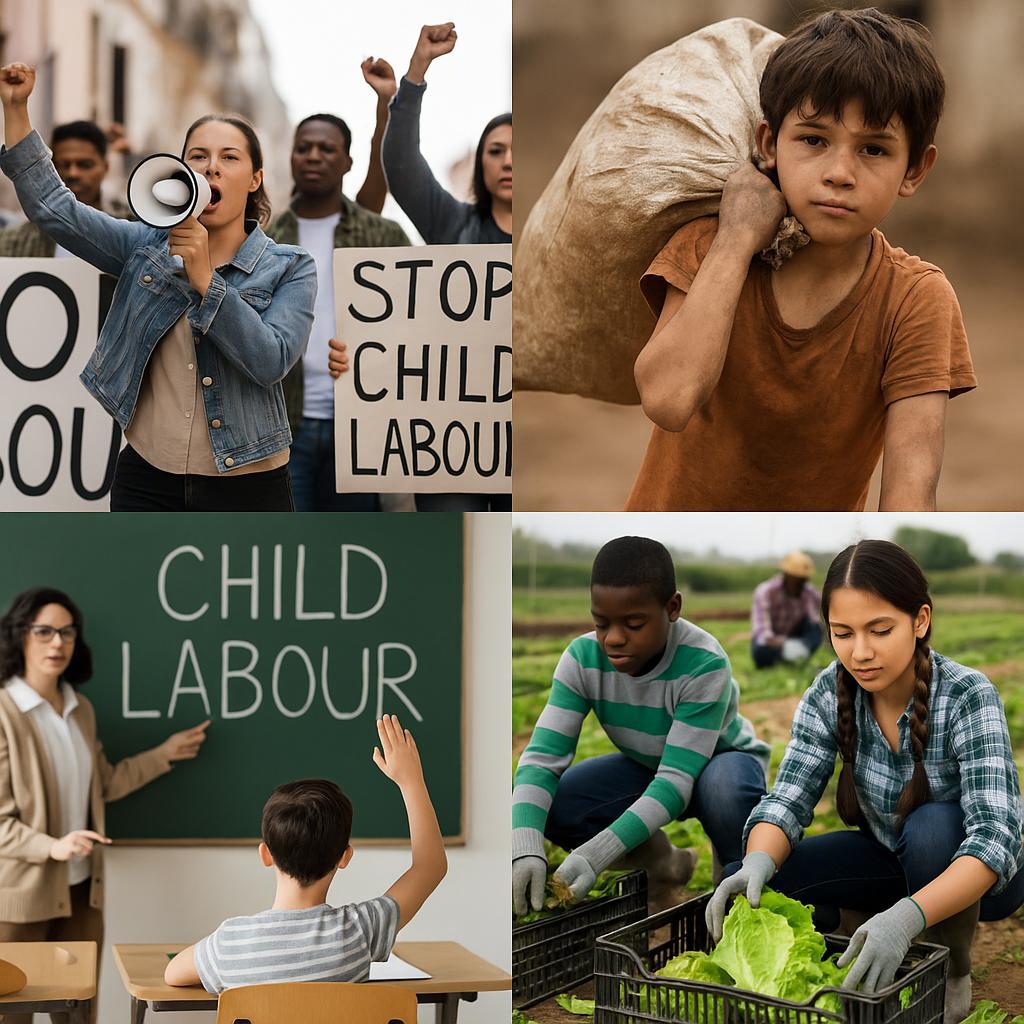
Representative image of child labour and the fight against child labour (generated by artificial intelligence).
In Türkiye, efforts to combat child labour are carried out through collaboration between the Ministry of Family and Social Services, the Ministry of Labour and Social Security, UNICEF Türkiye, the ILO Türkiye Office, various municipalities and civil society organizations.
Various events are organized annually on the World Day Against Child Labour:
These events are not merely symbolic commemorations; they aim to strengthen policy development and social pressure to eliminate child labour.
The June 12 World Day Against Child Labour is an international day that seeks not only to raise awareness about child labour but also to promote concrete steps toward its eradication. Annual events held on this date aim to raise public and policymaker awareness of the moral, legal and humanitarian dimensions of child labour.
Anadolu Ajansı. “Dünyada 160 Milyondan fazla Çocuk Her Gün Okul Yerine İşe Gitmek Zorunda Kalıyor.” Accessed June 11, 2025. https://www.aa.com.tr/tr/dunya/dunyada-160-milyondan-fazla-cocuk-her-gun-okul-yerine-ise-gitmek-zorunda-kaliyor/3397488
Hacettepe Üniversitesi. "Türkiye’de Çocuk İşçiliği ile Mücadelede Güncel Durum." Public Health Institute Report, 2024.
ILO Türkiye. “12 Haziran Dünya Çocuk İşçiliğiyle Mücadele Günü.” ILO Türkiye Resmî Sitesi. Accessed June 11, 2025. https://www.ilo.org/tr/resource/news/12-haziran-dunya-cocuk-isciligiyle-mucadele-gunu-0
Türk-İş. "Dünya Çocuk İşçiliği ile Mücadele Günü." Türk-İş. Accessed June 11, 2025.
UNICEF Global. “Child Labour: Global Estimates 2020.” UNICEF Global Reports. Accessed June 11, 2025. https://data.unicef.org/resources/child-labour-2020-global-estimates-trends/.
UNICEF Türkiye. "Çocuk İşçiliği." UNICEF Türkiye. Accessed June 11, 2025. https://www.unicef.org/turkiye/%C3%A7ocuk-i%C5%9F%C3%A7ili%C4%9Fi-0
İstanbul Barosu. “12 Haziran Dünya Çocuk İşçiliği ile Mücadele Günü." İstanbul Barosu. Accessed June 11, 2025. https://www.istanbulbarosu.org.tr/HaberDetay.aspx?ID=18024&Desc=12-Haziran-D%C3%BCnya-%C3%87ocuk-%C4%B0%C5%9F%C3%A7ili%C4%9Fi-ile-M%C3%BCcadele-G%C3%BCn%C3%BC-

No Discussion Added Yet
Start discussion for "June 12 World Day Against Child Labour" article
Definition of Child Labour
Historical Background and Establishment Process
Causes of Child Labour
Child Labour in International Law and Policy
Current Situation in Türkiye
Events Held on June 12