

This article was automatically translated from the original Turkish version.
+1 More
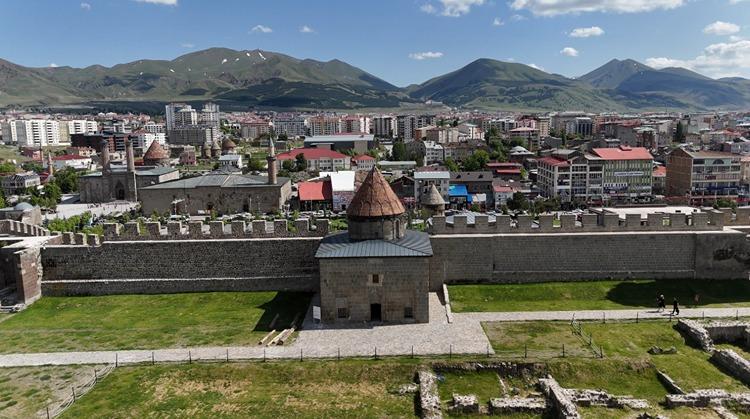
Erzurum The Kale Mescidi, built adjacent to a semicircular bastion on the southern wall of İçkale, is a monumental structure dating to the Saltuklu period. Recognized as the oldest Islamic structure in the city and Erzurum’s first mosque, the building presents, from the exterior, the appearance of a dominant mausoleum. Functioning simultaneously as a shelter due to its thick cut-stone walls and strategic location, it is among the most important examples reflecting the early architectural synthesis of Anatolian Turkish art and the Saltuklu style.【1】
Kale Mescidi (TRT 2)
Academic sources present differing views regarding the exact construction date and founder of the mosque. It is recorded that the structure, along with the Tepsi Minare, was commissioned by Saltuklu Emir Muzafferüddin Gazi and constructed between 1132 and 1134.【3】 Another dating, based on architectural and decorative features in art historical literature, attributes the structure to the reign of Saltuklu Emir Ebü’l-Muzaffer (1189–1197).【4】
During its historical evolution, the structure underwent various repairs. Evliya Çelebi noted during his visit in 1610 that no congregation was present in the mosque.【5】 For a long period, the building served as a storage facility. According to data from the Erzurum Metropolitan Municipality and the Directorate of Communications, restoration works were completed on 21 July 2022, leading to its revival. During restoration excavations, areas beneath the ground surrounding the mosque—believed to include a furnace, dungeon, and rooms—were uncovered. The first Friday prayer after restoration was held on 15 August 2025, with the participation of civil and administrative authorities.【6】

Kale Mescidi (Anadolu Ajansı)
The Kale Mescidi has a rectangular plan measuring 14.70 x 10.60 meters, oriented north-south.【7】 The structure is entirely built of finely cut stone and has a capacity for approximately 150 worshippers.【8】

Kale Mescidi İç Tasarımı(Erzurum Valiliği)
The interior space is divided into two transverse sections (nave areas) by two thick piers arranged in an "L" shape parallel to the mihrab. The entrance area is covered by a cross vault, while the square unit in front of the mihrab is surmounted by a high dome; the sides of these main sections are extended by pointed arches.【9】 The transition to the dome is achieved through pendentives, and the base of the dome is decorated internally with muqarnas and corbelled friezes. Additionally, four small window openings align with the main axes of the dome.
The mihrab on the qibla wall is a deep and wide niche set within the semicircular bastion of the fortress.【10】 The niche is framed externally by a simple molded profile and internally by a border of hexagonal patterns. A new niche with muqarnas squinches was later inserted into the mihrab, and fragments of naskh script inscriptions, believed to have been brought from other structures, were added above it. On the right pier relative to the entrance, a simple muqarnas mihrabiye is present; on either side of the mihrab niche, small arched square niches serve as decorative elements.【11】
The most distinctive feature of the exterior is the tall cylindrical drum crowned with a conical spire, forming a tambour structure that covers the internal dome. On the cylindrical body, sixteen slender, pointed decorative arches are arranged in rows created by kavals.【12】 Every third arch is followed by a fourth arch, on whose surface a shell-shaped muqarnas niche is carved to soften the massiveness of the facade.
The surface of the conical spire is adorned with rows of diminishing decorative arches, created by fine kavals, running from top to bottom. This style resembles the funerary monuments of the Cimcime Sultan and Üç Kümbet in Erzurum, reflecting the architectural character of the 12th-century Saltuklu period.【13】 The entrance door and windows on the north façade feature simple molded frames and pointed arch lintels; above the entrance, an additional small rectangular window opening is present.【14】
Anadolu Ajansı. "Erzurum'daki Kale Mescidi asırlardır ayakta duruyor". Accessed March 18, 2026. https://www.aa.com.tr/tr/kultur/erzurumdaki-kale-mescidi-asirlardir-ayakta-duruyor/3659212
Arık, Rüçhan. "Erzurum'da İki Cami." *Vakıflar Dergisi*, no. 8 (1969): 149-152. Accessed March 18, 2026. https://acikerisim.fsm.edu.tr/server/api/core/bitstreams/148db683-a209-404d-b0f8-2108689df01e/content
Erzurum Portalı. "Erzurum Kale Mescidi - Erzurum Portalı - Erzurum Haberleri." Accessed March 18, 2026. https://erzurumportali.com/shf/330/Erzurum-Kale-Mescidi
Erzurum Valiliği. "Kale Mescidi'nde Yıllar Sonra İlk Cuma Namazı". Accessed March 18, 2026. https://www.erzurum.gov.tr/kale-mescidinde-yillar-sonra-ilk-cuma-namazi https://www.erzurum.gov.tr/kale-mescidinde-yillar-sonra-ilk-cuma-namazi
TRT 2. "Erzurum Kalesi ve Kale Mescidi | Evliya Çelebi." YouTube. Accessed March 18, 2026. https://youtu.be/2fmqVQPz-bA?si=M4ZbPtb8QUW745fX
Çam, Nusret. "Erzurum Kale Camii." Vakıflar Dergisi, pp. 119–125. Accessed March 18, 2026. https://dergipark.org.tr/en/download/article-file/202989#page=117
Çobanoğlu, Ahmet Vefa. "KALE MESCİDİ." *TDV İslâm Ansiklopedisi* 24: 243–244. İstanbul: TDV Yayınları, 2001. Accessed March 18, 2026. https://islamansiklopedisi.org.tr/kale-mescidi
İletişim Başkanlığı. "Erzurum Büyükşehir Belediyesinin, Erzurum Kalesi içinde bulunan Kale Mescidinde başlattıkları tamirat, tadilat çalışmaları tamamlandı". July 21, 2022. Accessed March 18, 2026. https://www.iletisim.gov.tr/turkce/yerel_basin/detay/erzurum-buyuksehir-belediyesinin-erzurum-kalesi-icinde-bulunan-kale-mescidinde-baslattiklari-tamirat-tadilat-calismalari-tamamlandi
[1]
Ahmet Vefa Çobanoğlu, "KALE MESCİDİ," TDV İslâm Ansiklopedisi 24 (2001): s. 243. İstanbul: TDV Yayınları, 2001. Erişim Tarihi: 18 Mart 2026. https://islamansiklopedisi.org.tr/kale-mescidi
[3]
Erzurum Portalı, "Erzurum Kale Mescidi - Erzurum Portalı - Erzurum Haberleri," 2 Kasım 2024, Erişim Tarihi: 18 Mart 2026, https://erzurumportali.com/shf/330/Erzurum-Kale-Mescidi
[4]
Ahmet Vefa Çobanoğlu, "KALE MESCİDİ," TDV İslâm Ansiklopedisi 24 (2001): 243, Erişim Tarihi: 18 Mart 2026, https://islamansiklopedisi.org.tr/kale-mescidi
[5]
Erzurum Portalı, "Erzurum Kale Mescidi - Erzurum Portalı - Erzurum Haberleri," 2 Kasım 2024, Erişim Tarihi: 18 Mart 2026, https://erzurumportali.com/shf/330/Erzurum-Kale-Mescidi
[6]
Erzurum Valiliği, "Kale Mescidi'nde Yıllar Sonra İlk Cuma Namazı," 15 Ağustos 2025, Erişim Tarihi: 18 Mart 2026. https://www.erzurum.gov.tr/kale-mescidinde-yillar-sonra-ilk-cuma-namazi
[7]
Ahmet Vefa Çobanoğlu, "KALE MESCİDİ," TDV İslâm Ansiklopedisi 24 (2001): 243, Erişim Tarihi: 18 Mart 2026, https://islamansiklopedisi.org.tr/kale-mescidi
[8]
Anadolu Ajansı, "Erzurum'daki Kale Mescidi asırlardır ayakta duruyor," 14 Ağustos 2025, Erişim Tarihi: 18 Mart 2026. https://www.aa.com.tr/tr/kultur/erzurumdaki-kale-mescidi-asirlardir-ayakta-duruyor/3659212
[9]
Rüçhan Arık, "Erzurum'da İki Cami," Vakıflar Dergisi, sy. 8 (1969): 150. Erişim 18 Mart 2026, https://acikerisim.fsm.edu.tr/server/api/core/bitstreams/148db683-a209-404d-b0f8-2108689df01e/content
[10]
Rüçhan Arık, "Erzurum'da İki Cami," Vakıflar Dergisi, sy. 8 (1969): 154. Erişim 18 Mart 2026, https://acikerisim.fsm.edu.tr/server/api/core/bitstreams/148db683-a209-404d-b0f8-2108689df01e/content
[11]
Rüçhan Arık, "Erzurum'da İki Cami," Vakıflar Dergisi, sy. 8 (1969): 150. Erişim 18 Mart 2026, https://acikerisim.fsm.edu.tr/server/api/core/bitstreams/148db683-a209-404d-b0f8-2108689df01e/content
[12]
Rüçhan Arık, "Erzurum'da İki Cami," Vakıflar Dergisi, sy. 8 (1969): 149. Erişim 18 Mart 2026, https://acikerisim.fsm.edu.tr/server/api/core/bitstreams/148db683-a209-404d-b0f8-2108689df01e/content
[13]
Rüçhan Arık, "Erzurum'da İki Cami," Vakıflar Dergisi, sy. 8 (1969): 149. Erişim 18 Mart 2026, https://acikerisim.fsm.edu.tr/server/api/core/bitstreams/148db683-a209-404d-b0f8-2108689df01e/content
[14]
Ahmet Vefa Çobanoğlu, "KALE MESCİDİ," TDV İslâm Ansiklopedisi 24 (2001): s. 243. İstanbul: TDV Yayınları, 2001. Erişim Tarihi: 18 Mart 2026. https://islamansiklopedisi.org.tr/kale-mescidi

History
Architectural Structure
Interior Space and Roofing System
Mihrab and Interior Decorations
Roofing System and Exterior Decoration