


This article was automatically translated from the original Turkish version.
+1 More
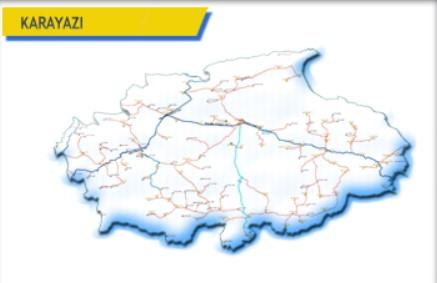
Karayazı, Erzurum District
District Governor | Muammer SARIDOĞAN | ||||||||
|---|---|---|---|---|---|---|---|---|---|
Karayazı, a district of Erzurum Province, is located in the Upper Murat-Van section of the Eastern Anatolia Region. Approximately 110 kilometers from the provincial center, it borders Eleşkirt and Tutak districts of Ağrı to the east, Karaçoban and Hınıs districts of Erzurum to the south, Tekman to the southwest, and Pasinler and Horasan districts to the north. Its position along the historic Silk Road created a foundation for interaction among different civilizations. Karayazı exhibits the defining characteristics of a continental climate, with animal husbandry as its primary economic activity; limited agricultural and beekeeping activities are also carried out. A large portion of the district’s land consists of pastures, alpine meadows, and grasslands.

Karayazı (Source: karayazı district governorship)
The settlement history of Karayazı and its surroundings extends back to the 3rd century BCE. Historical artifacts discovered in the villages of Salyamaç, Yolgören, and Çelikli around the Aras River support this claim. The district center was originally established near the village of Bayraktar. This settlement, known initially as Bayraktar, was founded by Bayraktar Han, one of the early leaders of Sultan Alp Arslan, who entered Anatolia after the 1071 Battle of Manzikert, and was known by this name for a long period. Today, a neighborhood named Bayraktar exists within the boundaries of Karayazı district.
The name “Karayazı” derives from the phrase “kar yazı,” meaning “snow-covered plain.” During the Ottoman Empire, the village of Bayraktar was recorded as a settlement under the Hınıs Sanjak. Following the foundation of the Republic of Türkiye, the Grand National Assembly of Türkiye (TBMM) granted Karayazı district status to ensure administrative unity and improve public services, taking into account the region’s geographical characteristics.
In 1937, the district center was established in the area now belonging to Çullu village, which is currently under Köprüköy district. Two years later, it was relocated northward to the present-day neighborhood of Bayraktar, where the government house and gendarmerie barracks were constructed, and it adopted the name “Karayazı.”
According to a local legend, the name “Karayazı” originates from a tragic event: A wedding procession traveling from Tekman to Bayraktar was caught in a snowstorm. All approximately forty to fifty horsemen perished in the storm, but only the bride survived. It is said that in grief, she exclaimed, “Karayazım, Karayazım, this is my summer; what can I do to the wheel when winter has come, my beautiful summer.” However, no official record confirms this narrative.
Karayazı is situated in the southwest of Erzurum Province, within the Upper Murat-Van section of the Eastern Anatolia Region. It borders Eleşkirt and Tutak districts of Ağrı to the east, Karaçoban and Hınıs districts of Erzurum to the south, Tekman to the southwest, and Pasinler and Horasan districts to the north. The district lies within specific latitude and longitude coordinates.
A continental climate prevails in Karayazı. Winds typically blow from northern directions. The region frequently experiences a wind known locally as “Kurdo,” accompanied by heavy snowfall. The highest recorded temperature in summer is 29.8 °C, with an average summer temperature of 8.9 °C; August is the warmest month. In winter, the average lowest temperature is -5.46 °C, with January being the coldest month (-15.3 °C).
The average atmospheric pressure in the district is around 610 mm, with pressure decreasing as elevation increases. The average relative humidity is 61%. Variations in pressure centers and low temperatures influence the maintenance of humidity at a relatively stable level.
Snowfall typically begins at the end of October and can last until the end of May. The average snow depth is 80 cm, but in higher elevation areas outside the district center, it can reach up to 150 cm. On average, the year has 79 clear days, 200 cloudy days, and 86 overcast days.

Winter in Karayazı district (Source: karayazı district governorship)
According to 2017 data from the Turkish Statistical Institute (TÜİK), the population of Karayazı district was 28,337. Despite its large area, the population density is low. Settlements are predominantly concentrated in rural areas, while the district center has a relatively smaller population. Due to historical and geographical factors, periodic outward migration has occurred. Analysis of the age structure reveals a young population, alongside large families, a pattern influenced by traditional family structures.
The primary economic activity in Karayazı is animal husbandry. Limited agriculture is practiced in the villages of Elmalıdere and Göksu. In recent years, beekeeping and cultivation of wheat, barley, korunga, and alfalfa have also been observed in some villages. A large portion of the district’s land consists of pastures, alpine meadows, and grasslands.
Karayazı, located at the Hınıs Pass, shares cultural characteristics with the neighboring districts of Hınıs and Karaçoban. It possesses a cultural heritage influenced by the traditions and folk dances of Southeastern Anatolia.
Important Historical and Natural Sites in Karayazı:
AA (Anadolu Ajansı). "Erzurum’un Tarih Kokan Mağarası: Cunni." aa.com.tr. Accessed April 19, 2025.
Accessed November 26, 2025.
Erzurum Büyükşehir Belediyesi. "Karayazı." erzurum.bel.tr. Accessed April 19, 2025.
Karayazı Kaymakamlığı. "Karayazı Tarihçe." karayazi.gov.tr. Accessed April 19, 2025.
Karayazı Kaymakamlığı. "Karayazı İlçemizden Kış Manzaraları." karayazi.gov.tr. Accessed April 19, 2025.
T.C. Erzurum Valiliği. "Karayazı." erzurum.gov.tr. Accessed April 19, 2025.
Türkiye İstatistik Kurumu (TÜİK). "Adrese Dayalı Nüfus Kayıt Sistemi (ADNKS) Sonuçları 2017 – İl ve İlçelere Göre Nüfus." TÜİK Veri Portalı, December 31, 2017. Accessed April 19, 2025.

Karayazı, Erzurum District
District Governor | Muammer SARIDOĞAN | ||||||||
|---|---|---|---|---|---|---|---|---|---|
No Discussion Added Yet
Start discussion for "Karayazı (District)" article
History
Geography and Climate
Population and Demographics
Tourism – Culture and Cuisine