

This article was automatically translated from the original Turkish version.
+2 More
Type of Geographical İndication | Signpost | ||||||||
|---|---|---|---|---|---|---|---|---|---|
Registration Number | 1682 | ||||||||
Registration Date | 02.01.2025 | ||||||||
Product / Product Group(s) | Handicraft Products Excluding Carpets Kilims and Textiles | ||||||||
Province(s) | Muğla | ||||||||
Applicant/Registrant(s) | Muğla Chamber of Commerce and Industry | ||||||||
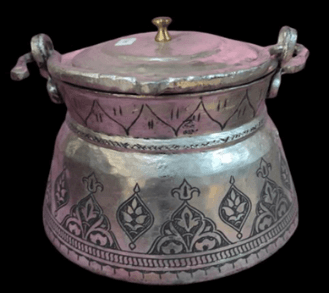
Kavaklıdere copper repoussé is a traditional craft with deep historical roots in the Kavaklıdere district of Muğla province, characterized by the manual shaping of copper sheets and the engraving of original motifs upon them. This handicraft is applied to the production of both utilitarian items—such as güğüm, ibrik, kazan, tepsi, sini, and dığan—and decorative objects—including çerez tavası and süs ibriği. The craft evolved from the copperworking tradition brought to the region by nomadic groups from the Taurus Mountains, with a history extending back to the 1600s. Kavaklıdere became the center of this art due to its rich copper ore deposits and favorable natural conditions.
The origins of copperworking in Kavaklıdere trace back to the 17th century and developed into an established craft throughout the Ottoman period. Craftsmen classified themselves as “büyük bakırcı” (master coppersmiths) and “küçük bakırcı” (minor coppersmiths) based on production scale. Büyük bakırcılar specialized in manufacturing kitchenware such as kazan, leğen, tencere, and sini, while küçük bakırcılar focused primarily on products like güğüm, ibrik, and tepsi. The tradition was transmitted from father to son and through master-apprentice relationships, but the number of masters has declined in recent decades due to the disinterest of younger generations in the profession. The registration process initiated in 2023 was completed on 2 January 2025 by the Muğla Chamber of Commerce and Industry, and Kavaklıdere copper repoussé has been protected under Industrial Property Law No. 6769 with a geographical indication mark.
Production is entirely manual and adheres to traditional methods. Copper sheets are cut to size and then shaped using hammers, anvils, and mallets. The production stages include cutting the sheet, shaping it, joining the parts, welding or soldering, engraving motifs, and, when necessary, attaching handles or spouts. For items subjected to heat—such as kazan and dığan—copper sheets 0.80–1 mm thick are used, while decorative items typically employ sheets 0.30–0.80 mm thick. Motifs are engraved using steel pens and hammers or applied through repoussé techniques. Local tools include scissors, ribbed hammers, burnishing hammers, wooden mallets, and compasses, all crafted in the region. Traditional joining methods such as kenet and ocak welding are still widely preferred.
The products of Kavaklıdere copper repoussé encompass a wide range: güğüm, ibrik, su maşrapası, kazan, kaynatma, depme, çanak, sini, tepsi, bakraç, dığan, and leblebi tavası (roasting pan). The production of leblebi tavası is a unique specialization found only in Kavaklıdere. Common motifs include baklava, almond, walnut, selvi (poplar), fan, pomegranate, mosque, fish, Star of David, palm tree, vase, tulip, and mosque chain. With the exception of fish and the Star of David, all motifs are considered distinctive to the region. Motifs are first traced with a compass and then engraved with a steel pen, adding aesthetic depth to the finished pieces.
Kavaklıdere copper repoussé is one of the foundational pillars of the district’s cultural heritage and economy. The craft has become synonymous with the region due to the high level of skill required in the hammering technique. One of the cultural contributions of copperworking is the Palleci language. Palleci is a secret communication system developed among coppersmiths and tinsmiths, containing approximately 200 words and numbers. It was used to conceal product prices and protect commercial interactions; for example, the phrase “Yanbollar ovanıyor, geneğindeki mazını kös et” translates to “Soldiers are coming, hide the weapon beside you.” Today, the future of the craft is threatened by a shortage of apprentices and pressure from industrial alternatives. However, the geographical indication registered in 2025 is expected to significantly contribute to its preservation.
While copperworking in Kavaklıdere once involved over 200 masters in its heyday, today it is sustained by only a limited number of artisans. Production is monitored under the coordination of the Muğla Chamber of Commerce and Industry, with all stages confined within the defined geographical boundaries. Inspections are conducted annually or upon complaint by expert evaluators. These efforts aim to preserve the craft’s traditional identity while creating conditions for its revitalization through tourism. Kavaklıdere, recognized as an open-air museum of copperwork, strives to transmit its cultural heritage to future generations.
Turk Patent and Trademark Office. "Kavaklıdere Bakır El İşlemeciliği Coğrafi İşaret Sicil Belgesi." Registration No. 1682 (January 2, 2025). Accessed October 19, 2025. https://ci.turkpatent.gov.tr/Files/GeographicalSigns/fa9161dd-bdde-4624-9779-4a59dbe49459.pdf.
Turk Patent and Trademark Office. "Kavaklıdere Bakır El İşlemeciliği." Geographical Indications Portal. Accessed October 19, 2025. https://ci.turkpatent.gov.tr/cografi-isaretler/detay/9042.
Çınar, Ali Abbas. "Kavaklıderede Bakırcılık Sanatı." Kavaklıdere Kaymakamlığı. Accessed October 19, 2025. http://kavaklidere.gov.tr/kavakliderede-bakircilik-sanati.

Type of Geographical İndication | Signpost | ||||||||
|---|---|---|---|---|---|---|---|---|---|
Registration Number | 1682 | ||||||||
Registration Date | 02.01.2025 | ||||||||
Product / Product Group(s) | Handicraft Products Excluding Carpets Kilims and Textiles | ||||||||
Province(s) | Muğla | ||||||||
Applicant/Registrant(s) | Muğla Chamber of Commerce and Industry | ||||||||
No Discussion Added Yet
Start discussion for "Kavaklıdere Copper Craftsmanship" article
Historical Development
Production Techniques and Tools
Products and Motifs
Cultural and Economic Significance
Current Status and Protection