

This article was automatically translated from the original Turkish version.
+2 More
Kayaköy is an abandoned settlement located 8 km southwest of the Fethiye district center in southwestern Anatolia, Muğla. Its historical process, according to philological and archaeological evidence, extends back to the 4th and 3rd millennia BCE. In antiquity, Kayaköy was known as Karmylassos and later by the name Levissi. The region was initially settled by the Lycians, then came under the rule of Alexander the Great, the Romans, the Byzantines, and the Rum, before passing to the Menteşe dynasty and eventually the Ottoman Empire. In 1923, a population exchange took place between Turks and Greeks. Today, Kayaköy is an archaeological site characterized by its historic stone structures and ruins, presenting the appearance of a “ghost town.”

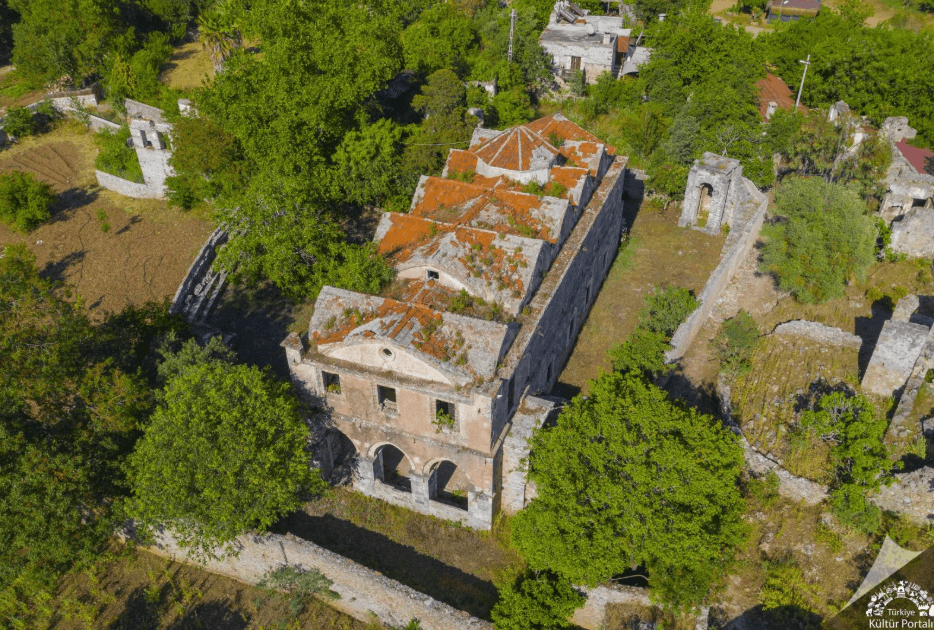
Kayaköy Archaeological Site (Türkiye Culture Portal)
According to philological records, Kayaköy’s history reaches back to the 3rd millennium BCE, while inscriptions on Lycian sarcophagi and rock tombs in the surrounding area date as far back as the 4th millennium BCE. In antiquity, this settlement, known as Karmylassos and later as Levissi, was inhabited by the Lycians. Following the conquests of Alexander the Great, the region came under the control of the Roman and Byzantine Empires.
Toward the end of the Middle Ages, in 1284, the area came under the rule of the Menteşe Beylik, and in 1424 it passed into the control of the Ottoman Empire. During the Ottoman period, particularly in its later centuries, the rights granted to religious minorities enabled Kayaköy to become a settlement with a concentrated Greek population. According to 1912 records, the village’s population was approximately 6,500, with Turks and Greeks living together.
However, following the 1923 population exchange between Türkiye and Greece, the Greek inhabitants of Kayaköy migrated to Greece. Although Turks from Western Thrace were resettled in the village under the exchange agreement, most of them soon relocated elsewhere due to poor living conditions, including water shortages and unsuitable land for agriculture. As a result of these migrations, Kayaköy was largely abandoned and has since become a significant archaeological site known as a “ghost town,” featuring largely ruined stone houses, chapels, two large churches, a school, and a customs building.
UNESCO has declared Kayaköy the Village of World Friendship and Peace. The 736 structures in the village have been officially registered as monuments and are under protection.
Kayaköy is an abandoned village located 8 km from Fethiye in southwestern Anatolia. The settlement is situated on a steep, rocky mountainside. Houses were arranged along the slope with consideration of geographical conditions, ensuring that no building obstructed the view or natural light of another.
The buildings in the village are generally constructed of stone and consist of small dwellings, each typically no larger than 50 square meters. A distinctive feature of the settlement is the numerous chapels scattered among the houses, along with two large churches, a school, and a customs building.
These structures represent a settlement that developed as a result of the rights granted to religious minorities during the later period of the Ottoman Empire. It is known that the northern section of the area designated as the Upper Church, along with its surroundings, contained shops such as a café, butcher, greengrocer, grocery store, and cloth merchant. Remains of windmills and shop structures that once formed the commercial center of the town are also present at the site. Today, the wooden components of these buildings—doors, windows, and roof systems—have been destroyed by natural elements, giving Kayaköy its overall “ghost town” appearance.
Akdu, Serap. "Kayaköy Örenyeri." *Türkiye Turizm Ansiklopedisi*. Accessed July 8, 2025. https://turkiyeturizmansiklopedisi.com/kayakoy-orenyeri
Bozyiğit, Recep, and Tapur, Tahsin. "Güneybatı Anadolu'da Terk Edilen Bir Yerleşim Merkezi: Kayaköy (Fethiye)." *Marmara Coğrafya Dergisi*, 22 (2010): 363-387. Accessed July 8, 2025. https://dergipark.org.tr/en/download/article-file/3225
T.C. Ministry of Culture and Tourism. "Kayaköy Örenyeri Site - Muğla." *Turkey Culture Portal*. Accessed July 8, 2025. https://www.kulturportali.gov.tr/turkiye/mugla/gezilecekyer/kayakoy
T.C. Ministry of Tourism and Culture. "Kayaköy." *Muğla İl Directorate of Culture and Tourism*. Accessed July 8, 2025. https://mugla.ktb.gov.tr/tr-177919/kayakoy.html


No Discussion Added Yet
Start discussion for "Kayaköy Archaeological Site (Karmylassos)" article
History
Settlement Characteristics