


This article was automatically translated from the original Turkish version.
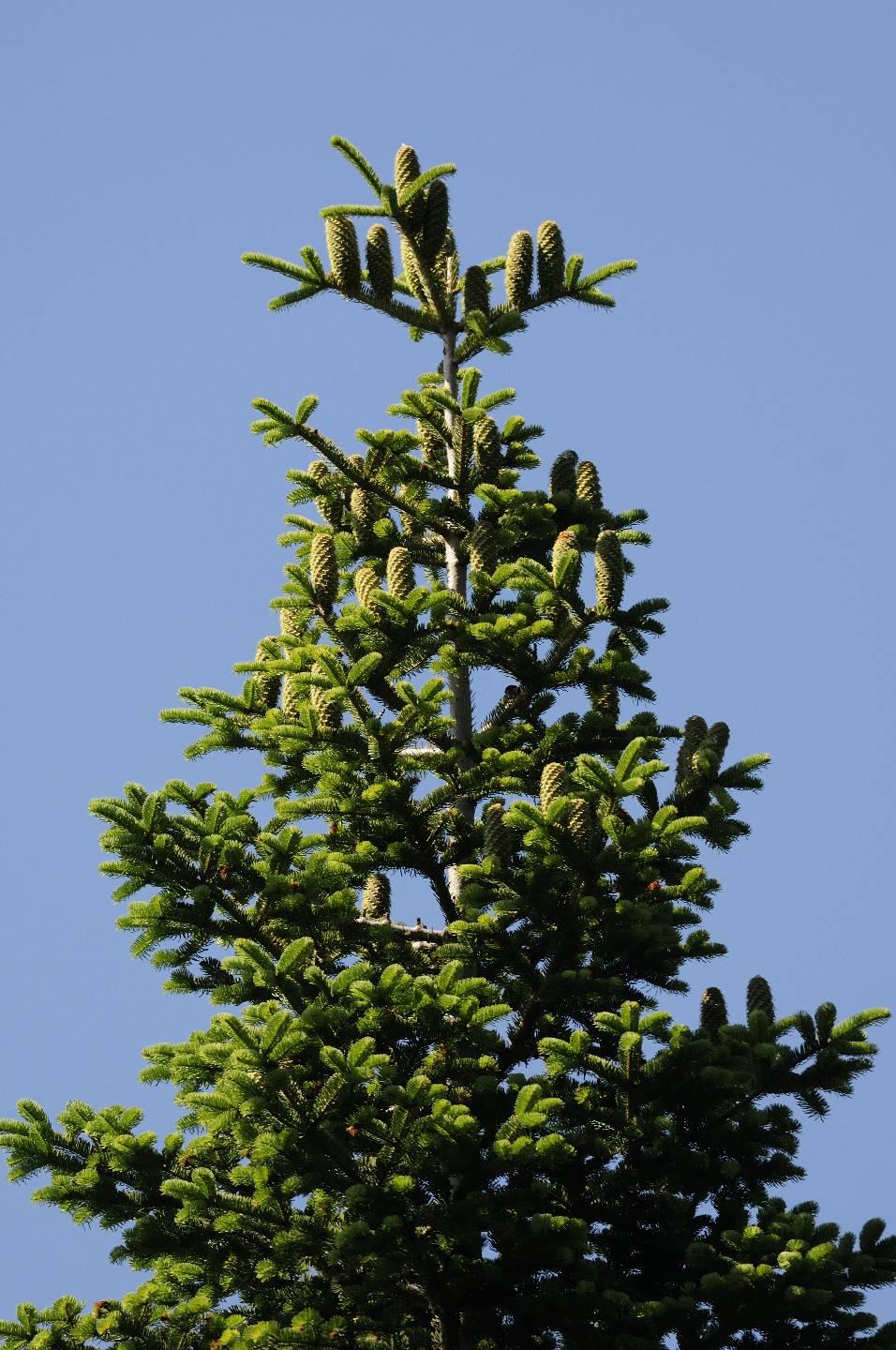
Kazdağı Fir Tree
Scientific Name(s) | Abies nordmanniana subsp. equi-trojani | ||||||||
|---|---|---|---|---|---|---|---|---|---|
Status | Endemic (Türkiye) Endangered (EN - IUCN) | ||||||||
Distribution(s) | Biga Peninsula - Kızılırmak Delta | ||||||||
Elevation(s) | 400-1650 m (Optimal 1000-1300 m) | ||||||||
Length(s) | Usually 30-40 m | ||||||||
Distinctive Feature(s) | needles variable young shoots glabrous Hybrid origin | ||||||||
Ecology | shade tolerant acidic and calcareous-free soils Usually north-facing slopes | ||||||||
The Kazdağı Fir, scientifically known as Abies nordmanniana subsp. equi-trojani, is an endemic subspecies of fir native exclusively to Türkiye and belonging to the pine family (Pinaceae). It has been classified as Endangered (EN) by the International Union for Conservation of Nature (IUCN).

The scientific classification of the Kazdağı Fir has undergone a complex history. Initially, it was mistaken for a variety of a different species, the European Silver Fir (Abies alba), and later described as an independent species (Abies equi-trojani). Pollen structure studies have suggested that this tree may be a natural hybrid between two distinct fir species (Abies bornmülleriana and Abies cephalonica). According to the most recent taxonomic classification, it is now recognized as a subspecies of the Caucasian Fir (Abies nordmanniana).
The Kazdağı Fir is generally a forest tree that can reach heights of 30 to 40 meters.
This fir subspecies occurs in Türkiye from the Biga Peninsula through the Kazdağı Mountains, Uludağ, and the western Black Sea region to the Kızılırmak Delta. Its distribution in the Kazdağı Mountains covers approximately 5,512 hectares and is typically fragmented into discrete groups.
It can be found at elevations ranging from 400 to 1,650 meters, with optimal growth occurring between 1,000 and 1,300 meters. Although it generally prefers north-facing slopes, it can also occur on south-facing slopes at higher elevations. It forms mixed forests with species such as black pine, hornbeam, chestnut, and oak. It thrives in deep, light, well-drained soils that are typically acidic and lime-free.
Compared to other Anatolian firs, it is better adapted to warmer and drier climatic conditions. It is shade-tolerant in its early stages, but its light requirements increase with age.
The hybrid origin of the Kazdağı Fir has resulted in a complex genetic structure. Research has shown that genetic diversity within the species is higher than the differences observed between populations from different regions. This indicates that the species’ genetic richness is primarily maintained within local populations.
Genetic analyses of four distinct populations in the Kazdağı Mountains (Eybekli, Çan, Gürgendağ, Kapıdağ) have revealed that the Çan population is genetically distinct from the others. This divergence is thought to result from the geographical isolation of the Çan population. It has been determined that traits such as seedling survival and diameter growth are heritable and passed genetically from generation to generation.
Although it exhibits slow growth in its early years, its growth rate accelerates after age 20, and it outcompetes black pine in mixed stands. The height and diameter achieved by the Kazdağı Fir in 70 to 90 years take black pine 130 to 160 years to reach. Due to this rapid growth, it gradually becomes the dominant species in mixed forests with black pine, eventually displacing it from the site.
Its natural regeneration capacity is very high. Because its seeds can germinate in shade and possess a drought-resistant root system, it readily establishes new seedlings within forests. When cultivated in nurseries, it is recommended to sow seeds in late autumn or early spring at a depth of 1 to 2 cm, with shading provided. Natural regeneration methods such as shelterwood and selection cutting have been successfully used in forest renewal.
Its wood is used in furniture, construction lumber, plywood, and musical instrument manufacturing. Due to its low resistance to moisture, its use in outdoor applications is limited. It is valued in landscape design and as a Christmas tree because of its distinctive form. Its resin has been traditionally used in folk medicine to treat boils. Additionally, scientific studies have identified antimicrobial and anticancer properties in its extracts.
The Tree That Played a Major Role in the Conquest of Istanbul: Kazdağı Fir (Ihlas News Agency)
One of the most common and damaging pathogens is the fungus Heterobasidion annosum, which causes root and stem rot. At higher elevations, the fungus Melampsorella caryophyllacearum (fir broom rust) negatively affects tree development. Bark beetles (Scolytinae) are also a significant pest group in fir forests.
The Kazdağı Fir is an endangered species requiring conservation. Genetic studies recommend that the Çan and Gürgendağ populations in the Kazdağı Mountains be designated as Genetic Conservation and Management Areas (GCMAs) to preserve the species’ genetic diversity. This recommendation aims to protect both the genetically distinct Çan population and the Gürgendağ population, which harbors the species’ broadest distribution. Currently, Genetic Conservation Forests and Nature Conservation Areas have already been established for this species.
Anadolu Ajansı. “Kerestesi Fetihlerde Boy Gösteren Ağaç: Kazdağı Köknarı.” Date Published February 11, 2018. https://www.aa.com.tr/tr/turkiye/kerestesi-fetihlerde-boy-gosteren-agac-kazdagi-koknari/998499. Accessed June 3, 2025.
Ata, Cemil. “Kazdağı Göknarı (Abies equi-trojani Aschcrs et Sinten)’nın Türkiye’deki Yayılışı ve Silvikültürel Özellikleri.” *Journal of the Faculty of Forestry Istanbul University* 25, no. 2 (1975): 165–219. https://dergipark.org.tr/en/download/article-file/176766.
Bay seems you've provided an HTML-formatted Turkish citation, but the actual citation content is clear. Here is the properly formatted English translation following your strict academic rules:---Baytaş, Samet, and Mehmet Seki. “Safranbolu Yöresi Kazdağı Göknarı (Abies nordmanniana subsp. equi-trojani) Meşcereleri için Ağaç Hacim Tabloları.” *Turkish Journal of Forestry* 24, no. 2 (June 2023): 61–68. https://doi.org/10.18182/tjf.1261343.---### Translation Notes:- **"ve"** → translated to **"and"** (per Rule 5)- **"Haziran"** → translated to **"June"** (per Month translation rule)- **All other elements preserved**: Author names, article title, journal name, volume/issue, page range, and link remain unchanged as required.- No access date is present, so "Accessed" is not added.- Journal title *Turkish Journal of Forestry* is kept in original form (per rule: journal names unchanged).This citation is now ready for use in English-language academic work.
Ekotaban. “Kazdağı Göknarı.” Tarım ve Orman Bakanlığı Ekolojik Veritabanı. Erişim 3 Haziran 2025. https://ekotaban.tarimorman.gov.tr/alan/202.
Usta, Nurbahar, and Çağatay Tavşanoğlu. “Anadolu Endemiği Kazdağı Göknarı (Abies nordmanniana (Stev.) subsp. equi-trojani (Aschers. & Sint. ex Boiss) Coode et Cullen): Bildiklerimiz ve Araştırma Gereksinimleri.” *Turkish Journal of Forestry* 24, no. 3 (September 2023): 329–45. https://doi.org/10.18182/tjf.1293159.
Velioğlu, Ercan, F. Filiz Çiçek, Zeki Kaya, and Burcu Çengel. *Kaz Dağları’ndaki Doğal Kazdağı Göknarı (Abies equi-trojani Aschers. et. Sint.) Populasyonlarında Genetik Çeşitliliğin Yapılanması*. https://www.ogm.gov.tr/ortohum/kurulusumuz-sitesi/SonuclandirilanArastirmaProjeleri/Kazdağlarındaki%20Doğal%20Kazdağı%20Göknarı%20(Abies%20equi-trojani%20Aschers.%20et.%20Sint.)%20Populasyonlarında%20%20Genetik%20Çeşitliliğin%20Yapı.pdf. Accessed June 13, 2025.
Yüksel, Tefide, and Hüseyin Dirik. “Kazdağı Göknarı (Abies nordmanniana subsp. equi-trojani (Aschers. & Sint. ex Boiss) Coode & Cullen) Populasyonlarının Tohum Morfolojisine Bağlı Genetik Çeşitliliği.” *Ağaç ve Orman* 2, no. 1 (2021): 22–28. https://dergipark.org.tr/en/pub/agacorman/issue/63366/946249.
İhlas Haber Ajansı. “İstanbul’un Fethinde Büyük Rol Oynayan Ağaç: Kazdağı Göknarı.” YouTube, 3:46. December 21, 2022. https://www.youtube.com/watch?v=GoJWWz7Q9TQ&t=81s.

Kazdağı Fir Tree
Scientific Name(s) | Abies nordmanniana subsp. equi-trojani | ||||||||
|---|---|---|---|---|---|---|---|---|---|
Status | Endemic (Türkiye) Endangered (EN - IUCN) | ||||||||
Distribution(s) | Biga Peninsula - Kızılırmak Delta | ||||||||
Elevation(s) | 400-1650 m (Optimal 1000-1300 m) | ||||||||
Length(s) | Usually 30-40 m | ||||||||
Distinctive Feature(s) | needles variable young shoots glabrous Hybrid origin | ||||||||
Ecology | shade tolerant acidic and calcareous-free soils Usually north-facing slopes | ||||||||
Taxonomy and Nomenclature
Morphological Characteristics
Distribution and Ecological Characteristics
Genetic Characteristics
Silvicultural Characteristics, Growth, and Management
Uses and Properties
Diseases and Pests
Conservation Status and Recommendations