


This article was automatically translated from the original Turkish version.
+1 More
Kımız is a fermented dairy product primarily made from mare’s milk and consumed by Turkic peoples throughout history. Among Central Asian Turks, kımız has been described as a beverage that enhances the courage of warriors, inspires poets, and dispels negative thoughts. The Kyrgyz have noted that households consuming kımız experience fewer health problems. The Dede Korkut Stories contain references to kımız being served at feasts.
culturally, kımız is not merely a beverage but also a product valued for its social and medicinal properties. Consequently, in Central Asian societies, specialized farms bred horses and optimized mare’s milk production specifically for kımız manufacturing.

Kımız (Anadolu Agency)
The primary raw material for kımız is mare’s milk. Mare’s milk differs from cow, sheep, and goat milk in composition and properties. It is regarded as the milk closest to human milk in terms of protein and lactose content. In some cases, cow’s milk is used as a substitute for mare’s milk, but due to compositional differences, mare’s milk remains the preferred choice.
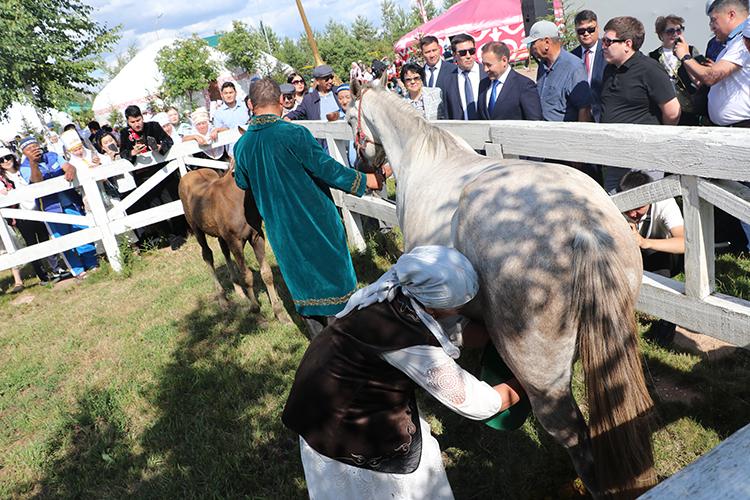
Milking a Mare (Anadolu Agency)
In traditional kımız production, milk is not heated. Freshly milked milk is mixed with kımız starter culture or previously made kımız and allowed to ferment. Fermentation typically takes place in leather sacks or similar vessels with a capacity of 10 to 150 liters. During this process, the milk is regularly beaten with special paddles to ensure homogenous fermentation. This procedure gives kımız its characteristic fluid consistency.

Kımız Production in Kazakhstan (Anadolu Agency)
In industrial kımız production, fresh or pasteurized mare’s milk is used. The milk is inoculated with appropriate microbial cultures (lactic acid bacteria and yeasts). During fermentation, the milk produces alcohol and lactic acid through the metabolic activity of these microorganisms. The carbon dioxide generated during this process contributes to kımız’s characteristic effervescent texture. Modern industrial production employs stainless steel vats and specialized mixing systems to ensure the product is produced under hygienic conditions with controlled consistency.

Industrial Production Steps Using Mare’s Milk (Common, 1996)
【4】
Although regional variations exist, kımız has traditionally been produced in vessels known as Saba and Torsuk, typically made of leather. Traditionally, fermentation occurs in sacks or similar containers that allow natural mixing of milk and starter culture and facilitate fermentation. In industrial production, stainless steel tanks are used. After fermentation is complete, kımız is bottled and prepared for fresh consumption or market distribution.

Saba (Sack) Made from Cowhide (Tegin and Zafer, 2014)
【5】
During kımız fermentation, both lactic acid bacteria and yeasts play roles. Lactic acid bacteria convert milk sugar (lactose) into lactic acid, while yeasts produce alcohol and aroma compounds. Fermentation of lactose and citrate contributes to the formation of flavor substances. Protein and fat metabolism further enhance kımız’s characteristic aroma. Both traditional and industrial production methods result in kımız possessing nutritional and probiotic properties due to its complex microbial flora.
Key metabolites formed during kımız fermentation include lactic acid, acetic acid, acetaldehyde, acetoin, diacetyl, ethanol, and carbon dioxide (CO₂). Additionally, flavor and taste compounds such as propyl alcohol, butyl alcohol, propionic acid, pyruvates, aldehydes, glycerol, and volatile fatty acids are produced.
During kımız fermentation, lactic acid bacteria carry out various biochemical processes including acid formation, proteolysis, lipolysis, and production of aroma compounds. These microorganisms also contribute to the microbial safety of kımız by inhibiting harmful bacteria.
Yeast species involved in kımız fermentation include Saccharomyces lactis, which ferments lactose; Saccharomyces cartilaginosus, which cannot ferment lactose; and Mycoderma species, which cannot ferment carbohydrates.
Yeasts synthesize substances necessary for LAB growth, while LAB provide a suitable environment for yeast development. During this process, amino acids and B vitamins (pantothenic acid, niacin, riboflavin, biotin) are produced. Aminopeptidase and carboxypeptidase activities convert bitter peptides into amino acids. Pathogens such as Yarrowia lipolytica and Debaryomyces hansenii are inhibited. The drop in pH increases the production of CO₂ and alcohol, enhancing product safety and shelf life.

Composition of Kımız (Tegin and Zafer, 2014)
【6】
Nutritional Value: Kımız is nutritious as it contains all essential nutrients. During fermentation, proteins are broken down into peptides and amino acids, making them easier to digest.
Alcohol Content: Ranging from 1 to 4 percent, it has a calming effect on the nervous system.
Digestion and Appetite: It increases gastric juice secretion, accelerates stomach and intestinal motility, enhances appetite, and improves nutrient absorption.
Diseases: It is beneficial in conditions such as tuberculosis, gastric inflammation, typhoid, dysentery, intestinal sluggishness, anemia, indigestion, fatigue, and loss of appetite. Sweet kımız may cause diarrhea, whereas kımız with high acidity and alcohol content can stop diarrhea.
Intestinal Flora: Microorganisms in kımız reach the intestines and help regulate the gut flora, thereby supporting recovery from gastrointestinal disorders.
In some Central Asian countries, mare’s milk has been used as an alternative to breast milk in infant feeding.
Among fermented dairy products, kımız holds importance for its nutritional and health benefits. Due to its probiotic microorganisms, it can be added to animal feed or water to improve livestock productivity. Technological advancements and scientific evaluation of its health effects are creating new avenues for kımız production and application.
Kımız Production (TRT Avaz)
Warning: The content presented here is for general encyclopedic informational purposes only. These details must not be used for diagnosis, treatment, or medical advice. Before making any decisions regarding health, always consult a physician or qualified healthcare professional. The author and KÜRE Encyclopedia assume no responsibility for any consequences arising from the use of this information for diagnostic or therapeutic purposes.
Akpınar, Aslı. "Orijini Farklı Kımızlardan İzole Edilen Laktik Asit Bakterileri ile Mayaların Tanımlanması ve Keçi Sütünden Kımız Üretimi." PhD thesis, [Ege Üniversitesi], 2015. Accessed September 2, 2025. https://tez.yok.gov.tr/UlusalTezMerkezi/TezGoster?key=WY5CM7tPNE2z_YM6pBu0t4iMQiyXBrTP_haJEwKsJ-NUM9vWe0N8uDA4nR1H5q0n
Anadolu Ajansı. "Kazakistan'da Geleneksel İçecek Kımıza Talep Artıyor." Accessed September 2, 2025. https://www.aa.com.tr/tr/yasam/kazakistanda-geleneksel-icecek-kimiza-talep-artiyor/3619383
Bayrak İşcanoğlu, İlknur. "Kırgız Halk Kültüründe Kutsal Bir İçecek Olarak Kımız." *Türkoloji ve Sosyo-Kültürel Araştırmalar Dergisi* 1, no. 1 (2024): 77–89. Accessed September 2, 2025. https://turskajournal.com/index.php/pub/article/view/10/3
TRT Avaz. "Kımız Nasıl Yapılır?" YouTube. Accessed September 2, 2025. https://www.youtube.com/watch?v=PjqqzCX2vnY
Tegin, Ruslan Adil Akai, and Zafer, Gönülalan. "Bütün Yönleriyle Doğal Fermente Ürün Kımız." *Manas Journal of Enginering* 2, no. 1 (2014): 23-34. Accessed September 2, 2025. https://www.researchgate.net/profile/Ruslan-Adil-Akai-Tegin/publication/306099628_All_Aspects_Of_Koumiss_The_Natural_Fermented_Product/links/57b1534f08aeb2cf17c47683/All-Aspects-Of-Koumiss-The-Natural-Fermented-Product.pdf
Yaygın, Hasan. "Kımız ve Kefir." *Beslenme ve Diyet Dergisi* 25, no. 1 (1996): 48–52. Accessed September 2, 2025. https://www.beslenmevediyetdergisi.org/index.php/bdd/article/download/508/459
Özşahin, Murat. "Başkurt Halk Yaşamında, Sanatında ve Tıbbında Kımız." Folklor Akademi Dergisi 8, no. 1 (2025): 8–16. Accessed September 2, 2025. https://dergipark.org.tr/tr/download/article-file/4601086
Üstün, Çağatay. "Eski Bir Türk İçeceği: Kımız (Koumıss)." *Türklük Bilimi Araştırmaları* 26, (2009): 247-255. Accessed September 2, 2025. https://dergipark.org.tr/en/download/article-file/156974
[1]
Hasan, Yaygın. "Kımız ve Kefir." Beslenme ve Diyet Dergisi 25, no. 1. (1996): 48. Erişim 2 Eylül 2025. https://www.beslenmevediyetdergisi.org/index.php/bdd/article/download/508/459
[2]
Hasan, Yaygın. "Kımız ve Kefir." Beslenme ve Diyet Dergisi 25, no. 1. (1996): 48. Erişim 2 Eylül 2025. https://www.beslenmevediyetdergisi.org/index.php/bdd/article/download/508/459
[3]
Hasan, Yaygın. "Kımız ve Kefir." Beslenme ve Diyet Dergisi 25, no. 1. (1996): 49. Erişim 2 Eylül 2025. https://www.beslenmevediyetdergisi.org/index.php/bdd/article/download/508/459
[4]
Hasan, Yaygın. "Kımız ve Kefir." Beslenme ve Diyet Dergisi 25, no. 1. (1996): 50. Erişim 2 Eylül 2025. https://www.beslenmevediyetdergisi.org/index.php/bdd/article/download/508/459
[5]
Ruslan Adil Akai, Tegin., ve Zafer, Gönülalan. "Bütün Yönleriyle Doğal Fermente Ürün Kımız." Manas Journal of Enginering 2, no. 1. (2014): 27. Erişim 2 Eylül 2025. https://www.researchgate.net/profile/Ruslan-Adil-Akai-Tegin/publication/306099628_All_Aspects_Of_Koumiss_The_Natural_Fermented_Product/links/57b1534f08aeb2cf17c47683/All-Aspects-Of-Koumiss-The-Natural-Fermented-Product.pdf
[6]
Ruslan Adil Akai, Tegin., ve Zafer, Gönülalan. "Bütün Yönleriyle Doğal Fermente Ürün Kımız." Manas Journal of Enginering 2, no. 1. (2014): 29. Erişim 2 Eylül 2025. https://www.researchgate.net/profile/Ruslan-Adil-Akai-Tegin/publication/306099628_All_Aspects_Of_Koumiss_The_Natural_Fermented_Product/links/57b1534f08aeb2cf17c47683/All-Aspects-Of-Koumiss-The-Natural-Fermented-Product.pdf


Historical Sources and Scientific Studies
Composition and Characteristics of Mare’s Milk
Lactose
Protein Structure
Bifidus Factor
Production Methods of Kımız
Traditional Production
Industrial Production
Production Vessels and Storage
Fermentation and Metabolic Activities
Main Metabolites
Role of Lactic Acid Bacteria (LAB)
Yeast Activity
Yeast-LAB Interaction
Nutritional Value and Health Effects
Use in Infant Nutrition
Modern Production and Geographic Distribution
Industrial and Biotechnological Significance