

This article was automatically translated from the original Turkish version.
Type of Geographical İndication | Mahreç Sign | ||||||||
|---|---|---|---|---|---|---|---|---|---|
Registration Number | 13 | ||||||||
Registration Date | 14.11.1997 | ||||||||
Product / Product Group(s) | Rugs and Kilims | ||||||||
Province(s) | Manisa | ||||||||
Applicant/Registrant(s) | Kula Municipality | ||||||||
Kula Hand-Knotted Rug is a handwoven carpet produced using traditional methods in the Kula district of Manisa Province in western Anatolia, Türkiye, and officially registered as a geographical indication. Registered on 14 November 1997 as a certification mark, this carpet is protected by the Kula Municipality. It is an original example of Turkish carpet art, distinguished by its technical features, production method, pattern repertoire, and quality control process.

Kula Hand-Knotted Rug (AA)
The Kula hand-knotted rug is woven using the Turkish knot technique. It adheres to a 30x50 quality standard, containing approximately 1,500 knots per square decimeter. The pile height ranges between 7 and 10 mm. The yarn used is primarily wool: pile yarn is 3.5/2 Nm, warp yarn is 4/3 Nm, thick weft yarn is 4/2 Nm, and fine weft yarn is 3.5 Nm. Total material consumption amounts to 5,400 grams per square meter.
The protection of the Kula hand-knotted rug under the geographical indication system is ensured through compliance checks during production and marketing stages. These inspections are carried out by regional directorates, factory directorates, and quality control commissions. Carpets produced in violation of the established technical specifications may not be labeled as “Kula Hand-Knotted Rug”; its commercial or cultural misuse is strictly prohibited.
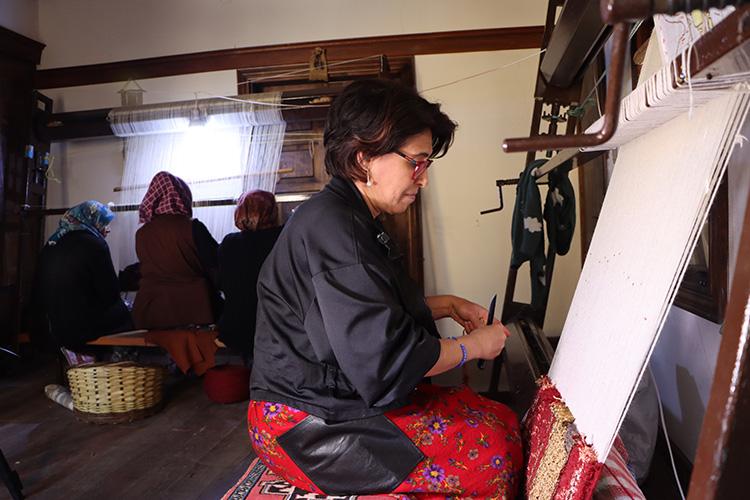
Kula rugs are woven on horizontal looms of the spiral type. Auxiliary tools include the “ıstar bıçağı,” a knife known locally by that name, the “sındı,” a specialized carpet scissors, and cutting knives for knot trimming. In traditional production, yarn was spun from the wool of local sheep and dyed using natural plant materials. Today, yarn is industrially sourced and synthetic dyes are preferred.
Pattern design is typically memorized; weavers apply motifs passed down through generations from memory. The weaving process consists of warping, tying the knots, weaving the kilim and čiti weave, knotting, inserting the weft, and trimming. After knotting, the pile yarn is cut to the desired pile height, and the rug is removed from the loom and swept or washed.
Historically, Kula rugs are examined in two periods: the “Palace Rugs” period from the 17th century to the 1860s, and the subsequent period marked by foreign influences. Palace-type rugs are generally prayer rug size. The mihrab arch is simply woven in a triangular shape; the ayetlik section is rectangular. Borders are multi-striped and decorated with motifs such as tulips, carnations, and hyacinths. The color palette prominently features apricot, gold yellow, navy blue, white, olive green, orange, blue, and black.
Designs are grouped into four main categories:

Kula Hand-Knotted Rug (AA)
Kula carpet weaving began in the 16th century with the production of prayer rug-type carpets using the Turkish knot and wool material. In the 19th century, the color palette darkened, with tones such as “safirol” (blue-navy) becoming widespread. During this period, new types emerged, including “Yılanlı Kula,” “Çaput Desenli Kula,” and “Safirol Halı.” In the 20th century, motifs became more realistic and cotton began to be used as a material. Knot density reached values such as 30x45 and 32x40.
After 1950, Kula rugs began to reflect influences from neighboring regions (Gördes, Demirci, Yuntdağ, Kozak, Isparta). In the 1980s, wool and cotton were used together, leading to greater quality variation. Rugs produced after 1995 are classified as “contemporary Kula rugs”; from this date onward, commercial considerations have determined color and design preferences.
Today, carpet weaving in Kula has declined significantly. Aside from a few families and the Kula Municipality, no other practitioners continue this craft. Although traditional patterns are still respected, distortions in motifs have been observed. Limited production continues through the efforts of Kula House (Culture Museum) and the Community Education Center.
Anadolu Ajansı. "Unutulmaya Yüz Tutan Kula Halıları Tarihi Konakta Yeniden Dokunuyor." Accessed October 19, 2025. https://www.aa.com.tr/tr/kultur-sanat/unutulmaya-yuz-tutan-kula-halilari-tarihi-konakta-yeniden-dokunuyor/2574202
Aygar, Bilge, and Sema Etikan. "Kula Halıları ve Gündümüzdeki Durumu." *Art-e Sanat Dergisi* 7, no. 14 (2014): 389–410. Accessed October 19, 2025. https://dergipark.org.tr/tr/pub/sduarte/issue/20735/221602.
Turk Patent and Trademark Office. *Kula El Halısı Mahreç İşareti Tescil Belgesi, No: 13*. 1997. Accessed October 19, 2025. https://ci.turkpatent.gov.tr/Files/GeographicalSigns/c3ddffcc-5ca8-48fd-9b72-fa783ccc385d.pdf.
Turkish Patent and Trademark Office. "Kula El Halısı." Geographical Indications Portal. Accessed October 19, 2025. https://ci.turkpatent.gov.tr/cografi-isaretler/detay/37876.

Type of Geographical İndication | Mahreç Sign | ||||||||
|---|---|---|---|---|---|---|---|---|---|
Registration Number | 13 | ||||||||
Registration Date | 14.11.1997 | ||||||||
Product / Product Group(s) | Rugs and Kilims | ||||||||
Province(s) | Manisa | ||||||||
Applicant/Registrant(s) | Kula Municipality | ||||||||
No Discussion Added Yet
Start discussion for "Kula Handwoven Carpet" article
Technical Features
Quality Control Process
Weaving Technique and Tools
Color, Motif, and Design Characteristics
Historical Development and Current Status