
This article was automatically translated from the original Turkish version.
+2 More
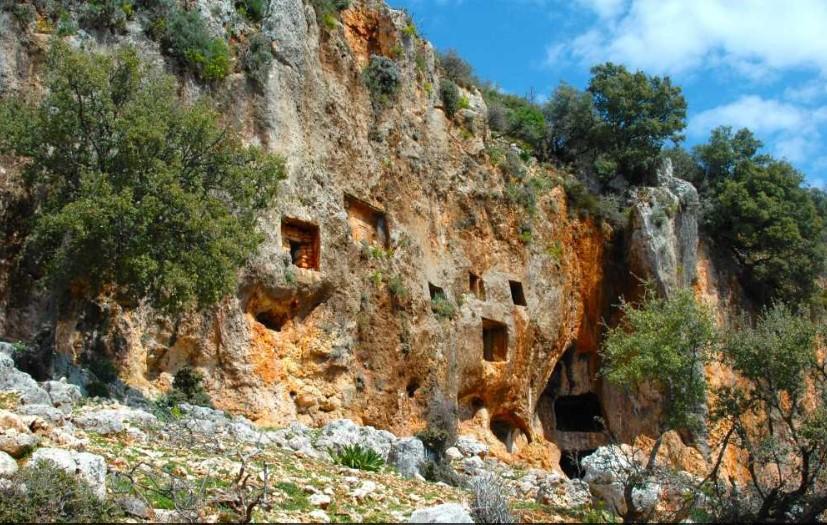
Kyaneai Ancient City is located on an east-west oriented plateau near the district of Kaş in Antalya Province, along the Demre-Kaş road and bordering the northern part of the present-day Yavu Village. It lies approximately 5 km from Üçağız Harbor between Antiphellos (Kaş) and Myra (Demre). Its name is of Greek origin, meaning “dark blue,” and it is also referred to as “shining rocks.”
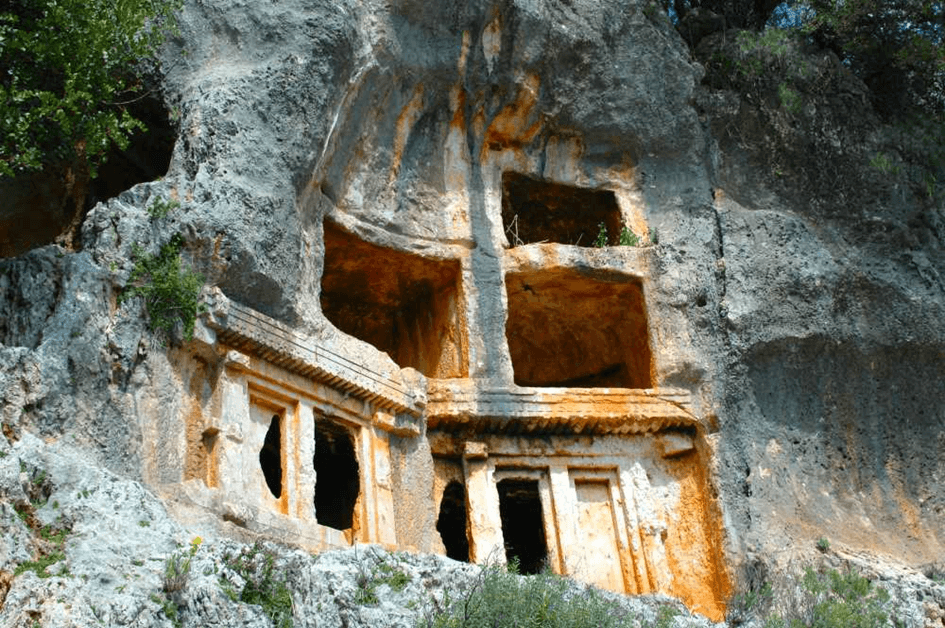
Kyaneai Ancient City (Culture Portal)
Lycian language inscriptions found at the site indicate that Kyaneai was inhabited from the 1st millennium BCE. Although the city’s name appears in ancient sources such as Pliny and other late antiquity authors, detailed chronological information remains limited. During the period of the Lycian League, coins minted in the city bear the inscription “Lykion Ku.” Under Roman rule, the city experienced significant development and later became recorded as a bishopric during the Christian era. Byzantine-era remains (5th–6th centuries) on the acropolis demonstrate that the city continued to exist, albeit on a reduced scale, until it was abandoned in the 10th century.
The acropolis is situated on a steep southern rocky platform oriented east-west. The southern side is not enclosed by walls. The city’s fortifications survive on three sides, with the northern and western gates still standing. Within the acropolis, remains of a library, bathhouse, grain storage, monumental fountain, cisterns, and tomb chambers have been identified. Dense vegetation hinders detailed examination of these structures.
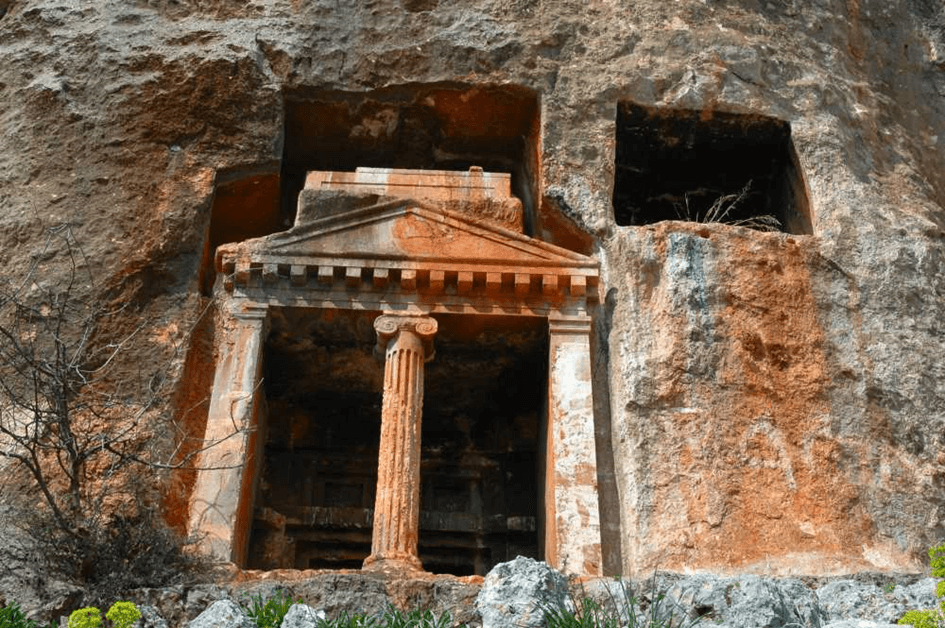
Kyaneai Ancient City (Culture Portal)
One of the most notable structures in the city is the Heroon near the western gate, distinguished by a sarcophagus dated to the 4th century BCE and adorned with various reliefs.
The necropolis area east of the acropolis contains numerous sarcophagi and rock-cut tombs extending down the steep southern slope. On the rocky terrain to the south, a single Ionic columned rock tomb with an anta facade and sarcophagi bearing carved Lycian inscriptions are found. Kyaneai is known as the city with the highest concentration of sarcophagi in the Lycian region and is often called the “City of Sarcophagi.”
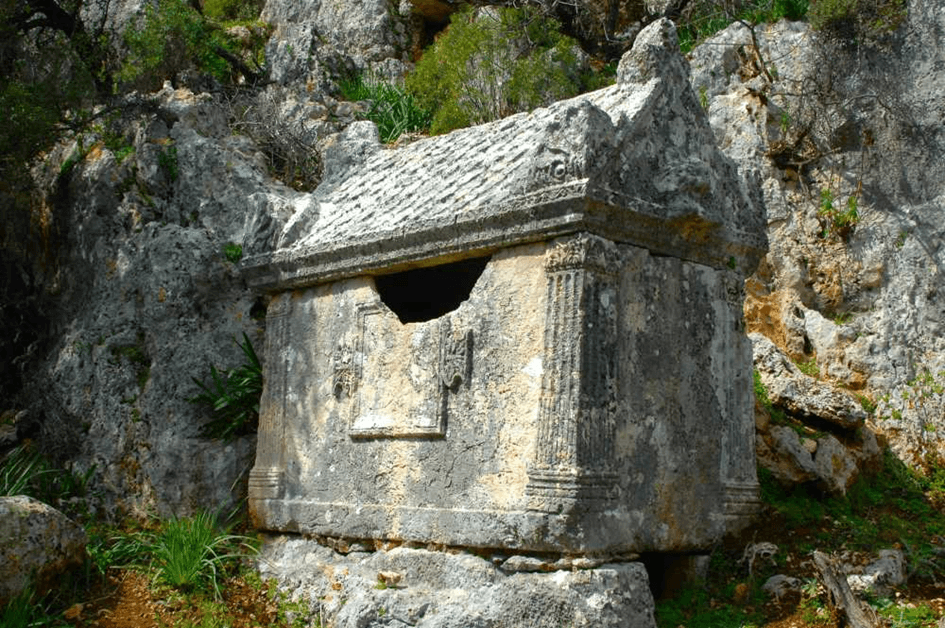
Kyaneai Ancient City (Culture Portal)
North of the plain west of the acropolis, a Greek-style theatre with double diazoma has been carved into the natural slope. The stage building (skene) was not constructed to a great height, in keeping with the view to the south. This theatre is among the earliest in Lycia, with a capacity of approximately 2,500 spectators, and overlooks Kekova and other Lycian cities.
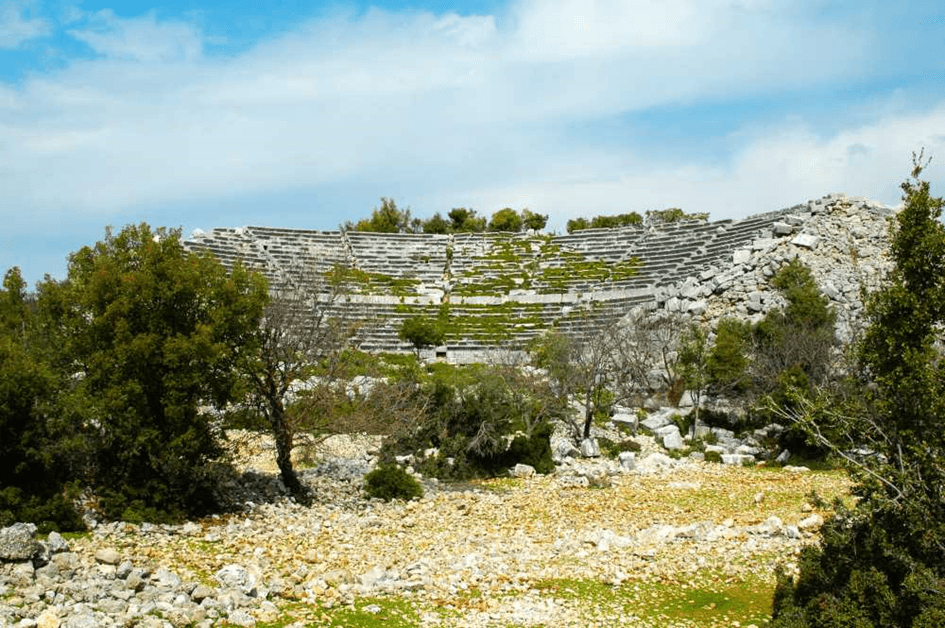
Kyaneai Ancient City (Culture Portal)
During the Roman period, the city developed urban infrastructure including a bathhouse, library, storage facilities, cisterns, and wells. The bathhouse complex comprised an apodyterium, frigidarium, tepidarium, and caldarium. In the Byzantine period, a basilica was constructed. Recent excavations indicate that metopes and triglyph friezes suggest the former presence of a temple.
T.C. Ministry of Culture and Tourism. "Kyaenai." *Kültür Portalı*. Accessed August 16, 2025. https://www.kulturportali.gov.tr/turkiye/antalya/gezilecekyer/kyaenai.
Ünal, Caner. 2020. “Kyaneai Antik Kenti.” *Türkiye Turizm Ansiklopedisi*. Accessed August 16, 2025. https://turkiyeturizmansiklopedisi.com/kyaneai-antik-kenti.

No Discussion Added Yet
Start discussion for "Kyaenai Ancient City" article
History
Architectural Features
Necropolis and Tombs
Theatre
Roman and Byzantine Periods