


This article was automatically translated from the original Turkish version.
+1 More
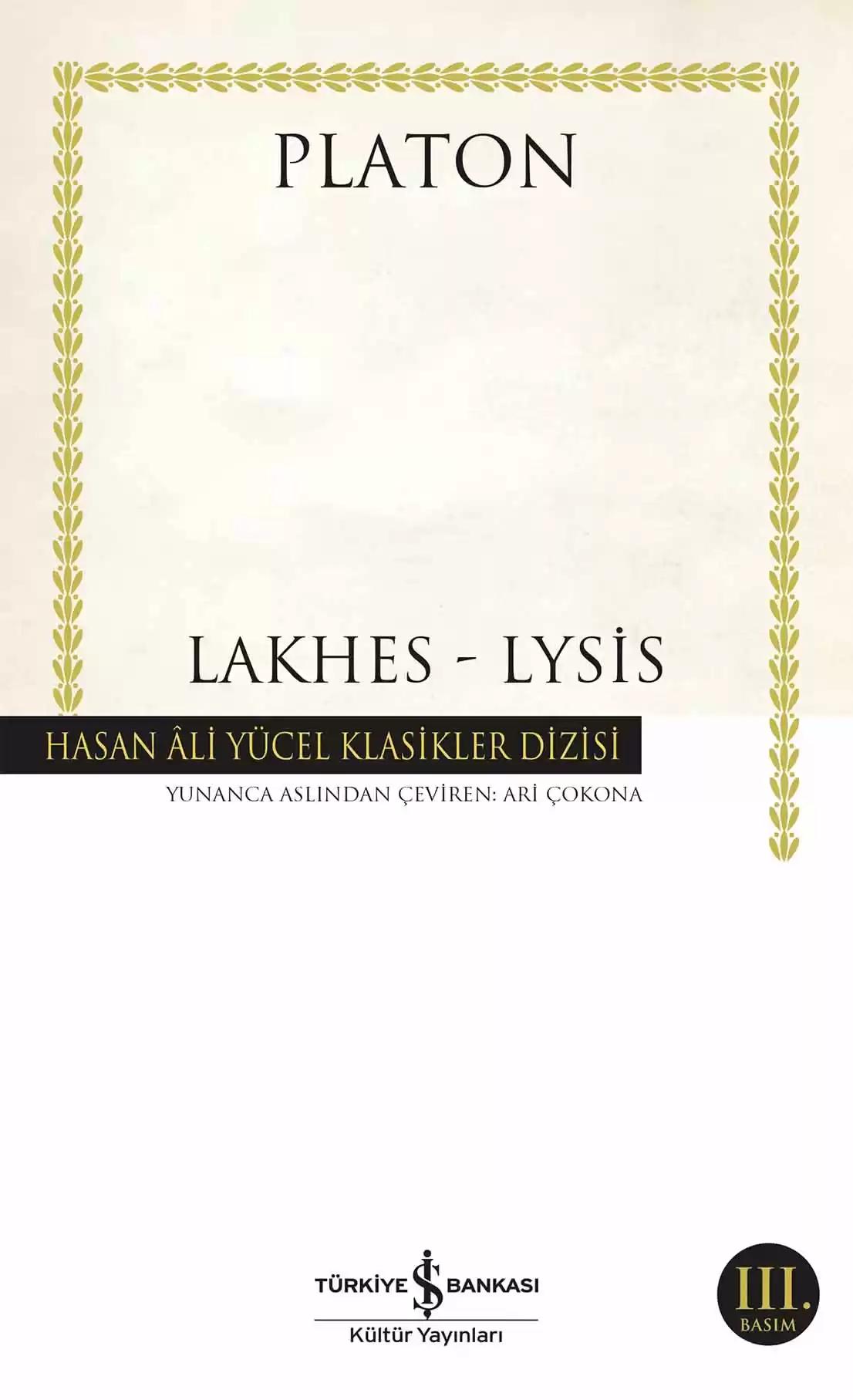
Lakhe-Lysis
Author(s) | Plato | ||||||||
|---|---|---|---|---|---|---|---|---|---|
Genre | Philosophy / Dialogue | ||||||||
Subject(s) | Examination of the concepts of courage and friendship | ||||||||
Prominent Theme | Definition of courage, nature of friendship, dialectical method | ||||||||
Number of Pages | 112 | ||||||||
Laches and Lysis are two separate dialogues written by the ancient Greek philosopher Plato. These works, composed in the dialogue form, are considered among the foundational texts of ancient Greek philosophy and are classified among Plato’s early writings. In both dialogues, the aim is to examine and define moral concepts through the Socratic method. The dialogues have been translated into Turkish and published by İş Bankası Kültür Yayınları.
Laches and Lysis are among Plato’s dialogues and present early examples of the dialectical method in philosophical problem-solving. In the Laches dialogue, the central theme is the concept of courage. Throughout the dialogue, Socrates and other characters attempt to define courage. In the Lysis dialogue, the concept of friendship is examined, with discussion centered on what friendship is and on what principles it is based. In both works, the boundaries of these concepts are explored through the questions posed by Socrates. Particularly in the Laches dialogue, it is emphasized that courage is not merely a virtue of the battlefield but a necessary virtue in all aspects of everyday life.
The Laches dialogue focuses on an inquiry into the definition of courage. Throughout the dialogue, the relationship between courage and knowledge is questioned, as well as whether courage constitutes a foundation of moral behavior. In this work, courage is treated not only as an individual virtue but also as a quality connected to social order.
The Lysis dialogue is structured around the concept of friendship. The definition of friendship, its underlying reasons, the fundamental principles of interpersonal relationships, and their moral dimensions are philosophically examined through Socrates’ questions.
Plato (Eflatun) was an ancient Greek philosopher who lived between 427 and 347 BCE. He was a student of Socrates and the teacher of Aristotle. Regarded as one of the founding figures of Western philosophy, Plato wrote his philosophical works primarily in the dialogue form. He developed ideas on fundamental philosophical topics such as the state, the soul, knowledge, justice, and virtue. Laches and Lysis are among Plato’s early works that address moral concepts.
These two dialogues serve as essential reference sources for academics, researchers, and philosophy students interested in ancient Greek philosophy, ethical theories, and the Socratic method of inquiry. They also appeal to general readers who are interested in the philosophical examination of concepts such as courage and friendship.
Laches and Lysis are among Plato’s early examples that demonstrate his dialectical method. In the Laches dialogue, the concept of courage is discussed within both individual and social contexts, while in the Lysis dialogue, the philosophical foundations of friendship are questioned. In these respects, the works contribute to the philosophical analysis of both individual morality and social order.
Bal, Metin. “Caydırmaya Karşı Platon’un Lakhes Diyaloğunda ve Aldous Huxley’in Cesur Yeni Dünya Romanında Cesaret Felsefesi.” Sosyal Bilimler Araştırmaları Dergisi 8. Accessed June 13, 2025. https://dergipark.org.tr/tr/download/article-file/440330
Platon. Lakhes – Lysis. Çev. Ari Çokona. İstanbul: Türkiye İş Bankası Kültür Yayınları, 2022.

Lakhe-Lysis
Author(s) | Plato | ||||||||
|---|---|---|---|---|---|---|---|---|---|
Genre | Philosophy / Dialogue | ||||||||
Subject(s) | Examination of the concepts of courage and friendship | ||||||||
Prominent Theme | Definition of courage, nature of friendship, dialectical method | ||||||||
Number of Pages | 112 | ||||||||
No Discussion Added Yet
Start discussion for "Lakhe - Lysis (Book)" article
Summary
Subject
About the Author
Target Audience
Significance of the Work