
+1 More

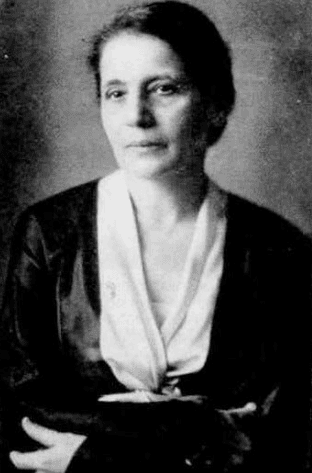
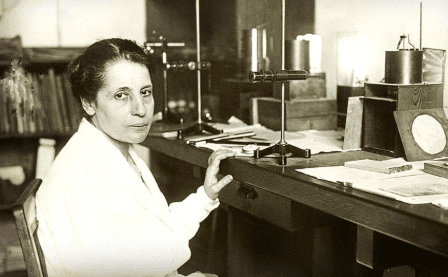
Lise Meitner
Doğum tarihi | 1878-11-07 | ||||||||
|---|---|---|---|---|---|---|---|---|---|
Place of Birth | Vienna | ||||||||
Ölüm tarihi | 1968-10-27 | ||||||||
Place of Death | Cambridge, England | ||||||||
Profession(s) | Physicist | ||||||||
Field of Work | Nuclear fission Radioactivity Nuclear physics | ||||||||
Education | Doctorate from Vienna University (1905) | ||||||||
Major Academic and Scientific Achievements | refused to participate in the Manhattan Project nominated 48 times for the Nobel Prize but never received it first person to scientifically use the term "fission" first person to theoretically explain the nuclear fission process with Otto Robert Frisch Discovery of the element protactinium with Otto Hahn (1918) | ||||||||
Institutions Worked at | Manne Siegbahn Institute Stockholm University of Berlin (first female physics professor) Kaiser Wilhelm Institute for Chemistry Berlin | ||||||||
Awards and Honors | Element 109 was named Meitnerium in her honor (1997) Enrico Fermi Award (1966) Max Planck Medal (1949) Leibniz Medal (1917) | ||||||||
Lise Meitner was a physicist who conducted research in radioactivity and nuclear physics during the first half of the 20th century. She began her scientific career in Austria and, together with Otto Hahn in Germany, discovered the element protactinium and, with Otto Robert Frisch, provided the theoretical explanation of the nuclear fission process. Meitner’s work served as a foundation for scientific publications on nuclear transformations and nuclear reactions.
Lise Meitner was born on 7 November 1878 in Vienna, the capital of the Austro-Hungarian Empire. She was raised in a Jewish family. During a time when women had limited access to higher education, she completed her secondary education through private tutoring and enrolled at the University of Vienna in 1901. Drawn to physics, she was greatly influenced by the lectures of Ludwig Boltzmann. In 1905, she completed her doctorate with a thesis on “heat conduction in inhomogeneous solids,” becoming the second woman to earn a doctorate in physics from the university.
In 1907, Meitner moved to Berlin, where she became one of the first women permitted to attend Max Planck’s lectures and soon began working as his assistant. That same year, she met Otto Hahn, and together they began experiments on radioactivity. In 1912, they moved to the newly established Kaiser Wilhelm Institute for Chemistry, where Hahn headed the radiochemistry division and Meitner led the nuclear physics division.
In 1918, they jointly discovered the element protactinium. In recognition of Meitner’s contribution, the laboratory was briefly known as the “Laboratorium Hahn-Meitner.” This collaboration lasted approximately 25 years.
During the 1920s and 1930s, Meitner made numerous important contributions to nuclear physics. She conducted experiments confirming the Klein-Nishina formula, investigated the radioactivity of potassium, observed positron emission in the laboratory, and studied the effects of slow neutrons. In 1926, she became a professor of physics at the University of Berlin, the first woman in Germany to hold such a position.
After the Nazis came to power in 1933, Jewish academics were dismissed from their positions. Meitner was initially unaffected because she held Austrian citizenship. However, her situation changed in 1938 with the annexation of Austria by Germany (the Anschluss). Hahn terminated her position at the institute. That same year, Meitner secretly fled to Sweden via the Netherlands. She began working in Manne Siegbahn’s laboratory in Stockholm but received little support there.
In 1938, Hahn and Strassmann observed that when uranium was bombarded with neutrons, barium was produced. Meitner, together with her nephew Otto Robert Frisch, interpreted this result as evidence that the uranium nucleus had split into two smaller nuclei, releasing a large amount of energy. They named this process “nuclear fission” and presented the physical explanation in a paper published in Nature in 1939.
In 1944, the Nobel Prize in Chemistry was awarded solely to Otto Hahn. Meitner’s contribution was overlooked. This omission has since been regarded as one of the most prominent examples of gender-based discrimination in the history of science and an instance of the “Matilda Effect.”
Meitner declined an offer to participate in the Manhattan Project during World War II. After the war, she continued her scientific work, participated in conferences across the United States and Europe, and gave lectures at universities. She was elected a foreign member of the Austrian Academy of Sciences in 1948, the German Academy of Sciences in 1949, and the Royal Society in 1955. In 1966, she was awarded the Enrico Fermi Prize together with Otto Hahn and Fritz Strassmann.
Lise Meitner died on 27 October 1968 in Cambridge, England. On her gravestone, at the request of her nephew Otto Frisch, the following inscription appears: “Lise Meitner: A physicist who never lost her humanity.” In 1997, the chemical element with atomic number 109 was named meitnerium in her honor.
AHF. “Lise Meitner.” Atomic Heritage Foundation. Accessed May 18, 2025. https://ahf.nuclearmuseum.org/ahf/profile/lise-meitner/
AIP. "Teaching Guide: Lise Meitner: Her Life in Modern Physics." American Institute of Physics. Accessed May 18, 2025. https://www.aip.org/history/teaching-guide-lise-meitner-her-life-in-modern-physics
AWIS. "Lise Meitner." Association for Women in Science. Accessed May 18, 2025. https://awis.org/historical-women/lise-meitner/
Allea. “Lise Meitner: A Physicist Who Never Lost Her Humanity.” All European Academies (ALLEA). Accessed May 18, 2025. https://allea.org/lise-meitner-a-physicist-who-never-lost-her-humanity/
EPA. "Women in Radiation History: Lise Meitner." United States Environmental Protection Agency. Accessed May 18, 2025. https://www.epa.gov/radtown/women-radiation-history-lise-meitner
Meitner, Lise. "Über die β-Strahl-Spektra und ihren Zusammenhang mit der γ-Strahlung." Zeitschrift für Physik 9 (1922): 131–144.
National Park Service. “Women of the Manhattan Project: Lise Meitner.” U.S. National Park Service. Accessed May 18, 2025. https://www.nps.gov/people/women-of-the-manhattan-project-lise-meitner.htm
Sime, Ruth Lewin, and Fay Ajzenberg‐Selove. “Lise Meitner: A Life in Physics.” *Physics Today* 49, no. 6 (1996): 55. https://doi.org/10.1063/1.2807657
Sime, Ruth Lewin. "Lise Meitner." In Wissen Macht Geschlecht: Ein ABC der transnationalen Zeitgeschichte, 67–70. Proceedings 9. Berlin: Edition Open Access, Max Planck Institute for the History of Science, 2016.
Sime, Ruth Lewin. “Lise Meitner and the Discovery of Nuclear Fission.” *Scientific American* 278, no. 1 (January 1998): 80–85. https://www.jstor.org/stable/10.2307/26057626

Lise Meitner
Doğum tarihi | 1878-11-07 | ||||||||
|---|---|---|---|---|---|---|---|---|---|
Place of Birth | Vienna | ||||||||
Ölüm tarihi | 1968-10-27 | ||||||||
Place of Death | Cambridge, England | ||||||||
Profession(s) | Physicist | ||||||||
Field of Work | Nuclear fission Radioactivity Nuclear physics | ||||||||
Education | Doctorate from Vienna University (1905) | ||||||||
Major Academic and Scientific Achievements | refused to participate in the Manhattan Project nominated 48 times for the Nobel Prize but never received it first person to scientifically use the term "fission" first person to theoretically explain the nuclear fission process with Otto Robert Frisch Discovery of the element protactinium with Otto Hahn (1918) | ||||||||
Institutions Worked at | Manne Siegbahn Institute Stockholm University of Berlin (first female physics professor) Kaiser Wilhelm Institute for Chemistry Berlin | ||||||||
Awards and Honors | Element 109 was named Meitnerium in her honor (1997) Enrico Fermi Award (1966) Max Planck Medal (1949) Leibniz Medal (1917) | ||||||||
Early Life and Education
Berlin Years and Collaboration with Otto Hahn
Scientific Contributions and Academic Career
Nazi Era and Exile
Discovery of Nuclear Fission
Nobel Prize and Aftermath
Postwar Period and Honors
Death and Legacy