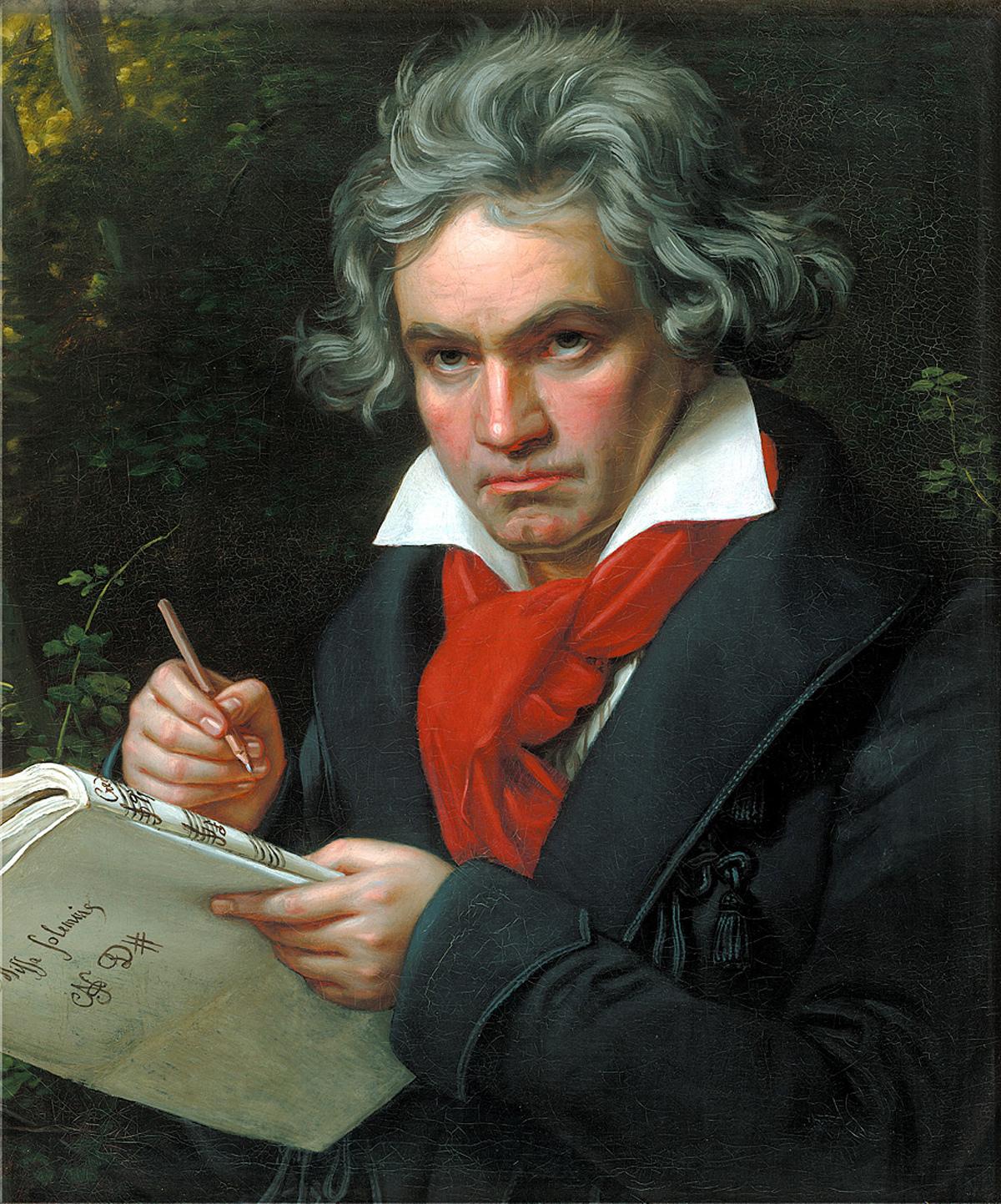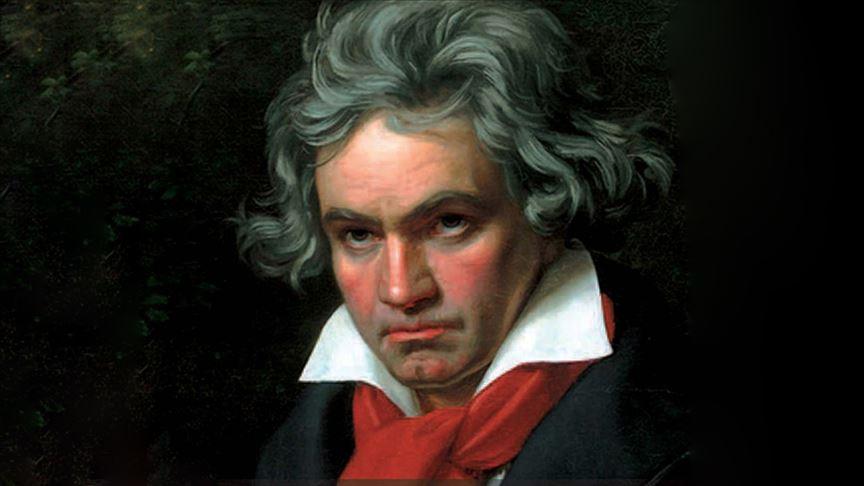
+1 More

Doğum tarihi | 1770-12-17 | ||||||||
|---|---|---|---|---|---|---|---|---|---|
Ölüm tarihi | 1827-03-26 | ||||||||
Nationality | German (Holy Roman Empire / Austria) | ||||||||
Profession(s) | Pianist Composer | ||||||||
Period(s) | Precursor to the transition from the Classical period to the Romantic period | ||||||||
Genres | Symphony, Sonata, Quartet, Concerto, Lied, Oratorio | ||||||||
Influenced by | Wolfgang Amadeus Mozart Joseph Haydn Johann Sebastian Bach | ||||||||
Influenced | Arnold Schönberg Gustav Mahler Richard Wagner Johannes Brahms Franz Liszt | ||||||||
Ludwig van Beethoven was born on December 17, 1770 in Bonn, Germany. His grandfather, Ludwig Beethoven, was a musician of Flemish origin known as a church music director, violinist, and tenor. His mother, Maria Magdalena, came from a family of servants and died of tuberculosis in 1787. His father, Johann Beethoven, also served as a tenor in the same church but became an indifferent parent due to alcoholism. Ludwig had two brothers, Kaspar (1774–1815) and Johann (1776–1848). After his mother’s death, Ludwig took responsibility for the care of his brothers.
Beethoven’s interest in music developed through his grandfather. He received his first lessons from his father and later became a student of Christian Gottlob Neefe. Neefe taught him the contrapuntal style of Bach and had him study works such as the Well-Tempered Clavier. Beethoven began working in the theater orchestra at age eleven and played the organ at age thirteen. To support his family financially, he turned to musical productivity at an early age and published his first composition at age twelve.
In 1787, with the support of Archbishop Maximilian Franz of Cologne, Beethoven traveled to Vienna where he briefly met Mozart. He played one of his compositions for Mozart and impressed him with his improvisation. However, he was forced to return to Bonn due to his mother’s illness.
During this period, Beethoven formed a friendship with the Breuning family in Bonn and gave lessons to Eleonore de Breuning. He also enrolled as a student at the University of Bonn and attended literature classes. He was particularly influenced by Schneider’s lectures on German literature and the works of writers such as Lessing, Goethe, and Schiller.
The period in which Beethoven lived was a transitional era marked by the spread of Enlightenment ideals of freedom, equality, and justice. The French Revolution (1789) and the American Independence Movement triggered widespread intellectual and political transformation across Europe. Beethoven was deeply influenced by these ideas and incorporated themes of humanity, freedom, fate, and universal brotherhood into his music. His Symphony No. 3 “Eroica”, composed in 1803, was originally dedicated to Napoleon Bonaparte but the dedication was changed to “To the memory of a great man” after Napoleon declared himself emperor. His Symphony No. 9 “Choral”, composed in 1824, is based on Schiller’s poem “Ode to Joy” and explores themes of humanity and brotherhood.
Beethoven moved to Vienna in 1792 and received financial and moral support from aristocrats such as Prince Karl Lichnowsky. Vienna was a major musical center, home to composers such as Haydn and Mozart. However, as Beethoven’s career progressed, he distanced himself from the traditional patronage system, marking a transition to a new era in which the artist was no longer merely a “craftsman” but an independent individual. Musical events in Vienna typically took place in private salons; public concerts were rare, and a regular audience of music lovers (Gesellschaft der Musikfreunde) was not established until 1812.
Beethoven regarded music as an expressive medium and viewed technical elements merely as tools. Listeners were moved not by virtuosity but by emotional intensity and inner expressiveness in his works. In opposition to the mechanical structure of the traditional keyboard tradition, he developed a dynamic and emotionally varied approach to the piano. His blending of delicate, serene melodies with abrupt and forceful transitions stands as a hallmark of expressive power. This approach left a lasting impact on subsequent pianists. Beethoven adapted orchestral thinking to the piano, evaluating the instrument’s technical and emotional potential together. He introduced new possibilities to the piano through wide octave spans and intensive use of the pedal, enhancing its volume and expressive capacity. He contributed to the structural development of the piano and offered suggestions to manufacturers.
Unlike Haydn and Mozart, Beethoven used the pedal to intensify timbres and blend sounds. In some passages, he applied the pedal throughout entire pages, moving beyond conventional notions of clarity to create an atmosphere where sounds merged. This approach paved the way for the timbral sensibility of Impressionist music that emerged in the late 19th century.
By combining sudden dynamic shifts, intense moods, and calm melodies, Beethoven established a foundation for Romantic music. These characteristics expanded boundaries both technically and emotionally. Following the training he received from Christian Gottlob Neefe, Bach’s contrapuntal and fugue techniques formed the core of Beethoven’s compositional approach. The fugue was not merely a developmental section but also a structural narrative device in his works. This technique, particularly enriching the sonata form, added layers of complexity to his music.
Beethoven’s music was shaped by the political and social transformations of his time. The principles of freedom, equality, and justice from the French Revolution and the Enlightenment found expression in his music as universal brotherhood and humanity. These themes were boldly expressed in the Eroica Symphony and, through Schiller’s “Ode to Joy,” in the Ninth Symphony. His deafness, inner conflicts, and familial responsibilities imbued his music with personal depth.
Beethoven abandoned the traditional patronage-based role of the “craftsman composer” and embraced the identity of an independent and free artist. This attitude found expression both in his music and in his social circle. He saw himself as an individual not bound to the aristocracy and guided his art by personal convictions. While masterfully employing classical forms, Beethoven transformed them and opened the way for a new musical era. Emphasizing quality over quantity, he sought depth and grandeur in his works, elevating the aesthetic value of music to a new level. The tonal transitions, structural intensity, and thematic depth in his compositions proved decisive for later composers. His music served as a bridge between the Classical and Romantic periods.
Beginning at age 26, Beethoven gradually lost his hearing and concealed this condition for some time. In 1802, he wrote a will addressed to his brothers in Heiligenstadt. In this letter, he described withdrawing from social life due to deafness but affirmed that his art kept him from suicide. By 1818, he was completely deaf and maintained communication through conversation books. He composed his greatest works after having completely lost his hearing.
Beethoven: Symphony No. 9, Jordi Savall with Le Concert des Nations ()
After the death of his brother Kaspar Karl van Beethoven in 1815, Beethoven embarked on a prolonged legal battle with his sister-in-law to gain custody of his nephew Karl. This process negatively affected Beethoven’s psychological well-being, and his strained relationship with Karl became one of the most painful aspects of his life. Karl’s suicide attempt in 1826 had a profound negative impact on Beethoven.
In late 1826, Beethoven began suffering from serious health problems. He is believed to have suffered from multiple medical complications including cirrhosis, lead poisoning, and kidney failure. During his final illness, he continued to live in Vienna with the support of friends and physicians but died on March 26, 1827, at the age of 56.
News of Beethoven’s death spread throughout Vienna’s musical circles, and approximately thirty thousand people attended his funeral. The poet and playwright Franz Grillparzer delivered a eulogy at the funeral.
Altar, Cevad Memduh. "Beethoven: Hayatı ve Eserleri." İstanbul Teknik Üniversitesi, Cevad Memduh Altar Arşivi. Accessed July 25, 2025. https://cevadmemduhaltar.itu.edu.tr/beethoven-hayati-ve-eserleri.html
Anadolu Ajansı. "Beethoven’ın Ölümünden Önce Hepatit B ve Karaciğer Hastalığından Müzdarip Olduğu Belirlendi." Anadolu Ajansı. Accessed July 25, 2025. https://www.aa.com.tr/tr/kultur/beethovenin-olumunden-once-hepatit-b-ve-karaciger-hastaligindan-muzdarip-oldugu-belirlendi/2853803
DW Classical Music. “Beethoven: Missa solemnis | Fabio Luisi, Staatskapelle Dresden, Chorus of the Sächsische Staatsoper.” YouTube. Accessed July 25, 2025. https://youtu.be/S8Yy0gSt-JE?si=HNjDX8-GuVkd8iQh
Erfurth, Andreas. “Ludwig van Beethoven—a Psychiatric Perspective.” *Cureus* 13, no. 10 (2021): 381-390. Accessed July 25, 2025. https://www.ncbi.nlm.nih.gov/pmc/articles/PMC8553682/
Meriç, Bahadır. “Ludwig van Beethoven’ın Bestecilik Yaşamının Dönemlerine Göre Yaylı Kuartetlerinin Örnekleme Yoluyla İncelenmesi.” Master's thesis, İstanbul Üniversitesi Sosyal Bilimler Enstitüsü, 2005. Accessed July 25, 2025. https://nek.istanbul.edu.tr/ekos/TEZ/40446.pdf
Oytun, Eren. “Beethoven’de Anlatımcılık ve Piyano Tekniği.” *Folklor/Edebiyat* 16, no. 64 (2010): 131–140. Accessed July 25, 2025. https://dergipark.org.tr/tr/download/article-file/255299
Pekdemir Peker, Ruba. “Zamanın Ötesinde Bir Besteci: Ludwig van Beethoven’in Evrensel Müzik Anlayışı ve Piyano Sonatları.” *Konservatoryum* 11, no. 2 (2023): 516–527. Accessed July 25, 2025. https://dergipark.org.tr/en/download/article-file/4312683
Rawpixel. "Beethoven portrait (1820) romanticism oil painting by Joseph Karl Stieler JPG." Accessed July 25, 2025. https://www.rawpixel.com/image/11499593/image-face-hand-person

Doğum tarihi | 1770-12-17 | ||||||||
|---|---|---|---|---|---|---|---|---|---|
Ölüm tarihi | 1827-03-26 | ||||||||
Nationality | German (Holy Roman Empire / Austria) | ||||||||
Profession(s) | Pianist Composer | ||||||||
Period(s) | Precursor to the transition from the Classical period to the Romantic period | ||||||||
Genres | Symphony, Sonata, Quartet, Concerto, Lied, Oratorio | ||||||||
Influenced by | Wolfgang Amadeus Mozart Joseph Haydn Johann Sebastian Bach | ||||||||
Influenced | Arnold Schönberg Gustav Mahler Richard Wagner Johannes Brahms Franz Liszt | ||||||||
No Discussion Added Yet
Start discussion for "Ludwig van Beethoven" article
Childhood and Musical Education
Youth and Journey to Vienna
Philosophical and Social Transformations of the Era
Musical Life in Vienna and the Patronage System
Artistic Identity
Deafness and the Heiligenstadt Testament
Major Works
Symphonies
Symphony No. 3 “Eroica” (Op. 55, 1803)
Symphony No. 5 (Op. 67, 1804–1808)
Symphony No. 6 “Pastoral” (Op. 68, 1808)
Symphony No. 9 “Choral” (Op. 125, 1824)
Piano Sonatas
“Hammerklavier” Sonata (Op. 106)
Sonata Op. 111
“Moonlight” Sonata (Sonata No. 14, Op. 27 No. 2)
“Pathétique” Sonata (Op. 13)
Chamber Music and Other Works
Late String Quartets (e.g., Op. 130–135)
Missa Solemnis (Op. 123)
Diabelli Variations (Op. 120)
Final Years and Death