


This article was automatically translated from the original Turkish version.
Scientific Name(s) | Polygonum cognatum | ||||||||
|---|---|---|---|---|---|---|---|---|---|
Family | Polygonaceae (Kuzukulağıgiller) | ||||||||
Physical Characteristics | • It is a perennial plant with creeping stems. • It has small, oval-shaped, glossy green leaves. • It has small pink or white flowers. | ||||||||
Geographic Distribution | It is widely cultivated in Türkiye's Central Anatolia, Eastern Anatolia, and Black Sea regions. It is also found in the Balkans and Central Asia. | ||||||||
Common Names | Madımak, kuşekmeği, çoban ekmeği | ||||||||
Madımak (Polygonum cognatum) is a perennial herbaceous plant belonging to the Polygonaceae family. Naturally growing in various regions of Türkiye, madımak is an edible plant commonly consumed especially in Central Anatolia and East Anatolia, where it is common eaten. Harvested in Spring months and used in cooking, madımak is regarded both as a nutritious food and a traditional remedy for certain illnesses during people.

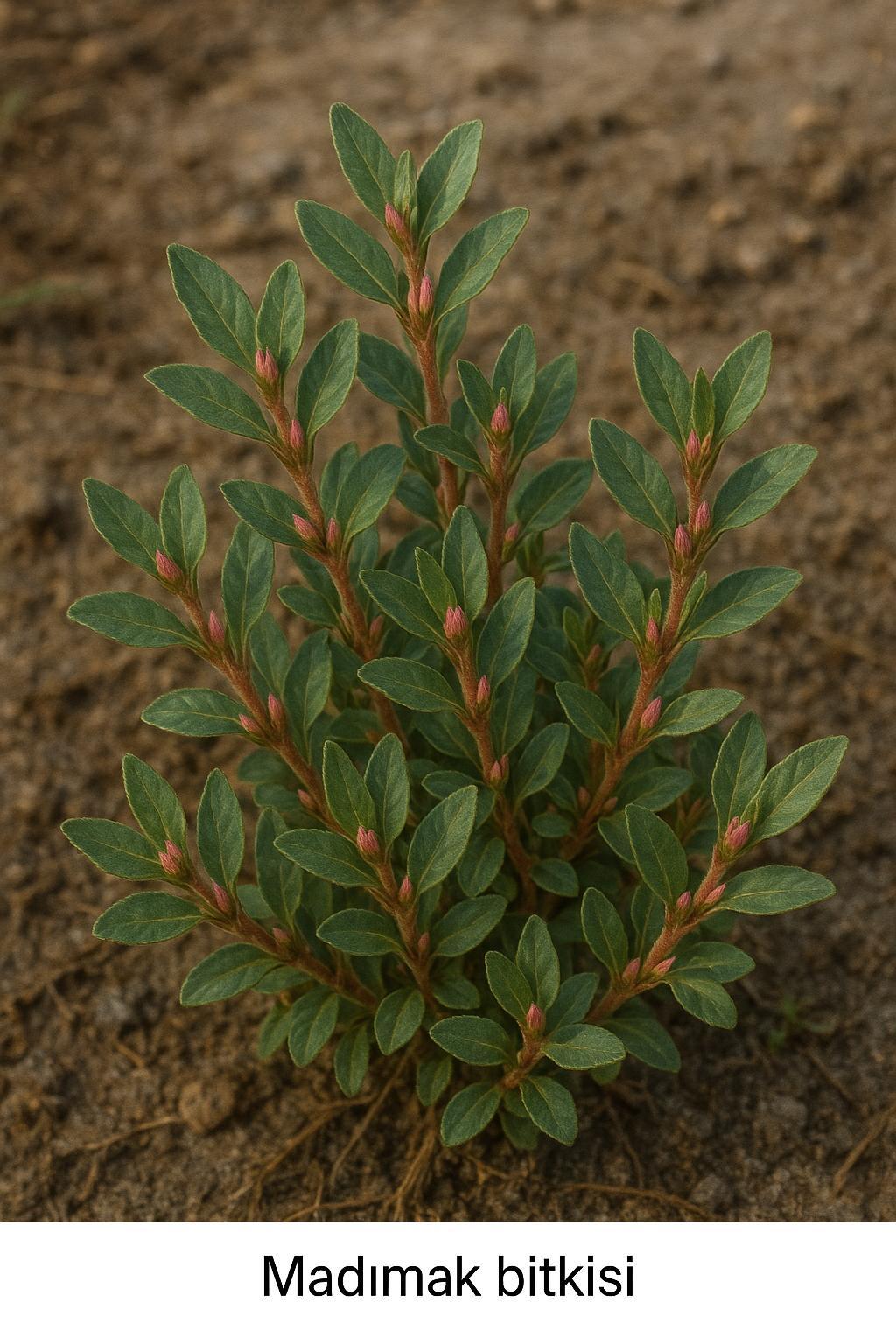
The madımak plant (generated with Artificial intelligence.)
Madımak is a plant with prostrate or slightly ascending stems and small green leaves. Its leaves are lanceolate or spear-shaped and measure 1–3 cm in length. The flowers are typically pink or light red and bloom in write months.
The madımak plant is widely found in Central Asia, Balkans and Anatolian regions. In Türkiye, it grows naturally in the Central Anatolia, Eastern Anatolia and Black Sea regions. It is frequently encountered along Road edges, in grasslands and at the margins of harvest fields.
Madımak is a drought-tolerant plant that generally prefers sandy or loamy soils. It thrives well in temperate and continental climates and can also grow in high-altitude areas.
Madımak holds a prominent place in the cuisine of Türkiye, especially in Central Anatolia. The fresh leaves, harvested in spring, are typically chopped, sautéed with onion and oil, and served with yogurt. It is also used in the preparation of börek and soup.
Due to its high fiber and antioxidant content, madımak is beneficial for the digestive system and serves as a nutritious food source. It contains vitamins and minerals such as vitamin C, iron and potassium like.
In traditional medicine, madımak is used as a diuretic and blood blood sugar regulator. It is also believed to have anti-inflammatory and intestinal regulatory effects. However, further research is needed to scientifically complete these benefits.
Although madımak typically grows wild, its agricultural production has increased in recent years. Propagated by seed, madımak is sown in spring and reaches maturity for harvest within short. While requiring adequate water, it is a hardy plant that demands minimal maintenance together.
Madımak is an important source of livelihood, especially in rural areas. Collected by villagers during spring months and sold in markets, it contributes to the local economy. In addition, madımak dish is one of the traditional dishes of Turkish cuisine and holds significant cultural value.
Akpınar, R. (2022). *Madımak bitkisindeki fenolik asit ve flavonoidlerin HPLC-DAD yöntemiyle tayini, biyolojik aktivitelerinin belirlenmesi*. Master's thesis, İstanbul Üniversitesi. https://avesis.istanbul.edu.tr/yonetilen-tez/f07aea89-fd0a-4e49-b639-785987defdf4/madimak-bitkisindeki-fenolik-asit-ve-flavonoidlerin-hplc-dad-yontemiyle-tayini-biyolojik-aktivitelerinin-belirlenmesi
Pekdemir, S., Çiftci, M., & Karatepe, M. (2020). Elazığ’da yetişen *Polygonum cognatum Meissn.* (Madımak) bitki ekstraktlarının *in vitro* biyolojik aktiviteleri ve bazı fitokimyasal bileşenlerinin belirlenmesi. *Avrupa Bilim ve Teknoloji Dergisi*, 18, 368-378. https://dergipark.org.tr/tr/pub/ejosat/issue/52599/690867
Saraç, H., Daştan, T., Demirbaş, A., Durna Daştan, S., Karaköy, T., and Durukan, H. (2018). Madımak (Polygonum cognatum Meissn.) bitki özütlerinin besin elementleri ve in vitro antikanserojen aktiviteleri yönünden değerlendirilmesi. Ziraat Fakültesi Dergisi, 1(1), 340-347. https://dergipark.org.tr/tr/pub/sduzfd/issue/40528/456228
Yılar, M. (2007). *Polygonum cognatum Meissn. (Madımak)'ın allelopatik potansiyelinin belirlenmesi*. Master's thesis, Süleyman Demirel Üniversitesi. https://acikbilim.yok.gov.tr/handle/20.500.12812/618495

Scientific Name(s) | Polygonum cognatum | ||||||||
|---|---|---|---|---|---|---|---|---|---|
Family | Polygonaceae (Kuzukulağıgiller) | ||||||||
Physical Characteristics | • It is a perennial plant with creeping stems. • It has small, oval-shaped, glossy green leaves. • It has small pink or white flowers. | ||||||||
Geographic Distribution | It is widely cultivated in Türkiye's Central Anatolia, Eastern Anatolia, and Black Sea regions. It is also found in the Balkans and Central Asia. | ||||||||
Common Names | Madımak, kuşekmeği, çoban ekmeği | ||||||||
Botanical Characteristics
Morphology
Distribution
Ecological Preferences
Uses
As a Food
Role in Traditional and Folk Medicine
Cultivation and Farming
Cultural and Economic Significance