


This article was automatically translated from the original Turkish version.
Magneto-rheological tool bearings (MRTB) represent a structure that exhibits far more dynamic, adaptable, and intelligent behavior compared to traditional mechanical support systems. These systems are manufacturing components that utilize fluids capable of altering their rheological (flow) properties in the presence of a magnetic field, offering high precision and impact damping capabilities. They have been developed specifically to overcome the limitations of conventional bearings in environments characterized by high vibration, high rotational speeds, or micro-scale machining requirements.
These bearings operate on the principle of magneto-rheological fluids (MR fluids). These fluids are specialized mixtures typically consisting of micron-sized iron particles suspended in a carrier liquid such as oil or silicone-based fluid. Under normal conditions, the mixture behaves as a liquid, but when a magnetic field is applied, it transitions into a viscous semi-solid state within milliseconds. This property enables the creation of variable stiffness support between moving parts, allowing the system to respond dynamically to changing load conditions.
In machine tools, particularly during operations such as milling, turning, and grinding, micro-vibrations and shock impacts directly affect tool precision and surface quality. While traditional bearings absorb these effects only within the limits of mechanical tolerances, MRTB systems can actively suppress these vibrations. This results in higher quality surface finishes, reduced tool wear, and lower noise levels.
Another critical advantage of MRTB systems is their real-time adaptability. An MRTB integrated with a CNC system can modify its stiffness structure according to the type of material being machined, the machining speed, or the tool geometry. Thanks to this active damping feature, the systems become not only part-specific but also optimizable for every new operation.
However, the most important factor enabling industrial adoption of MRTB technology is its compatibility with control algorithms. In modern MRTB systems, the magnetic field intensity can be automatically adjusted through PID (proportional-integral-derivative) or fuzzy logic-based controllers that analyze sensor data in real time. As a result, the system transcends the role of a passive bearing and actively intervenes in the manufacturing process.
From a design perspective, MRTB systems typically consist of magnetic coils, pole pieces, sealed chambers, and compartments containing the MR fluid. When an electric current is applied to the coils, the generated magnetic field acts on the fluid through the pole pieces. The success of the design is directly related to the proper guidance of magnetic flux and the stability of fluid viscosity. At this stage, materials science plays a critical role in ensuring system reliability.
This technology was first evaluated at the research level in the 1990s, but from the 2000s onward, it began to gain widespread use in high-precision industries such as defense and aerospace. For example, companies like Boeing and Lockheed Martin have increased efficiency in precision part machining by up to 20% using MRTB systems.
MRTB systems can also be integrated with smart maintenance systems. Changes in the electrical conductivity of the MR fluid can provide information about micro-wear or lubricant degradation within the system. When combined with predictive maintenance algorithms, this data can be used as a pre-failure warning system. Thus, the system plays a critical role not only during production but also in reducing downtime.
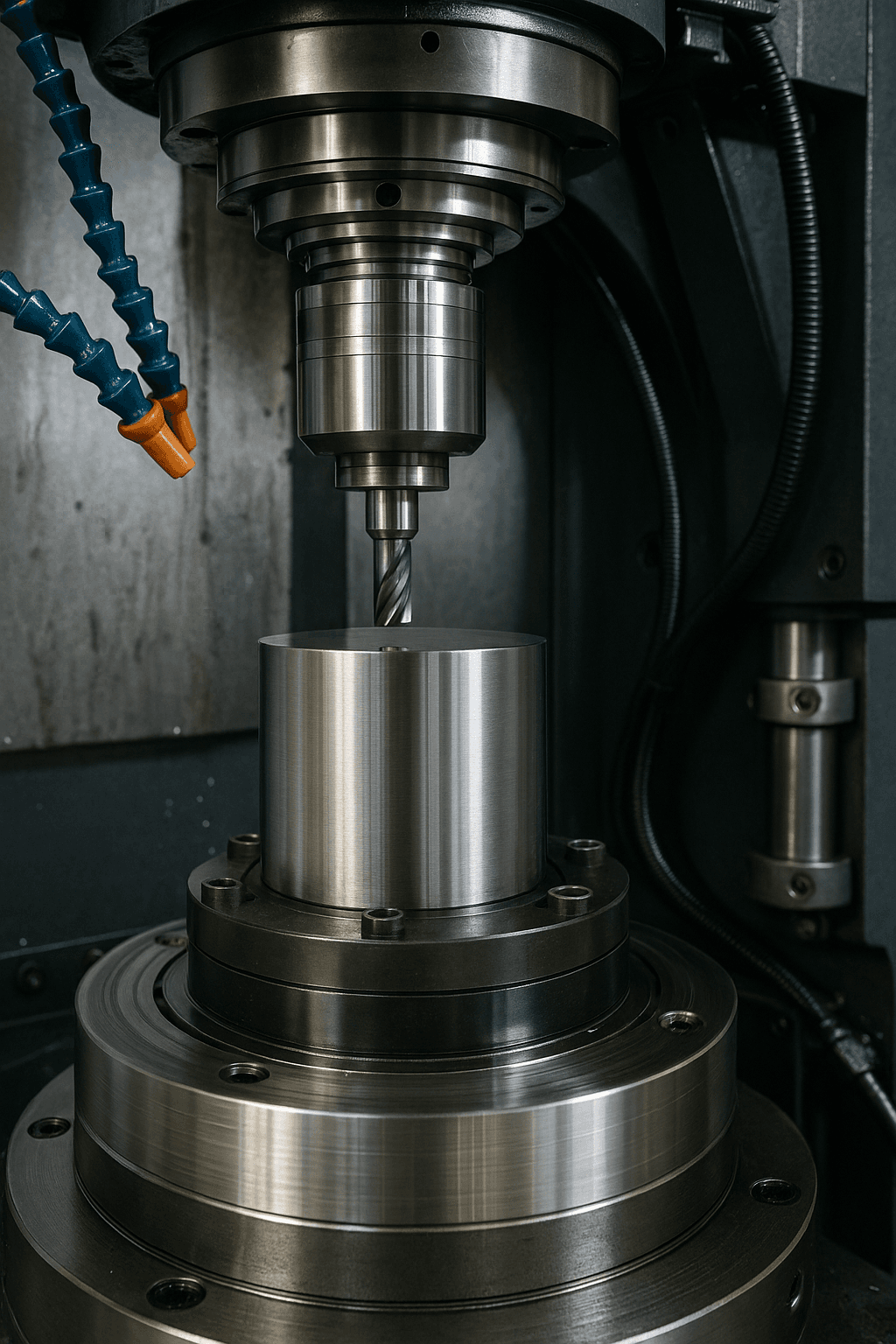
Magneto-Rheological Bearing System Equipped CNC (Generated with AI Assistance)
Magneto-rheological (MR) fluids are specialized fluids that are sensitive to magnetic fields and can rapidly alter their physical structure under such influence. Although these fluids have potential applications across many fields by transforming passive components into active and controllable systems, they hold critical importance in machine tools for dynamic stiffness and vibration control. The foundation of this technology lies in microscopic structures capable of transitioning from liquid to semi-solid within milliseconds, driven by electromagnetic forces.
MR fluids are primarily composed of three key components: a carrier liquid, magnetic particles, and often added stabilizers or additives. The carrier liquid is typically silicone oil, mineral oil, or a synthetic ester-based fluid. This liquid ensures the fluidity of the system and provides a medium for uniform particle dispersion. The magnetic particles are micron-sized soft iron or carbonyl iron particles. When exposed to a magnetic field, these particles align, dramatically increasing the viscous resistance within the fluid.
When a magnetic field is applied, the particles form chain-like structures within the fluid. These chains align vertically relative to the field direction, creating resistance to flow. This structural change occurs within only a few milliseconds, causing the fluid to assume a gel-like or solid-like character. Unlike classical hydraulic or mechanical systems, this transition is significantly faster and electronically controllable.
Another important feature of MR fluids is the reversibility of this transformation. When the magnetic field is removed, the particles disperse randomly and the fluid reverts to its original liquid state. The ability to control this transition enables the system to acquire active damping, adaptive stiffness, and intelligent support characteristics. This feature allows machine tools to respond effectively to continuously changing cutting forces and part tolerances.
The rheological behavior of MR fluids can be described using the Bingham plastic model. In this model, the fluid behaves like a solid below a certain yield stress and begins to flow only when this threshold is exceeded. This yield stress can be dynamically adjusted according to the intensity of the applied magnetic field. In this regard, MR fluids are far more complex and functional than classical Newtonian fluids.
In practical applications, sedimentation is one of the most common problems encountered with MR fluids. Over time, the particles tend to separate from the carrier liquid and settle at the bottom, negatively affecting the system’s rheological performance. To mitigate this, stabilizing additives such as surfactants and viscosity modifiers are used to slow sedimentation. Additionally, periodic mixing or internal circulation within the system helps maintain consistent performance.
The viscosity of MR fluids is influenced not only by the magnetic field but also by environmental variables such as temperature, pressure, and particle concentration. At high temperatures, the viscosity of the carrier liquid decreases while particle mobility increases, potentially disrupting magnetic alignment. Therefore, thermally controlled operation of MRTB systems is essential for stable performance.
Recent research has focused on developing nano-particle-enhanced versions of MR fluids. Nano-scale magnetic additives exhibit better dispersion than conventional micron-sized iron particles and can deliver higher performance under lower magnetic field intensities. This offers advantages in improving energy efficiency and achieving effective control in smaller systems.
MR fluids are also noteworthy for their tribological properties (friction and wear behavior). These fluids form a thin film layer between bearing surfaces, reducing friction and minimizing wear. As a result, the lifespan of system components is extended while maintenance requirements are reduced.
Magneto-rheological tool bearings (MRTB) are advanced technology products developed to provide active damping, precision control, and adaptive stiffness in modern manufacturing systems. These systems enhance production quality and extend tool life by overcoming the limitations of conventional bearing structures under high dynamic loads. Consequently, MRTBs are widely preferred in high-precision manufacturing, aerospace, defense industries, and micro-machining applications.
The first large-scale applications of MRTB systems were developed to reduce vibration-induced tolerance losses in high-speed spindle systems. In processes such as milling and grinding, micro-vibrations experienced by the spindle at high rotational speeds can directly affect surface quality. When integrated directly into the spindle, MRTBs detect instantaneous vibrations and increase stiffness via magnetic fields, preventing the system from entering resonance.
In the defense and aerospace industries, MRTB technology is widely used in precision part manufacturing and optical system assembly. Due to the need for micron-level precision and vibration-free environments in these fields, the rapid response time and high damping coefficient of MRTB systems provide significant advantages. For example, placing optical sensor carriers on magneto-rheological supports in satellite assembly lines has eliminated alignment errors caused by vibrations.
Performance analyses show that MRTB systems can suppress high-frequency vibrations two to five times more effectively than traditional passive dampers. These findings have been supported by modal analyses, demonstrating that MRTB usage is decisive in shifting resonance frequencies away from operational ranges. Simultaneously, cycle times have been reduced by up to 8%, and surface roughness has improved by up to 30%.
Another factor enhancing the effectiveness of these systems is their integration capability with real-time control systems. For instance, using PID (Proportional-Integral-Derivative) or adaptive fuzzy logic controllers, the magnetic field applied to MRTBs can be continuously adjusted. These control systems modify the magnetic field intensity based on vibration data from sensors during machining, ensuring an optimal response under constantly changing load conditions.
The use of MRTB systems in industry is not limited to improving machining quality. They also significantly impact tool life. The reduction in high-frequency vibrations decreases the dynamic impact loads on cutting edges, increasing the number of parts that can be processed per tool. Additionally, indirect effects such as more efficient coolant distribution and improved spindle balance have been observed to extend maintenance intervals.
It has also been reported that MRTB systems offer energy-efficient solutions. Mechanical friction losses common in traditional bearing systems are minimal in these systems. The fluid behavior controlled by magnetic fields activates only when needed, reducing the system’s overall energy consumption. In this regard, MRTB systems present a sustainable option for industrial facilities targeting energy efficiency.
Beyond high-precision applications, MRTB systems have also been successfully employed in multi-axis machine tools. In particular, in five-axis CNC systems, the stiffness requirements of moving table systems change instantaneously. In such systems, MRTB structures can be adapted as flexible bearing supports to provide different stiffness levels for each axis, thereby minimizing structural deformations caused by cutting forces.
Magneto-rheological tool bearings (MRTB) hold critical potential due to their high precision, dynamic damping, and adaptive stiffness properties in manufacturing systems. However, several engineering, materials science, and system integration challenges still hinder their widespread industrial adoption.
The first major limiting factor is the stability and longevity of magneto-rheological fluids. MR fluids tend to separate from the carrier liquid over time, leading to sedimentation. This reduces the consistency of the system’s rheological properties. In low-frequency applications, the accumulation of micron-sized iron particles at the bottom of the system can eliminate effective damping behavior. Although mixing systems and specialized additives are used to mitigate this, solutions are often temporary.
The second significant challenge is temperature dependency. The viscosity of MR fluids is highly sensitive to temperature. At elevated temperatures, the thinning of the carrier liquid reduces the particles’ ability to magnetically bond. Additionally, increased temperature can degrade the performance of magnetic coils, weakening the system’s overall damping capacity. Therefore, effective thermal management systems are essential in MRTB systems.
Another limiting factor is energy consumption and thermal efficiency. Although MRTB systems appear to consume less energy than passive components, they require continuous energy to generate the magnetic field. When high-frequency field variations and powerful magnetic coils are involved, this energy demand can impose a significant load on the overall system. This restricts their applicability, particularly in portable or battery-powered systems.
From a mechanical design perspective, sealing and structural integration remain significant problems. Sealing elements designed to prevent MR fluid leakage can wear over time and cause fluid loss. Additionally, the vibratory nature of the system creates stress on these elements, increasing maintenance requirements. Furthermore, their more complex structure compared to conventional bearing designs makes retrofitting existing machinery more challenging from an engineering standpoint.
In terms of system control, issues such as time delay and the accuracy of adaptive adjustments become prominent. Although the response time of MR fluids to magnetic fields is on the millisecond level, it is not always possible for control algorithms to adapt instantaneously to these changes. In multi-axis systems or variable-frequency applications, delays in the control system can prevent MRTBs from delivering their expected performance.
From a software and automation perspective, the widespread adoption of these systems requires integrated data collection and machine learning infrastructure. Since the behavior of MRTB systems changes over time, an AI-supported infrastructure is needed to continuously optimize system parameters by analyzing production data. This increases both software costs and system complexity.
Legal regulations and the lack of standards also pose significant barriers to the widespread adoption of MRTB systems. Currently, there are insufficient internationally accepted norms regarding the safety, lifespan, and performance criteria of these systems. This situation slows the commercialization of MRTBs in highly regulated sectors such as automotive and aerospace.

No Discussion Added Yet
Start discussion for "Magnetorheological Fluid Bearings" article
Properties and Mechanisms of Magneto-Rheological Fluids
Industrial Applications of Magneto-Rheological Tool Bearings
Challenges, Limitations, and Development Areas of Magneto-Rheological Bearings