

This article was automatically translated from the original Turkish version.
Type of Geographical İndication | Mahreç Sign | ||||||||
|---|---|---|---|---|---|---|---|---|---|
Registration Number | 349 | ||||||||
Registration Date | 07.05.2018 | ||||||||
Product / Product Group(s) | Bakery and Confectionery Products Desserts Dough Products | ||||||||
Province(s) | Manisa | ||||||||
Applicant/Registrant(s) | Petroleum Products Industry and Trade Ltd. Şti. Retailing Social Facilities Construction Transportation Tourism Food Teaching Msd Koza Education | ||||||||
Manisa Taban Simidi is a traditional bakery product unique to the Manisa province of Türkiye, officially registered with a geographical indication. A geographical indication application was submitted on 30 March 2010 under Law No. 6769 on Industrial Property, and the product was formally registered as a geographical indication on 7 May 2018. The product falls under the category of “simit” and is classified within the group of bakery and confectionery products, dough-based items, and sweets.
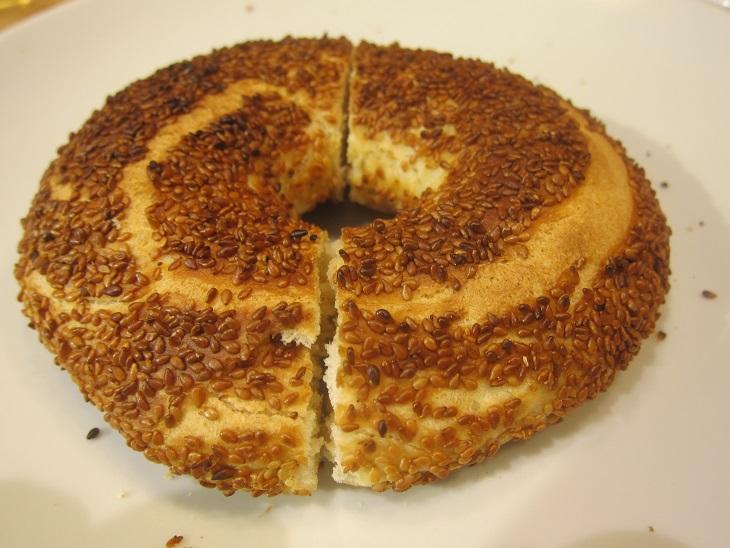
Manisa Taban Simidi is prepared from a composition of flour, water, chickpea yeast, grape molasses, and sesame. Its interior is white and it has a slightly sweet taste. It is called “taban simidi” (base simidi) due to its flat shape. Salt is used only in the preparation of the chickpea yeast; no salt is added during other stages of dough preparation.
Its distinguishing features include the slightly sweet aroma derived from chickpea yeast, the adherence and coloring of sesame to the simidi surface through the use of grape molasses produced from Sultaniye grapes, the use of sesame with a fat content exceeding 30% and a strong aroma, and physical parameters such as width, height, and acidity.
The production of Manisa Taban Simidi follows traditional methods and specific ratios. The most critical step is preparing the chickpea yeast. In this process, small-grained chickpeas grown in Manisa are ground, boiled water is poured into glass bottles, and the ground chickpeas along with salt are added. After the temperature is lowered to 35–40 °C, the mixture is left to ferment for 6–8 hours to produce the chickpea yeast. This yeast is the essential component responsible for the product’s slightly sweet flavor and delayed staling.
Flour, water, and chickpea yeast are mixed homogeneously and kneaded for 10–15 minutes. The dough is then placed in wooden troughs for a 30–40 minute pre-fermentation. After this step, the dough is kneaded again and left for a primary fermentation of 120–150 minutes. The interior of the simidi made from well-fermented dough remains white. Once fermentation is complete, the dough is transferred to wooden worktables, rolled into cylindrical shapes, and rested for an additional 10–15 minutes on wooden trays known as “pasa”.
After fermentation, the dough pieces are shaped into large rings and immersed in boiling water for 5–10 seconds. They are then transferred to a worktable coated with sesame mixed with grape molasses, flipped over, and coated with sesame. This process imparts shine and color to the simidi’s crust. The sesame-coated dough pieces are placed into an oven at 180–200 °C using a baker’s peel and baked for 10–15 minutes. The resulting simidi has a crust with a color close to brown. The product is stored at room temperature, away from direct sunlight and moisture. The packaging bears the logo and geographical indication marking “Manisa Taban Simidi”; if packaging is not used, this labeling must be visibly displayed at the production site.
The production of Manisa Taban Simidi can only be carried out within the boundaries of Manisa province. This geographical limitation is based on factors that directly influence the product’s distinctive characteristics. The small-grained chickpeas grown in Manisa provide the product’s slightly sweet flavor and durability, while the grape molasses derived from Sultaniye grapes gives the simidi’s crust its shine and color. The semi-humid climate conditions delay dough cooling, thereby enhancing fermentation quality. Production knowledge is passed down from master to apprentice and from father to son within the region.
Compliance with the geographical indication criteria is ensured through inspections conducted at least once annually and as needed. The inspection body consists of representatives from the registering company, the Yunusemre District Directorate of Agriculture and Forestry, and the Manisa Bakers’ Chamber. During inspections, particular attention is paid to the origin of the chickpeas and grape molasses, the production method, and the correct use of the logo.
Turk Patent and Trademark Office. "Manisa Taban Simidi Mahreç İşareti Tescil Belgesi." Turk Patent and Trademark Office. Accessed October 19, 2025. https://ci.turkpatent.gov.tr/Files/GeographicalSigns/3b6716b8-5bb9-47d0-a242-2a07c59649bc.pdf.
Turkish Patent and Trademark Office. "Manisa Taban Simidi - Geographical Indications Portal." Turkish Patent and Trademark Office. Accessed October 19, 2025. https://ci.turkpatent.gov.tr/cografi-isaretler/detay/38023.

Type of Geographical İndication | Mahreç Sign | ||||||||
|---|---|---|---|---|---|---|---|---|---|
Registration Number | 349 | ||||||||
Registration Date | 07.05.2018 | ||||||||
Product / Product Group(s) | Bakery and Confectionery Products Desserts Dough Products | ||||||||
Province(s) | Manisa | ||||||||
Applicant/Registrant(s) | Petroleum Products Industry and Trade Ltd. Şti. Retailing Social Facilities Construction Transportation Tourism Food Teaching Msd Koza Education | ||||||||
No Discussion Added Yet
Start discussion for "Manisa Taban Simidi" article
Product Characteristics
Preparation
Geographical Boundary and Local Elements
Monitoring