


This article was automatically translated from the original Turkish version.
In today’s world, where wearable technology and personal health monitoring devices are rapidly becoming widespread, certain components have a revolutionary impact. The MAX30100 sensor, developed by Maxim Integrated, is a pioneering component that perfectly fits this description. Thanks to its ability to measure two critical vital signs—pulse rate (heart rate) and blood oxygen saturation (SpO2)—in a single compact package, this sensor has become an indispensable tool for both hobbyists working on “Do-It-Yourself” (DIY) projects and engineers developing prototypes of wearable health devices.
This article serves as a comprehensive guide covering the MAX30100 sensor in all its aspects. It will not only explain what the sensor is and what it does but also delve in detail into the fascinating science behind its operation—photoplethysmography (PPG)—along with its technical specifications, common practical issues encountered during use, and methods to overcome them. By the end of this article, you will possess the theoretical and practical knowledge needed to confidently use the MAX30100 sensor in your next project.
The operating principle of the MAX30100 is based on a sophisticated optical technique called photoplethysmography (PPG). This method enables non-invasive (i.e., without entering the body), low-cost detection of changes in blood volume within tissues.
At its most fundamental level, PPG operates on the principle of light absorption by biological tissue. The sensor is placed on a region with dense blood vessels and relatively thin skin, such as a fingertip or earlobe. The light-emitting diodes (LEDs) on the sensor emit light at specific wavelengths into the tissue. Part of this light is absorbed by the tissue, bone, and blood, while the remainder is reflected or transmitted through the tissue to reach a photodetector on the sensor.
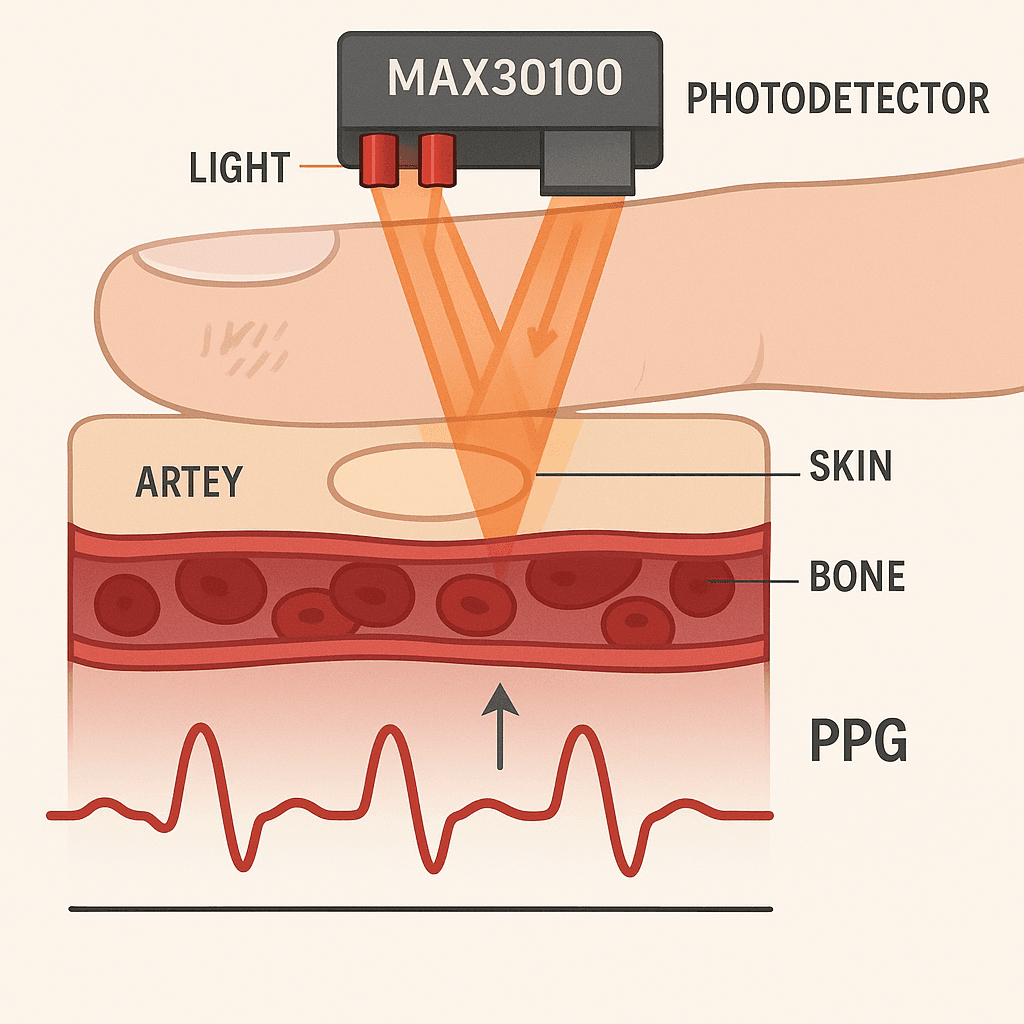
MAX30100 Operating Principle (Image generated by AI.)
With each heartbeat, blood is pumped into the arteries, causing a transient increase in blood volume at the fingertip. Since blood absorbs more light than surrounding tissue, this increase results in a decrease in the amount of light reaching the photodetector. When the heart relaxes, blood volume decreases and more light reaches the photodetector. This cyclic variation in light intensity forms a waveform synchronized with the heartbeat, known as the PPG signal.
The MAX30100 extends this basic principle by using two different colored LEDs to perform two distinct measurements: one emitting red light at approximately 660 nm and the other emitting infrared (IR) light at approximately 880 nm.
1. Heart Rate (BPM): To measure heart rate (beats per minute or BPM), only the infrared (IR) light is required. The time between periodic peaks in the IR light absorption signal directly corresponds to the heart rate.
2. Blood Oxygen Saturation (SpO2): Measuring SpO2 involves a more complex process and requires both the red and IR LEDs. The key to this measurement lies in the fact that hemoglobin in the blood absorbs light differently depending on whether it is carrying oxygen.
While analyzing the absorption of these two light types, the sensor separates the PPG signal into two main components—a point often overlooked by beginners but critical to understanding the sensor’s operation. The sensor does not simply output a number; it analyzes the underlying rich PPG waveform, which can be visualized by accessing raw data and may provide additional insights into vascular health, stress levels, and more. This analysis is performed based on two fundamental components of the signal:
1. DC (Direct Current) Component: This is the steady portion of the signal representing light absorption caused by constant factors such as finger tissue, bone, skin pigmentation, and the fixed volume of venous blood.
2. AC (Alternating Current) Component: This is the pulsatile portion of the signal that fluctuates with each heartbeat, resulting from the rhythmic increase and decrease in arterial blood volume.
The MAX30100 calculates the ratio of AC to DC components for both red and infrared light. It then divides these two ratios to obtain a coefficient known as the R Value:
<span class="katex"><span class="katex-html" aria-hidden="true"><span class="base"><span class="strut" style="height:0.6833em;"></span><span class="mord mathnormal" style="margin-right:0.00773em;">R</span><span class="mspace" style="margin-right:0.2778em;"></span><span class="mrel">=</span><span class="mspace" style="margin-right:0.2778em;"></span></span><span class="base"><span class="strut" style="height:1em;vertical-align:-0.25em;"></span><span class="mopen">(</span><span class="mord mathnormal">A</span><span class="mord mathnormal" style="margin-right:0.07153em;">C</span><span class="mord mathnormal" style="margin-right:0.07847em;">I</span><span class="mord mathnormal" style="margin-right:0.00773em;">R</span><span class="mord">/</span><span class="mord mathnormal" style="margin-right:0.02778em;">D</span><span class="mord mathnormal" style="margin-right:0.07153em;">C</span><span class="mord mathnormal" style="margin-right:0.07847em;">I</span><span class="mord mathnormal" style="margin-right:0.00773em;">R</span><span class="mord"></span><span class="mclose">)</span><span class="mord">/</span><span class="mopen">(</span><span class="mord mathnormal">A</span><span class="mord mathnormal" style="margin-right:0.05764em;">CRE</span><span class="mord mathnormal" style="margin-right:0.02778em;">D</span><span class="mord">/</span><span class="mord mathnormal" style="margin-right:0.02778em;">D</span><span class="mord mathnormal" style="margin-right:0.05764em;">CRE</span><span class="mord mathnormal" style="margin-right:0.02778em;">D</span><span class="mord"></span><span class="mclose">)</span><span class="mord"></span></span></span></span>
This R value is converted into a percentage of blood oxygen saturation (SpO2) using an empirical lookup table derived from the Beer-Lambert law and tested on healthy volunteers. This complex process is carried out by the sensor’s internal analog and digital signal processing units.
The MAX30100 is more than just a combination of LEDs and a photodetector. It is a highly integrated “System-in-Package” (SiP) solution that integrates all necessary components for advanced measurements into a single unit.
The sensor combines the LEDs, photodetector, optimized optics, and low-noise analog signal processing circuitry into an extremely compact package measuring just 5.6 mm × 2.8 mm × 1.2 mm. This miniature size makes it ideal for wearable devices such as smartwatches and fitness bands, where space is at a premium.
The following table summarizes the key technical parameters to consider when deciding to use the MAX30100 in a project. This table consolidates critical information such as voltage levels, power consumption, and communication interfaces needed by developers during hardware design.
The MAX30100 does more than collect raw data. It includes several internal features designed to ensure reliable and efficient measurements:
These programmable settings allow developers to strike a balance tailored to their project’s specific needs, creating a trade-off between power consumption, measurement speed, and signal quality. For example, when designing a wearable device where battery life is critical, lower LED current and reduced sampling rates can be selected to minimize power consumption. Conversely, in a laboratory prototype where maximum accuracy and noise immunity are prioritized, higher LED current and longer pulse widths may be preferred. This flexibility makes the MAX30100 suitable for a wide range of applications.
As with any technology, the MAX30100 has areas where it performs exceptionally well and others where limitations must be acknowledged.
To obtain reliable data from the MAX30100, several factors must be carefully considered:
How Does the MAX30100 Work? The Secrets of Photoplethysmography (PPG)
Basic Principle: Measuring Blood Flow with Light
How Are Heart Rate (BPM) and Oxygen Saturation (SpO2) Calculated?
Technical Specifications and Capabilities: The Anatomy of the MAX30100
Overview and Physical Characteristics
Electrical and Performance Specifications
Advanced Features: More Than Just a Light Source
Applications and Limitations: Where It Excels and Where It Struggles
Application Areas
Factors Affecting Accuracy and Limitations
