


This article was automatically translated from the original Turkish version.
+2 More
Mazıdağı (District)
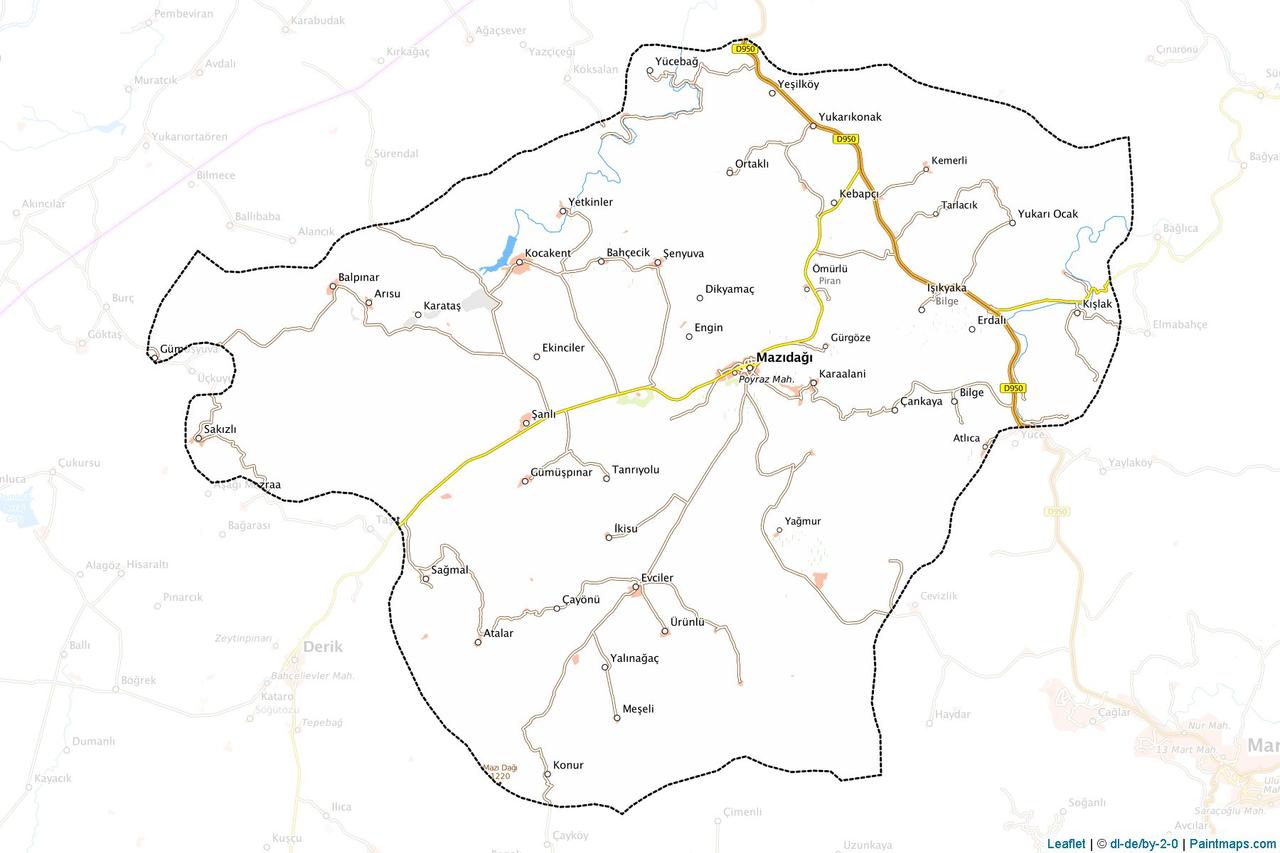
Mazıdağı is a district of Mardin Province in southeastern Türkiye, within the Dicle Region. Located at an elevation of 1030–1090 metres on a plateau between a series of circular mountains from which it takes its name, the district lies 47 kilometres northwest of Mardin. Covering an area of 869 km², Mazıdağı consists of 50 villages and 14 hamlets. Previously a subdistrict under Savur and Derik, it attained district status on 9 September 1937.
Although Mazıdağı’s history has not been the subject of specific research, its origins can be understood through information derived from the histories of surrounding major settlements. As a settlement, Mazıdağı dates back to the Byzantine period. Its former name, “Şamrah,” derives from its location along the route connecting Diyarbakır to Şam. The term “Şamrah” means “on the way to Şam.” The current name “Mazıdağı” originates from the dense stands of mazı trees that once covered the surrounding mountains.
Remains of the Saffron Castle, situated on a steep hill three kilometres southwest of the district, along with surrounding ruins, indicate the presence of a Syriac settlement along the Byzantine road linking Diyarbakır to Şam. During the wars between the Sasanians and Byzantines in the 5th and 6th centuries, Mardin and this region changed hands several times. After Şamrah came under Arab control in the 7th century, most of the Christian population converted to Islam; those who remained Syriac migrated to Mardin following Timur’s invasion in 1392.
Following the Ottoman victory at the Battle of Çaldıran in 1514, Diyarbakır and Mardin were incorporated into Ottoman territory, and Mazıdağı came under Ottoman administration. Additionally, the Derametinan Castle, still standing in the district, is a structure dating from the Byzantine period. This castle, which was captured after a 20-day siege during Timur’s campaign to seize Mardin and Diyarbakır, was built on a hill 150 metres high, commanding the caravan route. The Zambırhan and Asrihan caves, remnants from the Seljuk period, were later used by caravans as resting places. The remains of a Byzantine-operated silver mine and associated fortifications in Gümüşyuva Village further illuminate the district’s historical layers. Mazıdağı was fully liberated from French occupation on 21 September 1919.
Mazıdağı is located in the Dicle Region of southeastern Türkiye, in the northwestern part of Mardin Province. To its south lies Derik, to the east Mardin and Savur, to the north Çınar district of Diyarbakır, and to the west Viranşehir district of Şanlıurfa. Its geographic coordinates lie between 40–41° east longitude and 37–38° north latitude. The district’s elevation ranges from 1030 to 1090 metres above sea level, with a total area of 869 km².
The district is situated on the Mardin Escarpment, within a chain of circular mountains. Forested areas cover 38,925 hectares, while open areas span 182,878.5 hectares, totaling 221,803.5 hectares. The terrain is generally rugged, with no exceptionally high peaks; instead, it is characterized by broad hills and deep valleys. Major elevations include Sphere Hill (1047 m), Çevrik Hill (1103 m), and Reze Halil Hill (1211 m). The largest plain is the Dest Gevre Flatland, formed by alluvial deposits carried down from surrounding mountains.
The geological structure consists of formations from the Pre-Paleozoic, Paleozoic, and Mesozoic periods. The Kasrik Formation is notable for its rich phosphate deposits. Tectonic movements in the region are primarily vertical uplifts, with no major fault systems. Due to the sparse vegetation cover, Erosion erosion is rapid, and alluvial soils are transported onto the plains.
Mazıdağı has a typical continental climate. Summers are hot and dry, while winters are cold and wet. The annual average temperature is 16°C; summer highs reach 37–38°C, and winter lows range from -13 to -14°C. The highest rainfall (642.1 mm) occurs in winter. Cold winds blowing from the northwest during winter intensify climatic harshness.
The natural vegetation is influenced by climate and human factors. Forested areas account for 19% of the total area and are predominantly composed of mazı and oak trees. However, forests that were more extensive 20–30 years ago have significantly diminished due to deforestation and use as firewood. Olive trees, unlike in Derik district, do not grow in Mazıdağı, indicating the region’s distance from the Mediterranean climate zone. Overall, vegetation is sparse and low-growing.
Hydrographically, the district is poor. Surface and groundwater sources are limited; the only river is Karaçay (Çeme Reşan), which originates in the northwest and flows into the Tigris River. Water needs in villages are typically met by reservoirs fed by springs and wells, but these dry up in summer and lack hygienic standards.
The people of Mazıdağı are traditionally tied to the land and live in clustered settlements. Four family groups inhabit the district: Gançoyi, Yakupli, Bileçki, and Hani, with additional families from Kulptan. Although three tribes (Gançoi, Yakubi, Bilekçi) exist, their influence is limited. Traditional blood disputes persist in villages, and in recent years, these situation have increased. Peace initiatives often fail due to material constraints.
Houses are constructed from mudbrick, stone, and brick; due to the scarcity of timber, roofless homes are common. Traditional architecture is preserved in rural areas, while clothing has modernized. Entertainment ceremonies such as wedding and engagements include drum and zurna performances. No market, fairs, or festival like events are held in the district. Due to economic hardship, residents temporarily migrate to provinces such as Manisa, Adapazarı, and Ankara.
The main livelihoods in Mazıdağı are agriculture and animal husbandry. However, due to insufficient water resources, farming is limited to dryland agriculture. Phosphate deposits located 17 kilometres northwest of the district center have been operational since 1976 and constitute a major economic contribution to the region. The phosphate is part of the Kasrik Formation and represents the district’s most important natural resource.
Transport infrastructure is inadequate. Most roads connecting the district center to villages are unpaved and gravel, making travel difficult in winter. Mazıdağı is linked by asphalt roads to Derik (24 km), Mardin (47 km), and Diyarbakır (72 km). Economic ties are primarily with Diyarbakır, Mardin, and Kızıltepe.
Mazıdağı possesses significant tourism potential due to its rich historical and religious structures. The Sultan Şeyhmus Türbesi, located on the Mardin road in Supreme Village, is dedicated to Musa Ez-Zuli (1077–1164) and is the most visited religious site in the region. It attracts large crowds, especially during spring months and at the end of week, with 150–400 sacrifice offered daily. Visitors from Şanlıurfa, Diyarbakır, and Batman come for both worship and leisure. The tomb was restored in 2008. It is widely believed to be a place of intercession for childlessness, and those who receive blessings name their sons “Şeymus” and their daughters “Sultan.”
Pirğetap Türbesi, located in Ömürlü Village, is attributed to a religious scholar and is especially visited on Thursdays, Saturdays, and Sundays. Derametinan Castle, within the boundaries of Gümüşyuva Village, is a Byzantine-era structure that played a significant role during Timur’s conquest. The castle, situated on a 150-metre-high hill, is now in ruins. Zarzavan Castle, built along the Mardin-Diyarbakır highway on the Silk Road for caravan security, was destroyed by Timur.
According to 2013 data, Mazıdağı’s population is 33,083 (16,737 males, 50.59%; 16,346 females, 49.41%). According to the 2009 Address-Based Population Census, the population was 32,398 (district center: 10,189, 31.5%; villages: 22,209, 68.5%). The gender distribution is 16,112 females (49.73%) and 16,286 males (50.27%). The district has 51 villages and 19 hamlets, two of which are uninhabited. The majority of the population resides in rural areas and depends on agriculture and animal husbandry.
Mazıdağı (District)
No Discussion Added Yet
Start discussion for "Mazıdağı (District)" article
History
Geographical Structure
Climate and Vegetation
Social Structure
Economic Structure
Tourism Potential
Demographic Structure