


This article was automatically translated from the original Turkish version.
+2 More
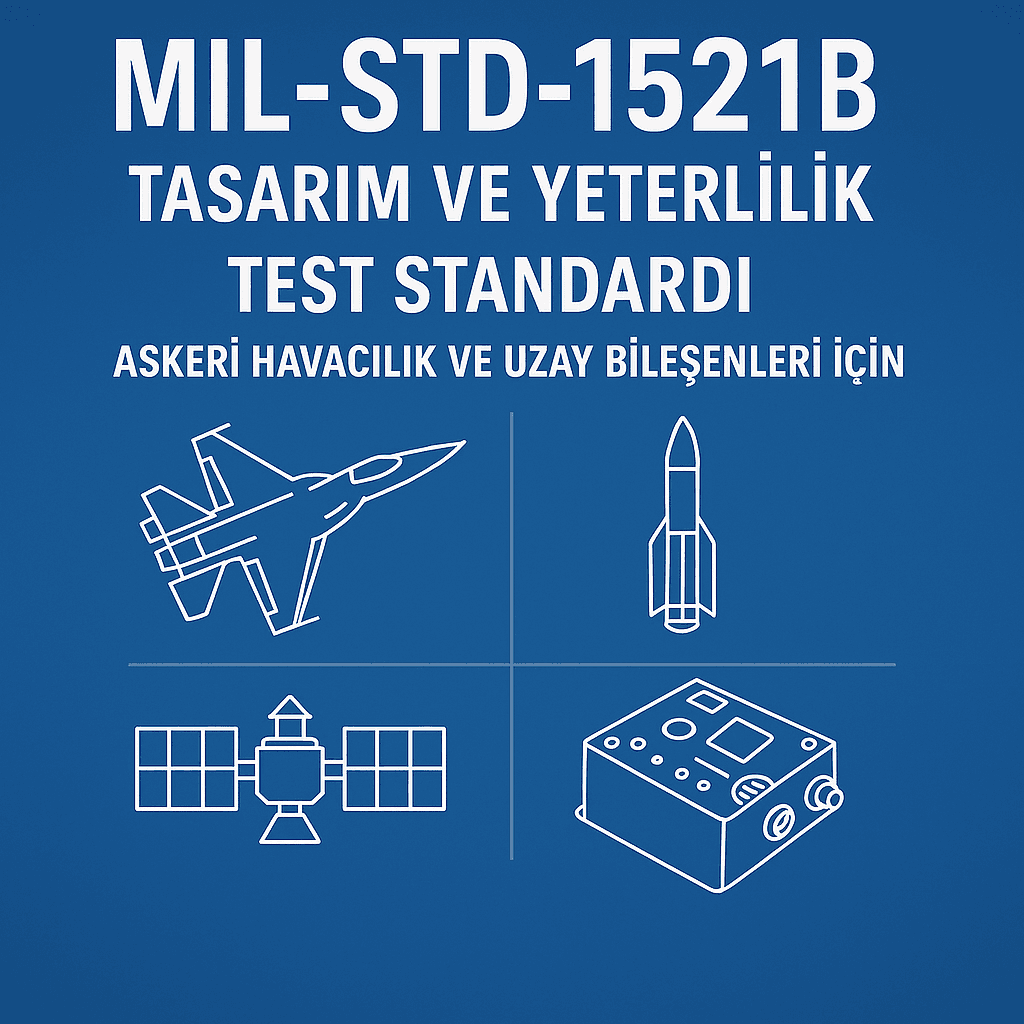
MIL-STD-1521B Design and Qualification Test Standard for Military Aviation and Space Components
Critical Review Stages | SRR, SDR, SSR, PDR, CDR, TRR, FCA, PCA, FQR, PRR, CRB, PIR | ||||||||
|---|---|---|---|---|---|---|---|---|---|
Users | System Engineers, Project Engineers, Test Specialists, Quality Control, Maintenance and Logistics Teams | ||||||||
Related Standards | MIL-STD-810G (Environmental Tests) MIL-STD-461F (EMC Tests) RTCA DO-160G (Civil Aviation) ISO 9100 / AS9100 (Quality Management) | ||||||||
Military aviation and space systems form the foundational pillars of international security and defense strategies. The design, production, and validation of these systems involve numerous critical components ranging from simple electronic circuits to complex mechanical assemblies. MIL-STD-1521B aims to achieve the highest quality levels in both security and operational effectiveness by standardizing the design and qualification testing processes for these components. This document, applied across a wide spectrum including aircraft landing gear, rocket motors, satellite guidance systems and electronic control units, consolidates the U.S. Department of Defense’s test requirements for weapons and space systems under a single framework.
MIL-STD-1521B (Weapons System Safety Program) is a comprehensive standard published by the U.S. Department of Defense (DoD) that defines the safety and performance criteria for military aviation and space vehicles and their components. The standard encompasses the following areas:
The document serves as a reference for both the development of new systems and the periodic testing of existing systems in operational environments. It applies to aircraft, helicopters, rockets, satellites and missile families as well as their mechanical actuators, sensor modules and electronic control units.
The primary objectives of this standard are:
In the complex systems of military aviation platforms, safety and compliance play a critical role in missions during both wartime and peacetime. For this reason, MIL-STD-1521B serves as a strategic tool in defense projects, balancing cost, schedule and performance.
MIL-STD-1521B is applied to a broad range of components including aircraft landing gear, hydraulic actuators, fuel systems, electronic circuit boards and valves in propulsion systems. Each test plan is developed by a project team encompassing the following disciplines:
During the certification process, all test documentation is maintained under configuration control and supported by requirements traceability matrices.
The standard divides its documentation into nine subparts (Subpart A–I) to systematize its structure. Each subpart plays a critical role in the process spanning from initial requirements gathering to certification and re-evaluation.
This section defines the foundational concepts of the entire standard. Terminology, abbreviations and definitions are clarified through a terminology glossary, enabling engineers and inspectors from different disciplines to communicate using a common language. The types of systems and components covered, operational conditions and exemption criteria are detailed. An example configuration control flow demonstrates step-by-step implementation of document revision management. Additionally, reporting formats, traceability matrix templates and test documentation rules are included in this subpart, ensuring that every step in the project is linked to a consistent documentation process.
The scope, roles, responsibilities and expected outputs of design reviews are described in detail. During the Preliminary Design Review (PDR), the transformation of requirements into design inputs, the development of system architecture diagrams and interface matrices are reviewed. During the Critical Design Review (CDR), the consistency of this architecture with concrete CAD (Computer-Aided Design) models, manufacturability criteria and the accuracy of supplier interfaces are verified. Common errors identified in meeting minutes and their resolutions are analyzed. In particular, the potential impact of geometric tolerance deviations in critical components on cost and performance is thoroughly examined.
Structural qualification tests focus on stress distribution calculations under static loads, material strength analysis and how Finite Element Method (FEM) results are validated against experimental data. The mechanical tests section details how vibration profiles in shaker rooms are specified and how impact and fatigue cycles are simulated in laboratory environments to replicate real-world conditions. Failure modes and the repeatability of results are presented alongside reporting formats and traceability requirements.
The interactions between harsh environmental conditions such as thermal cycling, UV radiation, humidity and salt spray are explained. The frequency and severity levels at which these tests are applied are supported by test sample sizing calculations. Technical details include how heating and cooling durations in thermal shock tests are calibrated within engineering tolerances and how aerosol distribution models for dust ingress tests are compared against reference values.
Lab layout diagrams for RF emission measurements, network filter topologies used to minimize antenna effects and pulse profiles applied during immunity testing are detailed. Protective enclosure design criteria are specified. Calibration protocols for measurement accuracy and methods for calculating measurement uncertainty are illustrated with examples. Case studies on grounding and shielded cabling techniques used to resolve EMI issues are also presented.
The selection criteria for structural damping materials used to reduce acoustic emissions and how their performance test results are compared are explained. In the manufacturing defects section, ultrasonic inspection for weld thickness deviations, delamination detection methods in composite materials and the sensitivity of penetrant testing for micro-crack detection are clarified with case examples.
Environmental and human factors to be considered in planning field tests, sensor calibration requirements and real-time analysis methods for telemetry data packets are provided in detail. Simulation scenarios for synchronization issues encountered during software and hardware architecture integration are presented. These are supported by examples from actual flight tests using MICROSIM or HIL (Hardware-in-the-Loop) systems.
The content standard for maintenance manuals, qualification of specialized tools and equipment used in repair procedures, and integration of the spare parts inventory into the traceability system via ERP (Enterprise Resource Planning) are detailed. The integration of Statistical Process Control (SPC) methodology and Model Predictive Control (MPC) approaches into batch quality control processes is explained.
Templates are provided for preparing the certification dossier, including all required technical reports, laboratory accreditation certificates and test certificates. Revision procedures and additional approval steps for extending certification validity or narrowing its scope are supported by technical references.
The following outlines the 12 critical review meetings defined by MIL-STD-1521B for a hardware design project, such as an aircraft landing gear actuator:

Project Phases (Batuhan Aslan)
MIL-STD-1521B integrates with the following national and international standards and references them in relevant subparts:
The most common challenges in applying MIL-STD-1521B are:
For example, in a missile defense system project, wing actuator vibration resistance was certified through thermal cycling between -55°C and +85°C, and the electronic control unit underwent EMI testing in compliance with MIL-STD-461F; all findings were tracked through a configuration management system.
Military-level test methodologies have elevated safety and quality standards in the civil aviation and aerospace industries. The ISO 9100 series of quality management standards incorporates procedures inspired by MIL-STD-1521B’s testing processes, thereby improving maintenance and compliance procedures for commercial airlines.
Example Standards and References
International Organization for Standardization. ISO 9100: Quality Management Systems – Requirements for Aviation, Space, and Defense Organizations. 2018. https://www.iso.org/standard/66955.html.
RTCA. *DO-160G: Environmental Conditions and Test Procedures for Airborne Equipment*. 2012. https://www.rtca.org/content/do-160g.
U.S. Department of Defense. *MIL-STD-1521B: Weapons System Safety Program*. 1990. https://quicksearch.dla.mil/qsDocDetails.aspx?ident_number=36001.
U.S. Department of Defense. *MIL-STD-461F: Requirements for the Control of Electromagnetic Interference Characteristics of Subsystems and Equipment*. 2007. https://quicksearch.dla.mil/qsDocDetails.aspx?ident_number=29193.
U.S. Department of Defense. *MIL-STD-810G: Test Methods for Environmental Engineering Considerations and Laboratory Tests*. 2015. https://quicksearch.dla.mil/qsDocDetails.aspx?ident_number=28532.

MIL-STD-1521B Design and Qualification Test Standard for Military Aviation and Space Components
Critical Review Stages | SRR, SDR, SSR, PDR, CDR, TRR, FCA, PCA, FQR, PRR, CRB, PIR | ||||||||
|---|---|---|---|---|---|---|---|---|---|
Users | System Engineers, Project Engineers, Test Specialists, Quality Control, Maintenance and Logistics Teams | ||||||||
Related Standards | MIL-STD-810G (Environmental Tests) MIL-STD-461F (EMC Tests) RTCA DO-160G (Civil Aviation) ISO 9100 / AS9100 (Quality Management) | ||||||||
Definition and Scope
History and Revisions
Purpose and Strategic Importance
Application Areas and Implementation
Structure and Sections of MIL-STD-1521B
Subpart A – General Provisions
Subpart B – Design Reviews
Subpart C – Structural and Mechanical Qualification Tests
Subpart D – Environmental Durability Tests
Subpart E – Electromagnetic Compatibility and Interference Tests
Subpart F – Acoustics and Manufacturing Defects
Subpart G – Functional and Operational Performance Tests
Subpart H – Maintenance, Repair and Spare Parts Approval
Subpart I – Certification and Re-evaluation
Project Phases and Critical Review Meetings
Related Standards and References
Challenges and Example Applications
Impact on the Civil Sector