
+1 More

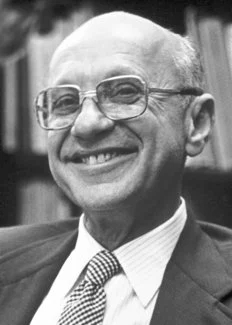
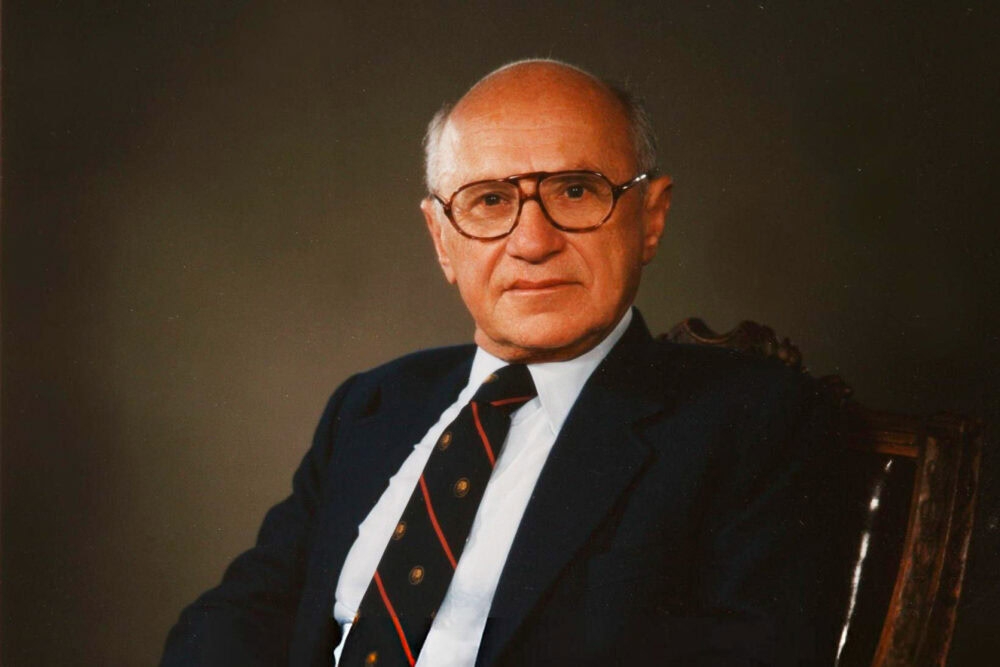
Milton Friedman is an American economist who played a decisive role in shaping 20th century economic thought. His approaches in monetary theory, consumption analysis and public policy have had wide resonance both in academic literature and in applied economics policy. The systematic formulation of the approach known as monetarism is one of the key elements that defined Friedman’s position within economic thought.
Milton Friedman was born on 31 July 1912 in Brooklyn, New York. He was the youngest child and first son of four children in a family of immigrants from Eastern Europe, born to Sarah Ethel (Landau) and Jeno Saul Friedman. His family migrated from the Carpatho-Ruthenia region to the United States and settled in New York.
When Friedman was still one year old, his family moved from New York to the town of Rahway in New Jersey. During this period the family’s economic situation was limited and unstable; despite his father’s various entrepreneurial efforts he failed to secure a steady income. His mother contributed to the family’s livelihood by running a small retail store.
Although his childhood and youth were marked by economic uncertainty, the supportive nature of his family environment played a crucial role in enabling him to continue his education. Friedman graduated from Rahway High School in 1928, during which time he lost his father. This event necessitated that he finance his higher education through his own means.【1】
Milton Friedman married economist Rose Director in 1938. This marriage was not only a personal union but also a long-standing academic collaboration. Rose Friedman played an active role in Friedman’s academic and intellectual work and contributed jointly to many of his projects.
Friedman’s personal life was deeply intertwined with his academic output. His collaborative work with his wife reached wide audiences particularly on the subjects of economic freedom and public policy. Through television programs and book projects his academic ideas were brought to the public.【2】
Despite beginning with economic hardship the family life gradually became integrated with academic and intellectual activities and achieved a stable structure over time.
Milton Friedman completed his undergraduate studies at Rutgers University, financing his education through scholarships and various jobs. Initially drawn to mathematics and working in actuarial science he gradually shifted his focus to economics. This shift became the defining element of his academic career.
His encounters with academics such as Arthur F. Burns and Homer Jones at Rutgers University shaped Friedman’s scientific approach. Burns introduced him to standards of scientific research while Jones deepened his interest in economic theory. These interactions led him to begin graduate studies at the University of Chicago.
His time at the University of Chicago was a crucial stage in Friedman’s intellectual development. He engaged with figures such as Jacob Viner, Frank Knight and Henry Simons and became part of a dynamic academic environment composed of international students. This experience was decisive in the formation of his theoretical approach.
Columbia University provided him with exposure to mathematical statistics and empirical research methods. Working with scholars such as Harold Hotelling and Wesley C. Mitchell he acquired diverse methodological perspectives in economic analysis.【3】
From the mid-1930s Friedman held positions at various research institutions and collaborated with Simon Kuznets at the National Bureau of Economic Research, where he made significant contributions to income analysis.【4】
During World War II he worked on tax policy at the U.S. Department of the Treasury and later undertook assignments at Columbia University involving statistical analysis and military applications.
After the war Friedman began his teaching career at the University of Chicago where he continued academic activities for many years and conducted extensive research on monetary theory. He also maintained his association with the National Bureau of Economic Research conducting research on money supply and economic fluctuations.
From the 1950s onward he engaged in international advisory work including assignments in Europe under the Marshall Plan and research on exchange rate systems.
From the 1960s Friedman became more visible in the field of public policy advising political actors and publishing articles in various media outlets. At the same time he continued his academic work as his primary activity.
In 1976 he was awarded the Nobel Prize in Economics, an honor bestowed in recognition of his contributions to consumption analysis, the history of money and stabilization policies.
After retiring from the University of Chicago in 1977 he continued his work at the Hoover Institution at Stanford University and maintained his academic activities.
One of Milton Friedman’s most important contributions to economics was the development of the monetarist approach. This approach emphasizes the decisive role of changes in the money supply in driving economic fluctuations. According to Friedman inflation is fundamentally a monetary phenomenon arising from uncontrolled increases in the money supply.【5】
Friedman’s development of the permanent income hypothesis made a significant contribution to consumption theory. According to this hypothesis individuals shape their consumption decisions not solely based on current income but on long-term income expectations. This approach provided a new framework for analyzing consumption behavior.【6】
Friedman also argued that there is a strong relationship between economic freedom and political freedom and advocated for limiting state intervention. Within this framework he emphasized the role of the market mechanism in enhancing economic efficiency.【7】
His proposals on monetary policy became a key reference point in debates over central banks’ policy tools. In particular his advocacy of rule-based monetary policy significantly influenced discussions on macroeconomic stability.【8】
Milton Friedman authored numerous works at both academic and popular levels covering topics such as monetary policy economic freedom market economies and public policy.
His major works include:
These works have had a broad impact in both academic circles and the general public.【9】
In addition Friedman’s television programs and writings served as important vehicles for disseminating economic ideas to wider audiences. In particular the television series and accompanying book Free to Choose played a decisive role in popularizing economic ideas.【10】
Milton Friedman died on 16 November 2006 in San Francisco United States due to heart failure.
His death generated widespread反响 in the economics community and he is remembered particularly for his contributions to monetary theory consumption analysis and public policy.
Even in the final years of his life he continued his academic work and public policy activities through his affiliation with the Hoover Institution at Stanford University.
[1]
NobelPrize.org. “Milton Friedman.” NobelPrize.org. Nobel Prize Outreach AB. Access date: 20 March 2026. https://www.nobelprize.org/prizes/economic-sciences/1976/friedman/facts/
[2]
Antal, Lara. “Milton Friedman.” Investopedia. Access date: 20 March 2026. https://www.investopedia.com/terms/m/milton-friedman.asp
[3]
NobelPrize.org. “Milton Friedman.” NobelPrize.org. Nobel Prize Outreach AB. Access date: 20 March 2026. https://www.nobelprize.org/prizes/economic-sciences/1976/friedman/facts/
[4]
NobelPrize.org. “Milton Friedman.” NobelPrize.org. Nobel Prize Outreach AB. Access date: 20 March 2026. https://www.nobelprize.org/prizes/economic-sciences/1976/friedman/facts/
[5]
Shleifer, Andrei. “Milton Friedman’s Era.” Translator: Buğra Kalkan. Liberal Thought 17, no. 65 (Winter 2012). Pages: 65–81. Access date: 20 March 2026. https://dergipark.org.tr/en/download/article-file/790743
[6]
Hetzel, Robert L. “Milton Friedman’s Contributions to Economics.” Translator: Ünsal Çetin. Liberal Thought 17, no. 65 (Winter 2012). Pages: 29–56. Access date: 20 March 2026. https://dergipark.org.tr/en/download/article-file/790740
[7]
Antal, Lara. “Milton Friedman.” Investopedia. Access date: 20 March 2026. https://www.investopedia.com/terms/m/milton-friedman.asp
[8]
Pirie, Madsen. “Milton Friedman, Nobel Laureate.” Adam Smith Institute. 31 July 2025. Access date: 20 March 2026. https://www.adamsmith.org/blog/milton-friedman-nobel-laureate
[9]
Trescott, Paul B. “Milton Friedman.” EBSCO Research Starters: Biography. 2023. Access date: 20 March 2026. https://www.ebsco.com/research-starters/biography/milton-friedman
[10]
Paraborsa. “Who is Milton Friedman?” Paraborsa. 29 March 2016. Access date: 20 March 2026. https://www.paraborsa.net/i/milton-friedman-kimdir/

Birth
Personal Life
Career
Contributions to Economics
Works
Death