


This article was automatically translated from the original Turkish version.
+1 More
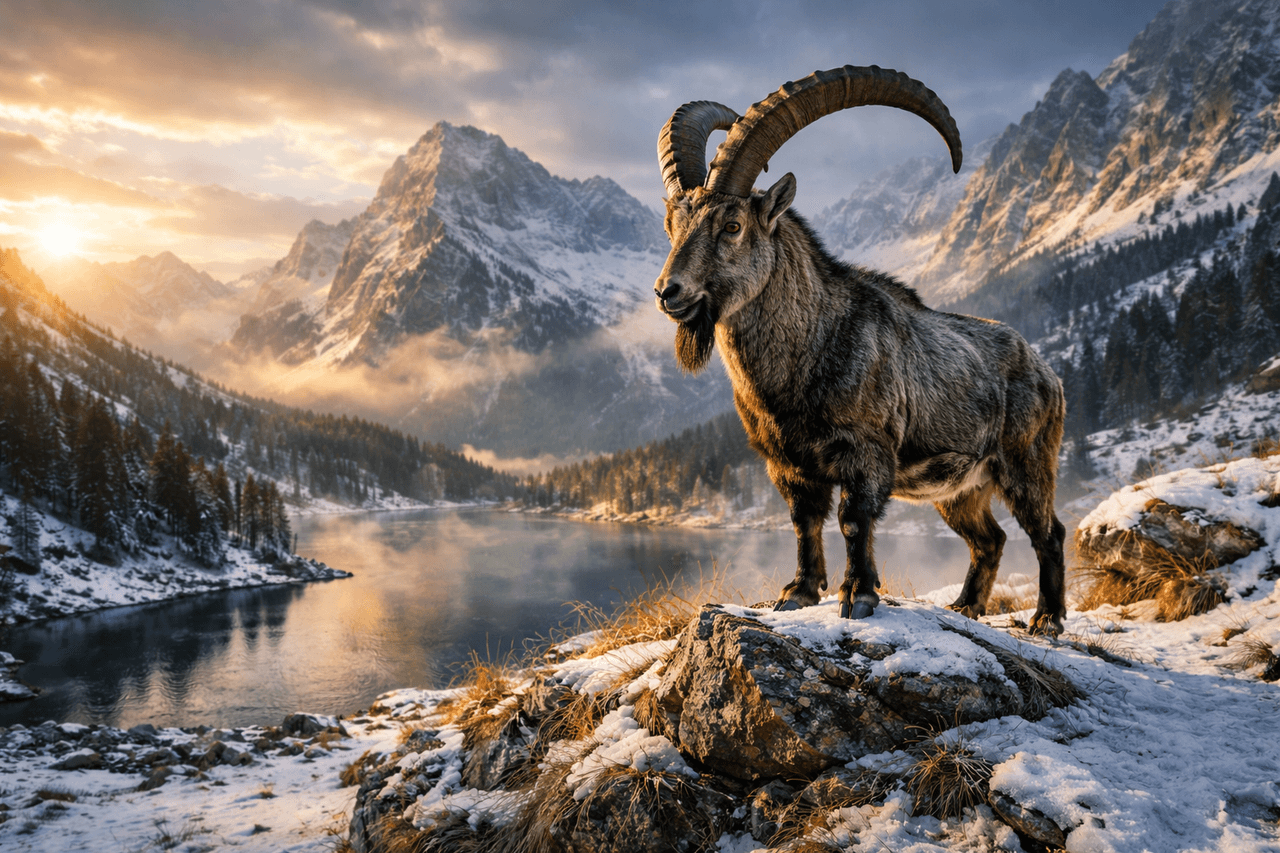
Generated with Visual Artificial Intelligence
Mountain (Wild) Goat (Capra aegagrus)
Scientific Name(s) | Capra aegagrus | ||||||||
|---|---|---|---|---|---|---|---|---|---|
Origin(s) | Ancestor of the domestic goat (Capra hircus) | ||||||||
Family | Bovidae (Horned animals) | ||||||||
Conservation Status | IUCN Red List: VU (Vulnerable) | ||||||||
Reproduction(s) | Mating: November-December Birth: May (usually twins) Gestation: ~5 months | ||||||||
Diet(s) | Herbivorous (fresh shoots rarely insects during scarcity moss) grass leaves | ||||||||
Weight(s) | Female 35 - 60 kg Male 50 - 85 kg | ||||||||
Other Name(s) | Red goat Deer (colloquial) Paseng Bezoar goat | ||||||||
Habitat | Steep cliffs and forest edges up to 4000-4500 meters above sea level | ||||||||
Hunting Status | Protected; hunting permit available only for males aged 8 and above with quotas | ||||||||
Physical Abilities | Jump 2-3 meters upward and 6-7 meters forward from standing position | ||||||||
Distribution in Türkiye | Mediterranean (Taurus Mountains), Aegean (Datça), Eastern and Southeastern Anatolia, Eastern Black Sea | ||||||||
Lifespan | In natural habitat: average 15 - 20 years | ||||||||
General Appearance | Summer: reddish-brown; winter: gray-white; males have a black stripe (collar) and beard on the back | ||||||||
Horn Structure | Backward-curving/sword-shaped; males 100-145 cm, females 25-30 cm | ||||||||
Body Length | 100 - 180 cm | ||||||||
Wild goat, or commonly known in literature as the bezoar goat (Capra aegagrus), is a agile mammal species adapted to life in steep rocky terrain and belongs to the family Bovidae. This species is regarded as the ancestor of the domestic goat (Capra hircus) and holds great importance due to its role as the genetic origin of domestic forms upon which millions of people worldwide depend economically.

Wild Goat (Image Generated by Artificial Intelligence)
Historically documented and in zoological literature as the "bezoar goat" or "red goat," this species is also named after the "bezoar stones" found in its stomach, which were once believed to have medicinal properties. The wild goat is one of the most characteristic large mammals of Türkiye's fauna and is recognized as an important indicator of biological diversity.
In scientific classification, the wild goat belongs to the kingdom Animalia, phylum Chordata, class Mammalia, and order Artiodactyla (even-toed ungulates), and is part of the subfamily Caprinae within the family Bovidae. There are nine distinct species within the genus Capra worldwide; the taxon found in Türkiye is the subspecies Capra aegagrus aegagrus. This species must not be confused with Capra ibex (Alpine ibex), which inhabits the Alps, or with Rupicapra rupicapra (chamois), which is found only in certain regions of Türkiye; these species are distinct both morphologically and genetically.
Wild goats possess a robust, muscular body and long legs adapted for movement across steep terrain, along with a strong neck structure. Adult males (bucks) have a body length ranging from 100 to 180 cm, shoulder height of 80 to 100 cm, and weigh between 50 and 85 kg. Females are more slender, measuring 60 to 80 cm in body length and weighing 35 to 60 kg. Their coat color varies with season and age: during summer, it appears reddish-brown or yellowish-brown, while in winter and with advancing age, it turns to grayish-white tones.
One of the most distinctive features of this species is its horn structure. Both males and females possess horns, but those of males are significantly larger and more prominent. Male horns can reach lengths of 100 to 145 cm, while female horns are limited to 25 to 30 cm. Male horns curve backward like a sword and bear distinct annulations that allow age estimation. Males also exhibit a prominent black dorsal stripe extending from the shoulder to the tail and a noticeable beard; these features are absent in females. Their feet consist of flexible hooves with hard edges that provide excellent grip on rocky surfaces, enabling them to move easily even on icy terrain.
Capra aegagrus has a wide distribution across the globe, encompassing countries such as Türkiye, Iran, Afghanistan, Pakistan, Russia, Georgia, Azerbaijan, and Armenia. Within Türkiye, it inhabits steep mountainous regions extending from the Datça Peninsula in the Aegean region along the Mediterranean belt through the Taurus and Anti-Taurus Mountains, as well as in the rugged highlands of Eastern and Southeastern Anatolia and the Eastern Black Sea region. Significant populations are found in the rocky areas of Antalya, Muğla, Mersin, Niğde, Erzincan, Erzurum, and Artvin provinces.
The preferred habitat ranges from sea level up to elevations of 4,000 to 4,500 meters, including steep cliffs, precipices, and areas near the tree line. During summer, wild goats favor high-altitude, snow-covered, rocky valleys; in winter, they retreat to secluded, warmer, or less snow-covered slopes and ridges.
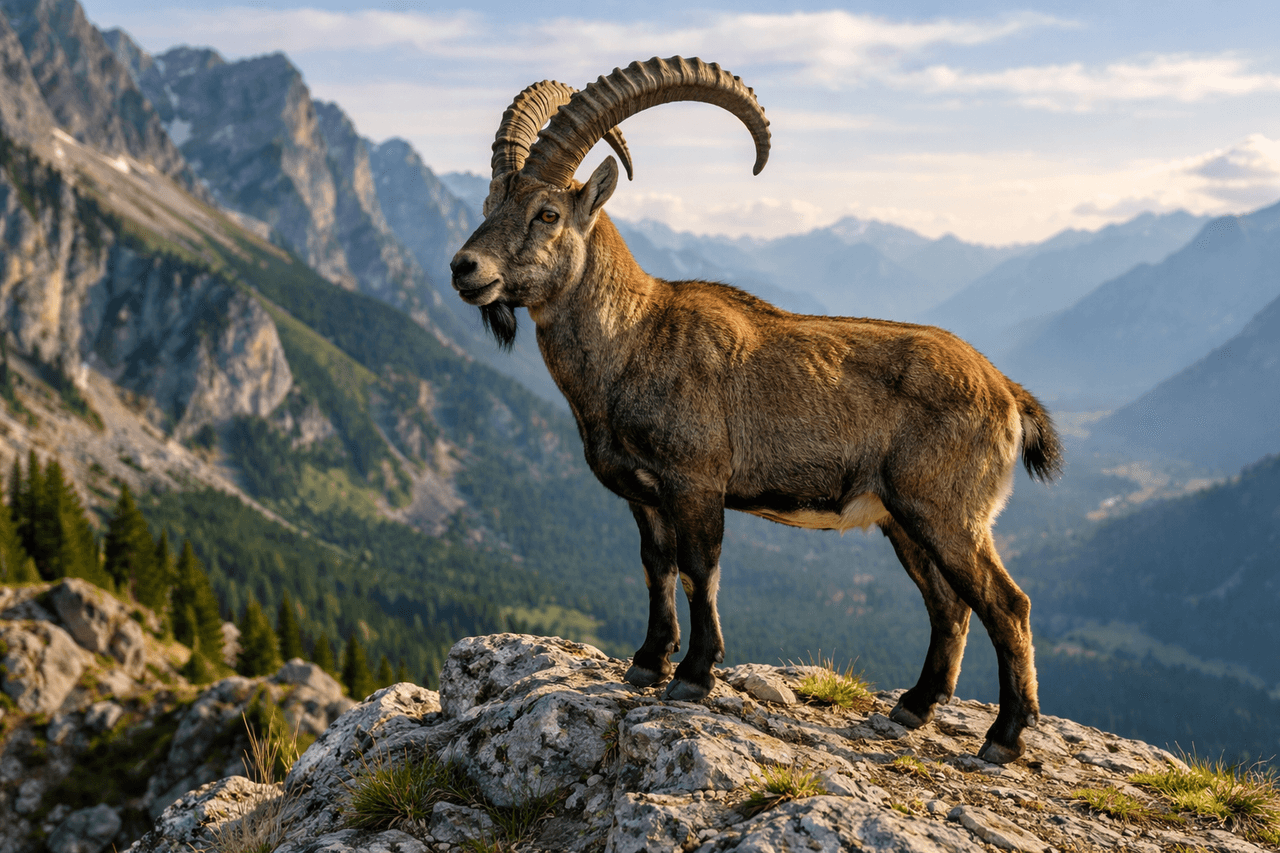
Wild Goat (Image Generated by Artificial Intelligence)
Wild goats are herbivorous and feed on fresh shoots, grasses, leaves, mosses, shrubs, and tree bark. Rarely, they have been observed consuming insects during periods of food scarcity. Feeding activity is concentrated during early morning and late evening hours; during the hottest parts of the day, they rest in the shade of rocks or in gullies. They obtain most of their water needs from the vegetation they consume.
Wild goats are social animals that live in herds. Herds are typically led by an older female and consist of females, kids, and young males. Adult males, outside the breeding season, generally live alone or in small groups. These animals possess highly developed vision, hearing, and olfactory senses. When threatened, they escape by climbing steep cliffs, and designated sentinels in the herd alert others with a high-pitched whistle.
The mating season of wild goats typically occurs during autumn, especially between mid-November and late December. During this period, males engage in intense combat to establish dominance for access to females. Gestation lasts approximately five months, with births occurring mainly in May. Females usually give birth to twins, occasionally single or triple kids. Kids are capable of following their mothers across steep terrain shortly after birth. Sexual maturity is reached between one and one and a half years of age, and their average lifespan in the wild is 15 to 20 years.
The wild goat (Capra aegagrus) is classified as a threatened species and is listed as "VU" (Vulnerable) on the International Union for Conservation of Nature (IUCN) Red List.
In Türkiye, this species is protected under the Illegal Hunting Law, and hunting is strictly regulated. Controlled hunting under trophy hunting programs is permitted only for males aged eight years and older with reduced reproductive capacity, within quotas established by the General Directorate of Nature Conservation and National Parks. Hunting of females and juveniles is strictly prohibited. Major threats to the species include poaching, habitat loss, and predation by carnivores such as wolves, lynx, and eagles.
Antalya Büyükşehir Municipality. "Dağ (Yaban) Keçisi." *Antalya Doğal Yaşam Parkı.* Accessed February 7, 2026. https://zoo.antalya.bel.tr/project/dag-yaban-kecisi/
Huş, Savni. “Dağ Keçileri.” Accessed February 7, 2026. https://dergipark.org.tr/en/download/article-file/174294
Paşalı, Hasan. “Türkiye’de Yaban Keçisi (Capra aegagrus aegragrus).” Animal Health, Production and Hygiene 3, no. 1 (2014): 245–247. Accessed February 7, 2026. https://dergipark.org.tr/en/download/article-file/1475068
T.C.İspir Kaymakamlığı Governorship. "Dağ Keçisi." Accessed February 7, 2026. https://www.ispir.gov.tr/dag-kecisi

Generated with Visual Artificial Intelligence
Mountain (Wild) Goat (Capra aegagrus)
Scientific Name(s) | Capra aegagrus | ||||||||
|---|---|---|---|---|---|---|---|---|---|
Origin(s) | Ancestor of the domestic goat (Capra hircus) | ||||||||
Family | Bovidae (Horned animals) | ||||||||
Conservation Status | IUCN Red List: VU (Vulnerable) | ||||||||
Reproduction(s) | Mating: November-December Birth: May (usually twins) Gestation: ~5 months | ||||||||
Diet(s) | Herbivorous (fresh shoots rarely insects during scarcity moss) grass leaves | ||||||||
Weight(s) | Female 35 - 60 kg Male 50 - 85 kg | ||||||||
Other Name(s) | Red goat Deer (colloquial) Paseng Bezoar goat | ||||||||
Habitat | Steep cliffs and forest edges up to 4000-4500 meters above sea level | ||||||||
Hunting Status | Protected; hunting permit available only for males aged 8 and above with quotas | ||||||||
Physical Abilities | Jump 2-3 meters upward and 6-7 meters forward from standing position | ||||||||
Distribution in Türkiye | Mediterranean (Taurus Mountains), Aegean (Datça), Eastern and Southeastern Anatolia, Eastern Black Sea | ||||||||
Lifespan | In natural habitat: average 15 - 20 years | ||||||||
General Appearance | Summer: reddish-brown; winter: gray-white; males have a black stripe (collar) and beard on the back | ||||||||
Horn Structure | Backward-curving/sword-shaped; males 100-145 cm, females 25-30 cm | ||||||||
Body Length | 100 - 180 cm | ||||||||
No Discussion Added Yet
Start discussion for "Mountain (Wild) Goat (Capra aegagrus)" article
Taxonomy and Classification
Morphological Characteristics
Geographic Distribution and Habitat
Diet and Behavior
Reproductive Cycle
Conservation Status